
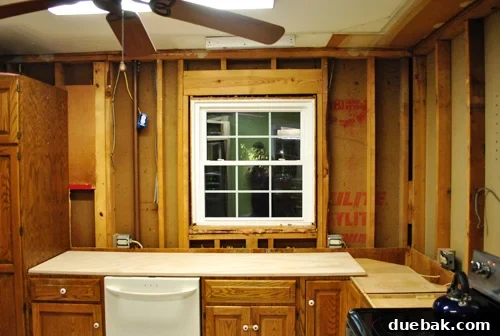
After the recent festivities, with all the indulgence that comes with Thanksgiving, it might be easy to forget the state of our kitchen. But allow us to jog your memory: our culinary command center took on a dramatically different look after the upper cabinets were finally taken down. This monumental step marked the true beginning of our ambitious kitchen transformation, a project we’ve been eagerly anticipating and planning for what feels like an eternity.
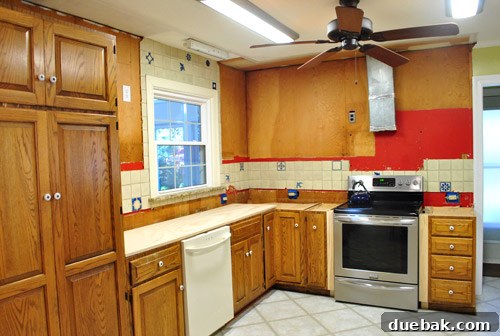
With the clock ticking relentlessly towards the installation of our new countertops – a mere two weeks away, promising an end to our sink-less and counter-less existence – our immediate priority shifted to preparing the walls for the upcoming backsplash. It’s crucial to clarify that the backsplash itself wouldn’t be installed *before* the new counters. Installing it afterward ensures a tighter, more professional fit against the finished countertops. Moreover, by waiting, we minimize the risk of any damage occurring to our pristine new backsplash during the heavy-duty counter installation process. The real reason for this early wall preparation was the inherent mess of demolition. We absolutely wanted to tackle the dirty work, the scraping and prying, before those beautiful new counters were in place, eliminating any potential for accidental scratches or dings. Thus, the time had come to bid a fond farewell to our quirky, old “random blue things” backsplash, a feature that, for all its eccentric charm, no longer aligned with our evolving vision.
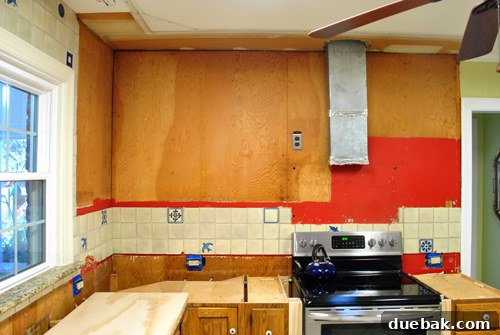
It’s hard to deny that we held a peculiar soft spot for this old backsplash. Its handmade quality and distinctively quirky appearance gave our kitchen a unique character. There was an undeniable charm to its imperfections, a story etched into every tile. However, as our dream kitchen began to take shape in our minds, incorporating modern aesthetics and a more cohesive design, this rustic charm started to feel increasingly out of place. Our hearts were instantly captured by the stunning penny tile we discovered; it was love at first sight, signaling a clear direction for our kitchen’s new identity. We often joked that the existing backsplash seemed better suited for an adobe-style home nestled in the American Southwest, a far cry from our current abode. But being the sentimental types, we concocted a plan to salvage a few of the more striking accent tiles, intending to keep them as mementos of our kitchen’s past – more on that sweet idea in a moment.
When it finally came down to the actual removal process, we approached it with a mix of apprehension and excitement. Surprisingly, the demolition went smoother than anticipated, at least in some areas. There were moments of triumph when significant sections of the backsplash, sometimes as large as three, four, or even six tiles, came off the wall in satisfying, intact chunks. All it took was a swift and decisive pry with a trusty screwdriver, and the tiles surrendered their hold, revealing the wall beneath. This initial ease gave us a false sense of security, making us think the entire process would be a breeze.
Alas, reality soon set in. While some sections were cooperative, the majority of the backsplash required a more painstaking, tile-by-tile removal. Many tiles fragmented into chipped pieces and broken shards, resisting a graceful departure. Despite this, we honestly can’t complain too much. The entire process, from the first pry to the last removed fragment, took a remarkably short time – perhaps a mere 45 minutes from start to finish. I personally handled about 80% of the work, driven by a newfound passion for demolition. Sherry, while equally keen on the satisfying chaos of demo, was on “Clara duty” after our little one woke up from what we all wished had been a much longer nap, leaving me to revel in the dusty glory.
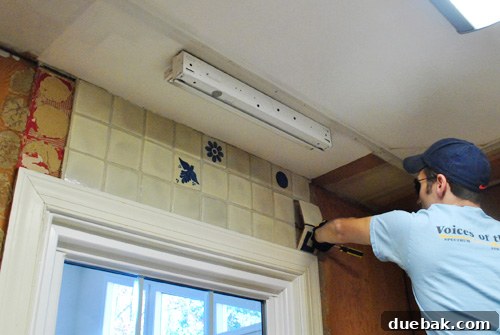
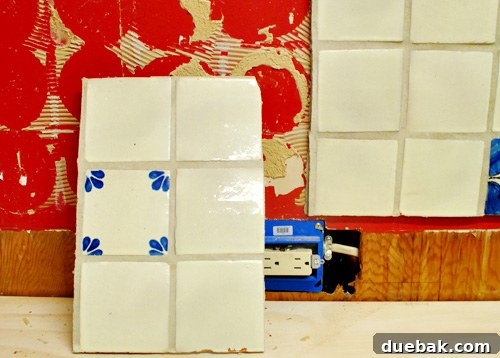
Our initial hope was to save a substantial number of those charming blue tiles, primarily for nostalgic reasons. We even envisioned a delightful upcycling project: adding small felt feet to the backs of the salvaged tiles to transform them into unique coasters. Imagine the conversations at dinner parties, sharing stories of their past life as a kitchen backsplash! However, the inherent fragility of these tiles, crafted from a red clay base, proved to be a formidable challenge. They shattered and crumbled with disheartening ease, making careful removal a Herculean task. Despite our best efforts and gentle persuasion, only three tiles managed to survive the demolition intact, emerging as the sole, lucky remnants of our past kitchen.
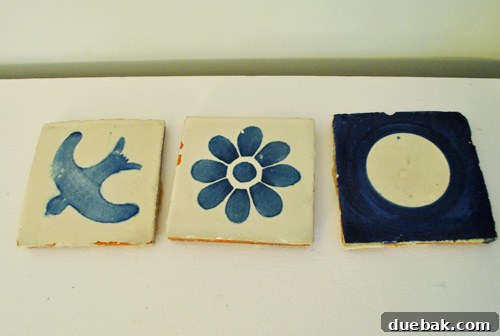
It was a touch disheartening, seeing our grand coaster dreams reduced to a trio, but three coasters are undoubtedly better than none. We count our blessings for these three miraculous survivors. We were also a little bummed that we couldn’t salvage more whole tiles, either to donate to a local ReStore, giving them a second life, or to share with friends who had expressed interest in these distinctive blue pieces. Their brittle nature was truly their undoing. Our three survivors truly felt like a small miracle, standing resilient amidst the debris.
Oh, but to ensure that the memory of the other random blue tiles that once graced our now-vanished backsplash lives on forever in our hearts (and perhaps yours), we decided to put together a little tribute video. You might want to have a box of tissues handy, as this emotional farewell might just tug at your heartstrings and bring a tear to your eye. Or, it might just make you laugh at our silliness – either way, prepare for an experience.
Forgive us; that was just a moment of our inherent weirdness shining through. It’s a bit like that “bow-chicka-bow-wow” console video we put together a while back. We simply can’t help ourselves when creativity (and a dash of eccentricity) strikes. But let’s steer back to the serious stuff: the continuation of our kitchen demolition and the essential steps that followed. As you may have observed in our video, once the tiles were gone, the room presented a rather unsightly picture, far from being ready for the arrival of its new, elegant backsplash.
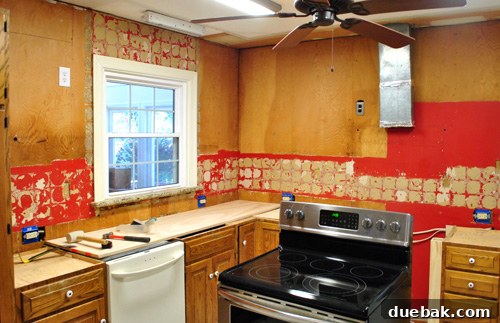
The walls, now stripped bare, revealed a host of new challenges. The plywood backing, which served as the original substrate, was covered in plentiful, bumpy leftover adhesive, making it an uneven and unsuitable surface for new tile. More critically, we realized that plywood, in general, is far from an ideal base for holding tile, especially when considering the significant weight of our chosen penny tile, which would extend all the way to the ceiling along the stove wall. The prospect of these beautiful, yet heavy, tiles adhering securely to an already questionable surface was concerning. After much deliberation, we resigned ourselves to the undeniable fact that we needed to properly demolish this plywood layer as well, and replace it with a more robust and tile-friendly material. Another sigh, another layer of demolition.
To ensure we were making the best decision for our kitchen, we contacted The Tile Shop. They’ve been our trusted go-to resource for all things tiling ever since we bombarded them with a million questions while we gutted and retiled our bathroom a few years back. Their expert advice was clear and definitive: we absolutely ought to install cement board. This confirmation, while validating our instincts, brought on a mild panic attack. Our counter templating had been done against the existing 1/4-inch thick plywood walls. The crucial concern was that if our new cement board was any thicker, or sat improperly on the wall, our custom-cut countertops might not fit correctly. The relief was palpable when we discovered that they indeed sell 1/4-inch cement board! This meant we could seamlessly swap out the plywood for cement board without altering the critical dimensions that the counter fabricators had measured, ensuring a perfect fit.
However, the next challenge was mine to conquer: precisely cutting the plywood along a straight seam, directly above the lower cabinets. This cut was essential to allow the upper section of plywood to be carefully pried off the wall and subsequently replaced with the new cement board. I don’t own a dedicated tool specifically designed for this kind of intricate cutting, but I decided my Dremel Trio was my best bet. Its distinct advantage was the ability to control the depth of the cut, a feature that was critical. I needed to slice through the entire 1/4-inch depth of the plywood, but absolutely avoid damaging the studs positioned behind it. This delicate balancing act required precision and patience, which I endeavored to demonstrate in the photograph below, showing the tool in action.
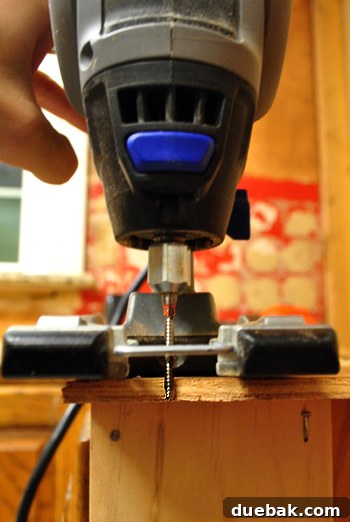
Funnily enough, had I seen the commercial for an even more specialized tool that aired the very next night, I probably would have impulsively bought it as an early Christmas present to myself. Oh well, such is the life of a DIYer; we pride ourselves on utilizing the tools we already possess and making them work for our projects, rather than constantly acquiring new ones. My primary struggle with the Dremel Trio, despite its depth control, was its inherent instability when cutting. Because it operates with a high-speed spinning motion, the tool constantly wants to veer off in different directions, making it difficult to maintain a perfectly straight line. To combat this, I fashioned a clever, makeshift guide. I loosely nailed a piece of scrap wood into the wall, positioned strategically. This improvised guide allowed me to press the Dremel firmly against it as I pushed the tool along the wall, ensuring my cut remained impeccably straight and precise.
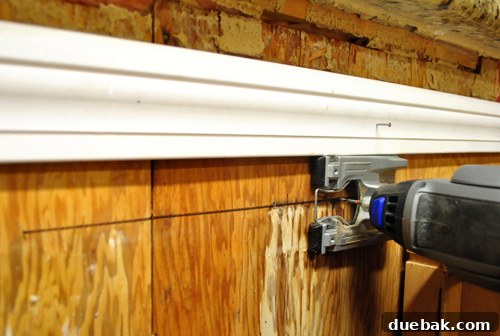
Well, straight enough for our purposes! As a crucial safety precaution, I made sure to turn off the power to the entire kitchen circuit before beginning my cuts. Even though I was only cutting to the shallow depth of the plywood, and not into the studs, the potential presence of hidden electrical wires behind the wall was a risk I wasn’t willing to take. To power my Dremel, I simply ran an extension cord from another room. Thankfully, my shallow cuts proved to be perfectly safe, as all the electrical wiring was located much deeper within the wall structure, far from my path. This meticulous approach, though time-consuming, gave me immense peace of mind throughout the process.
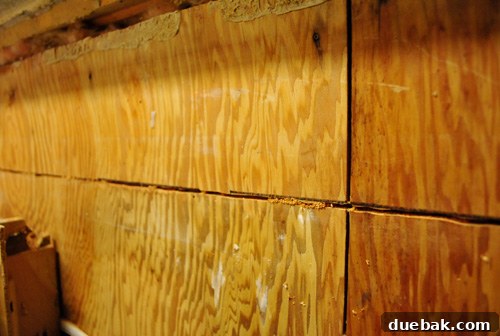
Making all of these precise cuts took me a bit longer than I’d like to admit – perhaps a solid 90 minutes. This extended time was largely due to the meticulous process of having to carefully move and double-check the placement of my makeshift guide for each section. Precision was paramount, and rushing the guide placement would have resulted in crooked lines and more problems down the road. However, once all the plywood was cleanly sliced, the remaining task of prying it off the wall became remarkably easy and satisfying. The clean cuts made all the difference, allowing the sections to come away smoothly.
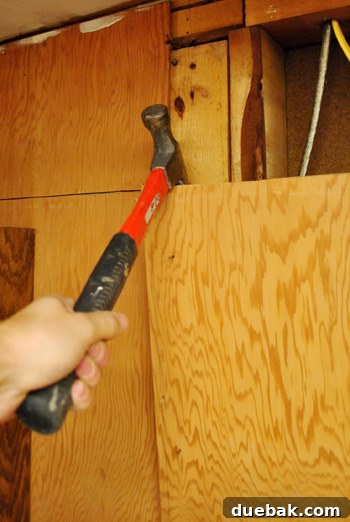
See? Look how fast I’m moving now that the hard part is done! Oh wait, these photos aren’t time-stamped, so you’ll just have to take my word for it. The satisfying feeling of those large sheets of plywood coming off the wall, revealing the studs beneath, was a true reward after the painstaking cutting process.
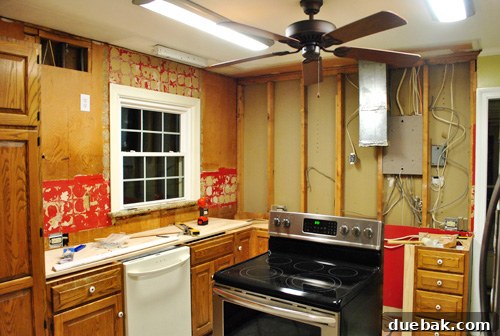
During this stage, I encountered one other minor speed bump. I realized that the trim around the kitchen window would also need to be removed. This was because it had been nailed directly on top of the plywood, meaning it would interfere with the installation of the new cement board and the future window sill. It was an unforeseen, but necessary, step in our comprehensive demolition plan.
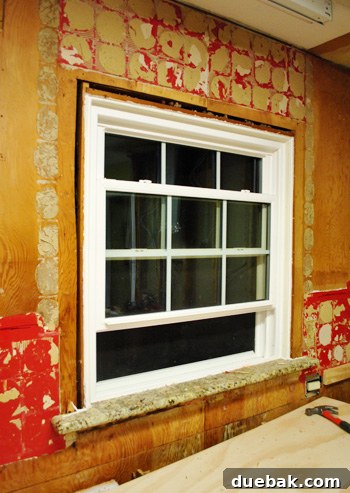
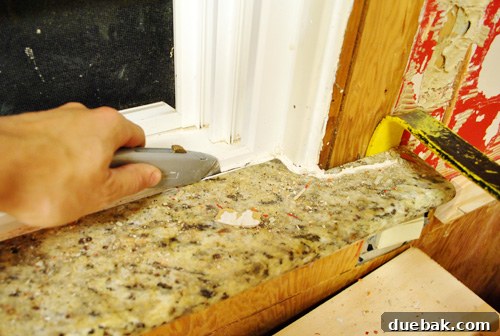
Removing the window trim inevitably meant saying goodbye to the last remaining piece of granite in our entire kitchen: the window sill. This was a relatively simple task, much like the removal of its granite brethren earlier in the project. All it required was carefully slicing through the caulk seal that held it in place, followed by a gentle but firm pry, and it came away cleanly. Easy peasy! Our plan is to replace it with a classic, regular old white wood sill, similar to the one we had situated directly above the sink in our very first kitchen. While a pristine white Corian sill would have been a lovely, more luxurious option, our budget dictated a more cost-effective choice. Based on our past experience, a wood sill painted with semi-gloss paint holds up remarkably well against moisture and daily wear, offering both durability and a clean aesthetic without breaking the bank.
Voila! So long, granite. Sayonara, plywood. With these final pieces removed, the kitchen walls were truly stripped down to their bare essentials, ready for their new, stronger foundation. It was a moment of accomplishment, knowing that all the demolition was finally behind us and the rebuilding phase could begin in earnest.
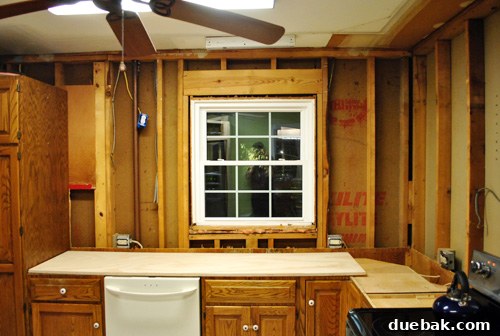
So, there we have it: all of the demolition is officially done and dusted. And our kitchen, bless its heart, is now officially looking more disastrous and chaotic than it ever has before. It’s a true testament to the “it gets worse before it gets better” adage of home renovation, and we are certainly in the thick of the “worse” stage right now. The raw, exposed walls, the absence of cabinets, and the general dust and disarray paint a picture of controlled chaos, but it’s a necessary step towards our dream kitchen.
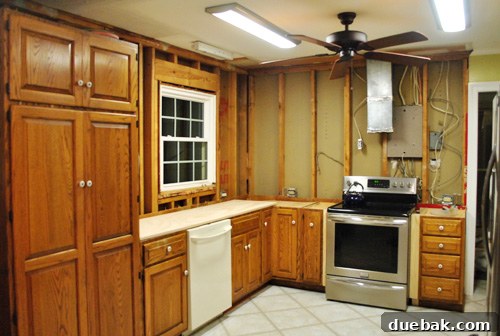
Not that where we started, before any of this demolition even began, was particularly impressive to look at anyway. It serves as a good reminder of how far we’ve come and how much potential these bare walls hold for the beautiful transformation ahead. The journey might be messy, but the destination will be worth every hammer swing and every dust cloud.
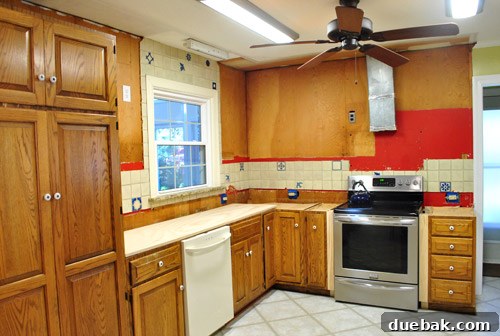
Next up, the “fun” part. Okay, maybe not *fun* in the traditional sense, but certainly rewarding. Our immediate task involves hanging the new cement board on the freshly prepped walls. Additionally, we’ll be installing some leftover paneling from the wall-opening project on either side of the window. This specific section of the wall won’t be tiled all the way to the ceiling, so we want it to seamlessly match the rest of the painted paneling throughout the room, creating a cohesive and polished look. I’m going to be completely real here: this is not a process that I anticipate we’ll particularly enjoy. Based on our past experience, when my dad helped us tackle this very task in our old bathroom, it was quite challenging. But it’s a necessary hurdle to overcome on our path to a truly functional and beautiful kitchen. And rest assured, it absolutely must be blogged about, so stay tuned for all the gritty details and insights as we progress through this crucial stage. In the meantime, we’d absolutely love to hear what projects you guys tackled around your homes this past weekend. Did anyone embark on any tiling adventures or demolition endeavors? Do you have any amusing or memorable demolition stories to share with us? We’re all ears!