
Embarking on a significant home improvement project like building a deck is both exciting and demanding. After successfully having my deck post holes inspected and approved by the county, the next critical phase was to prepare them for the structural posts. This involved ensuring proper drainage and creating a solid foundation, a step often underestimated but vital for the longevity and stability of any outdoor structure. Just as I had done when setting my fence posts the previous year, I started by adding a layer of drainage rock. This practice, universally recommended by local deck construction professionals, involves placing 2-3 inches of gravel at the bottom of each hole. Given that our holes were dug to a minimum depth of 21 inches, this layer still left ample depth (exceeding the county’s 18-inch requirement) for the concrete footings that would securely hold the deck posts.
Preparing the Foundation: Drainage and Unforeseen Critters
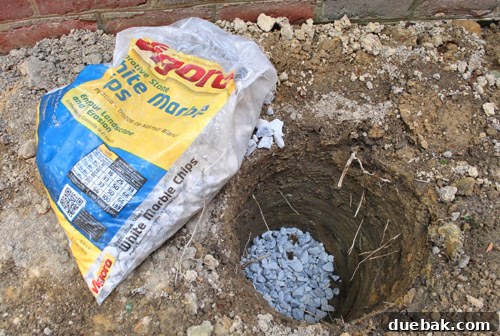
As I began to pour the rocks into the first hole, I was met with an unexpected and rather charming surprise. A gentle cascade of gravel caused some movement in the soil, revealing tiny frogs that had sought refuge in the cool, damp earth. Their camouflage was so effective that I hadn’t noticed them until they hopped to avoid being covered. Naturally, my immediate instinct was to ensure their safety. I carefully rescued them, relocating them to a nearby safe spot before continuing with the rock-laying process. This unplanned wildlife encounter added a unique, memorable moment to the often-laborious task of deck building.
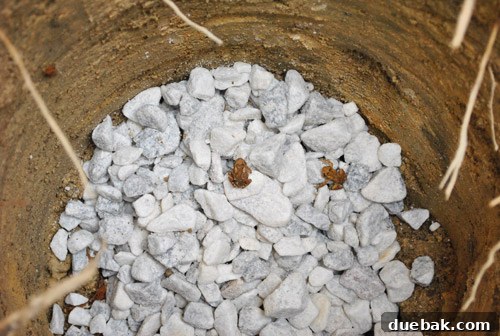
Learning from my initial experience, I proceeded with extra caution for the remaining holes. Before dumping more rocks, I meticulously inspected each one, hoping to spot any other hidden amphibians. Despite my best efforts, I regrettably missed a considerably larger toad that had made one of the deeper holes its temporary home. It wasn’t until the rocks began to settle that this “whopper” of a toad made its presence known, much to my surprise.
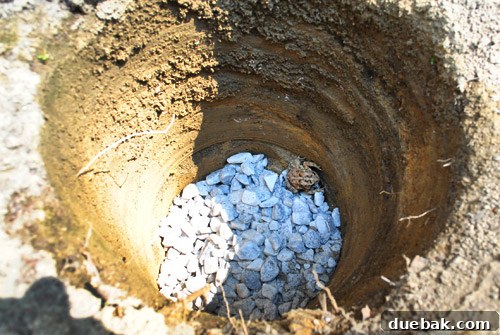
Once spotted, I was able to safely rescue the toad, using my gloved hands to gently lift it out. This moment provided an impromptu nature lesson for my daughter, Clara, who watched with rapt attention from behind the safety of the sliding glass door. Such experiences underscore the unexpected joy and connection to nature that even a demanding DIY project can bring.

This particular photograph holds a special place, not just for the memory of the rescue, but for the endearing image of Clara and our dog, Burger, observing the scene. I can almost imagine Clara imparting a profound biology lesson to Burger: “Look closely, young chihuahua, this is a frog. It makes a ‘ribbit ribbit’ sound.” Their shared, equally intense curiosity was a heartwarming sight.

Pouring Solid Deck Footings for Lasting Stability
With all my deck post holes now safely de-frogged (I only found one more after the toad incident) and adequately filled with approximately 3 inches of drainage rock, the time arrived to install the concrete footings. Many DIY enthusiasts often recommend pre-cast Dek-Blocks for this purpose, known for their convenience. However, county regulations in my area did not permit their use. While other types of pre-cast concrete blocks were allowed, I ultimately chose a different path: mixing my own concrete.
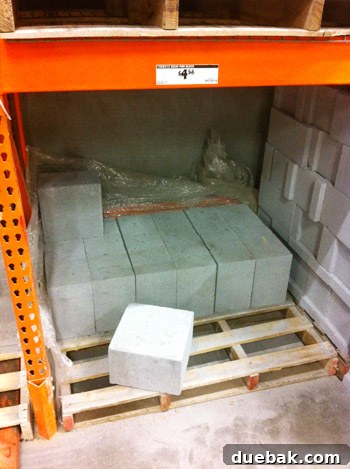
Initially, the idea of using pre-cast blocks seemed straightforward, promising ease and speed. However, upon closer inspection, I realized their practical limitations. Most of my holes were round, meaning I would have had to square them out to 12×12 inches to fit the pre-cast blocks correctly, necessitating additional digging. Furthermore, the bottom of each hole would need to be perfectly flat and level to ensure the blocks sat securely and evenly. Considering these factors, mixing my own concrete quickly became the more appealing and, surprisingly, simpler option. Concrete, by its nature, fills any irregular shape and self-levels to a degree, saving me from extra excavation and meticulous leveling. Adding to the convenience, concrete bags were already part of my lumber delivery from 84 Lumber, making it a cost-effective and readily available solution.
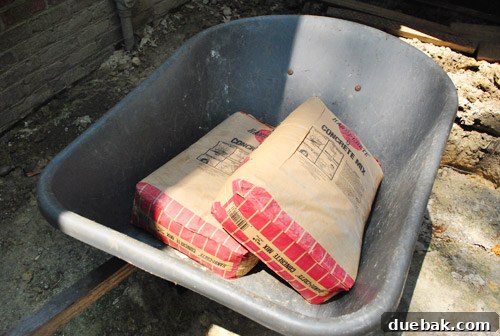
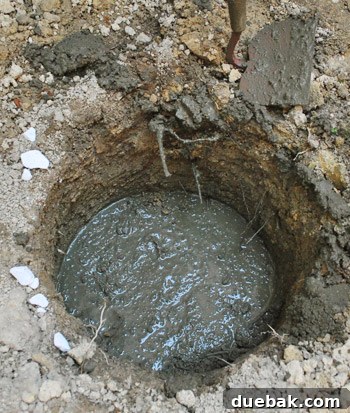
The process of mixing the concrete began by emptying each 60lb bag into a sturdy wheelbarrow. Water was gradually added, and I stirred the mixture using a garden hoe until it reached a smooth, creamy consistency. While perhaps an unconventional tool, the garden hoe proved surprisingly effective for the task.
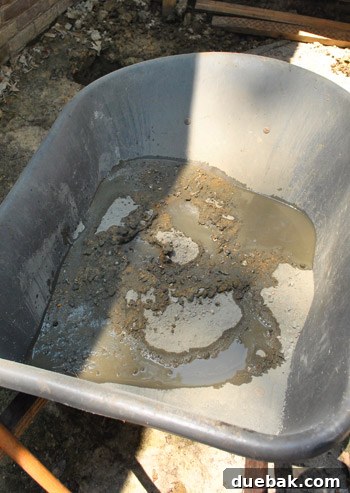
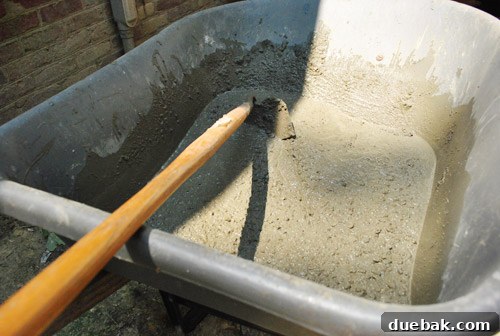
My first batch, as captured in the photographs, turned out a little soupier than intended. For subsequent mixes, I adjusted the water content to achieve a slightly thicker, more manageable consistency. Despite the initial runny mix, it dried perfectly fine, showcasing concrete’s forgiving nature. The most satisfying aspect was watching it naturally settle and flatten itself, creating a perfectly level surface ideal for setting the deck posts. This self-leveling property truly simplified the footing installation, making the overall process much more efficient.
Battling the Elements: Working in Extreme Heat
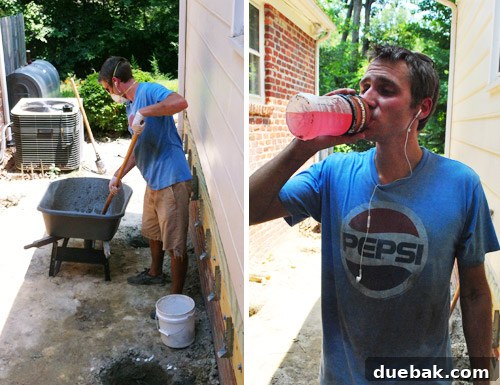
While mixing and pouring concrete might not sound like the most exhilarating challenge, the true obstacle presented itself in the form of the weather. The days I dedicated to this task were plagued by sweltering temperatures, easily “a bazillion degrees” outside. My phone’s weather app proudly displayed an orange exclamation mark, a clear warning of a heat advisory for our county—the kind that strongly advises against outdoor physical labor. Ignoring such warnings is never ideal, but with the project underway, I pressed on.

And yes, it was as miserable as it sounds. Within moments of starting, I was a sweaty, dirty mess. My primary strategy involved seeking refuge in the shaded areas of my workspace whenever possible and maintaining constant hydration. This meant consuming copious amounts of fluids, a necessity that unfortunately led to one rather amusing, albeit awkward, photograph that resembles a hybrid Powerade and Pepsi commercial.
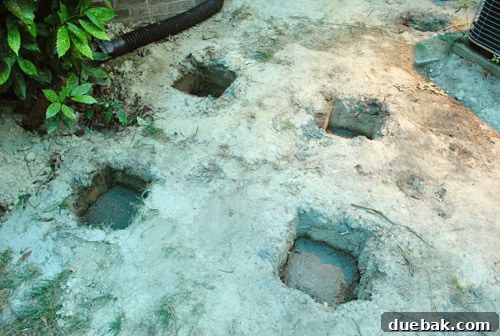
By the time all twelve holes had received their 8 inches of concrete, the heat had completely sapped my energy, and taking photographs was the last thing on my mind. It wasn’t until later that evening, when the intense heat of the sun had finally subsided, that I managed to snap a picture of the freshly poured footings, a testament to the day’s grueling work.
Laying Out the Framework: Posts and Girders
The following day brought a new delivery of materials from 84 Lumber. These were the additional supplies I had to order after the county mandated revisions to my initial deck plans. The revision required more posts and girders, a consequence of an earlier, rather disheartening “big fat F” from the inspection office. This second order was relatively small compared to my initial lumber delivery, but it included the crucial 4×4 inch posts needed for the next phase of the project: constructing the main support structure of the deck.
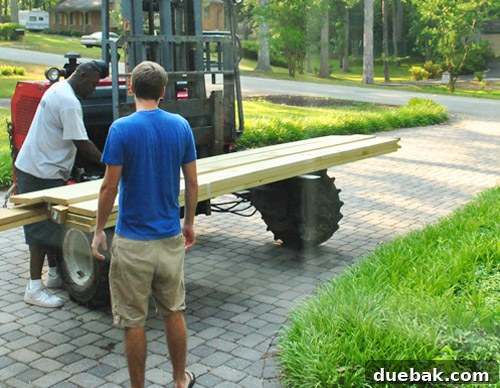
I had wisely purchased 12-foot long posts, which, given the modest height of my deck (barely 4 feet tall), allowed me to cut three individual posts from each length. This efficiency in material usage was a welcome bonus. The ground subtly slopes away from the house, so I meticulously staggered the sizes of the posts to compensate for the varying elevations, ensuring a level deck surface once completed.
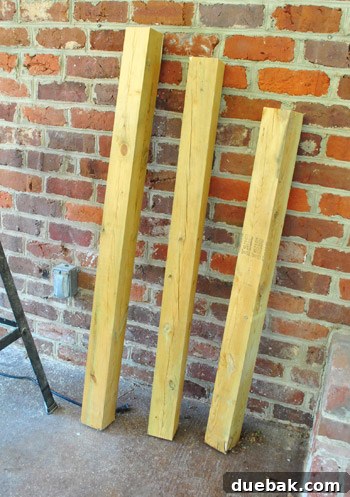
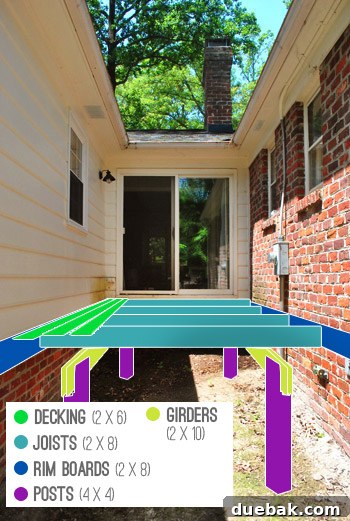
Setting these deck posts proved to be considerably more intricate than my previous experience with fence posts, primarily due to the complex structural demands of a deck. In essence, these posts would provide vertical support for large 2×10 inch girder boards, which run lengthwise beneath the deck. The joists, which span the shorter dimension across the deck space, would then rest on these girders. A critical alignment was required: the joists needed to line up perfectly with the rim boards already attached to the house. (These were initially planned as ledger boards, but their role shifted to providing lateral stability rather than primary joist support after the plan revisions). This visual diagram helps clarify the interconnected components of the deck’s substructure:
Precision and Placement: Marking and Notching Posts
Before permanently placing any posts, I meticulously set up a series of guides to ensure precise alignment with the existing rim boards. Accuracy at this stage is paramount for a structurally sound and level deck. After temporarily hanging joists at each end of the deck frame, I stretched a taut nylon string between their bottoms. This string served as an invaluable visual reference, representing the exact top surface of where my girder beams would eventually sit and where the joists would ultimately rest. This method was far more practical and accurate than attempting to temporarily hold an unwieldy 18-foot-long 2×10 board in place while trying to mark the posts.
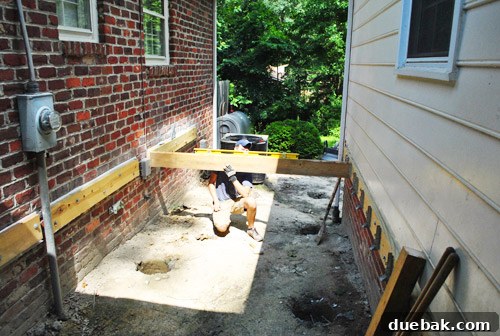
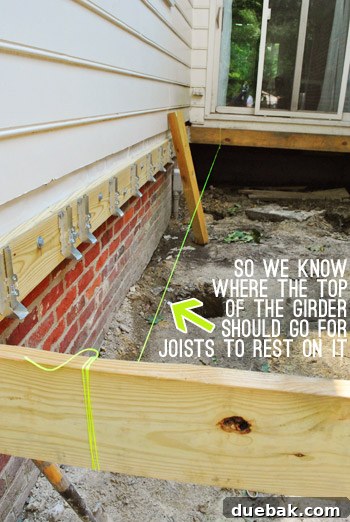
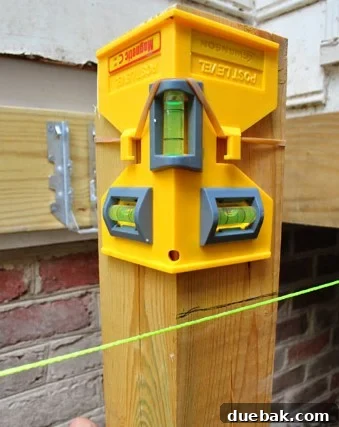
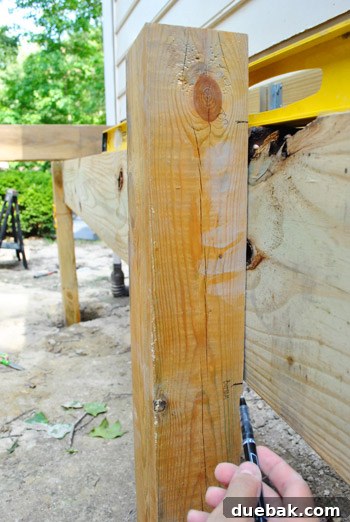
With the string guides firmly in place, I rested each post in its respective hole and carefully held it plumb, consistently double-checking its vertical alignment with a post level. I then marked the point where the string intersected the post. This mark precisely indicated the intended height for the top of my girder, providing the foundation for the crucial notching process. Our county offers two main approved methods for attaching girders to posts: using metal post brackets that sit atop the post, or cutting a notch directly into the post for the girder to rest within. I opted for the latter, largely influenced by successful examples I had seen online and a gut feeling that a notched connection would provide a more robust and secure fit than a simple bracket.
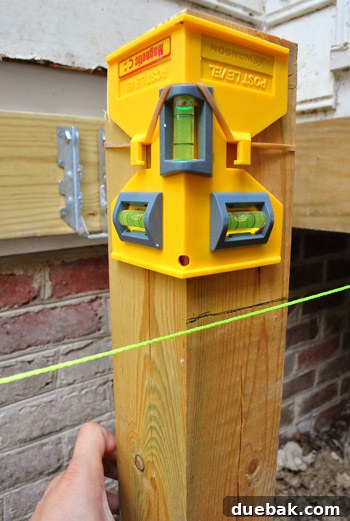
Using the top mark as my reference, I meticulously measured and drew the precise outline for the notch. This cut would allow a 2×10 girder to sit perfectly flush and at the correct height within the post. The notching process required precision and steady hands, as it directly impacts the structural integrity and levelness of the entire deck frame.
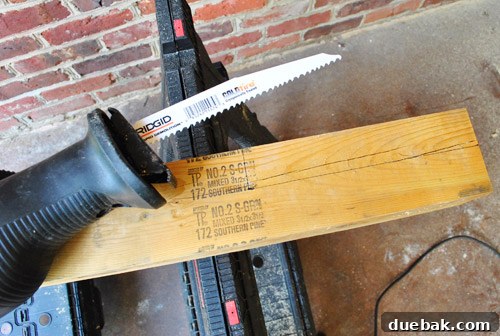
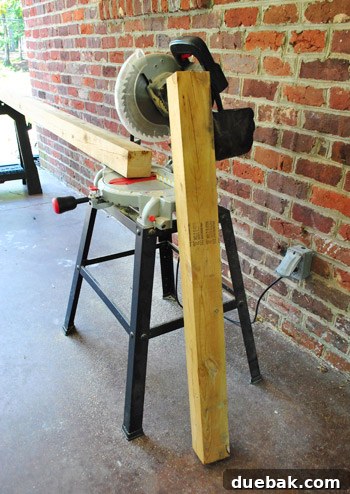
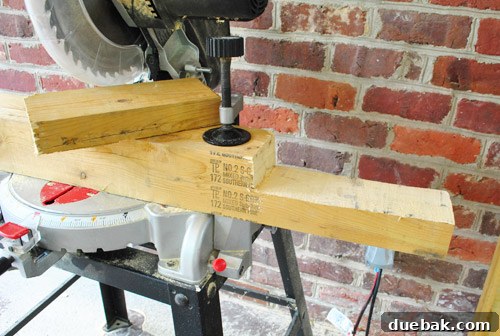
I utilized my reciprocating saw to make the necessary cuts for the notch. This step demanded my full concentration, leaving no opportunity to photograph the cutting in action as I focused intently on keeping the saw perfectly on my marked lines. The resulting notched post is shown below, ready for installation. (The miter saw visible in the background merely served as a convenient workbench with its built-in clamps, not for the notching itself).
Securing the Posts with Concrete
With the notch successfully cut, I carefully moved the post back into its designated hole. I then performed a critical double-check, verifying that my cuts aligned perfectly with the string line. Once confirmed, I used wooden stakes driven into the ground around the post to temporarily hold it perfectly straight and plumb. This temporary bracing is essential to ensure the post remains in the correct position while the concrete sets.
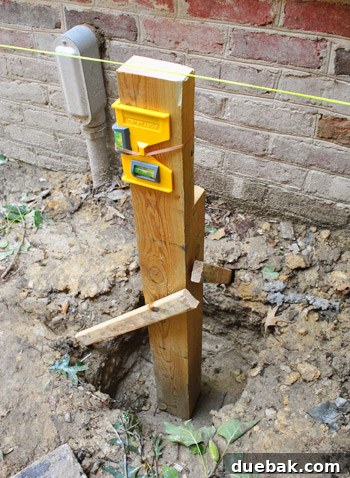
For the long-term stability of the posts, simply backfilling with dirt was not an option I trusted for a deck foundation. Instead, I defaulted to a proven method I had used for my fence: Quikrete no-mix concrete. This product is also an approved method in our county for securing posts, offering both convenience and reliability.
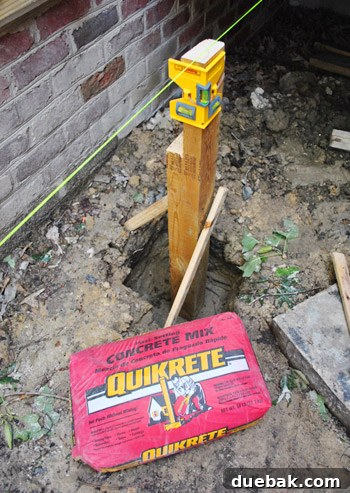
The beauty of Quikrete no-mix concrete lies in its simplicity. You just pour the dry powder directly into the hole around the post, ensuring it fills the void completely. Then, you add water, allowing it to soak into the dry mix. As the water penetrates, the concrete reacts and begins to set, drying to a rock-hard consistency. This method significantly streamlines the process compared to the pre-mixed concrete I used for the footings (which I chose initially because it was already part of my lumber order, and I wanted to avoid waste). The no-mix option is undoubtedly easier and quicker for setting individual posts.
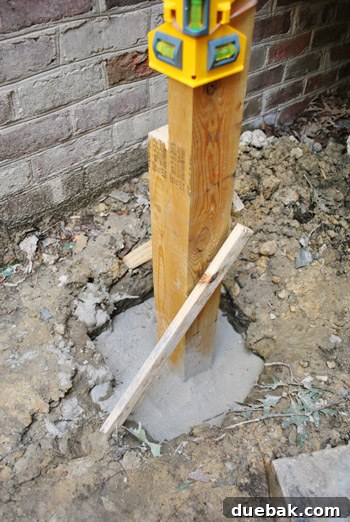
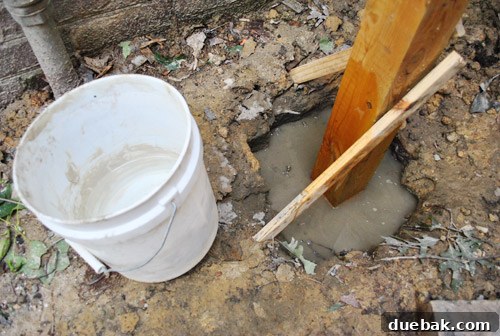
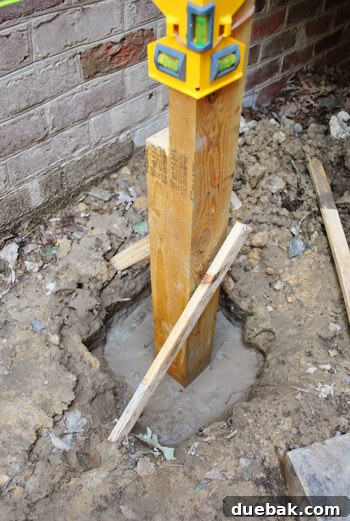
I then replicated this entire sequence – string guide, marking, notching, staking, and cementing – for another post at that end of the deck. While typing out the steps makes it seem fast, this was a fairly long and arduous process, perhaps taking three hours from initial joist setup to final cement pouring. Adding to the challenge, this day was scarcely cooler than the last, leaving me utterly exhausted. Fortunately, the need for the cement to fully cure provided a perfect, well-deserved excuse to pause and rest.
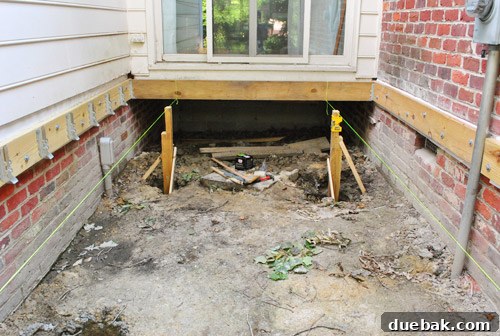
Erecting the Girders: A Solo Challenge
The third day of deck construction was dedicated to erecting the girders. This crucial step ideally calls for an extra set of hands, and I would have greatly appreciated my dad’s help. However, he was away visiting my grandma in West Virginia, leaving me to tackle the challenging task of setting an 18-foot-long board by myself. My partner, Sherry, was occupied inside with Clara, maintaining the blog, and managing last-minute book-proofing, though she was available for quick consultations or a brief helping hand when absolutely necessary.
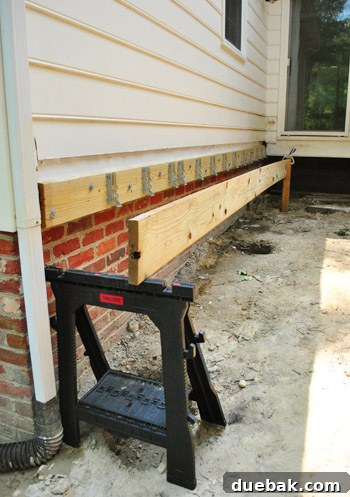
While my nylon string method for marking posts was effective, I decided that using the actual girder board itself would provide an even more trustworthy guide for setting the remaining posts. I clamped one end of the long girder to the already-notched post that had been cemented the previous day. To support the other end, I utilized a sawhorse, raising it to approximately the correct height. At this point, my objective was to accurately mark the next post (which was simply resting in its hole) for its corresponding notch. This involved a delicate balancing act: holding the heavy board level, checking its alignment, and simultaneously marking the post with a pen, all of which required considerable juggling moments after I snapped this photo.
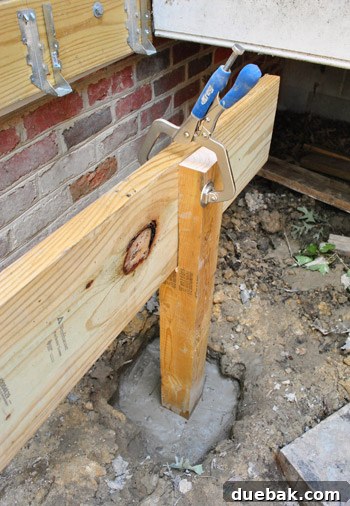
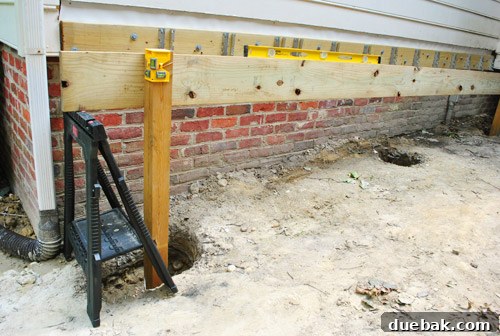
Despite the challenges, I successfully made my mark and cut the notch with the reciprocating saw. Once the notch was complete, I returned the post to its position and meticulously double-checked every critical measurement: ensuring the post was perfectly plumb (straight up and down), verifying the girder was level (or slightly sloped for proper water runoff, as per best practice), confirming the joist that would sit on the girder was level, and checking that the post’s distance from the house matched its counterparts. This comprehensive verification process is non-negotiable for a structurally sound deck.
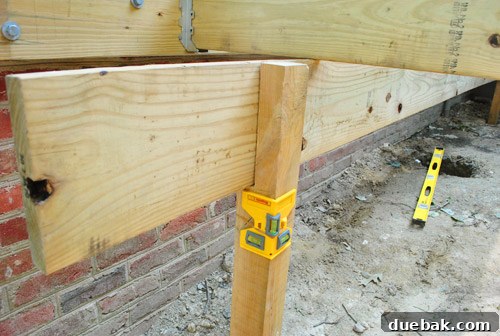
Once all checks were complete and adjustments made, I was able to cement the base of the post using the no-mix Quikrete again, this time without the need for temporary stakes. The sheer weight of the girder board itself provided sufficient stability, holding the post firmly in place while the concrete cured. Speaking of the girder, with both ends now supported, marking the middle post (each of my two main girders is supported by three posts) became incredibly simple. Dare I say, it was actually easy, a welcome respite from the earlier struggles!
Expanding the Foundation and Family Observations
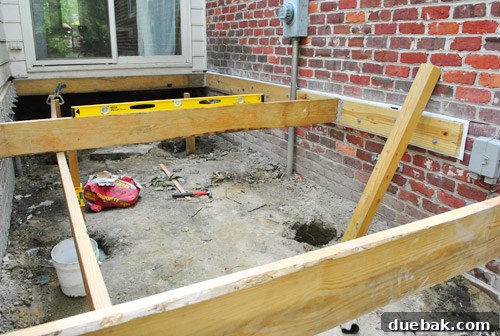
With one side of posts successfully installed and the girder temporarily secured with nails and clamps, I moved on to the other side of the deck. This section presented a slightly trickier scenario because its length (21 feet) was too extensive for a single girder board. Consequently, I planned to use two separate girders that would meet and butt up against one another at the central post. To establish a reliable reference point for the correct height, I temporarily set another joist across the middle of the span.
To truly convey the “excitement” of this construction process, one only needs to observe Clara’s intense engagement. My DIY efforts had, it seemed, become her new favorite spectator sport. The thrill was so palpable that she even brought her octopus balloon over to witness the action firsthand, a charming moment Sherry fortunately captured on camera. These little moments of family interaction provide welcome breaks and add a personal touch to the demanding work.
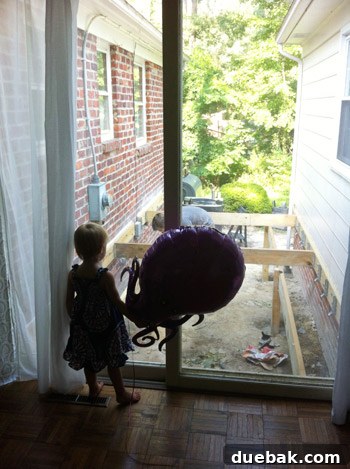
This image clearly illustrates the configuration for the longer side: how one girder board will share the middle post with another board, which will then span the remaining distance. This approach ensures structural integrity while accommodating the deck’s extended length.
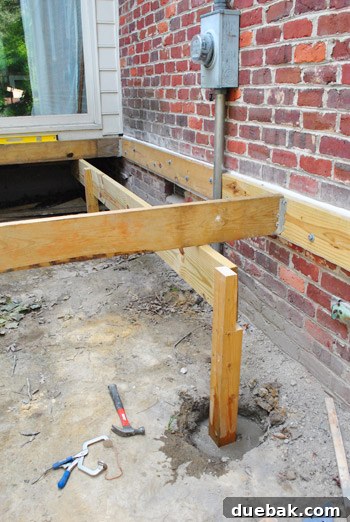
By the end of this afternoon – another scorching hot one – all six posts were securely set in concrete, and all my girder boards were temporarily held in place. The “temporarily” is key here; the girders require doubling up (meaning two 2x10s thick) for full strength. This particular task is one that undeniably necessitates more than just one person. Consequently, I had to wait for my dad to return from his visit to my grandma’s house, as we knew this step would take longer than Sherry could reasonably assist while also caring for Clara – in other words, it was a “longer-than-a-Clara-nap” project.
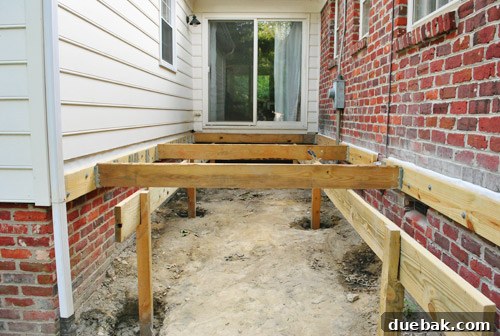
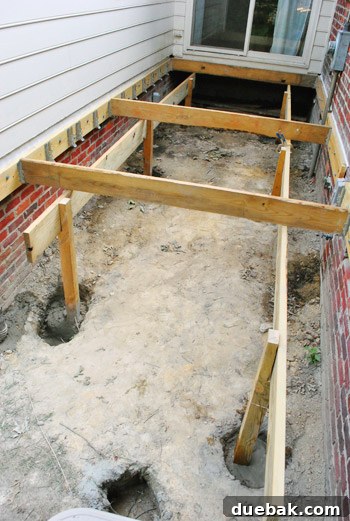
Once the doubling of the girders is complete, the next phase involves adding two more posts and another girder to construct the angled edge at the far end of the deck. You can spot the two empty holes towards the bottom left of this picture; one of these will be shared by another post. However, I decided it was best to get these primary girders firmly in place before tackling the complexities of the angled section.
Conclusion: The Journey Continues Towards a Completed Deck
This detailed account covers a truly productive few days on the deck project, despite the intense heat and the intricate nature of the work. While the structure is only just beginning to resemble a deck, the satisfaction of these foundational steps is immense. I am confident that significant visual rewards are just around the corner. Once these girders are permanently secured and doubled, the installation of the joists, which should be a relatively speedy process, will follow. After that, the final decking boards will be laid, transforming this skeletal frame into a functional and beautiful outdoor living space. The thought alone makes me sweat, though that’s likely just my sweat glands working overtime these days!
What about you? What projects have you been “sweating over” lately, either literally or figuratively? Are you tackling any challenging outdoor renovations under the blazing sun, or are you opting for a more relaxing way to enjoy the great outdoors, perhaps with a tranquil beach day?