
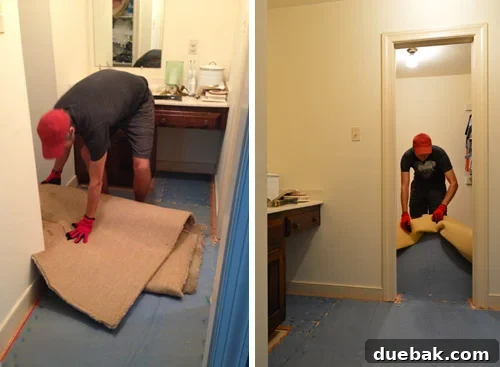
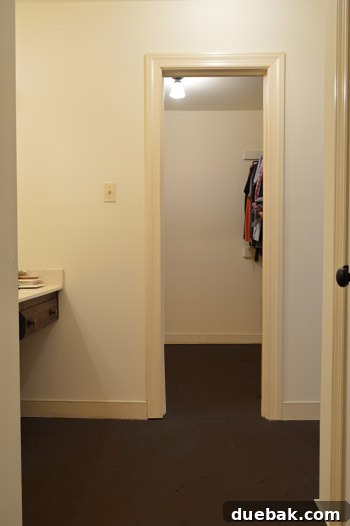
Four months. While not an eternity, it felt like an eternity and a half when the last remnants of our old, dated carpet stubbornly clung to our upstairs bathroom and closet. The mere thought of a carpeted bathroom sends shivers down the spine of any modern homeowner, conjuring images of dampness, dust, and an overall lack of hygiene. Our personal encounter with this design relic was precisely 3.9 months longer than we had ever intended, making yesterday’s transformation all the more satisfying.
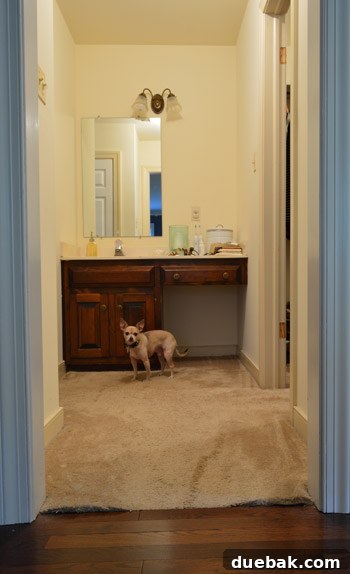
Conquering the Carpet: Our Bathroom Flooring Dilemma
You might be wondering why we left this creamy, wrinkly abomination in place when we tackled the rest of the upstairs carpet removal. The simple truth is, we knew hardwood wasn’t the answer for a bathroom. Without an immediate decision on new flooring, the old carpet stayed, blending ironically with our equally creamy walls and trim – a monochromatic scheme that was far from intentional or chic. It simply existed, a placeholder for a decision yet to be made.
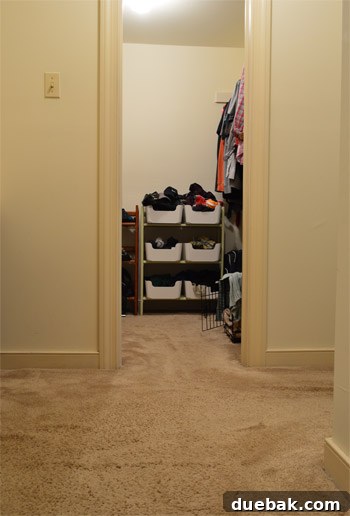
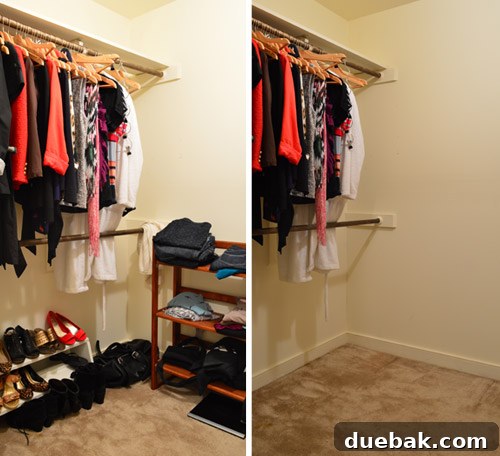
But yesterday morning, roughly 24 hours ago, the procrastination ended. A sudden burst of motivation hit, and we declared war on the carpet. The first step was to clear out our messy closet, granting us full, unrestricted access to the flooring underneath. This seemingly small act was a pivotal moment, signaling the start of a much-needed bathroom refresh.
The Nitty-Gritty of Carpet Removal: A Step-by-Step Guide
We’ve previously detailed the process of carpet removal in a video tutorial, but for those embarking on a similar DIY journey, here’s a quick rundown of how we vanquished our bathroom carpet:
- Yanking the Carpet: The initial, most satisfying step involves firmly gripping the carpet and pulling it away from the tack strips along the walls. These strips, embedded with sharp nails, are designed to hold the carpet taut. Once a corner is loose, it’s often a matter of leveraging your strength and body weight to peel the carpet back, section by section. We then rolled it up, making it easier to carry and dispose of.
- Padding Extraction: Beneath the carpet lay the blue foam padding. This layer typically comes up with surprising ease. It’s often secured with staples, which offer less resistance than the tack strips. A good pull is usually enough to tear it free, revealing the subfloor beneath.
These initial stages are the “fast and easy” wins, offering immediate gratification and a clear visual of progress.
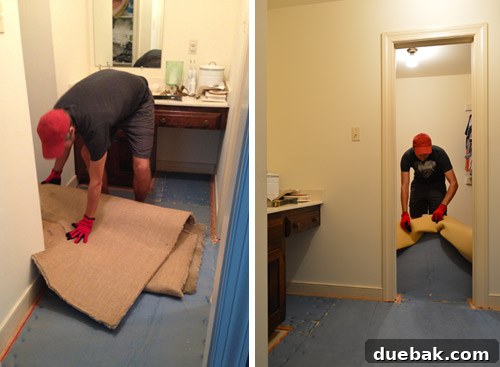
The next phase, however, requires a bit more elbow grease – what we affectionately call the “get-sweaty phase.”
- Tack Strip Removal: Armed with a crowbar, the real work began. Prying up each tack strip individually demands patience and brute force. They are typically nailed securely into the subfloor, and care must be taken to avoid damaging the underlying wood.
- Staple Obliteration: Once the tack strips are gone, countless tiny staples remain, scattered across the floor. A floor scraper is your best friend here. It allows you to systematically scrape and pop out each staple, ensuring a smooth, clear surface for your new flooring. This step, combined with a thorough sweeping and shop-vac clean-up, consumed a solid hour of my time, but the result – a pristine subfloor – was worth every bead of sweat.
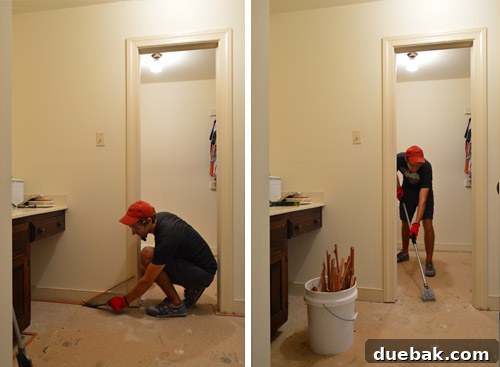
While I was engrossed in this dusty but gratifying task, Sherry was tackling another project in the garage. Weekend naptime often transforms into a frantic dash to squeeze in as many home improvement tasks as humanly possible, a testament to the dedication of DIY enthusiasts. But we’ll get to her project in a moment.
Temporary Solutions, Long-Term Visions: Our Flooring Journey
Now, this is usually the part where we’d unveil our grand plan for stunning new bathroom flooring. However, in true DIY fashion, our long-term vision is still taking shape. Our ultimate goal is to tile the bathroom area, creating a cohesive, spacious zone. This ambitious undertaking first requires significant demolition to combine the separate sink area with the shower/toilet space. We envision a single, larger bathroom rather than two smaller, choppy rooms, eliminating the need for two single sinks separated by a wall. This kind of major reconfiguration is something we prefer to undertake after living in a house for an extended period, allowing us to truly understand its flow and our needs before rushing into irreversible changes. So, while tile is on the horizon, it’s a “later” plan, not a “now” plan.
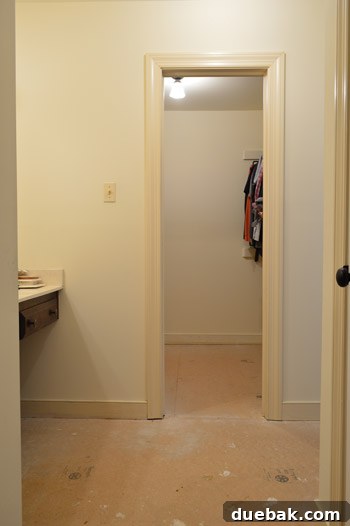
For the closet, we’re still weighing options. Perhaps hardwood, using leftover planks from another project, or maybe a wall-to-wall low-pile jute rug for warmth and texture. These decisions can wait, as the immediate priority was just getting rid of that carpet.
Our “for now” plan for the exposed particle board subfloor is simple and cost-effective: paint. A durable floor paint will not only make the space look more finished but also address the slightly dusty, unfinished feel. This temporary solution allows us to toss down some sheepskins or area rugs, instantly adding coziness and style without committing to a permanent solution that we’d eventually rip up anyway. We explored other short-term ideas, such as peel-and-stick floor tiles or a large seagrass rug cut to fit, but ultimately decided that paint plus area rugs offered the best balance of minimal cost, effort, and flexibility.
It’s important to note that tiling directly over particle board is not an option; it’s not a secure enough base. Future tiling plans would necessitate tearing up any temporary flooring, installing a proper cement backer board, and then tiling. Knowing this, slapping some paint on the particle board in the interim causes no harm and provides a much-needed aesthetic upgrade.
Mirror, Mirror on the Wall: A Vanity Upgrade
This post isn’t solely about our impromptu carpet removal adventure. It’s also about a serendipitous find that has already begun to transform our bathroom’s aesthetic: a stunning mirror we stumbled upon at HomeGoods last week. The moment we laid eyes on it, we were transported back to our previous home, specifically to the beloved quatrefoil mirror we hung above that bathroom’s sink. These were, thankfully, the good kind of flashbacks.
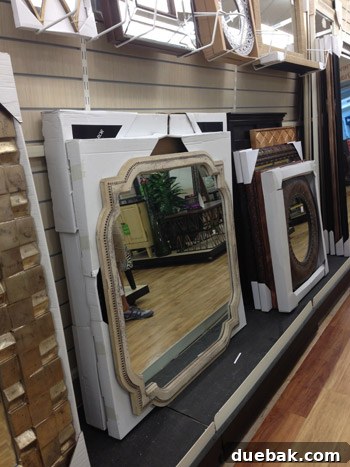
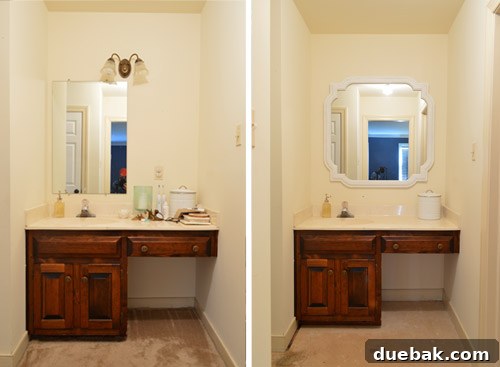
Our vanity was in desperate need of a larger mirror (as the first photo clearly illustrates), and this find was over 40 inches wide! We immediately recognized its potential to bounce an incredible amount of light around our somewhat closed-off sink nook, effectively mimicking the expansive feel of a large window. At $89, down from an original price of $299, it was an irresistible deal for such a generously sized and uniquely shaped mirror.
We appreciated the delicate beaded detail around its border, but its rustic paint job didn’t quite align with our vision. This is where Sherry’s garage project comes into play.
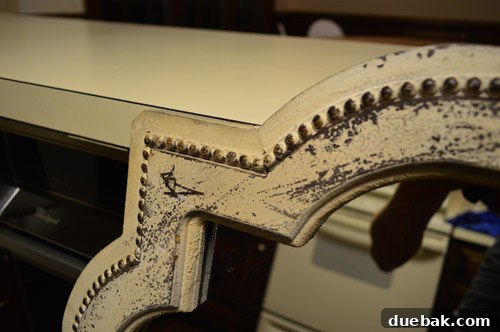
DIY Mirror Makeover: From Rustic to Refined
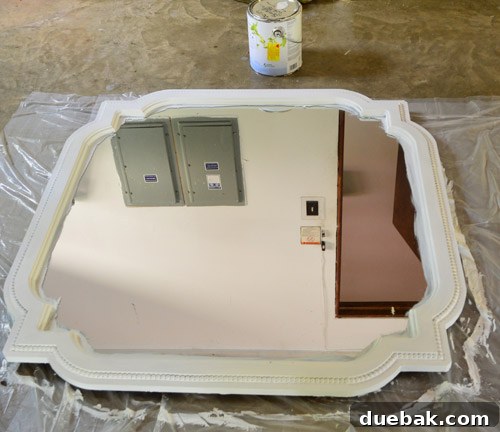
While I was grappling with tack strips, Sherry was busy in the garage, preparing our new mirror. She carefully laid it on a dropcloth and set to work priming and painting. The mirror ultimately required one coat of primer followed by two coats of Benjamin Moore Simply White eggshell paint, leftover from Clara’s bedroom walls. We opted for a less glossy finish, believing it would beautifully complement the mirror’s textured detailing. We briefly considered a bolder color, even a dark blue tone reminiscent of our nearby bedroom walls, but ultimately decided to keep the mirror crisp white. This choice allows us the flexibility to introduce color through wall paint or a vanity refresh later, maintaining the mirror’s window-like presence with its large pane of glass and clean, almost-rectangular frame.
Installation Hiccups and Creative Solutions
Removing the old, frameless half-mirror above the vanity was refreshingly easy. Thankfully, there was no adhesive, only clips screwed into the top and bottom. A quick loosening of these clips, and the mirror came right off – no shattering, no seven years of bad luck. A small win before the next challenge.
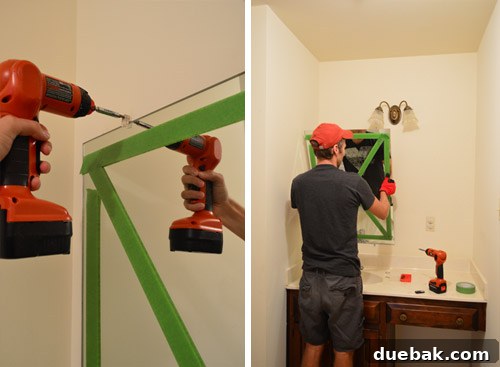
Then came the moment of truth: hanging the new, beautifully painted mirror. Our measurements indicated it would be tight, but we weren’t prepared for how “cozy” it actually looked. The mirror felt ridiculously cramped, visually overpowering the vanity and clashing with the existing light fixture.
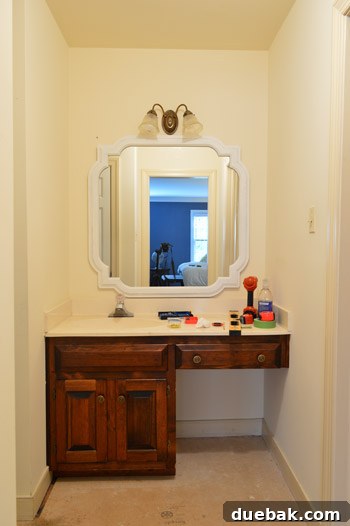
After a brief, solemn pity party, a simple solution emerged. We decided to temporarily nix the current light fixture. The nook already had a ceiling light, and the vanity light was inexplicably off-center. We capped the wires and installed a fixture box cover, allowing us to hang the mirror much higher. This temporary measure is part of a larger plan: once we find a light fixture we truly love, we’ll easily move the fixture box up about a foot to sit perfectly above the new mirror without any cramping. Since the wires for the fixture box descend from the attic, repositioning it will be a straightforward electrical task. We simply want to choose the new fixture first, as its dimensions will dictate the precise placement of the updated fixture box.
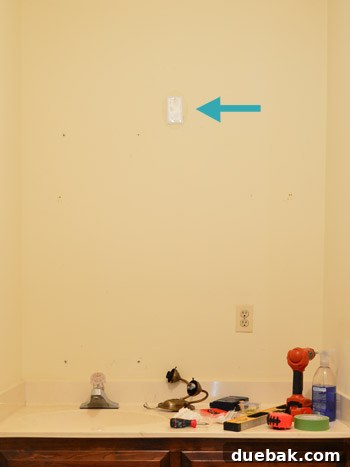
With the fixture box safely sealed off, we could finally raise the mirror to its ideal position – approximately 6 inches above the countertop, rather than almost resting on it. It now completely conceals the covered fixture. We also temporarily capped and covered an outlet, which is another item on our “to be moved” list for future electrical work. Despite these pending tasks, we are incredibly pleased with the progress made yesterday. While the floors aren’t yet prettier, the new mirror has already made the space feel significantly larger and more balanced, even with the vanity feeling heavier on one side for now.
Envisioning the Future: Quick Updates & Long-Term Goals
The combination of impatience (to remove the carpet) and serendipity (finding that mirror) has truly set our mental wheels spinning about this room. We’re now actively formulating a vision for some quick and easy updates that will tide us over until we gather enough steam and funds for a full gut renovation down the line. Sherry even mocked up a bit of what’s currently swirling in our brains. A quick disclaimer: we’re still very much in the “changing our minds every second” phase, having only started this whirlwind 24 hours ago, so the final outcome could still evolve dramatically.
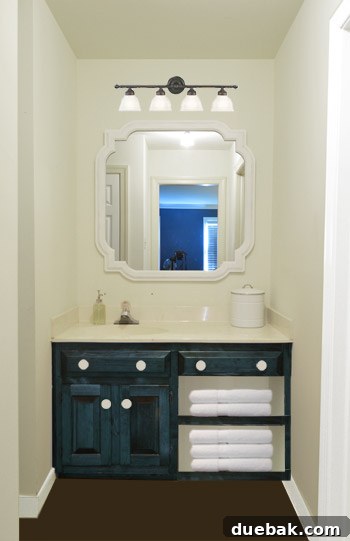
Naturally, wall and trim painting is on the agenda. The existing wall color will definitely change, but we’re still undecided on the exact shade, necessitating swatch tests. We’re also planning some sort of paint or stain on the vanity, perhaps a muted, grayed-out navy, complemented by some new knobs for contrast and a fresh look. The floor, as mentioned, will receive a temporary paint treatment. To maximize the dead space on the right side of the vanity, we’re considering building some open shelves for towel storage. Alternatively, we’ve debated enclosing that space and finding matching doors for a completely concealed front, though open shelving offers easier access and a lighter feel. And, of course, moving up the capped fixture box and adding a vanity light is a definite future step once we find the perfect fixture.
For now, however, the immense satisfaction of being rid of that old carpet and diving into a new corner of the house is paramount. It’s exciting to see the initial transformation and envision the full potential of this space. What exciting projects did you tackle this past weekend?