
Transform Your Kitchen: DIY Concrete Countertops with Ardex Feather Finish
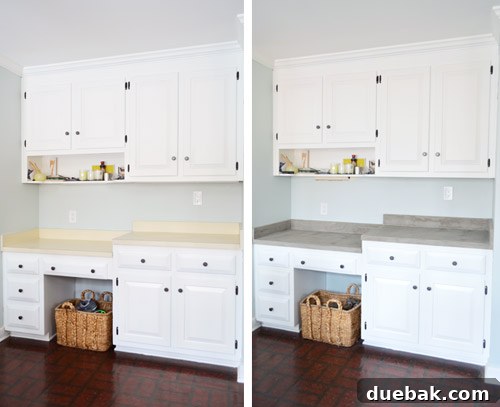
We embarked on an exciting journey to completely transform our kitchen’s existing laminate countertops by giving them a modern, industrial concrete finish. After much anticipation, we’re thrilled to share the final results, a detailed breakdown of the process, and a helpful video demonstration to guide you through this ambitious DIY project. This isn’t just a quick refresh; it’s a fundamental shift in our kitchen’s aesthetic and durability.
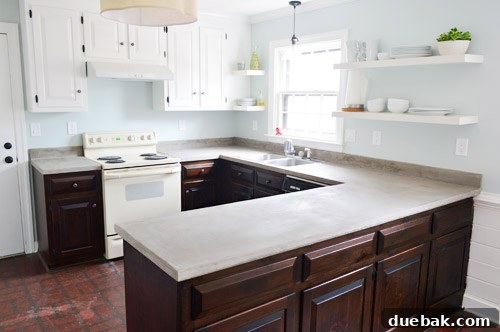
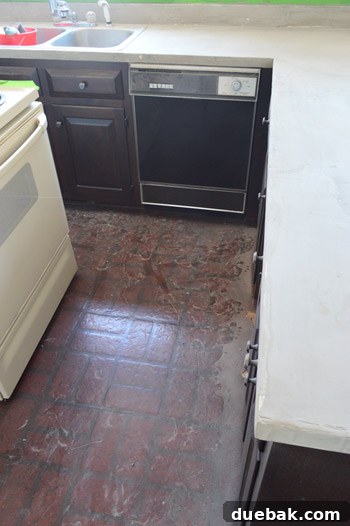
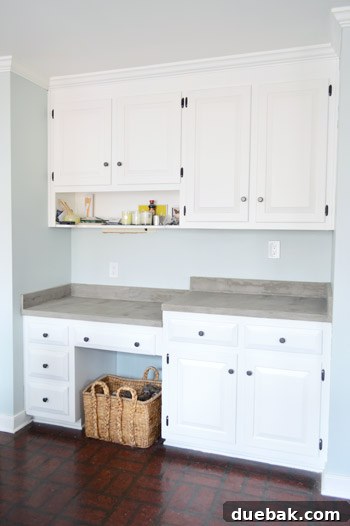
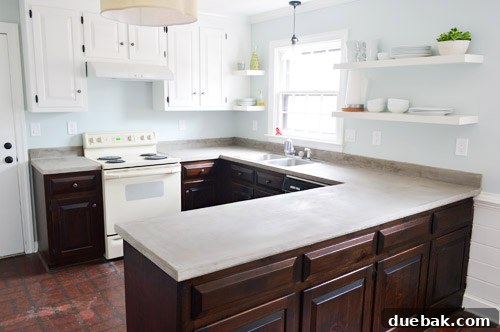
We couldn’t be happier with how our new concrete countertops turned out. While photos provide a glimpse, they truly don’t capture the complete transformation. The entire kitchen now feels significantly more updated and less ‘laminate-y’. In these initial photos, the aesthetic might appear somewhat stark or cool, but we envision a warmer, more inviting space once we introduce colorful window treatments, stylish items on the shelves and counters, and address the outdated faux brick flooring and almond-colored stove. We believe these subsequent updates will truly make the room feel entirely new and cohesive.
However, it’s important to be completely transparent: this project was no small feat. It demanded considerable effort, patience, and generated a substantial amount of dust. While the final outcome is incredibly rewarding, the journey to get there was certainly intensive.
Before & After: Bidding Farewell to Old Laminate
To truly appreciate the transformation, let’s take a moment to recall the “before.” Our kitchen was previously adorned with creamy-yellow laminate countertops, bearing the inevitable battle scars of everyday life – the occasional burn mark, various scratches, and general wear that comes with years of use. This dated surface was a major candidate for an upgrade. Beyond the main cooking area, we extended the concrete treatment to the adjacent breakfast nook, ensuring a consistent and modern look throughout the connected spaces. As of now, the countertops have yet to be sealed; we’re still sourcing the ideal product from our research. This sealing step will likely deepen their color, adding another layer of visual richness to the final look.
Choosing Ardex Feather Finish for Our DIY Concrete Counters
Our material of choice for this ambitious renovation was Ardex Feather Finish. We had been captivated by its potential after seeing successful DIY projects from various prominent blogs such as Kara Paslay Designs, Little Green Notebook, Sarah’s Big Idea, and A Beautiful Mess. Inspired by their stunning “after” pictures and the incredibly low price point for Ardex (approximately $19 per bag), I confess, I naively assumed this would be a swift and straightforward task. Oh, how quickly reality set in!
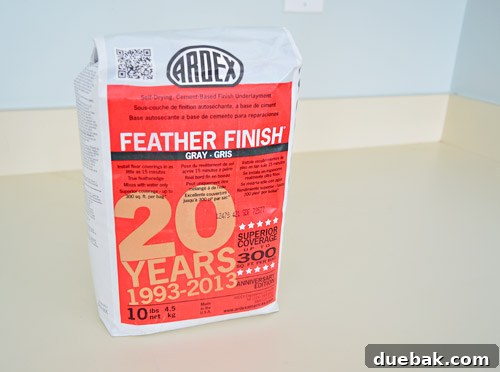
Perhaps it was our status as first-time concrete countertop creators, or perhaps the sheer scale of our workspace – a sprawling 45 square feet of counters encompassing a U-shaped cooking zone and a generous nook area – but this project quickly evolved into a physically demanding and rather messy endeavor that spanned five full days. While not inherently complicated or technically difficult, the sheer labor and time commitment far exceeded our initial expectations. With that in mind, let’s delve into the detailed process. Please forgive the non-chronological order of our photos; we captured numerous shots across our four application and sanding rounds, and I’ve selected those most illustrative for explaining each step. Now, let’s gather our essential supplies!
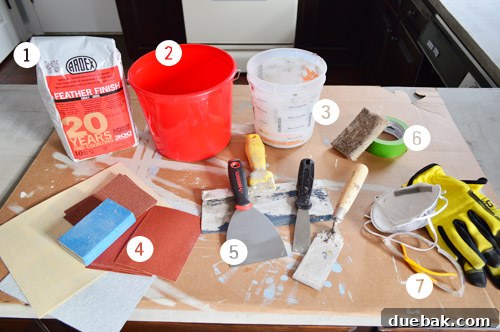
Essential Tools & Materials for Your Concrete Countertop Project
- Ardex Feather Finish: This is, of course, the star of our show. It can be a bit challenging to find locally, so we recommend checking their website for distributors or conveniently ordering it via Amazon. For our 45 square feet of countertops and four coats, we used approximately 2.5 bags, though we might have applied it a touch thicker than strictly necessary in some areas.
- Mixing Buckets: Small, sturdy buckets are perfect for mixing the Ardex powder with water. We opted for small batches to ensure optimal consistency and prevent premature hardening, making these small red buckets ideal.
- Measuring Cups/Buckets: Precision is key when mixing Ardex. We used separate measuring containers for water and Ardex powder to maintain the correct ratio, ensuring consistent texture across all batches.
- Sandpaper: A comprehensive selection of grits is crucial for achieving a smooth finish. We primarily used 60-grit for initial roughing and between coats, 120-grit for intermediate smoothing, and 220-grit for the final, fine finish. Don’t forget a comfortable sanding block for easy gripping and even pressure.
- Spreading Tools: A flat trowel is invaluable for efficiently mixing the Ardex in the bucket. For application, a large 10-inch drywall knife proved excellent for covering expansive flat areas quickly. A 4-inch putty knife was essential for tackling backsplashes and edges with precision, while a smaller flexible putty knife helped us navigate tight spots, particularly around the kitchen sink.
- Wall Protection & Clean-up Supplies: Keeping your workspace tidy and protecting surrounding surfaces is paramount. We kept sponges and paper towels constantly at hand for immediate clean-up of any drips or splatters on the walls. Taping off certain areas provided an extra layer of defense, which we’ll discuss further below.
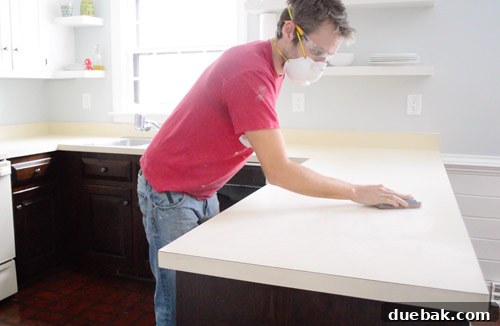
- Protective Gear: Safety first! During the rigorous sanding process, safety glasses and a dust mask were non-negotiable to protect our eyes and lungs from fine dust particles. Sherry preferred a heavy-duty respirator for superior protection. Durable work gloves were also crucial to prevent our hands from getting raw and sore from continuous sanding and material handling.
The Application Process: From Rough Start to Smooth Finish
Prepping the Laminate Surface
The very first step involved roughing up the existing laminate counters. This wasn’t just a suggestion; it was a critical step to ensure proper adhesion of the Ardex Feather Finish. We used high-grit sandpaper to create a textured surface, which significantly improved the bond. Initially, we began sanding barehanded, quickly realizing the strain it put on our fingers. About ten minutes in, we wisely switched to gloves and wrapped large sanding blocks with fresh sandpaper, making the process much more manageable and efficient.
Mixing Ardex to Perfection
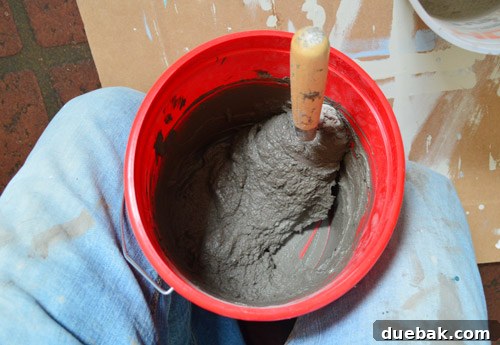
The Ardex bag suggests a mixture of two parts powder to one part water. However, through trial and error, we found this ratio to be slightly too thick for our preference, making it challenging to spread evenly. This thicker consistency, we believe, contributed to our first layer being heavier than intended. From that point onward, we opted for a slightly wetter mixture, adding a bit more water to achieve a more workable consistency.
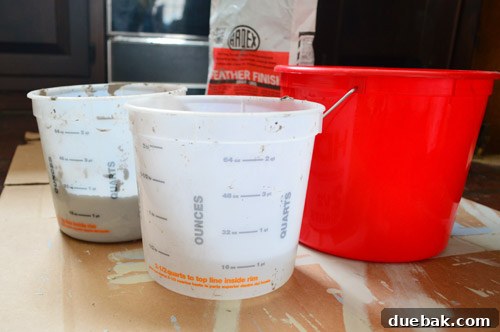
The ideal consistency, much like grout or thinset mortar, is akin to thick toothpaste. It should be substantial enough to cling to your spreading tool without running or dripping, yet fluid enough to spread smoothly and effortlessly. While larger batches might benefit from a paddle mixer, we found that hand-mixing worked perfectly for our smaller quantities. Sherry even took turns mixing without any issues. Since Ardex begins to harden within 15-20 minutes, mixing small, manageable batches proved to be the most practical approach, minimizing waste and ensuring optimal workability.
Spreading the Ardex: The Art of Layering
Spreading the Ardex across the flat countertop surfaces was, in a peculiar way, quite enjoyable. It felt much like icing a massive cake, and using the wide 10-inch drywall knife allowed us to cover large areas swiftly and efficiently. The backsplash, however, presented a different set of challenges, which we’ll delve into shortly.
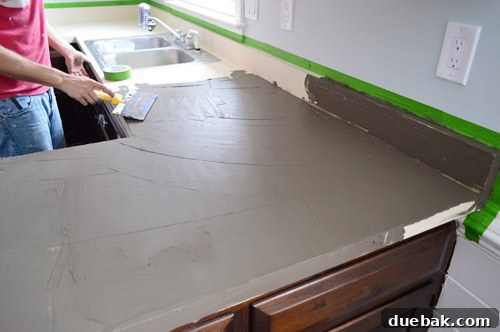
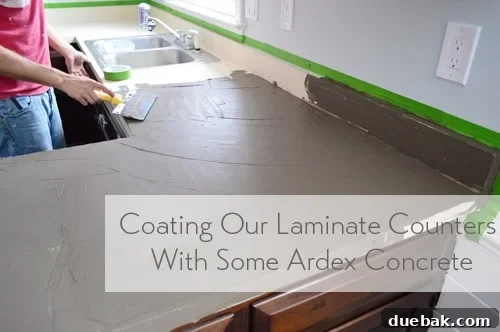
To provide a clearer understanding of the application technique, Sherry captured a short video of me applying the third coat. While I don’t claim to be an expert, we definitely noticed an improvement in our technique with each successive round. Sherry also observed that our sanding and smoothing skills became more refined with every layer. This is excellent news for first-timers, as your initial coats serve as valuable, low-risk practice rounds, which will ultimately be covered by subsequent layers.
Tackling Edges and Backsplashes
When it came to applying Ardex to the vertical sides and edges of the countertops, we switched to a smaller putty knife. Our strategy was to typically apply the bulk of the mixture to the horizontal surfaces first. By the time we moved to the sides, the remaining Ardex in our bucket had slightly thickened, making it less prone to sliding off the vertical surfaces and allowing for a cleaner application.
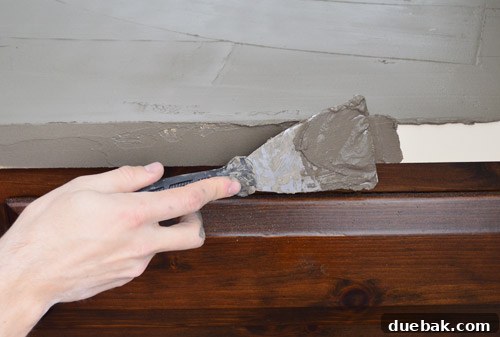
Initially, we found the edges particularly challenging due to the tendency for material to build up. However, a crucial realization came a couple of rounds in: after about 20 minutes, the Ardex would harden to an almost clay-like consistency. At this stage, either Sherry or I could return and meticulously smooth the edges using a damp finger, creating beautifully refined lines. My personal favorite part involved playfully “sneaking up” on Sherry, ‘Ghost’-style, to smooth the edges from behind her back. Who says DIY projects can’t have a touch of romance?
The Taping Dilemma: To Tape or Not to Tape?
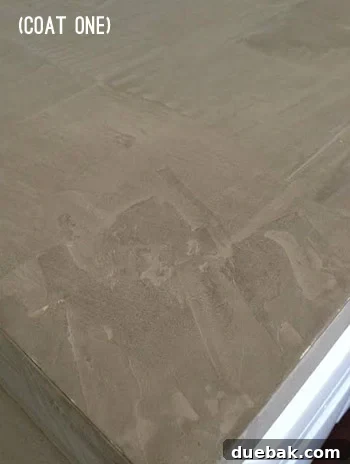
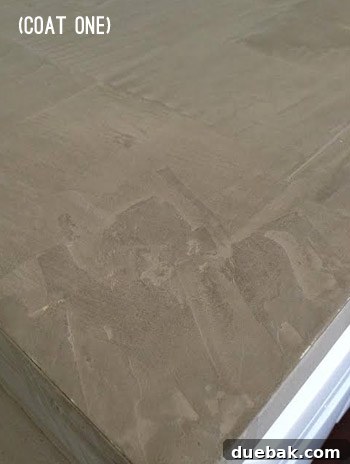
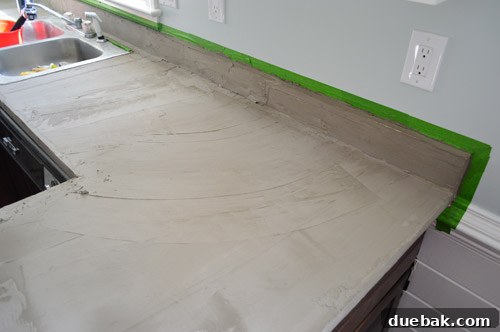
Here’s a look at our countertops after the first round of application and drying. You’ll notice Sherry taped off the walls, a decision made after I expressed concern about excessive splatter during application. In retrospect, we’re still undecided if this was the smartest move. While it certainly reduced our paranoia about making a mess, the removal process proved to be quite a chore and not entirely flawless, as the concrete had, in several spots, effectively bonded the tape to the wall.
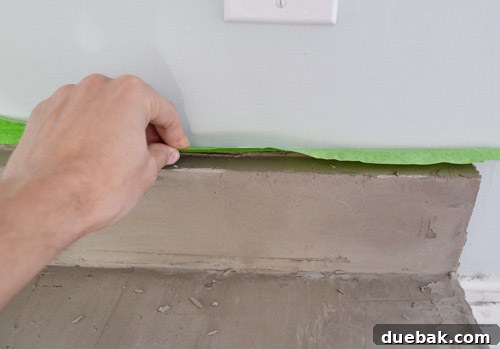
We ultimately decided to abandon the tape after our second round of smoothing. We carefully worked our way around the kitchen, slowly peeling it off, fearing that excessive concrete buildup would permanently entrap the tape. During this extraction, we discovered that pulling the tape downward from the top, rather than ripping it sideways (as one might after painting), yielded a much cleaner edge and prevented the tape from tearing. Despite this technique, we still had to carefully chisel it free in a few areas. Ultimately, we’re not convinced it was a time-saver.
The Crucial Step: Scraping and Sanding for a Flawless Finish
Things invariably look pretty rough after each application round – well, after every round, actually! But this is where the transformative (and admittedly messy) stage begins: the meticulous sanding process. This critical step is where you painstakingly smooth out any rough spots, ridges, or imperfections, preparing the surface for the next layer and ultimately guiding you towards a beautifully flat, smooth, and refined finish.
Initial Scraping: Removing High Spots
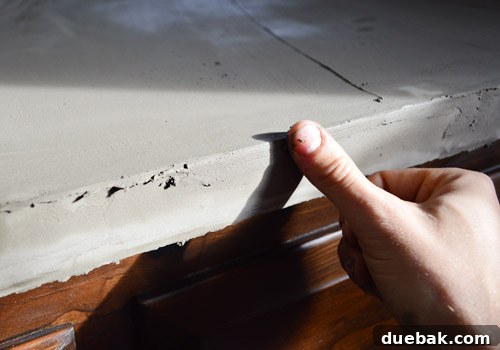
After allowing each applied layer to dry overnight, Sherry would begin by running a putty knife across the countertop surface. Her goal was to efficiently scrape off any obvious ridges or high spots left behind by the drywall knife during the Ardex application. Even though the Ardex had hardened, it wasn’t overly difficult to remove these irregularities. Blobs and ridges would simply pop right off as she systematically scraped back and forth, revealing a much smoother base.
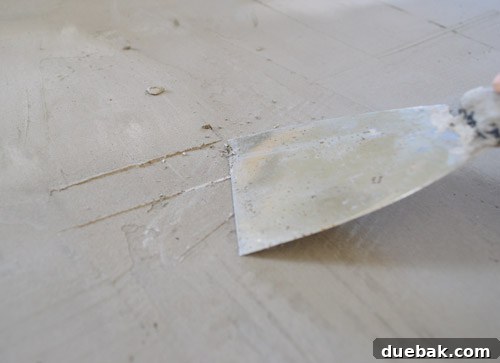
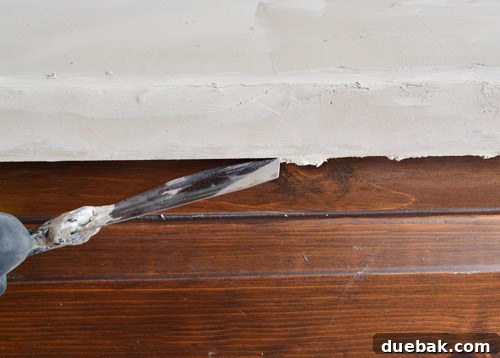
The most satisfying part of this initial scraping phase was cleaning up the bottom edge of the counters. Sherry discovered that by simply running our smaller putty knife along these edges, we could sheer off any irregularities, resulting in an incredibly crisp and clean line. This precise detail quickly became my favorite aspect of the entire project – I could have done it all day!
The Endless Cycle of Sanding
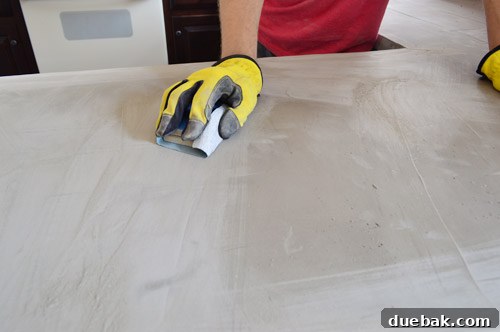
That satisfying step was swiftly followed by our least favorite, but absolutely essential, part of the process: sanding, sanding, and more sanding. We made the conscious decision to perform all sanding by hand. Our concern was that a power sander might be too aggressive, potentially sanding right through our freshly applied Ardex layers and exposing the underlying laminate once more. Furthermore, a power sander could leave undesirable rough ridges or marks as it traversed the counter’s surface. Given the numerous tight spots, such as the backsplash and areas around the sink, we concluded that manual sanding offered far greater control and maneuverability.
For every layer except the very last one, we meticulously wrapped a sanding block (chosen for its comfortable grip) with fresh, coarse 60-grit sandpaper. This aggressive grit allowed us to efficiently smooth out prominent ridges and rough spots. However, after the fourth and final coat of Ardex had been applied and thoroughly dried, we switched to a much finer 220-grit sandpaper. This finer grit ensured that we achieved a beautifully smooth finish without leaving behind any large, noticeable scratches in the crucial top layer of our concrete countertop.
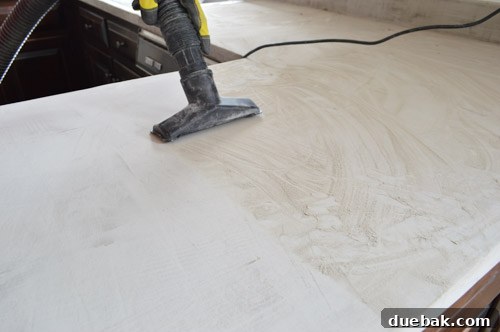
Sherry also discovered a highly effective technique: pausing periodically during sanding each section to vacuum off the accumulated dust using our trusty shop vac. This proved incredibly helpful because the fine gray dust could often obscure areas that still required more sanding. Beyond its practical benefits, this frequent dust removal also helped maintain our sanity by keeping the pervasive mess more contained, allowing us to see our progress more clearly.
The Unforeseen Challenge: The Dust Factor
Speaking of mess, the sheer volume of dust was, without a doubt, the biggest surprise of this entire renovation. Despite having researched other people’s experiences and acknowledging that sanding was an integral part of the process, neither of us was truly mentally prepared for the reality of a fine, pervasive gray powder accumulating EVERYWHERE. Our kitchen, being a central and high-traffic area of our home, meant that maintaining cleanliness became a significant time sink. After each round of application and sanding, we adopted a rigorous cleaning routine: sweeping, then vacuuming, and finally mopping the floors to ensure that no one inadvertently tracked the fine dust throughout the house over the five days we dedicated to the project.
Addressing Imperfections: The Multi-Coat Strategy
After our initial sanding step, following the first coat, we observed instances where the original laminate peeked through in a few spots. This was most common along the edges, where it’s particularly easy to scrape off too much material if you’re not careful. However, this is precisely why multiple coats are applied. We weren’t overly concerned, understanding that subsequent layers would address these minor imperfections.
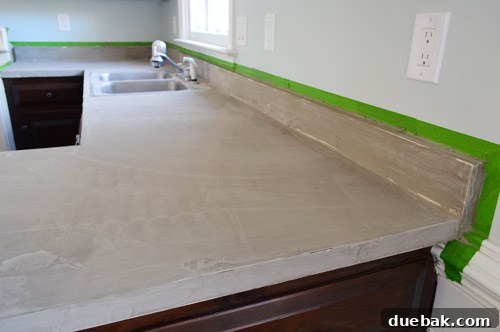
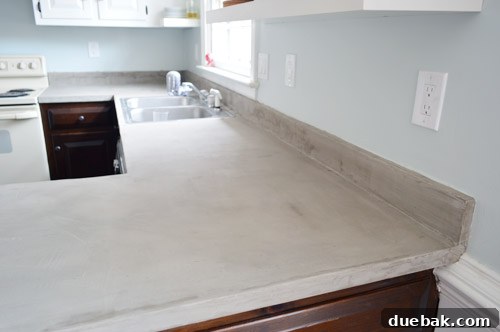
Here, you can observe a second coat being applied over the first. Notice the distinct difference in color between the wet Ardex and the lighter, dried material. We anticipate that once the countertops are sealed, their color will deepen significantly, more closely resembling the rich, darker tone of the wet Ardex. It will be interesting to witness this final transformation.
The Finished Look: Embracing Imperfection and Industrial Charm
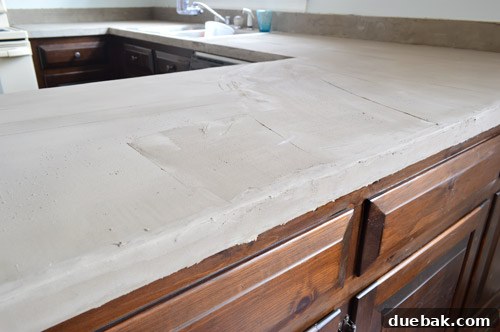
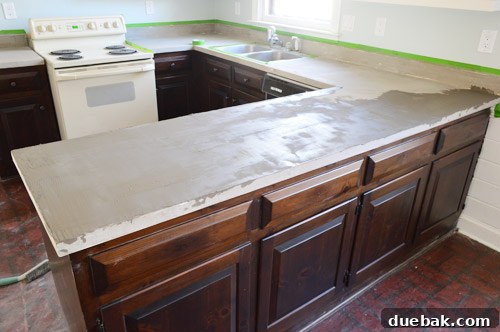
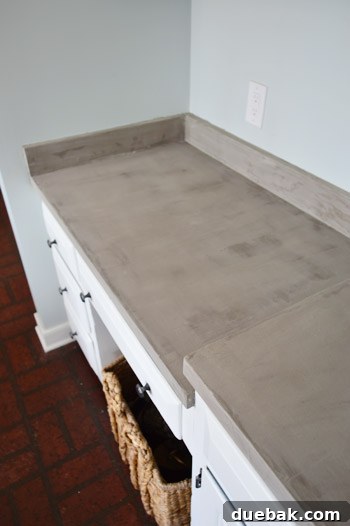
This image showcases our final countertops, prior to the crucial sealing stage. As you can see, they are still not absolutely perfect, a characteristic that many enthusiasts consider one of the inherent charms of the Ardex technique. The finish embodies a distinctively imperfect, industrial aesthetic, a stark contrast to the mass-produced uniformity of laminate. It undeniably feels more solid and stone-like, effectively shedding the plastic-like sensation of the old counters.
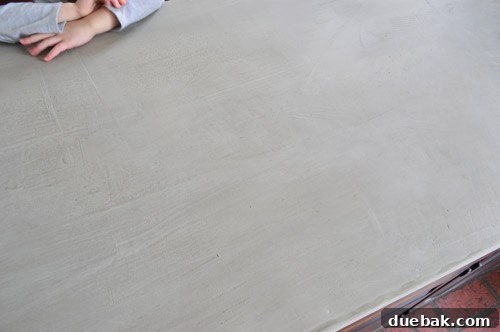
I must admit, it took me some time to fully appreciate the “flaws” and organic variations of this finish. Sherry was immediately captivated by its unique character, but the perfectionist within me initially struggled with the fact that such a project doesn’t yield perfectly uniform results. I anticipate that once we apply the sealer, my appreciation will deepen even further, as the sealer will subtly darken the surface and replace the current chalky texture with a more refined, polished appearance. I’m genuinely looking forward to that final touch.
Navigating Tricky Spots: Backsplash and Sink Areas
Undoubtedly, the backsplash proved to be the most challenging area to achieve a smooth finish. Its small surface area, coupled with its composition almost entirely of edges and corners, made both applying the Ardex and sanding it a demanding task. It required a fair bit of body contorting on my part (lucky Sherry was too pregnant to comfortably reach most areas, thanks to her baby belly, which I admit, I was slightly envious of by the project’s end).
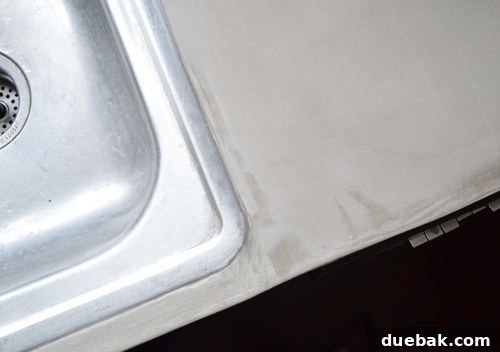
Another particularly tricky spot was the area surrounding the sink. If this were our “forever” counter, I would have gone through the extra effort of removing the sink entirely. However, our old copper pipes beneath are extensively corroded, which would necessitate calling in a professional plumber for replacement. To avoid this added complexity and expense for a temporary solution, we opted to save that for Phase 2 of our kitchen update. Instead, we carefully taped and sanded around the sink. The results, I’m pleased to report, turned out significantly better than I had initially anticipated.
Despite the challenges and inherent imperfections, we are genuinely pleased with the overall improvement this project brought to our kitchen. It’s incredibly satisfying to eliminate another dated, yellowed surface and contribute to a more updated feel in the room. Just cover the floor with your hand and squint – trust us, it works!
Cost-Effectiveness and The Next Step: Sealing
Although the time investment for this update was more substantial than we initially envisioned—roughly 15 hours spread across five days, including prep and extensive clean-up—the financial cost remains remarkably fantastic. The three bags of Ardex, of which we ultimately used only 2.5 for four comprehensive coats, totaled a mere $57. We likely spent an additional $20 on various buckets and sandpaper. This means for 45 square feet of transformed countertops, our investment was an incredibly budget-friendly $1.71 per square foot, a price point that is exceptionally hard to beat for such a significant aesthetic upgrade.
This cost, however, does not include the sealer, which is the very next item on our to-do list. We’ve dedicated considerable time to researching sealer reviews, as the consensus indicates that choosing the wrong sealer can lead to a host of problems down the line, including increased scratches, stubborn stains, and even bubbling. Getting this step right is paramount for the longevity and performance of our new concrete surfaces. Our research points to two highly recommended products: Ardex Clear Concrete Guard High Performance Sealer and GST International Satin Seal Water Based Acrylic Sealer. We’re currently debating between the two and are eager to hear if anyone in our community has a preference or experience with either. Since neither is available locally, we’ll need to order one online and await its arrival. Rest assured, we will absolutely share our final choice, document its application process, explain how it alters the finish, and provide ongoing updates on how these concrete countertops wear for us over time.
Update: You can find out what we ultimately used to seal them here, and get a long-term update on their durability and how they’re holding up here.
Psst – Wanna know where we got something in our house or what paint colors we used? Just click on this button: