
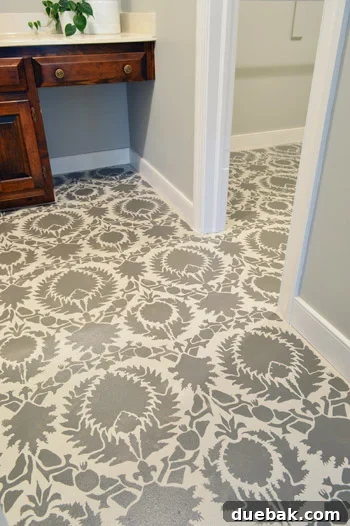
Transform Your Space: A Stunning DIY Stenciled Subfloor Makeover
We did it! After days of planning and a few hours of dedicated work, our bathroom and closet floor has been completely revitalized with a beautiful stencil pattern. The effort was absolutely worth it, and the transformation from the old, worn carpet to this eye-catching design is simply incredible. This budget-friendly DIY project proves that a dramatic change doesn’t always require a full-scale, expensive renovation.
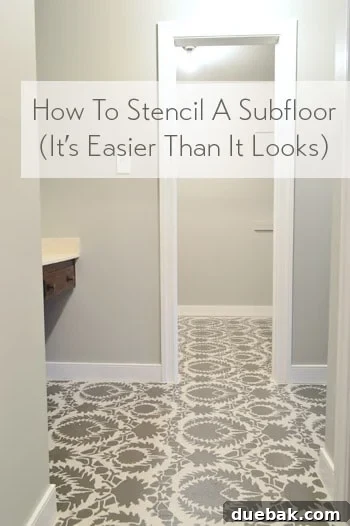
From Drab Carpet to Fab Flooring: Our Journey Begins
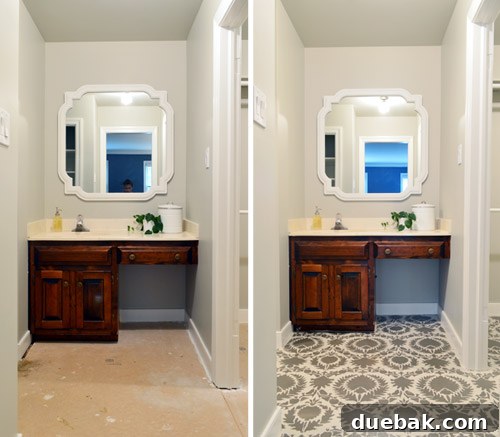
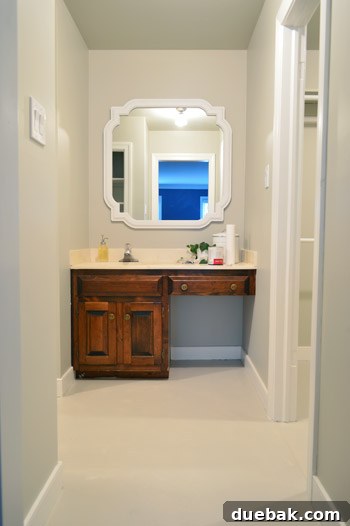
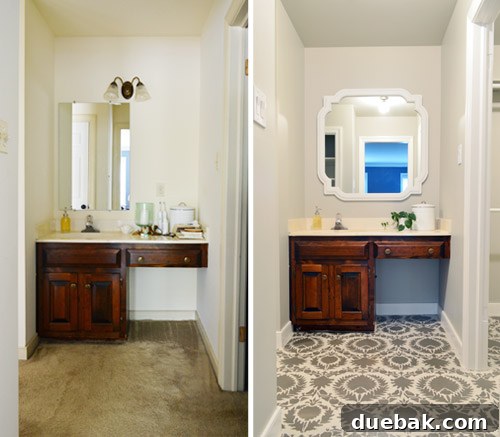
Before diving into the detailed steps of this exciting project, let’s take a quick look back at where we started. Remember when the floor in our closet and vanity area looked like this, burdened by tired, dated carpet?
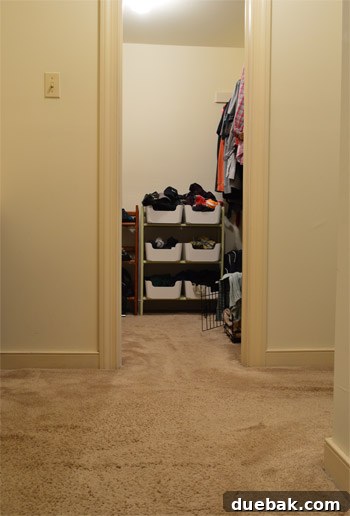
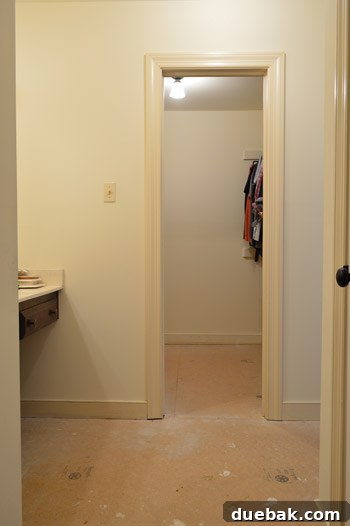
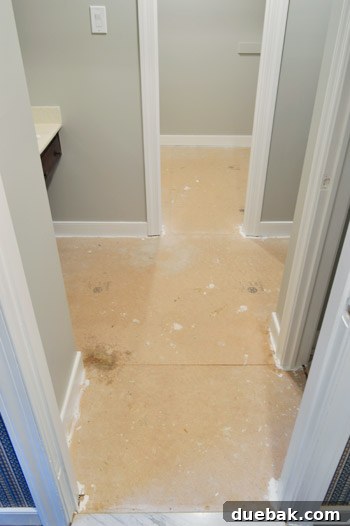
And then, in a moment of sheer determination, we ripped up the carpet, revealing the raw, unpolished subfloor beneath. The vision of potential quickly replaced the sight of the worn-out textile.
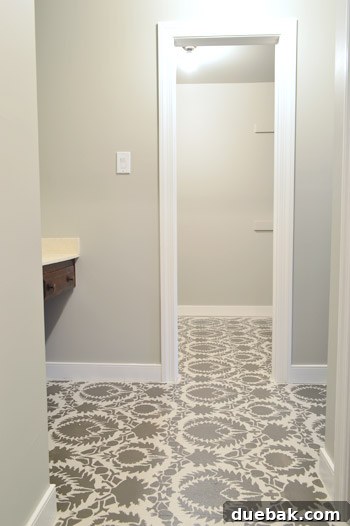
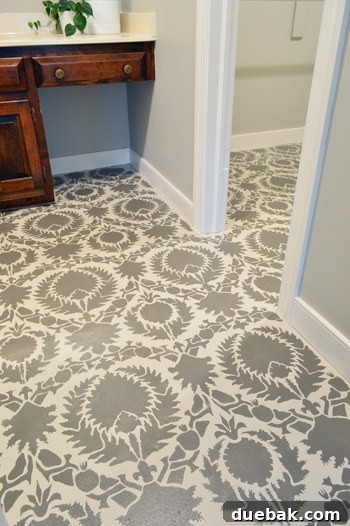
Well, fast forward just five hours and a mere $24 in materials, and that same space has undergone a breathtaking transformation, now looking like this! It’s proof that a little creativity and effort can go a long way.
Why Stencil the Subfloor? A Smart Interim Solution
Our main bathroom already features classic tile, but this particular area – a separate vanity space connected to an adjoining closet – was plagued by old carpet. It had reached a point where we simply couldn’t endure it any longer. Knowing that a full-scale renovation, which includes knocking down the dividing wall between the vanity and bathroom for a larger, unified space, was in our long-term plans, we needed an effective interim solution.
We briefly considered several options: peel-and-stick floor tiles offered quick installation, while a large seagrass rug cut to fit wall-to-wall would add natural texture. However, we ultimately settled on stenciling and sealing the subfloor. This option presented the perfect balance of aesthetic improvement, cost-effectiveness, and minimal effort that wouldn’t be wasted when the eventual renovation takes place. It’s a temporary upgrade that brings immense satisfaction without a significant financial or time commitment.
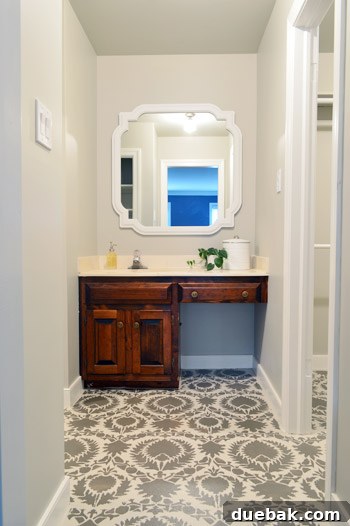
Since our future tiling project will require removing this particle board subfloor and installing a proper backer board anyway (you can’t tile directly over particle board as it’s not a stable base), there was absolutely no harm in adding a touch of paint and personality in the meantime. This approach allowed us to experiment with a bolder design than we might choose for a decades-long permanent fixture, embracing the fun of a temporary decor update.
One of the greatest joys of tackling temporary, affordable afternoon updates like this is the freedom to be adventurous. You can choose a design or color palette that’s a little more daring, something you might hesitate to commit to for a more permanent installation. And speaking of other elements in the space, don’t mind that vanity! It’s next on our list for an update – either a rich ebony or charcoal stain, or a subdued dark paint color, to ensure it harmonizes perfectly with the new floor and the overall aesthetic of the room.
The DIY Stenciled Floor Process: Step-by-Step Guide
Let’s rewind to the beginning, back to the bare subfloor, and walk through the entire process. We’ll share all the steps, along with some invaluable tips and lessons we learned along the way.
Step 1: Subfloor Preparation for a Smooth Canvas
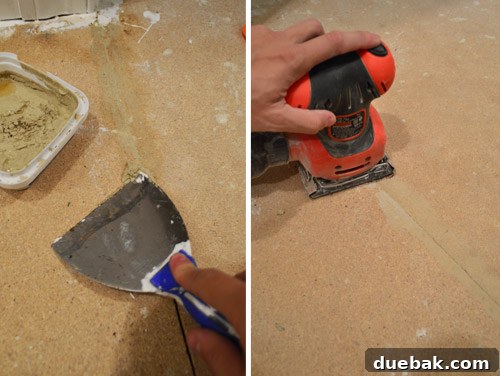
Our subfloor, made of particle board, presented a very smooth, almost chalky surface. To achieve the best possible finish, our first task was to minimize the visibility of the seams between the different particle board sheets. There were only three seams in our space, making this step relatively quick. We carefully applied wood filler to each seam, ensuring an even application. Once the filler was completely dry, we lightly sanded the areas to create a smoother, more uniform surface. While not absolutely perfect, this crucial step significantly improved the overall look, making the floor appear much more cohesive and ready for painting.
Step 2: Priming for Adhesion and Longevity
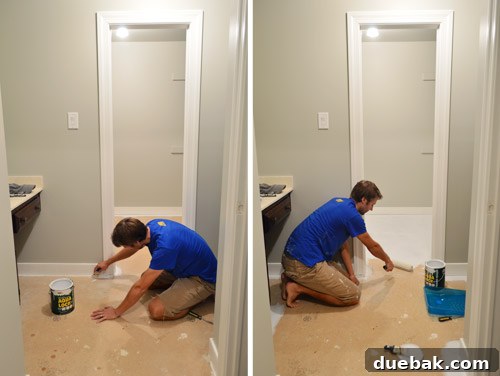
With the seams addressed, it was time to prime the entire subfloor. We chose Aqualock water-based primer for its effectiveness and low-VOC (Volatile Organic Compound) properties. While not entirely no-VOC, it was a much safer choice for indoor use, especially with a little one in the house. The primary purpose of the primer was twofold: firstly, to create an optimal surface for the paint to adhere to, ensuring its longevity; and secondly, to block any potential stains or bleed-through that might occur when painting over such a porous material like particle board. Applying a quality primer like Aqualock is a foundational step that should never be skipped, as it guarantees a professional-looking finish and durability.
Step 3: Applying the Base Coat and Color Choices
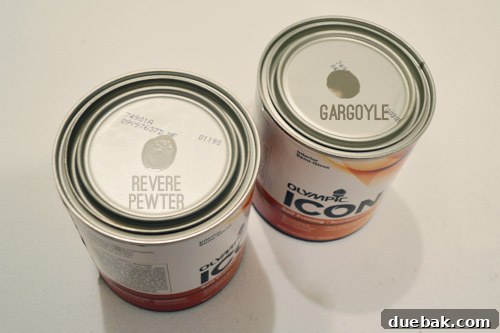
For our paint, we opted for two $12 quarts of semi-gloss paint from the new no-VOC Olympic Icon line. We had them color-matched to two Benjamin Moore shades: “Revere Pewter” for the base (intended to match the walls) and “Gargoyle” for the darker stencil pattern. While Benjamin Moore paints are often our go-to, for temporary upgrades like this, saving a little money is a smart move, especially since this floor will eventually be replaced. We deliberately avoided typical outdoor porch and floor paints, which are usually fumy and often oil-based. Our priority was a no-VOC option for a healthier indoor environment. We believe that the combination of a high-quality primer, semi-gloss paint, and a thick coat of sealer will provide ample durability for the next few years. We’ll certainly keep you updated on how the floor holds up over time!
Once the primer was completely dry, we applied two coats of our chosen base color. As this was a no-VOC step, it was a comfortable process for both of us to tackle. I handled the intricate cutting-in along the edges, while John efficiently rolled the rest of the floor. A crucial tip here: always plan your painting route to avoid painting yourself into a corner! We noticed that the color-matched Revere Pewter on the floor didn’t perfectly match the true RP on the walls. This is always a risk when color-matching across different paint brands, but we weren’t deterred. The colors remained within the same family, maintaining a sophisticated, subdued palette. Our goal was a high-contrast floor, but one that still felt cohesive with the existing elements, like the bold navy tones in the adjoining bedroom. We were simply relieved that the colors complemented each other without clashing.
Step 4: The Art of Stenciling – Tips for Success
Stenciling a floor becomes significantly easier and more enjoyable with two people working as a team. From past experience, stenciling our office floor alone was a much more arduous and time-consuming task, partly due to using a less efficient method. This time, with both of us tackling it, the process was remarkably smoother and quicker. Stenciling a floor also has an inherent advantage over walls: you’re not battling gravity. A few pieces of painter’s tape securely hold the stencil in place, allowing you to roll without the constant worry of it slipping down a vertical surface.
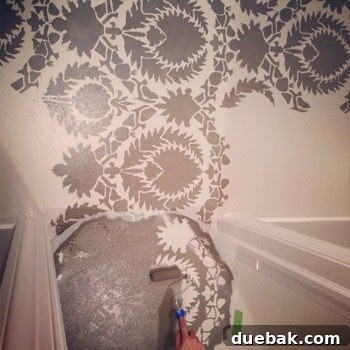
For a visual guide on the rolling technique, including some live-action tips, you can refer to this video we created years ago while stenciling a wall for a book project. The principles remain the same for floors:
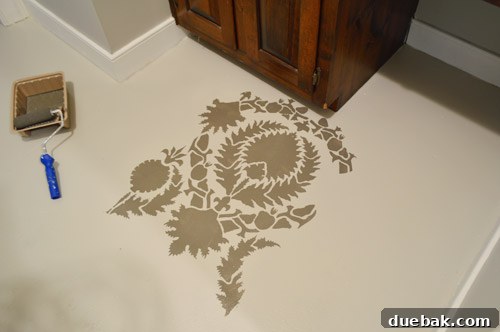
To ensure a balanced and visually appealing pattern, we began our first stencil placement right in the middle of the vanity area, allowing the pattern to radiate outwards. The stencil we used is the elegant Suzani Silk Road stencil from Royal Design Studios. At $49, it’s an investment, but we had purchased it back in 2011 for a book project that was eventually cut, so it had been patiently waiting for its moment to shine.
The Power of the Foam Roller: A Game Changer
Remember that much easier stenciling method I alluded to? We discovered during our book project that applying a small, even amount of paint with a foam roller yields incredibly clean lines – just as crisp as meticulous hand-dabbing, but without the agonizing effort. When I stenciled the office floor by hand, I ended up with claw hands and hours of lost time. This entire floor project, thanks to the small foam roller and thin paint application, took us only five hours. It was a true “Hallelujah!” moment for efficient DIY.
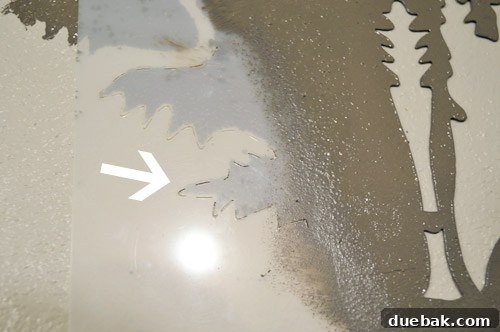
With a large stencil like ours, having two people is invaluable. Each stencil features registration marks around its perimeter, designed to align with the previously applied pattern. Having an extra set of hands makes lining up these marks and slowly lowering the stencil into place much simpler, greatly reducing the risk of smudging. Instead of placing and then sliding the stencil to match, which often leads to blurred edges, two people can carefully position each corner simultaneously for a flawless application.
Navigating Corners and Edges
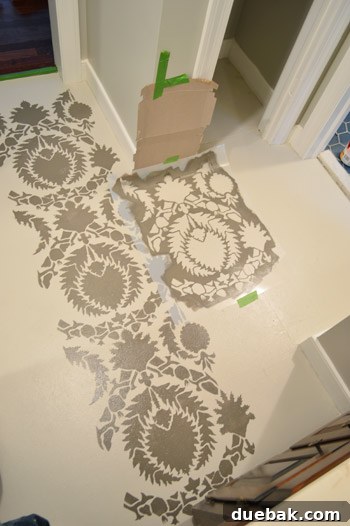
The biggest challenge in this room was the abundance of walls and corners, which meant numerous partial stencil applications. This required bending the flexible plastic stencil (it bends easily without creasing) and carefully working the roller into tight spots. We kept spare cardboard, like empty cereal boxes, handy to protect the walls and baseboards from stray paint when the stencil had to be bent against them. After each placement, John would hold the stencil up, and I would use a folded paper towel to dab off any excess paint from the back. This quick wipe-down prevents “ghosting” – a faint double outline – on the next application, a step that is absolutely worth the time.
Strategic Planning for Your Exit Route
When stenciling a floor, particularly in a smaller or irregularly shaped room, it’s crucial to plan your exit route meticulously. In a typical square room, this might be straightforward, but our space with its distinct vanity and closet areas made it tricky to maintain a clear path while ensuring the pattern remained straight and centered. Since we wanted to start in the middle of the vanity and work our way out, beginning in a closet corner was not an option for maintaining pattern symmetry. For this reason, we decided to break the stenciling into two separate days.
On the first day, we completed as much as we could comfortably reach, making sure to leave strategic “walking paths” or alternating rows clear, similar to a checkerboard pattern. This allowed those sections to dry completely. The following day, with the initial areas dry and walkable, we could then safely step on them to fill in the remaining blank sections. This two-day approach proved incredibly effective in preventing smudges and ensuring a clean, continuous pattern.
The “Intentional Border” and Final Touches
After all the main stenciling was complete, I used a small craft brush to fill in any tiny gaps or imperfections. Initially, I planned to meticulously touch up the entire perimeter by hand, as the roller left a slight 1/2-inch gap around the baseboards, which I thought might look unfinished.
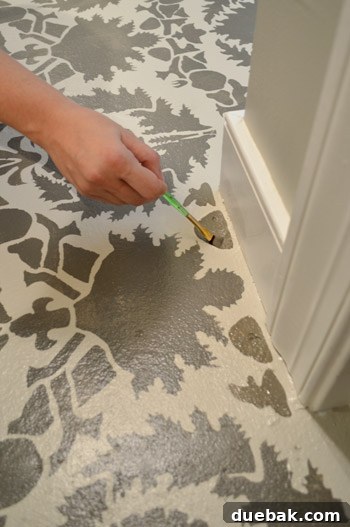
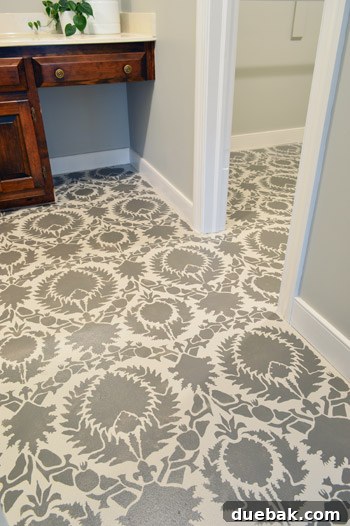
However, after stepping back and observing the space, we realized something surprising: the small, consistent gap around the room actually created an almost intentional, clean border. Rather than risk making it look worse with hand-painted touch-ups that might not be perfectly even, we decided to embrace it as part of the design. You can subtly see this neat border around the baseboard in the bottom right of the image below.
Step 5: Sealing for Maximum Protection
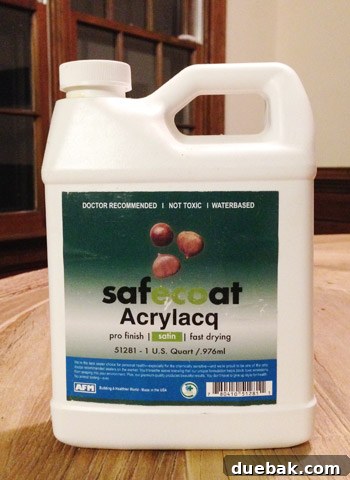
As the final, crucial step, we plan to apply SafeCoat Acrylacq, a non-toxic polycrylic sealant that we’ve trusted since my pregnancy with Clara. This protective layer will provide enhanced durability, guarding against wear and tear, and ensuring the stenciled floor remains beautiful for years to come. We’ll be sure to report back on how the sealing process goes and its long-term performance.
Reflections and Future Plans
Even without the final sealant applied, the stenciled floor has held up remarkably well over the past few days. Walking into the vanity and closet area is now an absolute joy, a stark contrast to standing on that old, uninspiring carpet. We are incredibly happy with the results and thrilled to see our project list dwindling down to just a few remaining tasks. This means a budget breakdown is just around the corner – exciting times!
remove the carpetpaint and hang a larger window-like mirror(more on both of those steps here)paint the trimpaint the walls and ceilingreplace all of the outlets/light switches(more on all three of those steps here)stencil the floors- seal the floors and add some better storage solutions to the closet
- paint or stain the vanity, add new hardware to it, and add some built-in shelves to make the empty space under the counter on the right side more functional
We hope our stenciled subfloor journey inspires you to tackle your own home improvement projects, big or small. The satisfaction of transforming a space with your own hands, especially on a budget, is truly unparalleled. Have you tried stenciling in your home? Perhaps a wall, a ceiling, a floor, or even furniture? We’d love to hear about your experiences! And remember, for the sake of your wrists and efficiency, always opt for a small foam roller over the tedious dabbing method!
Psst- Curious about where we found other items in our home? Just click the button below to explore our curated selections: