
Mastering the DIY Patio: From Demolition to Foundation Prep
Embarking on a do-it-yourself patio installation is an exciting endeavor, promising to transform your outdoor living space into a personal oasis. However, like many ambitious home improvement projects, the initial enthusiasm often meets the stark reality of manual labor – especially when it involves extensive digging. What might seem straightforward on paper can quickly evolve into a test of endurance, skill, and sheer willpower. Our journey to a beautiful new paver patio began with precisely this challenge: confronting a landscape that needed significant reshaping, starting with the arduous task of excavation and demolition.
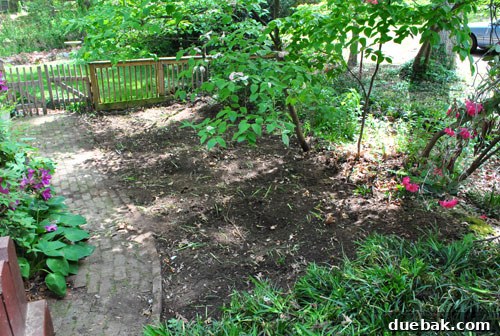
After successfully clearing out a large patch of liriope, which, surprisingly, came up with relative ease, I admit I felt a surge of unwarranted confidence. This early win, while encouraging, inadvertently set the stage for a dramatic clash with the true demands of site preparation. The initial simplicity of plant removal lulled me into believing the rest of the project would follow suit, creating a false sense of security that would soon be shattered by the formidable obstacles ahead. Little did I know, the real work, and the real lessons, were just about to begin.
The Unforeseen Challenges of Brick Path Removal
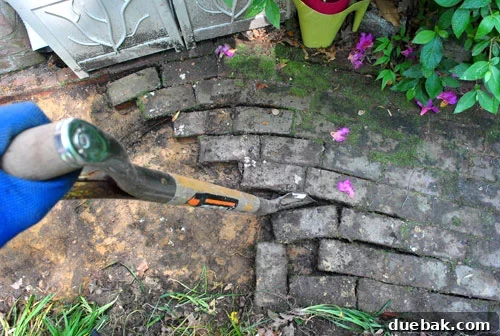
The next item on our extensive to-do list for this backyard renovation was the removal of an existing brick path. Observing a few loose bricks at its edge, I confidently declared to my partner, Sherry, “This shouldn’t be too bad.” This innocent statement, made with the best of intentions, immediately became a self-fulfilling prophecy of difficulty. It was the precise moment I inadvertently invoked the universe’s mischievous sense of humor, setting the stage for a series of unexpected challenges that would test my resolve and muscle strength. The quiet chuckle of fate seemed to echo in the air, a precursor to the sweat and toil that lay ahead.
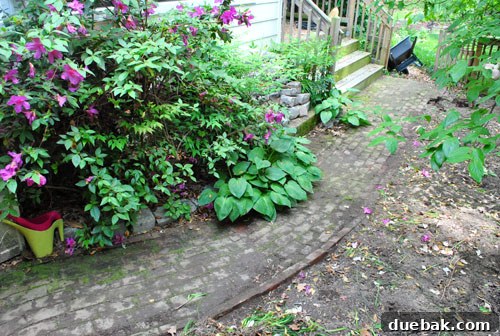
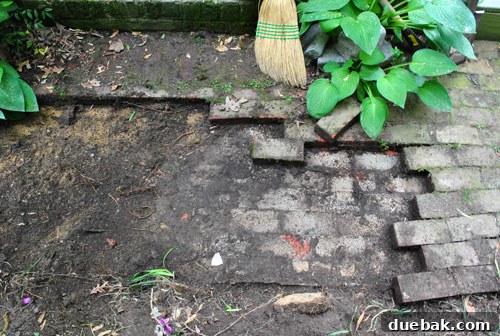
Initially, the brick removal process seemed to validate my optimistic outlook. As Sherry later recounted, the first half of the pathway yielded without much resistance because the bricks were simply laid atop a bed of sand. A quick thrust of the shovel beneath an edge, a gentle pry, and entire rows of bricks would lift away, revealing the sandy base beneath. This effortless progress further reinforced my dangerous “this’ll be easy” mentality, drawing me deeper into the illusion that the project would be a breeze. Each easily removed brick chipped away at my caution, building up an unrealistic expectation for the remainder of the task.
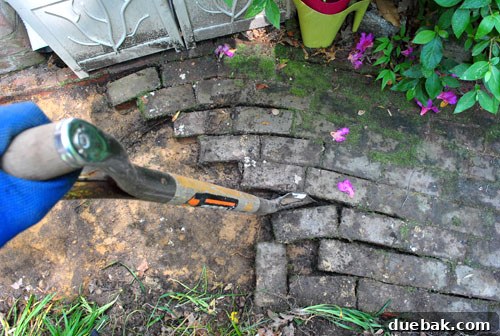
Then, just as my confidence reached its peak, I hit an immovable object. And when I say “hit,” I mean it quite literally. The innocent sand-laid path abruptly transitioned into a formidable barrier: concrete. I discovered, to my dismay, that the latter half of the bricks had been meticulously set in some form of mortar, anchoring them firmly to the ground. This sudden shift required a complete change in strategy and tools. While it wasn’t insurmountable at first – a few well-aimed swings with my trusty sledgehammer were enough to loosen the initial stubborn bricks – it marked the end of the “easy” phase and the beginning of the true demolition work. Each strike was a testament to the unexpected complexity of this DIY patio project, turning a simple removal into a robust test of strength and perseverance.
Conquering the Concrete: A Battle of Will and Hammer
By the time every last brick had been painstakingly pried loose, some requiring multiple decisive blows from the sledgehammer, and manually carted to the carport for future use, I was utterly spent. The physical exertion of lifting, smashing, and hauling had drained my energy reserves, yet an even more daunting challenge loomed: approximately ten feet of stubborn concrete still needed to be removed. This segment of the project promised to be a true test of endurance, and in my state of exhaustion, I found myself channeling the sentiments of Liz Lemon with a heartfelt “nards.” The initial glow of completing the brick path quickly faded, replaced by the heavy anticipation of the concrete battle ahead.
With my energy levels plummeting, so too did my confidence. I found myself contemplating the rental of a specialized demolition hammer, recalling its effectiveness in breaking up our old bathroom floor. Sherry relayed this thought to Katie B. during a phone call, amidst her attempts to cut fabric for a birthday quilt for our “sleeping bean.” However, the thought of driving to Home Depot, navigating the rental process, and spending additional money didn’t feel like the easier solution. Mustering every ounce of remaining strength, I decided to give the stubborn concrete a few more good whacks with my sledgehammer, hoping for a miracle.
And miraculously, it shattered. This unexpected breakthrough, a testament to persistence, offered a much-needed morale boost and a fresh surge of energy. It proved that sometimes, the simplest tools, combined with determination, can achieve what seemed impossible. This small victory revitalized my spirit, transforming a moment of near defeat into a renewed determination to press on with the demolition. It was a powerful reminder that even the toughest obstacles can yield to a consistent effort.
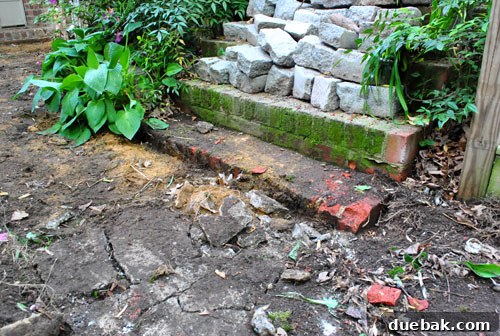
Fueled by this moment of triumph, I pressed on, smashing away at the remaining concrete with renewed vigor. For a while, the progress was steady and satisfying. Each swing connected, creating cracks and fragments that slowly but surely reduced the imposing slab to manageable pieces. However, as I continued my relentless assault, I began to notice a troubling trend: the concrete was gradually thickening. What started as a relatively easy-to-break, inch-thick layer soon transformed into a formidable six-inch monolith, likely poured to level out a significantly sloped area beneath it. This unexpected density underscored the importance of thorough site assessment in any DIY patio project. The battle was far from over, as evidenced by the intense effort captured in Sherry’s “creepy blue glove” photo, reflecting the escalating demands of the task.
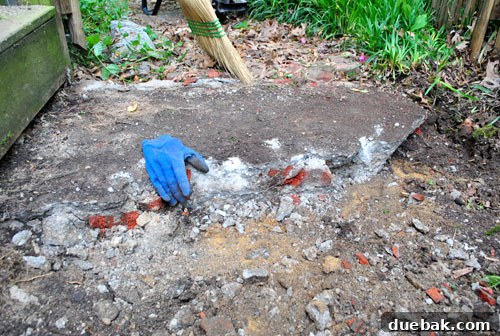
To maintain my sanity and amusement amidst the grueling work, I confessed to Sherry later, I resorted to a unique form of psychological warfare against the unyielding concrete. My attempts at “smack talk” quickly devolved into quirky, geeky chants – “By the hammer of Thor!” becoming a frequent refrain, clearly betraying my recent overexposure to superhero commercials. I even imagined a distant squirrel observing my antics with a smirk. Yet, entertaining the local woodland creatures seemed a small price to pay for maintaining my focus and motivation. Whatever the method, it proved effective, and by the end of the day, every last piece of concrete lay shattered. Sherry, though amused by the sheer insanity of my approach, couldn’t argue with the results. It just goes to show that sometimes, a little creative self-motivation is exactly what a DIYer needs to push through the toughest parts of a project, transforming daunting tasks into achievable milestones.
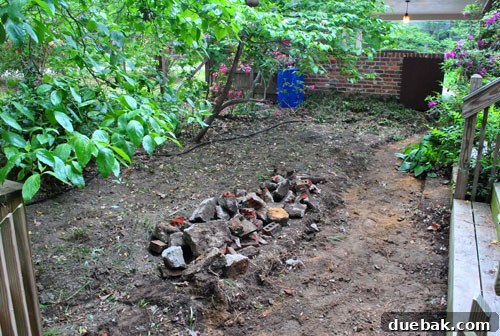
While all the concrete was “out,” the arduous task of its removal was only partially complete. The shattered debris, a tangible testament to a day of relentless hammering, was strategically piled in a hidden back corner of our property, nestled behind some trees. Hauling it to the dump would be a project for another day, when my energy reserves had sufficiently replenished. This often-overlooked step in demolition highlights the multi-phase nature of site preparation; getting materials broken up is one thing, but getting them off the property is another beast entirely.
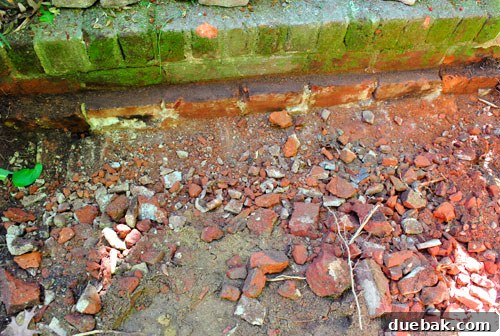
Regrettably, my sledgehammer-slinging days were not yet entirely behind me. A final, pesky obstacle remained: the bottom step of an old, unusable brick staircase. Situated next to the functional wooden steps, this brick remnant stood about two inches too high, threatening to interfere with the precisely planned perimeter of our new paver patio. It, too, had to be busted up, ensuring a seamless and level edge for the upcoming pavers. I’ll spare you the gritty, repetitive details of this last demolition sprint, but suffice it to say that a second, slightly less exhausted day of sledgehammering transformed that stubborn old brick into mere pebbles. Yes, Thor worked his magic one last time, clearing the way for the next phase of our patio construction.
Laying the Groundwork: Precision in Patio Foundation
With my metaphorical slate finally clean – every last trace of liriope, brick, and concrete vanquished – we were at last ready to formally begin laying the essential foundation for our new patio. This crucial phase demands meticulous planning and execution, emphasizing the importance of following expert guidance. For this project, I’m diligently adhering to the comprehensive instructions provided in a series of Lowe’s installation videos, which offer a clear, step-by-step approach to paver patio construction. Furthermore, I’ve cross-referenced these methods with the insights of local professionals who specialize in both commercial and residential paver installations. Their unanimous agreement with every step outlined in the videos has instilled immense confidence, ensuring that our foundation is built to last. This thorough approach, integrating both visual guides and expert advice, is indispensable for any DIYer aiming for a durable and aesthetically pleasing patio. The selected video clips, unfortunately, also confirmed what I already suspected: more digging was indeed on the horizon.
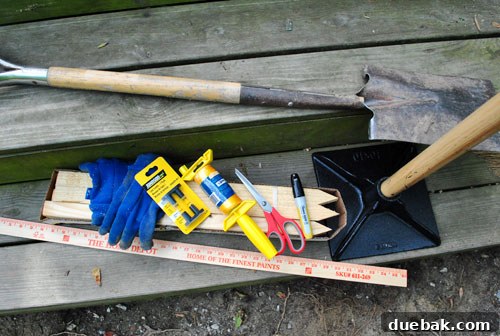
Transitioning into this meticulous phase required an investment in specific tools and materials, amounting to approximately $40. Essential new supplies included sturdy wood stakes, precise line levels, durable nylon mason string, and a robust hand tamper – each playing a critical role in establishing the patio’s layout and ensuring a solid base. Alongside these new acquisitions, we leveraged several items already on hand, such as comfortable work gloves, a reliable yardstick or ruler for accurate measurements, sharp scissors for cutting string, a permanent marker for clear labeling, and, of course, a sturdy shovel for the inevitable digging. Gathering all these tools beforehand is a vital step in any DIY patio project, preventing delays and ensuring efficiency as you move from demolition to meticulous foundation work.
Staking Out the Patio Perimeter for Perfect Drainage
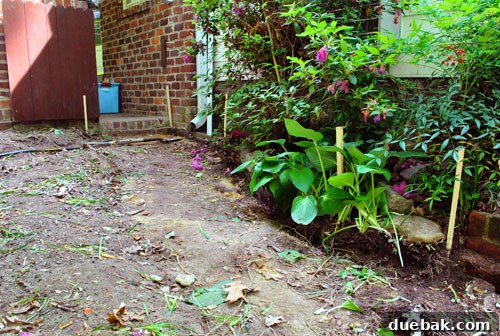
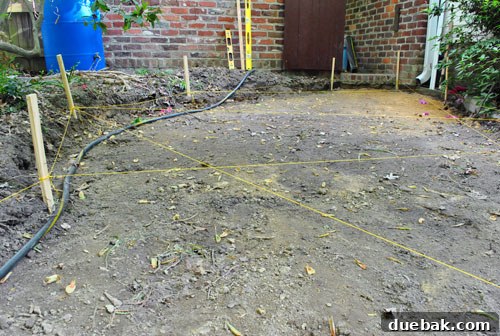
Fortunately, this next task offered a brief respite from the relentless digging, shifting focus to precision rather than brute force. The immediate objective was to meticulously stake out the patio area, establishing precise boundaries that would dictate the exact depth of excavation required across every section. We had already defined the desired perimeter using our garden hose, allowing for a layout that was mostly straight on three sides, with a gently curved back edge, much like our old patio at our previous house. This curved design adds aesthetic appeal and integrates more seamlessly with the natural landscape. I then carefully drove wood stakes into the ground at key corners and critical turns along this perimeter. It was important to drive them in deeply, as I anticipated digging a significant amount of dirt around them in the subsequent steps. This careful staking is the cornerstone of a well-designed patio, ensuring accuracy in shape and foundation depth from the very beginning of your DIY patio installation.
The subsequent step involved meticulously marking things off with string, a critical phase that determines the final elevation and slope of your paver patio. The primary goal here is twofold: first, to precisely indicate where the top surface of your pavers will eventually sit, and second, to ensure that the entire patio slopes gradually away from the house. This essential slope is not merely for aesthetics; it’s a vital engineering detail designed to prevent water accumulation near your home’s foundation, protecting against potential moisture damage. As demonstrated in the instructional video, I utilized a reliable line level to meticulously tie the string between two stakes, ensuring it was absolutely 100% level before making any adjustments. This initial level string serves as the baseline from which all subsequent slope calculations are derived, laying the groundwork for effective drainage in your new outdoor living space.
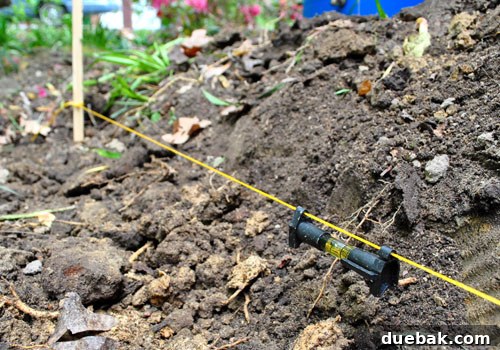
Once the initial level string was established, the next task was to adjust it to achieve the proper drainage slope. Based on the distance between the stakes – in this instance, six feet – I calculated the necessary drop. The general rule for effective patio drainage, as emphasized in the video, is a one-inch slope for every four feet of distance. For my six-foot span, this meant lowering the string by 1.5 inches from the perfectly level baseline. To optimize both string usage and effort, I opted to simply adjust the existing strings rather than tying on additional ones, making the process more efficient. This careful calculation and adjustment ensures that rainwater will effectively drain away from the house, preventing pooling and protecting the integrity of both your foundation and your new paver patio.
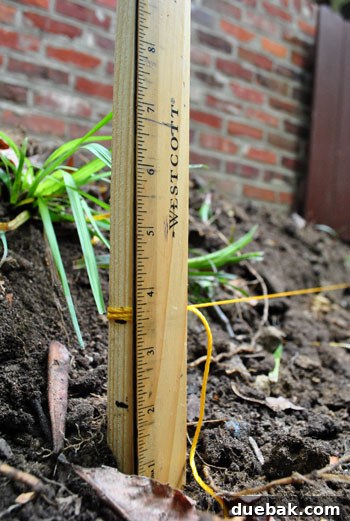
This seemingly straightforward stringing process unexpectedly consumed more time than anticipated. The instructional video, by showcasing a simple square patio on a perfectly flat surface, had created an illusion of ease. My reality, however, involved constructing a gently curved patio on an already sloped terrain. Adding to the complexity were the pre-existing features that defined three of the four sides of our project: the carport at the top, the deck stairs along one side, and the fence at the bottom. To further complicate matters, the area naturally sloped towards the house, forcing me to contend with the existing grade to create a new surface that would effectively slope away from it. This battle against the natural terrain required constant adjustments and meticulous checks, transforming a quick step into a time-consuming exercise in patience and precision.
Despite the unforeseen complexities and the battle against the existing grade, I eventually managed to get all my strings meticulously tied. Each line was carefully positioned, ensuring that the critical slopes directed water away from the house, exactly as required for proper drainage and foundation protection. Every element was precisely lined up, harmonizing with the existing structures while establishing the perfect framework for our new paver patio. This final alignment of strings represented a significant milestone, marking the successful completion of the layout phase and paving the way for the substantial excavation that lay ahead. It was a moment of quiet triumph, confirming that even the most challenging landscapes can be tamed with patience and precise planning in DIY patio construction.
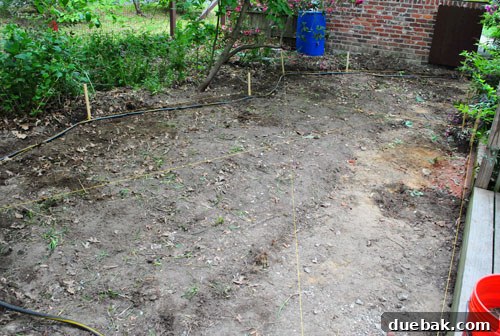
While the video tutorial primarily focused on perimeter strings, I opted to incorporate additional guide strings crisscrossing the patio area, inspired by Nicole’s detailed DIY patio photos. This wasn’t an extra step; it was a crucial enhancement for ensuring comprehensive accuracy. These interior strings allowed me to meticulously check not only the perimeter slope but also the diagonal slope across the entire footprint, a vital consideration for larger or irregularly shaped patios. More importantly, they provided invaluable reference points right across the middle of the excavation area. After all, what good is a patio that boasts perfect edges if its center bulges awkwardly or sinks unevenly, collecting water and debris? These internal guides act as an indispensable safeguard against such imperfections, guaranteeing a truly level and functional outdoor living space.
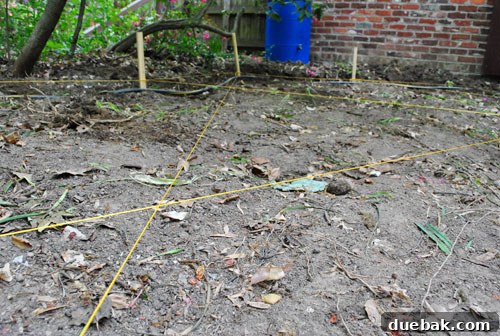
And if, by chance, you find yourself without a line level, there’s always the option of enlisting a truly dedicated, albeit slightly distracted, chihuahua to double-check the slope of your lines. While their technical expertise might be questionable, their enthusiastic presence certainly adds a unique charm to any DIY project.
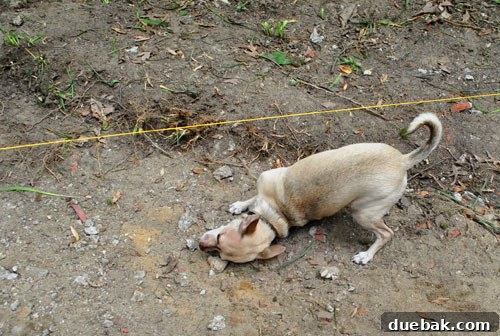
In all seriousness, while Burger’s intentions are pure (he’s usually just attempting to crush a bug with his neck in such photos), his practical assistance in a precise construction project like this is, shall we say, limited. Beyond the occasional muddy face lick and marking of the work area, I highly recommend relying on an actual line level. A two-pack can be found for around $3, offering unparalleled accuracy and efficiency, even if it lacks the comedic value of a bug-hunting chihuahua. For critical tasks like ensuring proper patio slope and drainage, investing in the right, inexpensive tool is always the smarter choice for any serious DIYer.
The Digging Marathon: Sculpting the Patio Base
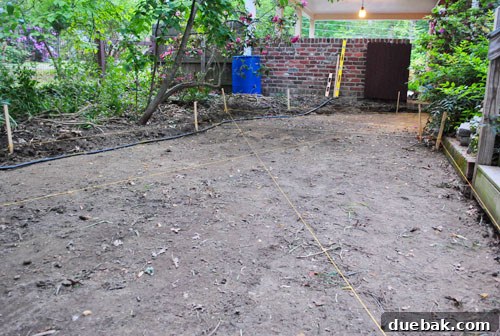
Regrettably, I have no “during” photos of the next, most physically demanding phase of this project, primarily because my hands were perpetually on a shovel, and my mind was focused solely on the monumental task at hand. This stage was essentially a continuous cycle of digging, meticulously measuring the depth against my guide strings, more digging, hauling countless wheelbarrows of excavated dirt, yet more digging, pausing to rub my aching back, digging again, taking much-needed water breaks, and then, with dwindling energy, begging Sherry to bring an almost absurd number of granola bars for “fuel.” Each interval was followed by a moment of reluctance, barely mustering the nerve to stand up again, only to resume digging, frequently checking the level, tirelessly cutting out stubborn roots, and yes – an endless repetition of digging. This relentless process stretched over one and a half days, totaling approximately six hours of intense manual labor, all aimed at achieving the precise depth for the patio base. This meticulous excavation involved lowering the entire area nearly seven inches below my nylon strings – 6 3/8″ to be exact. This specific depth is crucial, providing adequate room for a three-inch layer of compacted gravel, a one-inch bed of leveling sand, and the final two and three-eighths-inch thickness of the pavers themselves, ensuring a perfectly flush and stable finished surface. By the time I finally finished, the excavated area bore an uncanny resemblance to an archaeological dig site, a testament to the depth and scale of the transformation.
Compacting the Base: The “Vigorous” Reality of Hand Tamping
Once the digging was finally complete and the required depth achieved, I went over the entire excavated area one last time with a level. This final check was critical to ensure that the correct slope for drainage was maintained consistently across the entire surface, preventing any future pooling. Following this, a vigorous round of tamping with the hand tamper ensued. While “vigorous” is the best word I can use to make it sound appealing, the reality was anything but fun. I fully acknowledge that renting a plate compactor would have offered a far less laborious route, dramatically reducing the physical strain. However, I’d heard mixed reviews regarding the ease of use for DIYers, and crucially, I knew it would necessitate the removal of all my meticulously placed middle guide strings. These strings, which I consulted with such frequency that I dared not be without them, were my safeguard against a potentially huge sunken spot in the middle of the patio – a flaw that would collect water and debris for decades to come. Plus, after all the manual labor already invested, what was a little more at this point? My back, I’m sure, had a different opinion, but after a few hours of serious tamping (and just one blister), the dirt base was compacted within an inch of its life, providing a rock-solid foundation for the layers to come. And let me tell you, putting that strenuous step behind me was an immense relief.
Reflections on a DIY Journey: Exhaustion, Humor, and Anticipation
My apologies if this account sounds a tad whiny at times. As my lady likes to say, I’m just trying to “keep it real.” “Fake Chipper John” would declare it was all good, old-fashioned, sweaty fun. But “Keeping It Real John” confesses: holy crap, that was significantly more exhausting and took considerably longer than I ever anticipated. The sheer physical and mental demands of the demolition and foundation prep pushed me to my limits. Nevertheless, it’s done, and I’m incredibly psyched to have survived to tell the tale. This initial, arduous phase of our DIY patio project is complete, paving the way for the exciting layers to come. Next up, we have an insane amount of gravel and sand to meticulously layer into that precisely leveled and tamped hole, followed by the actual pavers. Although I’m quite sure I’m oversimplifying those steps too, as DIY projects often have a way of revealing unforeseen complexities!
But to prove that my sense of humor remains firmly intact despite the exhaustion, I wanted to share a genuinely amusing warning label I discovered. It was printed on the new wheelbarrow tire I had to purchase, necessitated by our old one getting mysteriously punctured at our previous house last year. This small detail served as a lighthearted reminder that even in the most strenuous projects, there’s always room for a laugh.
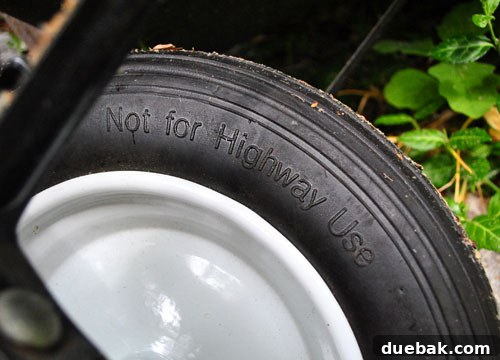
So, if anyone out there had grand plans to take their wheelbarrow for a high-speed spin down I-95, you might want to seriously reconsider and work on a Plan B. That warning serves as a rather pointed reminder of its intended purpose.
And speaking of Plan B, might I subtly suggest that it involves lending a hand to help me haul and meticulously level all that gravel and sand that conveniently got delivered just yesterday morning? Doesn’t hurt to ask, right? Oh well, I suppose it’s time to don my tough-guy pants – perhaps my “Thor pants” – and get back to work. The journey to a stunning DIY paver patio continues, with more details and progress reports coming soon. Stay tuned for the next phase of transforming our backyard into the ultimate outdoor living space!