
Mastering Your Kitchen Renovation: A Step-by-Step Guide to Countertop Demolition and Smart Savings
Embarking on a kitchen renovation can be an exhilarating yet daunting experience. From choosing the perfect materials to navigating the inevitable challenges of demolition, every step requires careful planning and a dash of resilience. Our current project involves upgrading our kitchen countertops, and we’re excited to share our journey of smart savings, unexpected hurdles, and the satisfaction of DIY accomplishment. As a seasoned DIY enthusiast knows, every penny saved is a penny earned, and our approach to this remodel perfectly embodies that philosophy.
Securing Stellar Savings: The Countertop Procurement Process
The first significant milestone in our kitchen transformation was ordering the new countertops. After extensive research and comparisons, we finally made our selection, which you can read more about here. For us, the decision wasn’t just about aesthetics; it was heavily influenced by value and transparency. We managed to secure our chosen Corian countertops at an impressive $38 per square foot from Home Depot. This transparent pricing, devoid of hidden fees or unexpected surcharges, was a refreshing change and contributed to an overall cost of approximately $1700 for the entire kitchen – a significant investment, but one we had diligently saved for.
Our journey to this final price involved comprehensive comparison shopping. We solicited quotes from Lowe’s and several local retailers. The local options, while offering personalized service, simply couldn’t compete on price, quoting upwards of $55 per square foot – a substantial difference that highlighted the value of larger chain stores for basic materials. Lowe’s matched Home Depot’s base price of $38 per square foot, but their additional charges for services like the sink cutout pushed their overall quote higher. The real triumph in our procurement process, however, came through strategic coupon stacking. Home Depot generously agreed to price-match a 10% off Lowe’s project coupon we received via mail, and further allowed us to combine it with a 5% discount for using our Lowe’s credit card. This unique ability to stack discounts, which we’ve found isn’t universal across all Lowe’s locations nationwide, resulted in considerable savings and solidified our decision to proceed with Home Depot.
A Sustainable Choice: Reusing Our Existing Sink
Beyond the countertops themselves, another crucial aspect of our budget-friendly renovation strategy involved reusing our existing kitchen sink. This decision not only saved us a couple of hundred dollars on a new purchase but also aligned with our commitment to sustainability where possible. We genuinely love our current sink – its functionality, size, and overall condition made it a prime candidate for retention. As we’ve mentioned previously here, many homeowners often opt for stainless steel undermount sinks over seamless Corian versions due to perceived ease of care for the latter. However, our existing sink served us well, and we saw no reason to replace a perfectly good item.
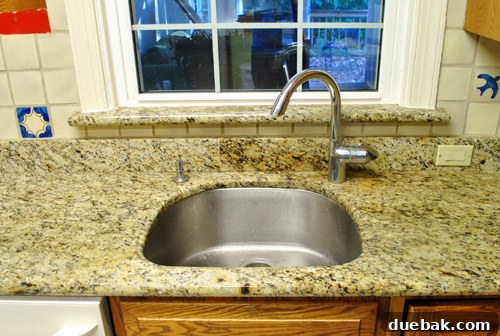
However, reusing the sink introduced a specific challenge. Both Lowe’s and Home Depot informed us that the Corian fabricator would need our actual sink for precise templating. This critical step ensures that the new countertop is cut perfectly to accommodate the existing sink, guaranteeing a seamless and secure fit. The necessity of providing the fabricator with the sink meant that we had to remove it from our current granite setup, which in turn mandated the complete removal of the surrounding granite slab. This requirement ultimately dictated the initial phases of our kitchen demolition.
The Demolition Begins: Preparing for New Countertops
Disconnecting Plumbing and Garbage Disposal: The First Hurdle
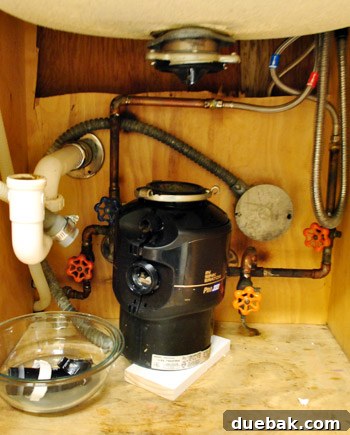
The first step in liberating our sink was disconnecting the garbage disposal and the intricate plumbing beneath it. While online tutorials (like this helpful guide: how-to) often make this process seem straightforward, my experience proved otherwise. What should have been a quick task turned into a 45-minute wrestling match due to a stubbornly jammed mounting ring. Despite following all the steps I had diligently researched and watched, the ring refused to budge. Persistence, a variety of tools, and perhaps a little brute force eventually prevailed, freeing the disposal from its grip. On the bright side, I now possess an intimate knowledge of my garbage disposal’s internal workings – a skill I never anticipated acquiring, but one that perhaps belongs on a whimsical “Things To Accomplish Before I’m 30” list, which you can appreciate the reference to here.
Faucet Removal: A Smoother Sailing
Next on the agenda was removing our kitchen faucet, which, like the sink, we intend to reuse – at least in the short term. Upgrading to a different one-hole faucet later down the line won’t pose a significant challenge. Fortunately, this step proceeded much more smoothly than the garbage disposal saga. Locating the installation manual online and simply reversing the original steps proved to be an efficient strategy, allowing the faucet to be detached with relative ease. This experience underscored the invaluable resource that manufacturer manuals can be for DIY projects, saving both time and potential frustration.
Tackling the Granite: A Multi-Stage Demolition
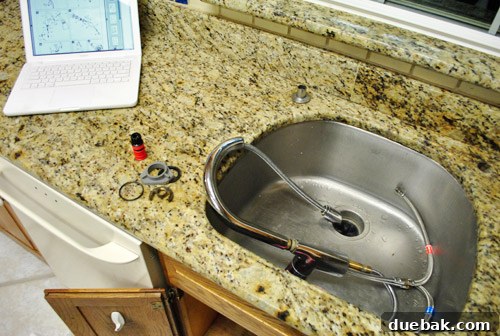
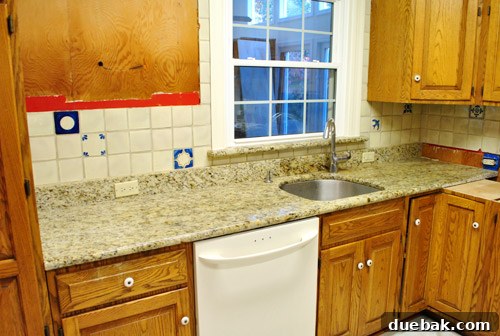
With all the fixtures successfully detached, it was time for the main event: granite removal. Having previously tackled a portion of our kitchen granite when we made room for our new stove here, we were mentally prepared for the process. We knew it wouldn’t be overly complicated, but it would certainly demand some physical exertion. We started by methodically prying off the backsplash using a crowbar, a relatively straightforward task that served as a good warm-up.
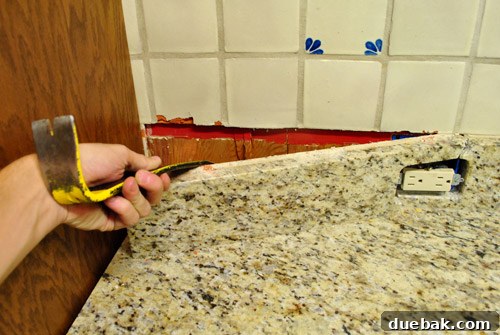
No sweat.
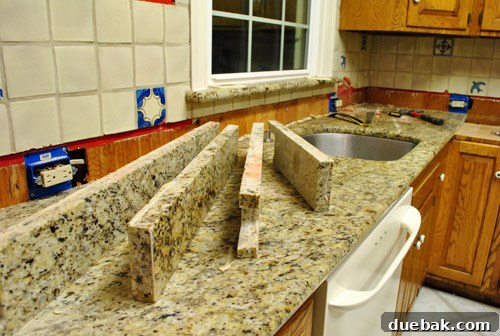
Next, we carefully made several slices along the adhesive line that secured the countertop to the cabinets. With the adhesive compromised, we began to pry the granite upwards. To our pleasant surprise, this initial section of the granite lifted up remarkably easily, providing a fleeting moment of relief and progress.
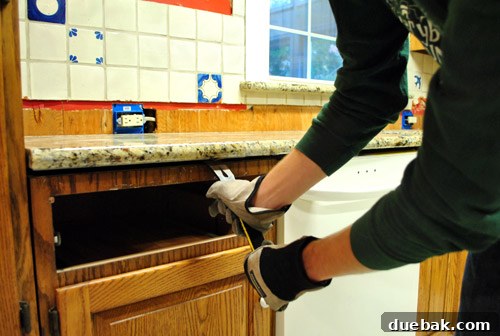
The Heavy Lift: A Family Affair and a Strategic Pivot
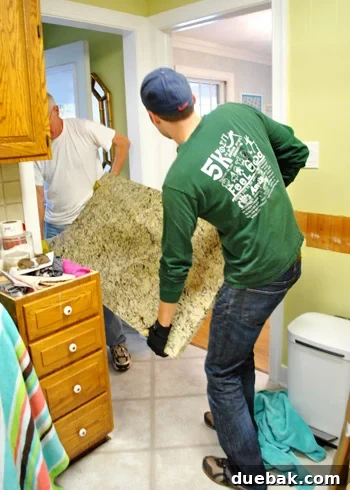
Then came the truly muscle-intensive part of the operation. Recognizing the significant weight of the remaining granite slab, especially with the sink still attached, we enlisted the help of my parents. My mom graciously took on the role of Clara-watcher and photographer, while my dad joined us for the heavy lifting. Our initial plan was to remove the entire slab with the sink still integrated, as both Lowe’s and Home Depot staff had suggested this might allow us to more easily cut the sink free without warping or damaging it later. This method, we hoped, would guarantee the sink’s integrity and save us the cost of a replacement.
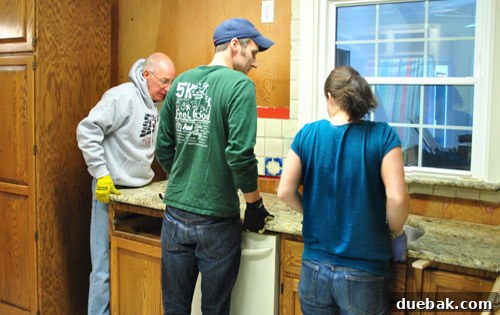
However, it quickly became apparent that this particular slab of granite, especially its extended length, was far beyond our combined lifting capabilities. The sheer weight, coupled with the precarious task of lifting it high enough to clear the cabinets without risking damage to the sink or the cabinets themselves, made the original plan unfeasible. A dropped slab could easily mean a damaged sink (a $200+ replacement) and potential structural harm to the cabinetry. We realized that even with two more burly individuals, this method might still prove too challenging. So, we regrouped and devised a new strategy: to remove the sink first by carefully separating it from the granite adhesive.
Our revised approach began with gently sliding a spackle knife into the narrow space where the undermount sink was glued to the granite. Once Sherry, whom we affectionately refer to as the “boss” of our DIY operations, managed to break the initial seal in one spot, we could systematically tap the knife around the perimeter with the aid of a hammer. While I say “we,” my dad, ever the helpful hand, ended up doing the lion’s share of this delicate work, though Sherry certainly initiated the crucial first edge. I’m still not entirely sure how I managed to mostly observe, but a sincere “thanks, Dad!” is definitely in order.
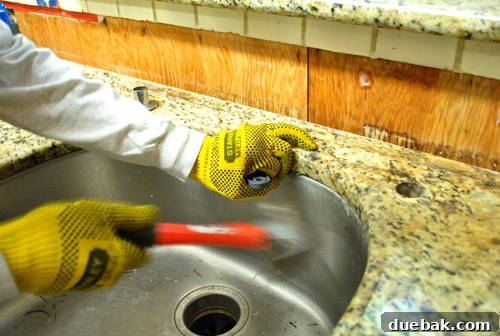
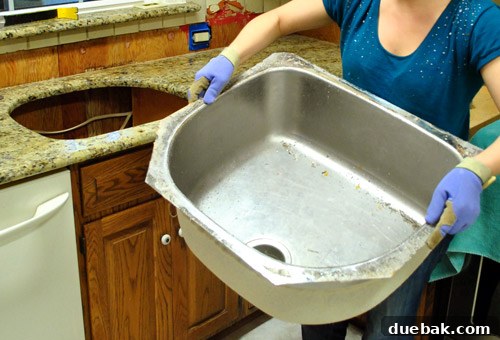
This meticulous process of freeing the sink from its adhesive bond took approximately 45 minutes. With the glue finally vanquished, we were able to tilt and carefully raise the granite just enough to gently lift the sink out from underneath. We essentially hinged the granite back, much like the lid of a heavy trunk or chest, which allowed us to minimize the amount of weight we had to support ourselves. The best part? The sink emerged completely unharmed, just a little dirty. This success meant we could happily save those “200 beans” and reuse our beloved sink! It was truly a happy day of significant savings. You can see just how sizable our sink is in the accompanying shot, with Sherry providing a sense of scale. A quick clarification from Sherry: the apparent “dandruff or debris” on her shoulders in the photo is, in fact, elegant gold beading from her clothing, which apparently looks much clearer in person. You’ve got to admire a woman who tackles kitchen demolition in fancy beaded attire!
The Final Push: Removing the Granite Halves
At this point, we theoretically could have left the remaining granite in place. However, we knew that countertop installers typically prefer either completely clear surfaces or fully intact countertops when taking measurements for templating, as a half-and-half scenario could lead to inaccuracies. Plus, we still had my dad on hand, and as I mentioned before, his extra strength was definitely an asset we wanted to utilize. (That last part sounds bad, but in the spirit of renovation camaraderie, his help was invaluable!)
With the sink safely relocated to another room, we cautiously lifted one end of the granite slab. What quickly revealed itself was a welcome sight:
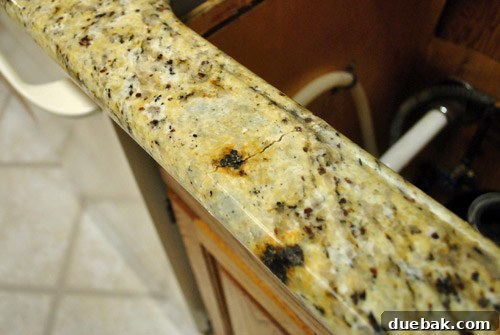
Never did I imagine I’d be so thrilled to discover a crack in my granite countertop! We had anticipated that the granite might naturally fracture around the sink area – a common occurrence that is often difficult to avoid during removal. This crack was a blessing in disguise, as it meant we could now lift each side of the slab separately, transforming one impossibly heavy piece into two manageable ones. Each half was roughly the same size as the granite piece we had removed when installing the stove a few weeks prior here, a weight we knew we could confidently handle.
However, our moment of triumph was briefly interrupted by an unforeseen obstacle beneath the crack: a sturdy metal rod. This rod had apparently been installed during the original construction to reinforce the granite across the sink opening, ensuring its structural integrity. “Boo for unforeseen metal rod-like obstacles!” was the general sentiment.
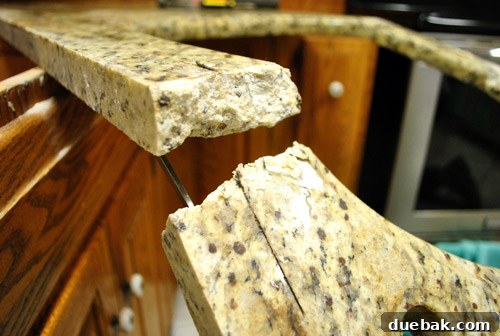
Despite this momentary setback, our momentum continued. After carefully sliding one half of the cracked granite onto the floor, the exposed metal rod was bent enough for us to leverage a screwdriver and pry it completely loose. This allowed us to fully separate the two halves of granite, each now light enough for just two of us to carry out of the kitchen with relative ease.
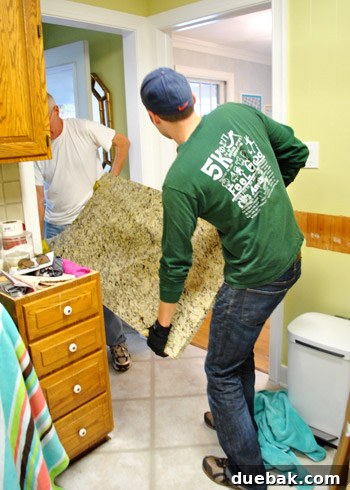
Here’s a glimpse of the aftermath after the first half of the granite was removed. Note the highly essential “construction-grade beach towel” strategically placed to protect our new stove. I’m entirely kidding about the “construction-grade” part, just in case my sarcasm wasn’t perfectly clear – no need to waste precious time Googling such a specialized item!
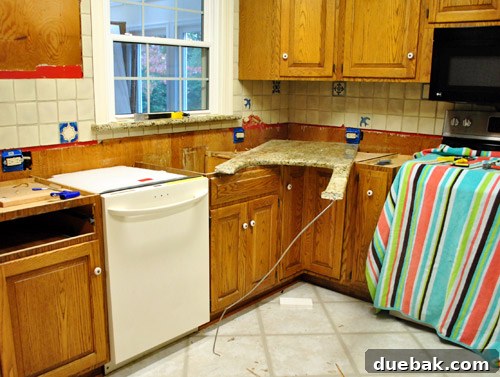
The Interim Kitchen: Sinkless but Prepared
With all the granite successfully removed and temporarily residing in our carport, awaiting its new home via Craigslist, our kitchen now presents a somewhat stark picture. It’s safe to say we are 100% sinkless, a truly humbling experience for a busy household.
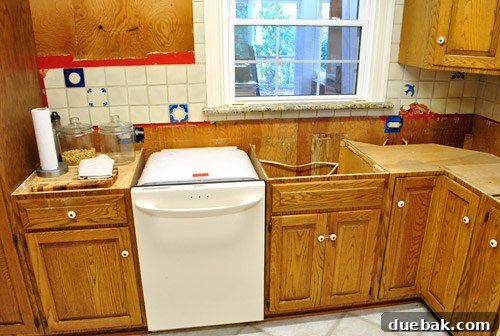
According to the countertop fabricator, we anticipate being without a functional sink for approximately three weeks, possibly four, especially with the Thanksgiving holiday factored into the timeline. To mitigate the inconvenience, I’ve reconnected the dishwasher drain, ensuring we can at least maintain a semblance of civilized living by keeping our dishes clean. While I find myself rinsing non-dishwasher-safe pots in the bathroom sink, I constantly remind myself that this temporary setup is far superior to our experience with our first kitchen renovation. That was a full gut job, leaving us without a stove, fridge, microwave, or dishwasher for months on end. This perspective helps keep the current minor discomforts in check.
Join the Conversation: Your Renovation Stories and Tips!
Our kitchen renovation journey has been filled with both anticipated tasks and unexpected discoveries. We’d love to hear about your own experiences! Have any of you foolishly underestimated the weight of an eight-and-a-half-foot slab of granite, believing it could be lifted by just a few people? Have you ever encountered hidden metal rods or other surprising reinforcements when removing or installing countertops? What are your tips for successfully keeping and reusing an existing sink during a remodel? And, for those who found their garbage disposal disconnected in mere seconds, consider me a deeply jealous man. Share your stories, advice, and any challenges you’ve overcome in your home improvement adventures!