

The journey of a wedding dress often culminates in a single, unforgettable day. Yet, for many brides, the thought of preserving such a beautiful and significant garment, only for it to remain unworn in a closet, feels like a missed opportunity. What if you could infuse new life into your bridal gown, transforming it into a versatile piece you could cherish and wear again? We’ve received numerous inquiries about just such a transformation, particularly after sharing the story of my own wedding dress’s remarkable “presto-change-o.”
This guide offers a concise yet comprehensive overview of how to dye your wedding dress, taking it from its original “I do” splendor to a chic “party on” staple. While this tutorial focuses on a daring black dye transformation, the principles can be adapted for a spectrum of colors. For a more exhaustive understanding of fabric dyeing in general, we highly recommend consulting our detailed clothes dyeing tutorial.
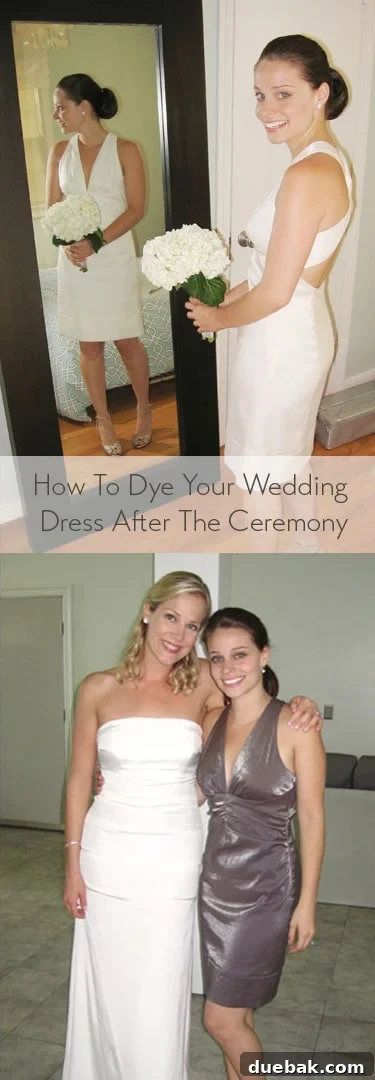
Transforming Your Wedding Dress: A Bold DIY Dye Project
Embarking on a DIY dress dyeing project, especially with something as sentimental as a wedding gown, requires a blend of courage, careful planning, and a little bit of faith. The allure of turning a once-in-a-lifetime dress into a regularly worn piece, reflective of your evolving style, is undeniably strong. This guide will walk you through the six easy steps I followed to transform my own wedding dress from pristine white to elegant black, ready for countless future celebrations.
Before You Begin: Essential Considerations for Dyeing Your Wedding Dress
Before diving into the dyeing process, understanding a few critical factors can significantly impact your results and preparedness. Dyeing isn’t just about dipping fabric into colored water; it’s about chemistry, fabric science, and a touch of artistic vision.
Firstly, **fabric composition is paramount**. Most dyes, especially all-purpose ones like RIT, work best on natural fibers such as cotton, linen, ramie, and rayon. Silk and wool, also natural, can be dyed but require specific dyes and methods due to their delicate protein structure. Synthetic fabrics like polyester, acrylic, or acetate are notoriously difficult to dye at home and often require specialized dyes and extremely high temperatures, often not achievable with household methods. Blends can yield mixed results – natural fibers will pick up the dye, while synthetics might not, leading to a heathered or two-toned effect. Always check your dress’s care label for its fiber content. If your dress is primarily synthetic, this DIY method may not be suitable.
Secondly, **perform a patch test**. If possible, find an inconspicuous area of the dress, such as an inside seam allowance or an extra piece of fabric often provided with formal wear, to test your chosen dye. This step is critical, especially when dealing with a “dry clean only” garment or an unknown blend, as it can reveal how the fabric will react to heat, water, and the dye itself. It also gives you a preview of the final color.
Thirdly, **prepare your workspace**. Dyeing can be messy. Protect your surfaces with plastic sheeting, old towels, or newspapers. Wear old clothes and rubber gloves to prevent staining your skin and clothes. Ensure good ventilation, especially if working with hot water that produces steam. Having all your supplies ready and within reach will make the process smoother and less stressful.
Finally, consider the **starting color and desired outcome**. While dyeing a white dress black is a straightforward transformation in terms of color theory, attempting to dye a light-colored dress a different light color can be more complex, as the original hue can influence the final result. For instance, dyeing a cream dress blue might result in a greenish tint. For a true, deep black from white, ample dye is essential.
Your Six-Step Guide to Dyeing a Wedding Dress
Here’s a breakdown of how my very own wedding dress transitioned from its ceremonial white to a vibrant, reusable cocktail dress in six straightforward steps:
Step 1: Selecting and Preparing Your Dye
For a truly impactful color transformation from white to a rich black, **purchase two bottles of liquid RIT dye in black**. This isn’t an arbitrary quantity; doubling the content of dye is a crucial step to ensure that a very light garment, especially one as substantial as a wedding dress, achieves a deep, uniform, and saturated color. Using an insufficient amount of dye can lead to a washed-out, uneven, or grayish result, which is definitely not the goal when aiming for a striking black. Liquid dye is generally preferred for its ease of mixing and consistent application compared to powder dyes, which might sometimes leave undissolved granules. Always ensure you choose a dye suitable for your dress’s fabric composition; RIT All-Purpose Dye works well for most natural fibers. While black was my choice, consider other bold shades like emerald green, sapphire blue, or deep burgundy to give your dress an entirely new persona suitable for various occasions.
Step 2: Preparing the Dye Bath for Optimal Absorption
The preparation of your dye bath is critical for an even and successful color application. **Fill a clean sink (or a large bucket/utility tub if your dress is bulky) with enough HOT AS YOU CAN GET IT water** to allow your garment to move around freely without being cramped. The hotter the water, the more the fabric fibers will open up, allowing for deeper and more effective dye absorption. Before introducing your dress, **add both bottles of RIT liquid dye to the hot water and stir the mixture thoroughly** until the dye is completely dispersed. This ensures a consistent dye concentration throughout the bath, preventing splotches and uneven coloring on your dress. A well-mixed bath is the foundation for a professional-looking finish.
Step 3: The Moment of Truth & Pre-Wetting the Garment
This step often comes with a bit of trepidation, especially if your dress’s label dictates “dry clean only,” and the dye bottle explicitly states “not for use on dry clean only fabrics.” I certainly paused to reflect on the potential risks. However, the thought of my beautiful wedding dress remaining unworn, gathering dust, outweighed the fear. After contacting countless local dress dyers, all of whom declined due to the “too risky” nature of the project, I realized this DIY approach was my best (and only) option to give the dress a second life. Weighing the slim chance of wearing a white wedding dress again against the exciting possibility of transforming it into a versatile cocktail gown, the decision became clear. Before taking the plunge, **say a tiny prayer (or five) and thoroughly wet the dress with hot water.** Pre-wetting the fabric ensures that the fibers are uniformly saturated, preventing dry spots that can lead to uneven dye absorption and streaking when the dress enters the dye bath. This primes the fabric to receive the dye evenly and beautifully.
Step 4: The Dyeing Process – Stirring for Perfection
Once the dress is in the dye bath, it’s natural to “freak out a little,” but resist the urge to panic and **press on with constant stirring**. For a solid 25 minutes, you need to gently but continuously move the garment up and down, back and forth within the hot dye solution. This constant agitation is absolutely vital to prevent the dye from settling unevenly and to ensure every fiber of the fabric is exposed to the dye. Remember, you want the water to be piping hot when you start because the dye works most effectively when the fabric remains in hot water. The hotter the initial bath, the longer you can stir the garment effectively, allowing for maximum color saturation. For darker or more intense shades, you might even extend the stirring time, checking the color periodically until you reach your desired depth. Patience and persistence are key here to avoid a splotchy outcome.
Step 5: Rinsing, Cooling, and Drying to Set the Color
After 25 minutes of thorough stirring (or once your desired shade is achieved), it’s time to carefully **remove the item from the dye bath**. Begin by **rinsing the dress under warm water that gradually gets colder and colder**. This gradual temperature change is crucial for “shocking” the fabric fibers and effectively sealing in the color. As the water cools, the fibers close, trapping the dye particles within. Continue rinsing the dress under cold water, ideally ice cold, until the water running off the fabric is completely clear. This step is non-negotiable, as any remaining loose dye can bleed onto your skin or other fabrics later. Once the rinsing is complete, **gently squeeze out excess water** (avoid harsh wringing to prevent stretching or damage) and then **hang the dress up to air dry**. I hung mine in a sunroom with a bucket underneath to catch any errant drips, saying a few more prayers for a successful outcome. Ensure adequate ventilation and space for even drying.
Step 6: Post-Dye Cleanup and Enjoying Your New Dress
The dyeing process isn’t truly complete until your workspace is spotless. This step, surprisingly, can often be more stressful than the actual dyeing! **Thoroughly clean your sink, tub, and any surrounding surfaces to remove all traces of dye immediately.** Dye can easily stain porous surfaces like countertops and even etch into some finishes if left to sit. I was particularly nervous about our stainless steel sink and granite countertops, as dye seemed to get everywhere. However, with some good old soapy scrubbing, a bit of bleach for porcelain (if applicable and safe for your surface), or dedicated dye remover (such as RIT Dye Remover), everything came clean. Prompt action is your best friend here. Once your area is clean, you can fully appreciate your newly transformed dress!
The Reveal: From Wedding Gown to Wardrobe Staple
As my dress initially dried in the sunroom, I admit it looked somewhat alarming. The color appeared inconsistent, almost ruined in parts, and the fabric seemed stiff. However, once it was completely dry, a magical transformation occurred. The color locked in beautifully, presenting a rich, uniform black. To my relief, there was no black dye bleeding onto my skin, a worry I’d harbored throughout the process. For a mere $12 worth of dye, I had successfully turned my once-in-a-lifetime gown into a versatile, elegant cocktail dress that I can wear time and time again. And believe me, I intend to wear it for as long as I can comfortably fit into it!
It’s important to acknowledge that this entire process could just as easily have ended in disaster. The lesson here is profound: **only dye something that you might never wear again if it remains in its original state.** This approach manages expectations and reduces the emotional stakes. Remember the golden rules for success: **stir, stir, stir constantly** to ensure even dye penetration, and **use hot, hot, hot water** to open up the fabric fibers for optimal color absorption. Dyeing is undeniably a bit like Russian Roulette, where the outcome can vary significantly based on fabric, technique, and a little luck.
For those interested in exploring alternate dyeing methods or troubleshooting specific fabric challenges, click here to visit the RIT Dye website, which offers a wealth of information and guides to help you achieve hopefully fabulous results.
Happy dyeing, and may your transformations be as rewarding as mine!