
Transforming Our Kitchen: From Unfinished to Counter-Ready
Every home renovation project has those moments when you step back and feel a mixture of excitement and utter exasperation. For us, that feeling hit hard as we gazed upon our “new” tile-ready kitchen walls. They were undeniably a step forward, but the lingering presence of unfinished details made the space feel anything but complete.
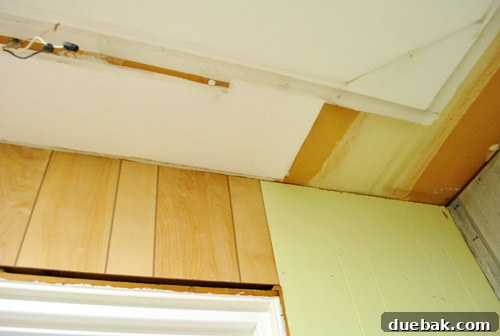
The primary culprits stealing our enthusiasm were glaringly obvious: mismatched, unpainted paneling that gave us an involuntary shiver, and those unsightly, unpainted, and stained sections of the ceiling that had been exposed after we carefully removed the upper cabinets. These stark contrasts highlighted just how much work lay ahead, turning our excitement into a mild dread.
Breathing New Life: Tackling the Paint Job
So, what was our immediate course of action to remedy this aesthetic dilemma? We rolled up our sleeves and grabbed the paint brushes, of course! A fresh coat of paint, or several in our case, promised to be the quickest and most impactful way to start unifying the space and making it feel like a proper kitchen in progress.
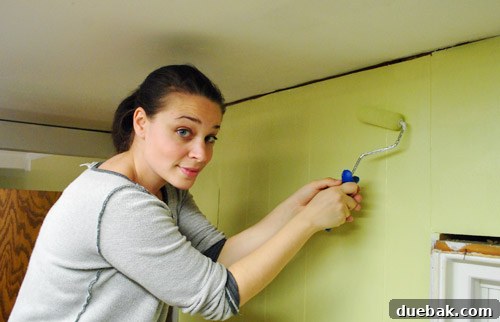
The paneling, notoriously thirsty for paint, required a diligent application of two coats of high-quality primer followed by two thorough coats of our chosen paint. This multi-layer approach ensures maximum adhesion, durability, and a smooth, consistent finish, effectively masking the previous discrepancies. For the ceiling, however, the task proved to be a more formidable challenge. With areas that had never seen paint before and others bearing stubborn stains, achieving a perfectly seamless look demanded significant effort. We honestly lost count of the primer and paint coats, estimating it to be somewhere around five or even six layers! Our weapon of choice for this extensive priming was Kilz CleanStart primer, a fantastic no-VOC option that allowed us to work without harsh fumes. Coupled with leftover ceiling paint generously left by the previous owners in the basement, we finally achieved a perfectly matched and unified ceiling. The transformation was palpable, and the relief of seeing the space come together was immense. Can you hear our collective sigh of satisfaction?
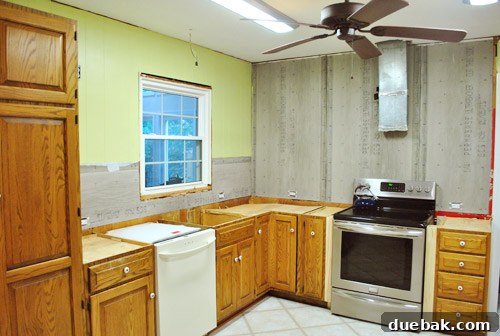
While the initial painting efforts provided a significant visual upgrade, we were keenly aware that this was just one step in a much larger kitchen remodel. The space, though cleaner and brighter, still retained a raw, utilitarian feel. Our excitement builds as we anticipate the next crucial phases: installing brand-new kitchen counters (which we hope to showcase very soon!), re-installing elegant molding around the window, adding a stylish backsplash tile, updating the lighting fixtures, painting the cabinets a fresh color, and finally, laying our beautiful cork floors. Each step brings us closer to a truly polished and functional kitchen, and we’re thrilled to be slowly but surely inching towards that coveted finish line.
Essential Support: Installing Counter Brackets for Our Peninsula
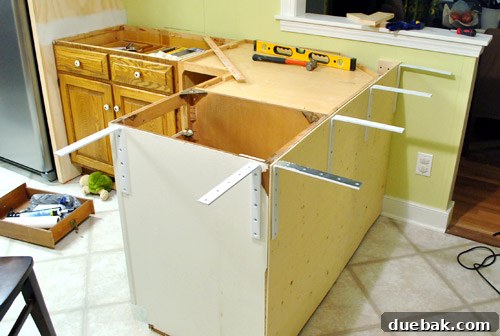
Before the much-anticipated counter installation could proceed, there was one vital task left on our checklist: securing the counter support brackets. This was a detail we had briefly mentioned in a previous post before Thanksgiving. During the counter templating process, we learned an important lesson from the expert: any countertop overhang exceeding 10 inches requires robust support. Our kitchen peninsula, designed for function and entertaining, features a generous 12-inch overhang on two sides, making these brackets absolutely non-negotiable.
The professional option for reinforcing our Corian counters would have set us back a hefty $300. However, the templating specialist, seemingly understanding our DIY-loving nature, hinted at a more budget-friendly alternative. This was music to our ears! We opted for the savvy DIY route, heading to Lowe’s hardware aisle and purchasing six sturdy 10-inch steel brackets. At a mere $6 each, the total cost for these essential supports came to a very reasonable $36, a significant saving compared to the professional reinforcement. Sherry, ever the master of spray paint, took on the task of giving them a clean, uniform finish, ready for installation.
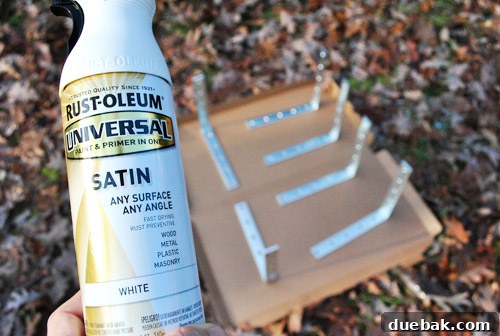
DIY Bracket Installation: A Step-by-Step Guide
Once the brackets were perfectly dry, I brought them into the kitchen along with some scrap pieces of wood, which I cut into precise 12-inch sections. The templating expert’s advice was clear and crucial: avoid screwing the heavy steel brackets directly into the thin cabinet backs alone. Instead, we needed to create a robust anchor point. This involved placing the thicker scrap wood inside the cabinet, positioning it directly behind the spot where the bracket would be, and then drilling into this reinforced surface. This technique ensures superior strength and stability, crucial for supporting a heavy countertop overhang for years to come.
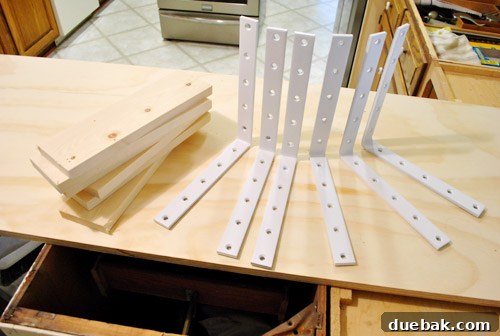
With the reinforcement strategy in place, the next step was meticulous measurement and marking. I carefully measured the cabinet interior and marked the exact locations to ensure the brackets would be perfectly and evenly spaced along the peninsula. After marking, I loosely hammered the scrap wood pieces into their designated positions on the interior back of the cabinet. This initial placement provided a solid backing without being fully secured just yet, allowing for minor adjustments.
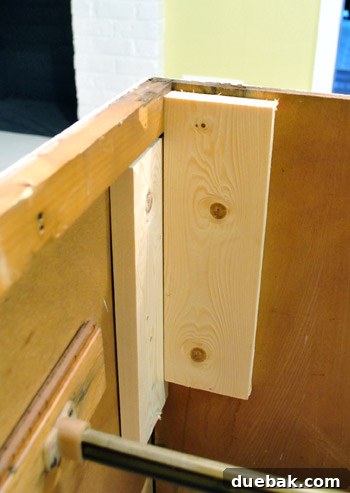
To accurately screw in the brackets, I employed another clever DIY trick: I used a spare piece of wood as a temporary counter surface. This allowed me to ensure that each bracket was positioned at the correct height, guaranteeing it would effectively carry the load of the countertop overhang without being too high or too low, maintaining a perfectly level surface. With the temporary counter in place, I then securely fastened each bracket with three strong screws, driving them through the cabinet back and firmly into the reinforced scrap wood behind. This method provides an incredibly stable and reliable support system.
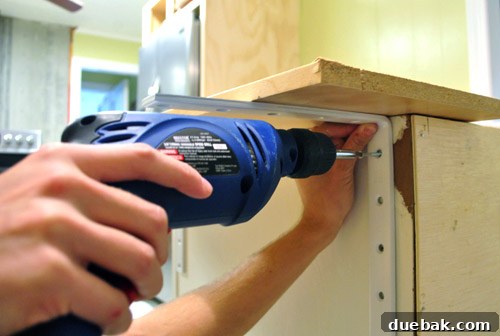
After securing the first three brackets, the peninsula was already taking on a more defined and robust appearance. This visible progress fuels our excitement for the final countertop installation. It’s important to note that once our Corian counters arrive and are put into place, we’ll take an additional step to ensure ultimate stability: screwing them into the Corian from below. Rest assured, Corian is specifically manufactured with internal wood reinforcement whenever an overhang is designed, providing dedicated anchor points for screws. This multi-point attachment guarantees a rock-solid and safe countertop for all our kitchen activities.
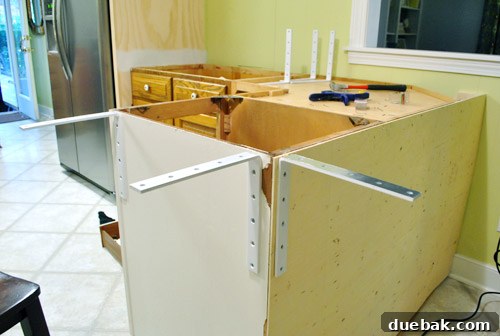
Aesthetic Refinements: Concealing Brackets and Looking Ahead
While these essential brackets will be largely out of sight once the counters are installed and the cabinets are painted a crisp white, we’re not stopping there with our aesthetic plans. We envision adding elegant shaker-style panels to beautifully dress up the back (and potentially the side) of the peninsula. These panels won’t just add a touch of sophisticated detailing; they’ll also serve a functional purpose by completely concealing the steel brackets. Our plan involves routing out the back of the shaker panels, creating a channel for the brackets, and then laying the panels over them. This will hide the supports entirely, creating a sleek and seamless look. It promises to be a fun and rewarding challenge, and we’ll certainly keep you updated on our progress when we reach that exciting stage of the renovation!
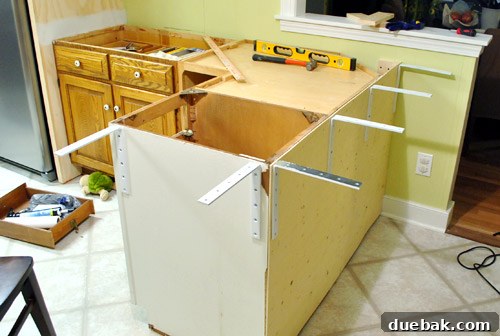
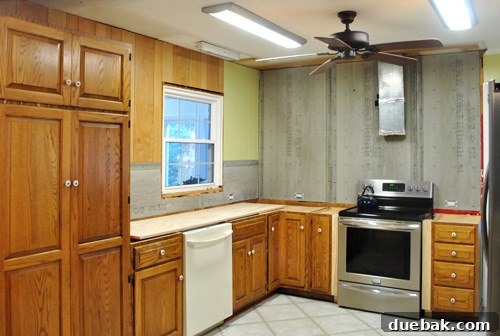
The Counter-Ready Kitchen: Strategic Priming and Future Plans
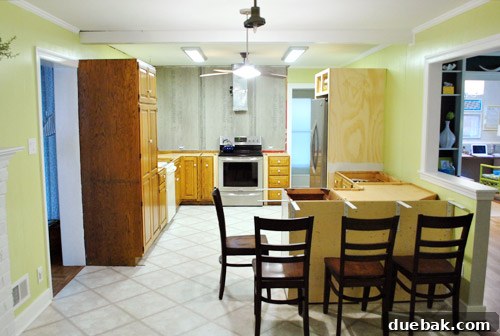
And so, here stands our kitchen in its truly counter-ready state. You might notice another small but strategic detail: we’ve also applied a stripe of primer along the refrigerator surround, precisely where it will meet the new countertop. This isn’t just for show; it’s a practical step in our renovation sequence.
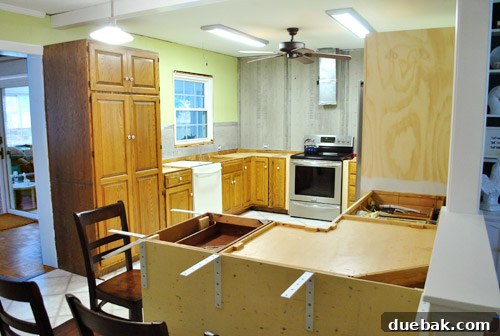
We deliberately chose not to prime and paint the cabinets before the impending counter installation. Our experience from installing granite counters in our first house taught us a valuable lesson: heavy, tightly fitting countertops often require significant scraping and shoving during placement, leading to inevitable touch-ups on freshly painted cabinets. To avoid this headache, we prefer to install the counters first, carefully cover them, and then proceed with painting the cabinets afterward. The small stripe of primer applied beforehand, however, is a clever workaround. It ensures that when we eventually paint right up to the edge of the new counters, there won’t be any sliver of brown wood peeking through. If a tiny gap does exist between the paint and the counters, it will be white against white, blending seamlessly rather than creating an noticeable brown line. It’s all about those small details that make a big difference in the final finish!
It’s finally starting to resemble a functional kitchen, isn’t it? Please, feel free to overlook the temporary wood chairs; they are neither counter height nor the correct color, serving merely as placeholders for now. They await their stylish replacements in due time.
The Reality of Renovation: Living in the Midst of a Project
In keeping-it-real news, the truth is our kitchen often looks a little more chaotic than those staged photos suggest. Renovation life with a family means navigating tools, materials, and constant adjustments. It’s a messy, but ultimately rewarding, process.
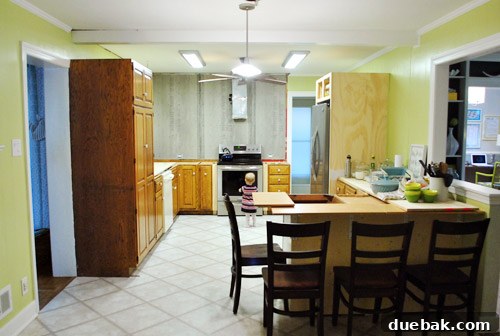
As parents, our “Toddler Impalement Device!” alarms immediately went off when we saw those exposed brackets. Safety for our little Clara is always paramount. Thanks to some resourceful thinking and leftover cabinet shelves, we quickly fashioned a dummy counter. This temporary solution made the edges of the peninsula much more visible to Clara (and her sometimes clumsy parents!), reducing the risk of bumps and scrapes. Having the temporary chairs in place also serves as a visual barrier and helps define the space. It’s all about adapting and ensuring a safe environment during a busy renovation!
Perhaps we should just cancel our Corian order and learn to love these makeshift counters?
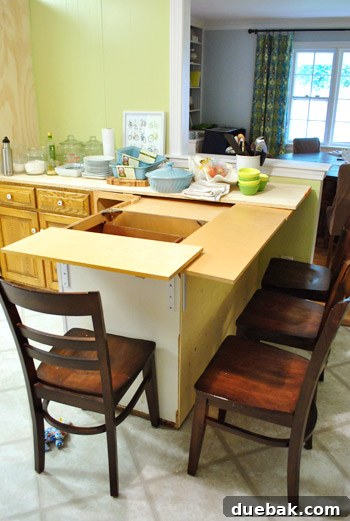
Yeah, probably not! We are incredibly excited that our next major update for you all should be the reveal of our beautifully installed countertops. We’re crossing our fingers for delivery and installation tomorrow morning. Woot! We can barely contain our excitement for this monumental step in our kitchen’s journey.
Anticipation and the Joys of a Working Kitchen
Oh, how joyfully we anticipate using a proper kitchen sink again! My, how we have missed the convenience and functionality it offers. This feels like our very own “Merry Countermas!” Thankfully, we still have a working fridge, stove, and dishwasher, which means we can continue to cook meals at home (a huge relief!). However, washing all the non-dishwasher-safe items in the bathroom sink or even the tub has proven to be quite annoying and cumbersome. It truly makes you appreciate the simple luxuries of a fully functional kitchen.
What aspects of home renovation are you currently anxiously awaiting? Have you recently tackled any ceiling priming and painting projects? Did you, like us, completely lose count of the coats needed to achieve perfection? Oh man, that feeling of being done with a challenging painting project is truly liberating, isn’t it?
Psst – For anyone interested in a fantastic deal, we’ve listed our old granite counters on Craigslist. You can find more information about them and their dimensions right here.