
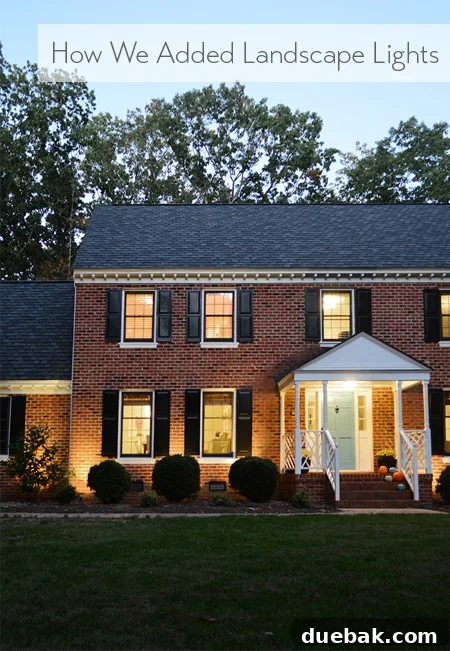
Transforming your home’s exterior doesn’t have to be a daunting task. One of the most impactful and often overlooked upgrades you can make is the addition of thoughtfully designed landscape lighting. This past summer, we embarked on a DIY journey to illuminate our outdoor spaces, and what we discovered was a project far less complex and costly than we initially imagined. The results? A stunning evening glow that enhances curb appeal, improves safety, and adds a touch of sophistication that truly makes coming home a delight.
For years, we’ve admired the inviting, stately glow of homes in our neighborhood, creating that welcoming ambiance as evening descends. We always thought such elegance came with a hefty price tag and a complicated installation process. We had mentally filed this idea away for ‘someday,’ assuming it would be a significant time and financial investment. However, a helpful tutorial from Sarah at Thrifty Decor Chick completely changed our perspective. Her step-by-step guide quickly propelled landscape lighting to the very top of our home improvement list, and to our pleasant surprise, the entire project was completed and enjoyed on the very same day we started!
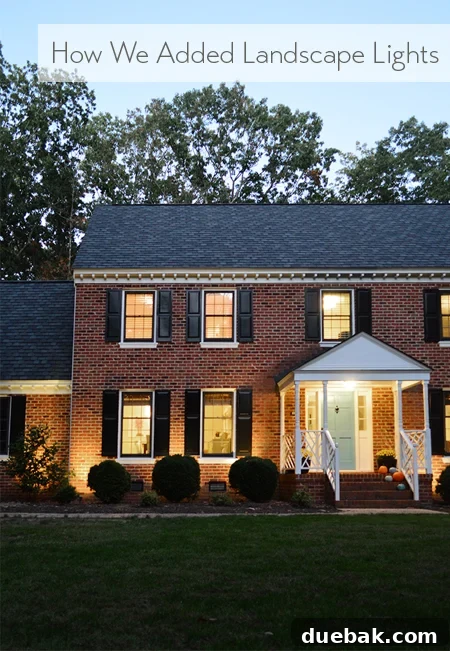
While the actual wire connecting and light placement proved to be surprisingly straightforward, the initial planning and material selection required a bit of careful consideration – mostly involving a touch of basic math and ensuring we chose the right components. Although we didn’t capture every step of the installation process in detail, we’re here to share everything we learned so you can confidently tackle your own outdoor lighting project.
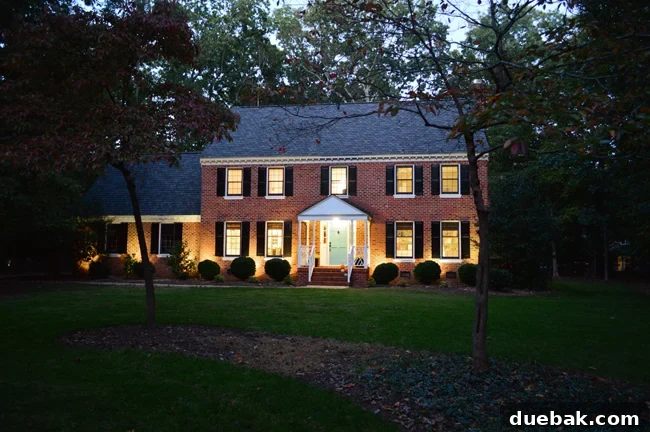
Based on the essential elements highlighted in Sarah’s recommended lighting kit, we knew we needed three fundamental components for a functional low-voltage landscape lighting system: the lights themselves, a power pack (or transformer), and suitable low-voltage cable. The trickiest part was figuring out the right combination and specifications for our specific needs.
Note: The exact products we originally used are no longer available in the market. However, this modern kit offers a similar solution, often at a more affordable price point, and crucially, features energy-efficient LED lights rather than the halogen ones we initially installed. This is a significant upgrade for any new installation.
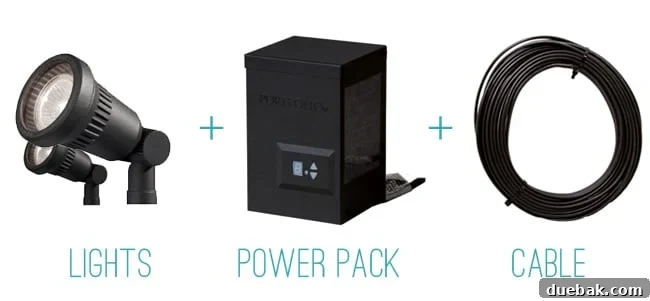
Choosing Your Landscape Lighting Components: A Detailed Guide
1. The Lights: Spotlights for Maximum Impact
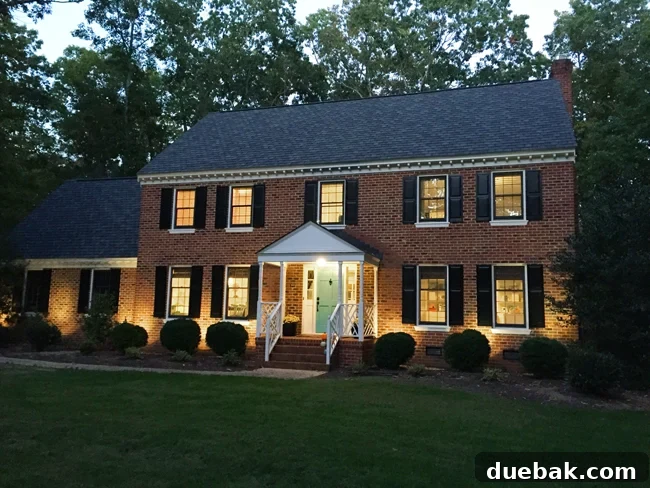
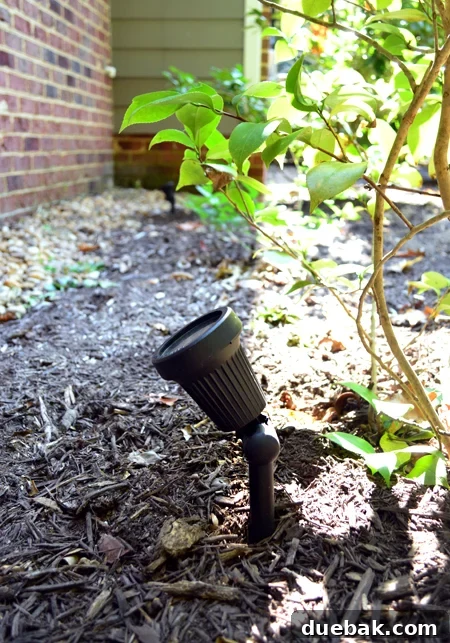
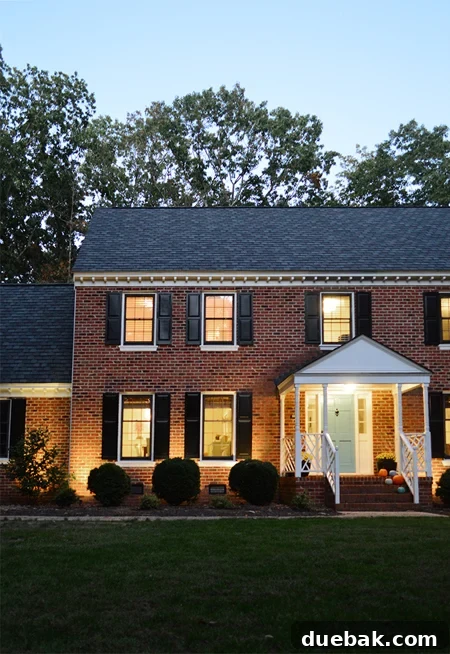
Selecting the lights was arguably the easiest part of our process. We decided to stick with 20W halogen spotlights, similar to those found in the kit that inspired us. Our primary goal was to highlight the architectural features of our home and create a warm, inviting facade. After observing other homes and experimenting with placement, we determined that one spotlight positioned between each downstairs window and one on each of the house’s front corners would achieve the desired effect. This strategy helps create a balanced, upward wash of light, accentuating the structure rather than just illuminating the ground. When choosing your lights, consider various types beyond spotlights, such as path lights for walkways, well lights for subtle uplighting from the ground, or floodlights for broader coverage, depending on your aesthetic and functional goals.
2. The Power Pack (Transformer): The Brain of Your System
This is where the math comes into play, but don’t be intimidated! The power pack, also known as a transformer, is crucial. Its primary function is to safely convert your standard 120V household electricity from an outdoor outlet down to a much safer 12V low-voltage current, which is what these landscape lighting systems operate on. The key is to select a transformer with sufficient wattage capacity to power all your lights. To do this, simply add up the total wattage of every fixture you plan to install. In our case, with 9 lights each drawing 20 Watts, our total came to 180 Watts (20 Watts X 9 lights = 180 Watts). It’s always a good practice to choose a transformer that offers a little extra wattage beyond your calculated total. Many experts, including those at Lowe’s, suggest adding at least a 20W buffer. We opted for a 200-watt transformer, providing us with a comfortable margin. Ensure your chosen transformer is a “multi-tap” version, which allows you to connect or “tap in” more than one wire, offering greater flexibility in your wiring layout. These units typically plug directly into any exterior GFCI-protected outlet.
3. The Cable: The Lifeline of Your Lighting System
The low-voltage cable requires significant forethought to ensure even illumination across all your fixtures. Voltage drop is a critical factor: the farther your lights are from the power source, the dimmer they can become. Connecting too many lights on a single, long run of cable can result in the last light appearing noticeably dimmer than the first. To counteract this, various wiring strategies and charts are available to help you achieve consistent brightness throughout your system. These resources also guide you in selecting the correct cable size or gauge. Thicker gauges (like 12-gauge) can carry power farther with less voltage drop than thinner ones (like 14-gauge). For our project, we decided to split our lights onto two separate sections of similar-length 14-gauge cable. Each section ran to an opposite side of our front porch, following recommendations to minimize voltage drop and ensure even light distribution. This dual-path approach is excellent for larger layouts or to prevent noticeable dimming.
Effortless Installation: Connecting Your Landscape Lights
Once the planning was complete and we knew the placement of every component, the physical installation – connecting wires, placing lights, and burying cables – was surprisingly simple. A huge advantage of low-voltage systems is that you perform all wire connections *before* plugging in the transformer. This means you’re working with no live wires, ensuring a safe installation process!
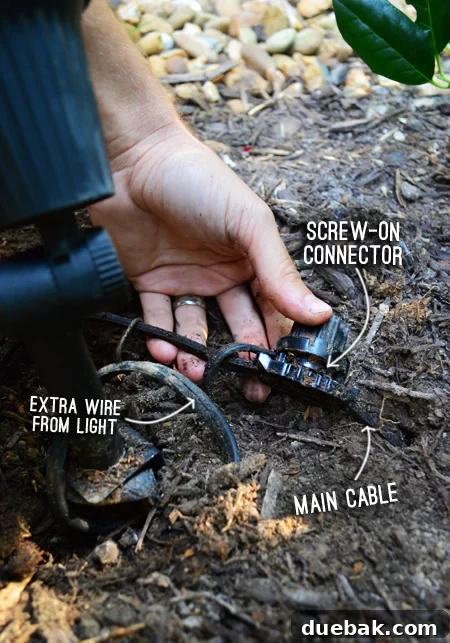
Our process began by staking the spotlights into their designated ground positions and loosely laying out the low-voltage cable along their path. Connecting each light to the main cable was tool-free and straightforward: simply screw the light’s connector cap tightly over the main cable, following the installation instructions. These caps typically have small, sharp teeth that pierce the cable’s insulation to make a secure electrical connection. For demonstration, we unearthed a connection recently so you can see what it looks like.
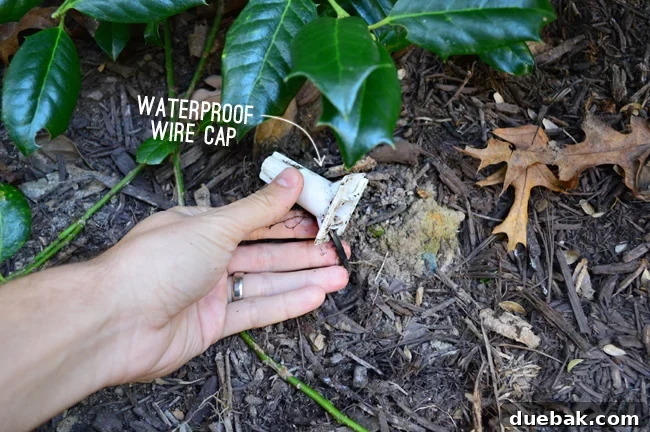
Since we utilized two separate cable runs returning to the transformer rather than a single looped one, we needed a robust solution for terminating the “outside” ends of each cable. After a bit of research, we opted for specialized waterproof wire caps. These caps are designed to withstand moisture and corrosion, making them ideal for buried outdoor applications where environmental exposure is a concern.
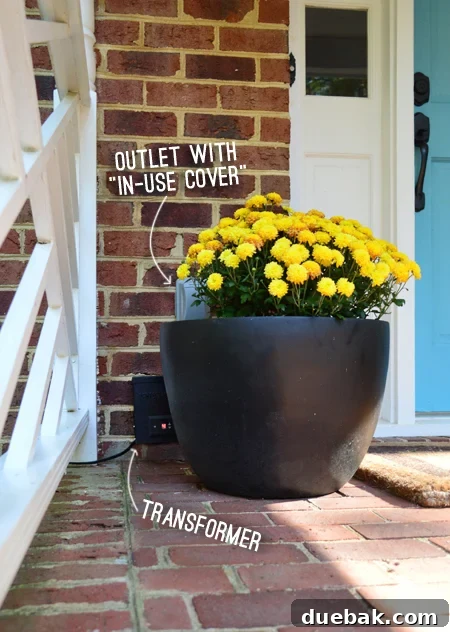
The final step in wiring involved connecting the prepared cable ends to the underside of the transformer unit. This did require a basic pair of wire clippers to strip a small section of insulation, exposing the copper wires for a secure connection. Once all connections were made, we plugged the transformer into an exterior outlet on our front porch and mounted it securely to the brick wall. Mounting it a few inches off the ground provides better aesthetics and protects it from potential puddles after rain. While we temporarily moved our planter for the photo, it typically conceals both the transformer box and the outlet from view, maintaining a clean look.
Fine-Tuning and Final Touches
With everything connected and the transformer plugged in, we waited for dusk to fine-tune the system. The darker evening light is essential for accurately adjusting the spotlights’ angles and the stakes’ precise placement to ensure the light beautifully highlights the house. Each light typically has about a foot of cord between the fixture and its connection point to the main cable, offering some crucial wiggle room for adjustments even after initial setup. This flexibility allows for perfect aiming to achieve your desired aesthetic effect, whether it’s accentuating architectural details or washing a wall with light.
Once we were satisfied with our nighttime adjustments, the final step was to permanently install everything. The next morning, in daylight, we dug a shallow trench, just a few inches below ground level, and carefully buried all exposed cables, connectors, and waterproof wire caps. Since our entire system is contained within the boundaries of our mulch bed, we don’t have to worry about accidentally cutting any wires with lawn mowers, aerators, or other yard tools. This burial provides both protection and a seamless, professional appearance.
One of the best features of modern landscape lighting systems is their automation. As you can see in the time-lapse video below, our lights automatically turn on when it gets dark, thanks to a built-in light sensor on the power pack. Our transformer also includes a digital timer, allowing us to set exactly how many hours the lights remain on (ours typically turn off around the time we head to bed). This “set it and forget it” functionality is incredibly convenient. In total, the project cost us just over $200 and took approximately four hours to install, making it an incredibly rewarding DIY endeavor.
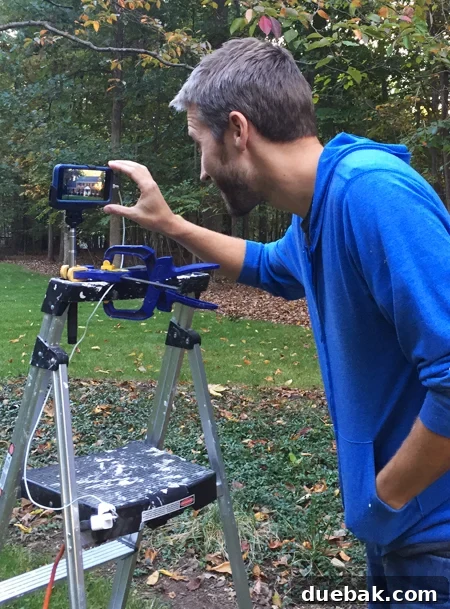
Speaking of the video, we employed a rather ingenious (and perhaps amusing) setup to capture the time-lapse: a selfie stick clamped to an old stepladder! We utilized our iPhone’s time-lapse feature and then simply went inside for dinner while it recorded the magical transformation. We’re quite sure our neighbors had a good laugh, and probably a few head-scratches, watching our creative filming methods!
We are thrilled to report that these lights have been performing flawlessly for many months now. The joy of rolling down our street at night and seeing them automatically click on, ready to welcome us home, truly never gets old. It’s a simple upgrade that delivers immense satisfaction and transforms the entire feel of our property after dark.
Updates & Evolution: Embracing LED and Solar Technology
UPDATE! Embracing the Efficiency of LED Lighting: Since our initial installation, we’ve made the conscious decision to transition our entire house to LED lights, both interior and exterior. The benefits are simply too significant to ignore: massive energy and cost savings, and perhaps best of all for “lazy people” like us, they boast an incredibly long lifespan, meaning you practically never have to change a bulb! For those looking to make a similar switch, our favorite interior LEDs provide a warm, natural glow that avoids the “weird/blue” hue sometimes associated with other LED options. And for our exterior uplighting, these exterior LED spotlights, conveniently available in packs of four, are now our go-to choice. Upgrading to LED is a smart long-term investment for any home.
UPDATE #2! The Simplicity of Solar Lights: After moving to our new home, we explored even simpler lighting solutions for our backyard. We’ve since discovered an incredibly effective way to illuminate our entire backyard using *only* solar-powered lights. This solution offers ultimate flexibility and requires zero wiring. If you’re interested in a no-fuss, energy-independent lighting option for areas where running wires might be difficult or undesirable, be sure to check out the post we wrote detailing our favorite outdoor solar lights.
Psst – Looking for something else you saw in our home? We’ve finally put together this handy Shop Our House page to help you track down any furniture, accessories, or even our paint colors.
* This page contains affiliate links, meaning we may earn a small commission at no extra cost to you if you make a purchase through them.