
Transforming Our Sunroom: The Journey to a Stunning Wood Planked Ceiling
Embarking on a home improvement project can often feel like stepping into a dream. When we first envisioned a beautiful wood planked ceiling for our sunroom, the initial thought was simple: a quick trip to the local hardware store, a stroll down the beadboard aisle, and our cart filled with supplies. It seemed straightforward, a task as easy as pie. Little did we know, this journey would unfold into a comprehensive learning experience, brimming with unexpected choices, challenges, and ultimately, immense satisfaction.
Choosing Your Ideal Ceiling Material: Beyond the Basics
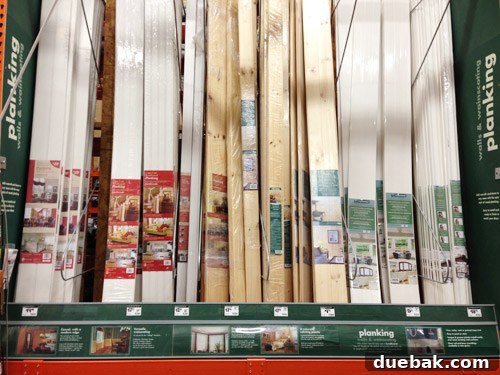
The quest for the perfect beadboard ceiling revealed a surprising array of options. Historically, beadboard was crafted from individual tongue-and-groove planks, much like hardwood flooring. The distinctive feature, the “bead,” is a subtle ridge or indentation between each board, giving it that classic charm. However, modern manufacturing has introduced several alternatives, each with its own set of advantages and drawbacks, making the selection process more nuanced than we first imagined.
The Panel Dilemma: Convenience vs. Aesthetics
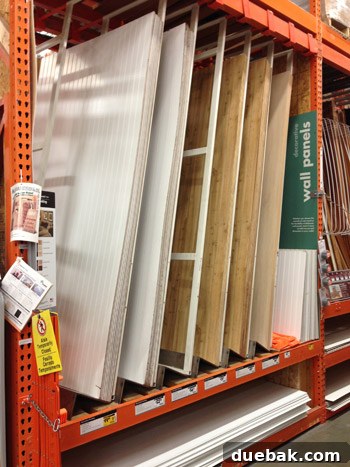
Our initial consideration leaned towards large, 4ft x 8ft sheets of beadboard panels. These are often the most budget-friendly choice, frequently costing less than $1 per square foot. The affordability was certainly tempting, but we quickly realized the practical challenges. Installing such cumbersome panels on a high sunroom ceiling seemed incredibly daunting, even with the suggestion of renting a drywall lift. While a lift could ease the installation, the added expense of rental and transportation would significantly cut into the initial cost savings. More critically, using panels meant contending with visible seams where one sheet met another. Although these can be concealed with trim, we felt this wouldn’t achieve the seamless, authentic look we desired, especially on our sloped ceiling.
Exploring Vinyl Planks: Durability at a Cost
Next, we seriously considered vinyl planks. Vinyl is often a compelling choice for outdoor or semi-outdoor spaces like sunrooms due to its inherent resistance to rot and warping from moisture exposure. This seemed like a practical solution, particularly given the sunroom’s susceptibility to varying weather conditions. However, online forums frequently mentioned that vinyl planks could appear “too plastic-y,” detracting from a natural wood aesthetic. For us, the ultimate deal-breaker was the price. At approximately $1.79 per square foot, vinyl planks were nearly double the cost of the panels, effectively doubling our project budget right from the outset. This significant price difference, combined with aesthetic concerns, led us to look elsewhere.
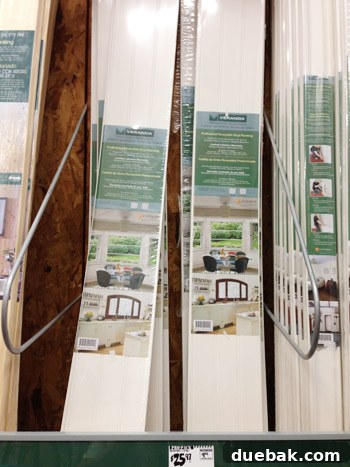
The Chosen Path: Authentic Wood Tongue-and-Groove Planks
Driven by a desire for an authentic plank appearance and a careful evaluation of cost versus aesthetic appeal, we finally narrowed our options to individual tongue-and-groove wood planks. Both Lowe’s and Home Depot offered similar selections. We found a suitable option at Lowe’s that came in under the $1 per square foot mark, hitting our target price point. This choice promised the traditional look we craved, free from unsightly seams and boasting genuine wood grain. The total cost for twenty six-packs of 6-inch tongue-and-groove planks came to $297, or $0.94 per square foot. While slightly exceeding our initial budget of $250, the promise of a long-lasting, visually appealing result made it a worthwhile investment.
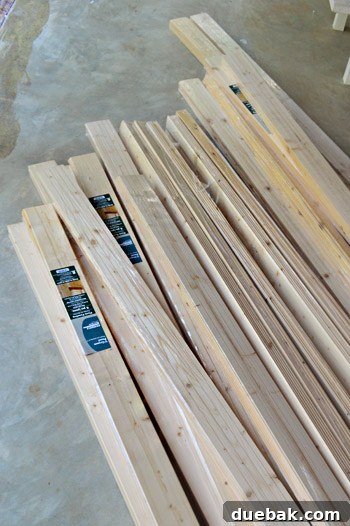
Prepping for Longevity: The Essential Priming and Painting Process
Our chosen individual wood planks, unlike the large panels, could easily fit into our car, eliminating the need for additional equipment like a scaffold or drywall lift. However, this convenience came with its own set of challenges. Installation would be more meticulous, with each 6-inch board requiring individual handling. Furthermore, wood is inherently susceptible to moisture issues, such as warping or rotting, if not adequately protected. Given that our sunroom’s exterior is also wood and has withstood decades of elements, we were confident our new ceiling would endure, provided we prepared it thoroughly. This meant a crucial step: priming and painting both sides of every single plank, one by one, before installation. Even though the backs wouldn’t be visible, sealing them was vital for comprehensive protection against moisture and the elements.
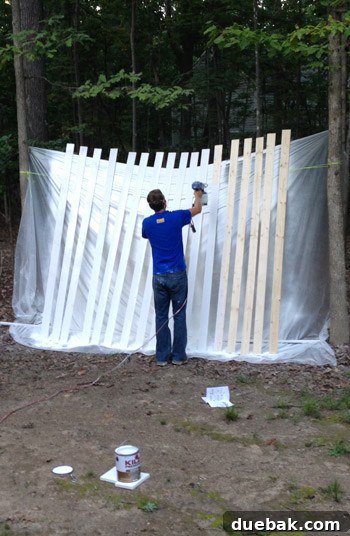
Optimizing the Painting Workflow
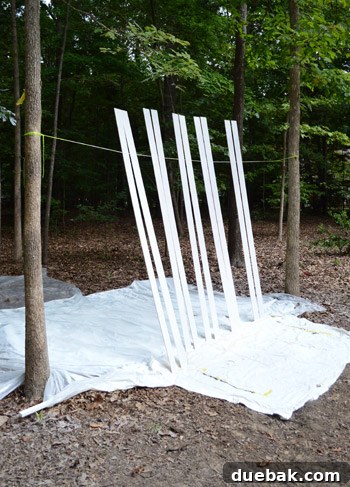
My initial painting setup, using a plastic drop cloth on the ground, proved inefficient as the plastic kept sticking to the wet backside of the boards. Through trial and error, I discovered a more effective method: laying drop cloths on the ground for protection and stringing nylon rope between two trees to create a makeshift hanging station. This allowed me to process 10-12 planks simultaneously. With a paint sprayer, I could efficiently coat two boards at once – spraying the backside and then flipping them over to tackle the front. This technique significantly streamlined the process, though it remained labor-intensive. For those curious, we used a paint sprayer similar to this one on Amazon.
The Time Investment and Material Choices
This extensive preparation alone consumed about four days, split into two-hour sessions. We had 120 boards, each requiring primer and paint on both the front and back. Our garage’s makeshift drying station could only accommodate about 45 boards at a time, protecting them from rain, dirt, and leaves while curing. This meant a cyclical process: prime and paint one batch, install them, then repeat with the next. Factoring in the frequent cleaning of the paint sprayer, it’s fair to say this wasn’t the most enjoyable part of the project. However, the vision of the finished ceiling was a constant motivator.
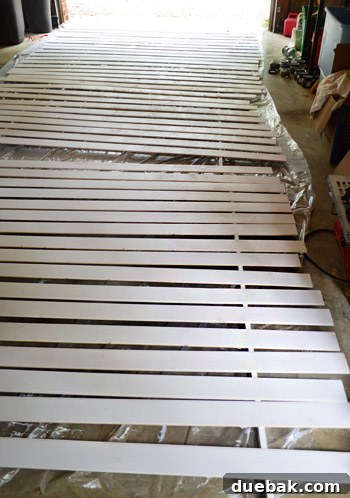
For materials, we opted for reliable products: Kilz Premium primer and Benjamin Moore’s Regal Select Exterior paint in a low luster finish. The color chosen was “In Your Eyes,” a beautiful, pure light blue. Our color selection was deliberate; we wanted a hue that was vibrant enough to be distinctly blue but not so dark that it would intensely reflect into the living room window or clash with our home’s brick exterior. It was important for the color to consistently read as blue, avoiding any gray or green undertones in varying light conditions. For those seeking similar inspiration, we’ve also compiled a list of the best haint blue paint colors for porch ceilings, a popular Southern tradition.

A Critical Learning Curve: The Insulation Revelation
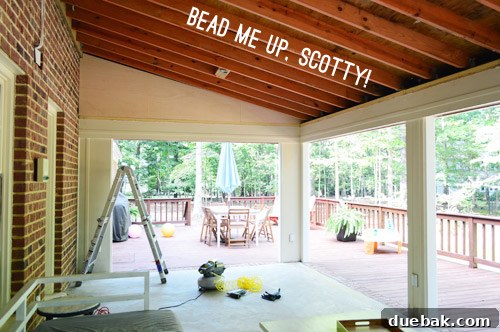
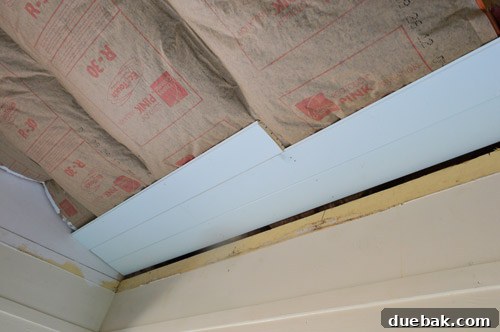
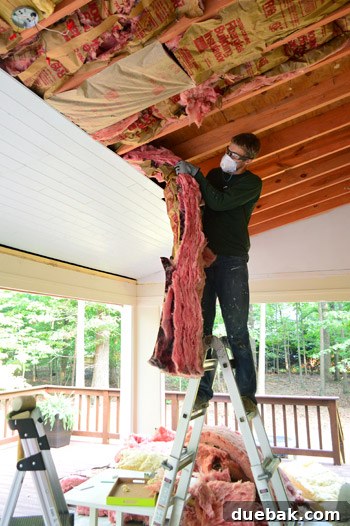
Before diving into the installation, a crucial discovery regarding insulation completely altered our plans. Initially, influenced by commenters and our own instincts, we decided to re-insulate the ceiling to mitigate summer heat. The sun relentlessly beats down on this roof throughout the day, and while open doorways facilitate cross-breezes, insulation seemed like a logical step to keep the room cooler by absorbing constant sunlight. We mostly reused existing insulation, supplemented by one new roll to fill gaps. However, we soon learned this was a mistake. We later removed it, but its initial presence is visible in the following images.
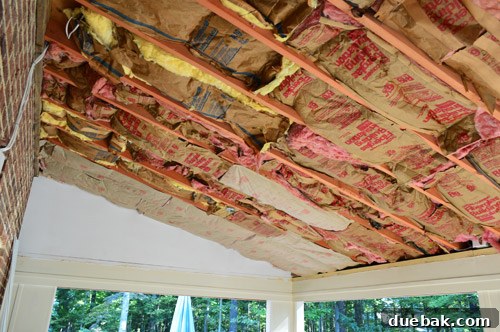
The critical lesson we learned, confirmed by a framing expert (who also helped us remove our drop ceiling), is that insulation, while excellent at trapping heat, requires proper airflow to dissipate that heat and manage moisture. When installed directly between the roof and a beadboard ceiling without ventilation, it creates a dead air space. This absence of airflow can lead to significant moisture buildup, potentially threatening the integrity of our new beadboard ceiling. More alarmingly, trapped heat can prematurely degrade the roof itself, shortening its lifespan. We are immensely grateful for this timely correction, preventing us from having to tear out a newly installed ceiling. With ample cross-breezes and the planned installation of two ceiling fans, we’re confident our sunroom will remain a comfortable, shady retreat from the deck, even without insulation.
Precision Installation: Techniques for a Flawless Finish
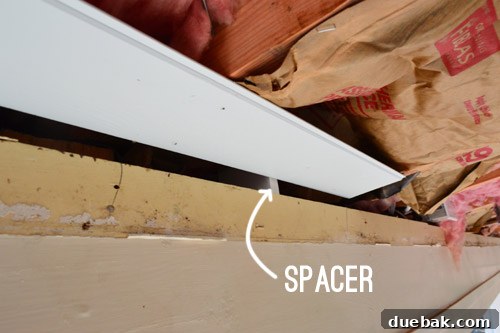
The installation of the planks brought back vivid memories of our hardwood floor project, particularly the importance of establishing a perfectly straight first board. This foundational step is crucial to prevent the entire ceiling from appearing crooked. To achieve this, I cut several scrap wood spacers to place along the front wall, ensuring our initial row was perfectly even and set the stage for subsequent rows.
Ensuring Structural Integrity: Direction and Staggering
We opted to hang our planks parallel to the long wall, aligning them with the ceiling joists spaced every 16 inches. This method ensured maximum sturdiness and allowed us to nail directly into the joists at close intervals, significantly reducing the likelihood of sagging or warping over time. Given the 20-foot length of that wall, each row typically required about 2.5 boards to complete.
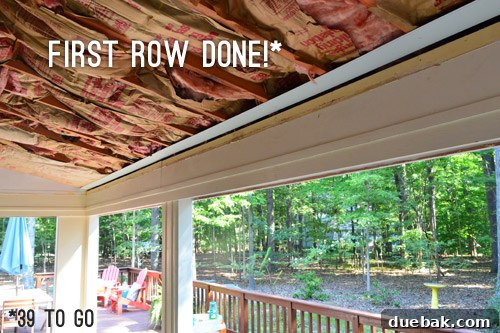
Drawing further inspiration from our hardwood flooring experience, we meticulously staggered the breaks between boards from one row to the next. This not only enhances the structural security of the ceiling by avoiding a single line of weakness but also contributes significantly to a more visually appealing and cohesive finish. For instance, if one row began with a full board, the subsequent row would start with a partial scrap, ensuring that no two board ends aligned directly on the same joist.
Seamless Joints: The Scarf Joint Technique
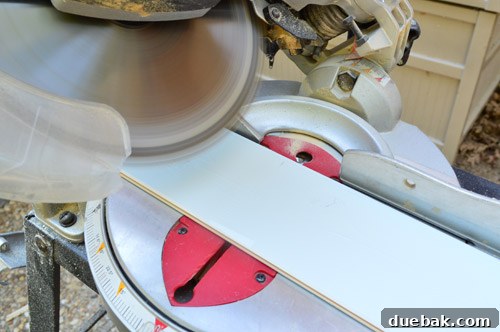
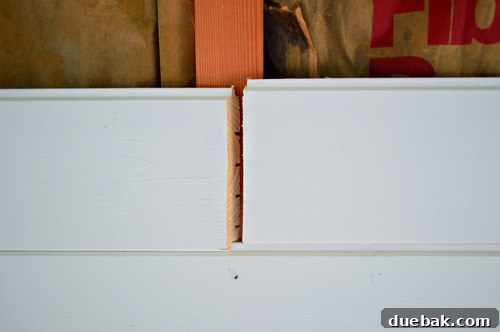
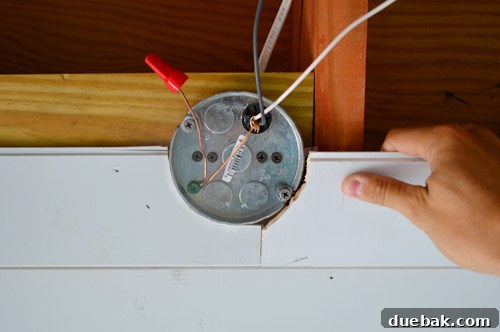
My partner, Sherry, provided invaluable assistance with the numerous cuts while I handled the nailing. To further minimize the visibility of seams, we employed a scarf joint technique, cutting every board end at matching 45-degree angles. This allows the boards to overlap slightly, creating a stronger bond and a much more seamless, professional appearance in the long run. You can see this closer in the image below, illustrating how one board is installed next to another. We also ensured that all our seams consistently coincided with a ceiling joist. This strategic alignment allowed us to nail both ends of a seam directly into the joist, effectively preventing the board ends from bowing away from the ceiling.
Smooth Sailing with the Right Tools
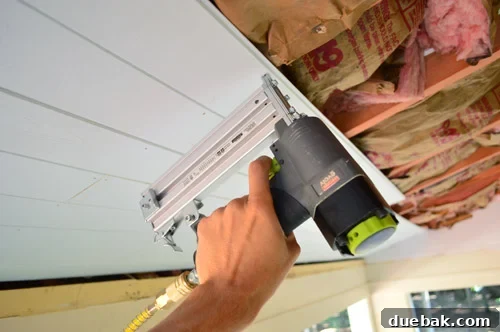
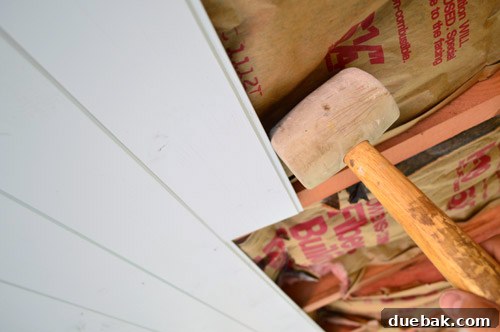
While all the precision cutting was a time-consuming aspect, having an extra set of hands made a significant difference. Fortunately, the rest of the installation proceeded quite smoothly. The tongue-and-groove design allowed each board to slide into place nicely, occasionally requiring a gentle nudge with a rubber mallet for a snug fit. Following this, each plank was secured with a shot from the nail gun into the joists, enhanced by a bead of wood glue applied along the joists before the plank’s installation. This combination ensured a strong, lasting hold. For reference, our nail gun is similar to this one on Amazon.
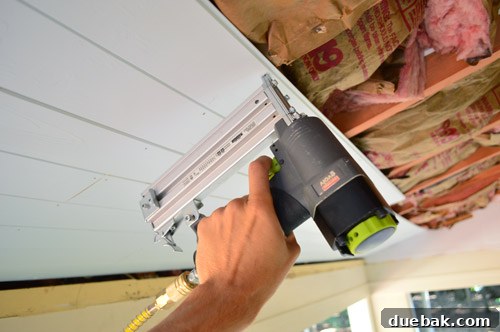
It took us a solid five hours over several days to hang the first batch of 45 boards, making it a notably slow-paced project. There were moments when the thought of simply hoisting a few 4ft x 8ft panels seemed incredibly appealing. However, this deliberate pace turned out to be a blessing in disguise, allowing us to catch our insulation error before it was too late. Because the beadboard hadn’t progressed too far, we could easily access and remove the faulty insulation without dismantling the entire ceiling.
The Final Stretch: Progress and Practical Additions
After another round of priming and painting the next set of planks, we resumed installation. By this point, I had developed a rhythm, and the second batch took me only four hours, a significant improvement, even working solo. Navigating around the two fan fixture boxes with a jigsaw presented minor challenges, but nothing insurmountable.
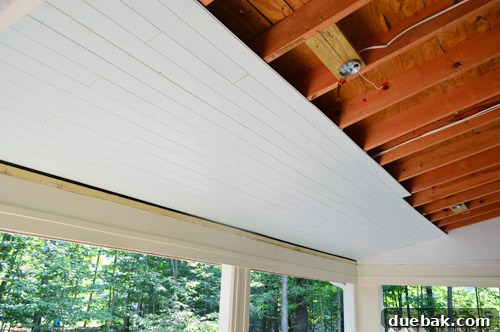
With that batch installed, the space truly began to resemble a finished ceiling.
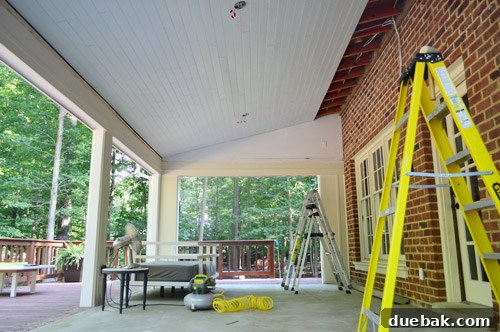
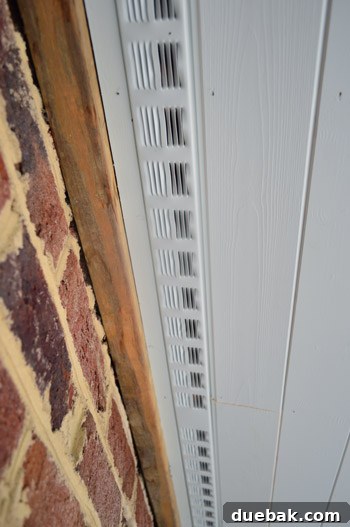
My final day of ceiling installation went relatively quickly, with only a small section remaining. Despite the increasing height challenges and the accumulated strain on my neck and shoulders from days of overhead work, I was excited for the next task: adding a row of vents across the top. This addition, also recommended by our framing expert during the insulation discussion, would introduce crucial airflow, further safeguarding the ceiling and roof.
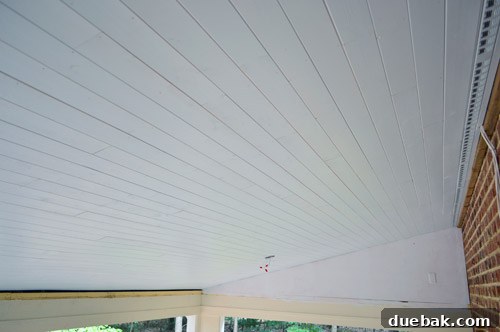
At last, all the ceiling boards were in place. While technically not a “beadboard” ceiling in the traditional sense, as our planks lack the engraved bead design, they interlock beautifully to create that classic look. We are very pleased with our decision to use simpler 6-inch planks; a smaller bead detail, given the overall scale, might have made the ceiling appear too busy.
Putting on the Finishing Touches: Ensuring Durability and Beauty
Our ceiling work isn’t entirely complete, but we’re certainly in the home stretch. The next crucial steps involve adding trim around the edges, which will then need to be caulked and painted for a polished, sealed finish. Furthermore, I plan to meticulously fill the numerous nail holes in the boards before applying one final coat of paint over the entire ceiling. This last protective layer, applied now that all planks are securely in place, will serve as an essential barrier, helping to seal the seams and further protect the wood against moisture and the elements for years to come.
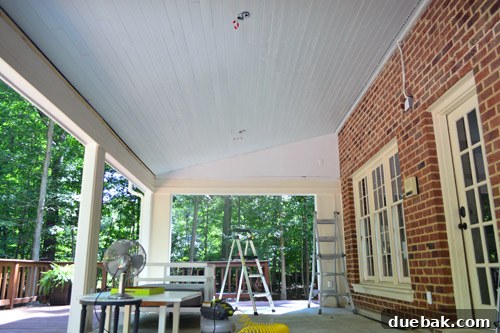
Witnessing this progress is incredibly rewarding. It almost feels like regaining feeling in my arms after weeks of physical exertion!
Our Sunroom Renovation To-Do List: Nearing Completion
Here’s an updated look at our comprehensive sunroom renovation checklist:
Rip up the old carpeting(more on that here)Remove the sliding doors and tracks to open things up(more on that here)Convert outlets to outdoor-safe rain-proof ones with covers(more on that here)Add fresh casing to the openings and caulk like crazy to waterproof everything(more on that here)Demo the old ceiling in hopes of possibly lofting it (get a pro in here for advice)(more on that here)Remove old beams, reinforce ceiling stability, and re-route electrical for two fans instead of one(more on that here)Prime, paint, and install our beadboard ceiling- Add trim around the ceiling, caulk and paint that, and hang two ceiling fans
- Repaint the columns & interior of the sunroom with white exterior paint (it’s currently cream)
- Tile the floors (we bought something that’s outdoor safe and less slick than the glue-stained concrete here)
- Get a rug, furniture, and maybe even add some outdoor curtains and lanterns/sconces?
- Build an outdoor fireplace like this down the line
This extensive list puts us well past the halfway point in our sunroom transformation. The next major milestone is tiling the floors, after which we can truly begin coasting towards the finish line. This past week was particularly intensive with painting, as we also tackled Clara’s walls, ceiling, and closet, making it one of the most paint-heavy weeks we’ve ever experienced. Sherry also conquered another area of blue trim, and we’ll share those details very soon.
Psst- Curious about where we found specific items for our home? Simply click the button below: