

Navigating the Delicate Balance: Our Approach to Sharing House Hunting Adventures Responsibly
In the vibrant world of online content creation, sharing personal experiences is often key to connecting with an audience. However, this comes with a significant responsibility, especially when those experiences involve real-world properties and the privacy of their current occupants. We recently found ourselves at this very crossroads, wrestling with the challenge of how to candidly share our house hunting journey – the exciting discoveries, the unexpected quirks, and yes, even the occasional critiques – without infringing on the privacy of the sellers and their homes. It was a debate we remember discussing at length, seeking a solution that honored both transparency and respect.
Our commitment to responsible storytelling led us to a consensus: we would only share doctored images of home exteriors. This approach allowed us to convey the essence of the properties we visited while ensuring the anonymity of the homes and their owners. A perfect example of this successful strategy can be seen in this blurred exterior shot, which effectively communicates a home’s style without revealing identifying details.

The Allure and Ethics of House Hunting Content
There’s an undeniable charm to house hunting stories. They offer a glimpse into potential futures, ignite dreams of homeownership, and provide a relatable narrative of decision-making and discovery. Readers are drawn to the journey, eager to see what others are considering, what challenges they face, and what ultimately captures their hearts. This engagement creates a powerful connection between content creator and audience, making such stories incredibly popular.
However, this popularity comes with an inherent ethical tightrope. When we critique a home, even constructively, we are talking about someone’s personal space, their sanctuary. Unfiltered images and detailed commentary could inadvertently lead to privacy breaches, generate unwanted attention for sellers, or even influence potential buyers unfairly. The last thing we ever want to do is cause discomfort or disrespect to individuals who are in the vulnerable position of selling their homes. Maintaining goodwill within the community and upholding a reputation for integrity are paramount to our work.
Beyond ethical considerations, there can also be legal implications, though indirect, when sharing private property images without consent. While blogging about general experiences is permissible, specific, identifiable details can sometimes cross lines. Our goal was always to err on the side of caution, prioritizing the privacy of others over the immediate gratification of sharing every unedited detail.
The Genesis of a Problem: Our First Attempt at Anonymity
Reaching our successful solution of digitally blurred images wasn’t without its detours. Like many creative endeavors, our journey involved a “Plan A” that, while well-intentioned, proved to be an epic fail. It was an amusing, albeit slightly embarrassing, learning experience that taught us valuable lessons about aligning creative vision with practical necessity. This “sad first attempt” to disguise each home occurred before we embraced the digital wizardry of photo editing software.
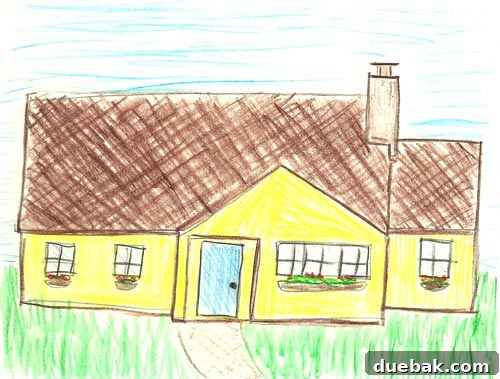
When Artistic Vision Meets Practicality: The Colored Pencil Conundrum
My wife, Sherry, is incredibly talented. This isn’t just a biased husband speaking; it’s a genuine admiration for her creative flair. Her skill shines through in many of her projects, particularly her charming and accurate hand-drawn illustrations. For instance, her cute drawings of our home’s floor plan and our lot are often praised for their clarity, detail, and endearing aesthetic. They translate complex spatial information into easily digestible and visually appealing content, which is a testament to her unique artistic perspective.
Given her proven track record, it felt natural for Sherry to tackle the challenge of disguising the house exteriors with her artistic touch. Her idea was to create hand-drawn, colored-pencil “interpretations” of each home, aiming for an abstract, stylized representation that would obscure identifying features while still conveying the general feel of the architecture. She poured her creativity into these sketches, attempting to capture the essence of each house through vibrant colors and whimsical lines.
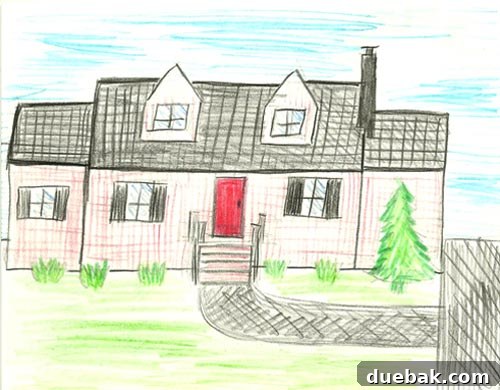
However, the results, while undeniably unique and reflecting Sherry’s artistic hand, were, to put it gently, not quite what we needed for the blog. Her “crooked colored-pencil interpretations” leaned heavily into abstract art, making it difficult to discern the actual architectural styles or features we were discussing. They were charming as standalone art pieces, but as functional tools for conveying information about real estate, they fell short. The lines were intentionally askew, the colors subjective, and the overall effect was more bewildering than informative or privacy-preserving in a practical sense.
It wasn’t an easy conversation. Looking her in the eye and explaining that her creative solution wasn’t “the way to go” felt genuinely difficult, especially given my admiration for her talents. It’s tough to critique someone you love, especially when they’ve poured their heart into a project. But the goal of maintaining both clarity and privacy on the blog was paramount. Luckily for me, Sherry possesses a fantastic sense of humor and a pragmatic approach to problem-solving. After taking one more look at her artistic endeavors, she burst out laughing, realizing the disconnect herself.
This moment of shared laughter marked a turning point. It highlighted that while creativity is invaluable, sometimes a more direct, digital approach is necessary for specific content goals. It was a wonderful reminder that not every brilliant idea translates perfectly to every context, and that’s perfectly okay. The ability to laugh at a failed attempt and pivot quickly is a valuable asset for any content creator.
Embracing Digital Solutions: The Power of Photoshop and Beyond
With our artistic Plan A amicably shelved, we turned to our trusty digital friend: Photoshop. This powerful image editing software offered the precision and versatility we needed to achieve our privacy goals without sacrificing the overall aesthetic quality of our content. The pivot to a digital solution was a logical step, as digital tools excel at tasks requiring consistency and technical accuracy.
Our chosen technique involved using a specific filter to blur the exteriors. After some experimentation, we found the “Paint Daubs” filter in Photoshop worked wonders. Unlike a simple pixelation or Gaussian blur, which can sometimes look harsh or artificial, the Paint Daubs filter offers an artistic, painterly blur. This subtly transformed the photographic details into a softer, almost impressionistic rendering, effectively obscuring identifying features while retaining the general shape and color scheme of the house. It struck the perfect balance: privacy was ensured, and the images still contributed positively to the visual flow of our posts without appearing jarring or unprofessional. This artistic blur maintained a certain level of visual interest, aligning with our blog’s creative spirit.
Exploring Image Anonymization Techniques for Content Creators
The “Paint Daubs” filter is just one of many techniques available for image anonymization, each with its own advantages and applications. Content creators frequently encounter situations where sensitive information or identities need to be protected within visual media. Understanding these different methods can significantly enhance one’s ability to create ethical and responsible content.
- Gaussian Blur: This is one of the most common and widely used blurring techniques. It applies a smooth, soft blur that effectively obscures details without creating harsh edges. It’s excellent for subtly hiding faces, license plates, or backgrounds.
- Pixelation/Mosaic: This technique breaks the image into large, square pixels, rendering specific areas unidentifiable. While highly effective for privacy, it can sometimes appear aggressive or detract from the overall image aesthetic if not applied carefully.
- Redaction: Often used for text or specific objects, redaction involves covering sensitive areas with solid blocks of color (typically black). This is a very direct and unambiguous way to hide information.
- Artistic Filters: Similar to our use of “Paint Daubs,” many software programs offer artistic filters that can transform images into paintings, drawings, or other stylized forms. These can obscure details while adding a unique visual flair, maintaining an aesthetic appeal that simple blurring might lack.
- Object Removal/Content-Aware Fill: For more complex scenarios, advanced tools can remove entire objects or people from an image, seamlessly filling the space with surrounding textures. This is ideal when an element needs to be completely absent rather than just obscured.
When selecting a technique, the key is to balance the degree of anonymity required with the desired visual impact and the nature of the content. For house exteriors, a subtle artistic blur like the one we chose maintains context better than stark pixelation, which might convey an image is heavily censored. Furthermore, while Photoshop is a professional-grade tool, excellent alternatives exist. Free software like GIMP offers similar functionalities, and numerous online image editors and mobile apps now provide quick and effective blurring, pixelation, and artistic filter options, making privacy protection accessible to everyone.
Beyond the Blur: Ethical Content Creation in the Digital Age
Our experience with house hunting images goes beyond a simple anecdote about a Photoshop filter; it encapsulates a broader commitment to ethical content creation. In an age where digital footprints are vast and often indelible, understanding and implementing robust privacy practices is not just good practice, it’s a necessity. For bloggers, vloggers, and any online creator, this means consistently asking: “Whose privacy am I affecting, and how can I protect it?”
Establishing a clear and consistent privacy policy, even if informally, helps guide content decisions. This includes everything from anonymizing personal details in stories to being mindful of geotagging locations. By actively demonstrating respect for privacy, content creators build a foundation of trust with their audience. This trust is invaluable, as it assures readers that while they are being entertained and informed, they are also engaging with a responsible and considerate source.
This commitment extends to other areas of content creation. For example, when featuring individuals, securing explicit consent is crucial. When discussing sensitive topics, using pseudonyms or altering minor details can protect identities while preserving the authenticity of a story. The digital landscape is constantly evolving, and with it, the best practices for ethical storytelling. Staying informed and adaptable is key to navigating these waters successfully.
Learning from Experience: Our Journey to Responsible Storytelling
Reflecting on our house hunting journey, from the initial enthusiasm to the creative misstep with colored pencils, and finally to the effective digital solution, is a testament to the iterative nature of content creation. It reminds us that every “epic fail” is merely an opportunity for a “Plan B” success, a chance to learn and refine our processes. The initial debate about privacy, Sherry’s earnest artistic attempt, and our eventual embrace of Photoshop all contributed to a deeper understanding of what it means to be responsible storytellers.
And as for how it all went so terribly wrong with the drawings, Sherry has a theory. She blames none other than Danielle Staub. Apparently, she was catching up on some Real Housewives reruns while getting her colored pencil on. That beeyotch ruins everything, even potentially influencing artistic judgment, according to Sherry’s humorous take! It’s a silly, lighthearted explanation that perfectly captures the spirit of our dynamic and our ability to find humor in our own missteps.
So, there you have it: our little behind-the-scenes outtake, a Friday bid-ness story about balancing creativity with caution, and transparency with privacy. It’s a journey that reinforces our dedication to sharing our lives authentically, but always with a mindful eye towards the impact on others. We believe that thoughtful content creation involves more than just sharing; it involves protecting, respecting, and always striving for the best approach.
Have any of you faced similar dilemmas in your creative endeavors? Perhaps a “Plan A” that went spectacularly awry, only for you to pivot to an ingenious “Plan B”? We’d love to hear your stories of adaptation and success after an initial stumble. Share your experiences in the comments below!