
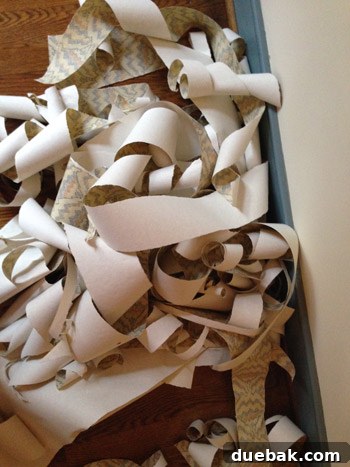
The wallpaper in our dining room is finally gone. What a relief!
Fresh, ready-to-paint walls make me so happy. (The endless blue trim, not so much.)
You might recall that every time I remove wallpaper I experiment with a different method so I can report back on what actually works. Previously I tried boiling water in a spray bottle, a steamer (which has been the easiest so far), and warm water with Dr. Bronner’s soap plus a wet rag to remove the underlayer. This time I tried a technique recommended by a former pro painter: dry stripping followed by wet stripping.
Her approach was simple—peel the paper off by hand without scoring or spraying, then use a large damp sponge to saturate and remove the remaining underlayer. I gave it a try and was pleasantly surprised: much of the paper came off in large sheets, though there were also thinner strips and leftover corners that required additional effort. It wasn’t lightning-fast, but it wasn’t painfully slow either. I’d rank dry stripping as about the same time commitment as spraying, waiting, and peeling—maybe a bit faster because you skip the soaking and waiting step. Of course, this won’t work in every situation, but if your drywall was properly prepped for wallpaper (as ours was) you may have similar success, especially with older paper. Ours was about 30 years old and already loose at some seams.
Dry stripping mostly removed the top patterned layer. Some methods, like steaming, can sometimes remove both layers at once, but with this technique I peeled off the glossy patterned paper first and left the white papered underlayer in place. Over a few days I worked my way around the room removing the patterned layer.
Here’s the underlayer I mentioned. To remove it I dunked a large sponge in warm water and wiped down the walls. That deposited enough moisture to soak through the underlayer so it began to loosen—often you can see it bubble away from the wall around the dampened area.
Then I peeled it off. This was slower: the underlayer tended to come away in small slivers, so each wall took about an hour and a half to remove the clingy glue film.
One tricky spot was the seams next to the corner built-ins, where the built-ins had been installed after the wallpaper. The wallpaper was tucked behind the trim, so I used an X-Acto knife to slice the edge, scoring a few times to cut completely through right against the trim for a clean edge.
Then I grabbed the strips with tweezers and worked them down each side of the built-ins for a neat finish.
My biggest challenge was the wallpaper inside the built-in bookcases. Unlike the primed walls, these plywood backs were unprimed and the wallpaper had been glued with a very strong adhesive. After spending about two hours on one cubby and getting a rough, lumpy surface, we decided not to keep trying to remove it. Instead we made a practical choice: leave the existing paper in place and treat it as a base for one of several finish options—paint, new wallpaper, or applied fabric. In fact, the cubby I attempted to strip ended up rougher and bumpier than the ones left intact, so leaving that paper gives a smoother foundation.
It’s a little disappointing to still have wallpaper mocked-up in the built-ins, but I’m thrilled the rest of the dining room walls are free of paper and ready for paint—including that blue trim.
To prep walls for painting after wallpaper removal, I’ve had good results spraying them with a mixture of vinegar and warm water and scrubbing with the nubby side of a sponge to remove any residual glue. Some specialty primers claim to block leftover adhesive, but so far the vinegar rub-down has worked well for us and saves the step and expense of a special primer.
A quick progress check on my pre-baby goals: de-blue-trim-ify the dining room; de-wallpaper the dining room (done); finish Project No More Graph Paper in the kitchen (done); strip the bold blue master bathroom wallpaper; rip up the old carpet runner on the stairs (done); paint the blue trim in the office. Slow but steady progress!
We still have another whole room upstairs with wallpaper waiting for us. Which final method should we use there? Maybe fabric softener—people say good things about it. So far the steamer has been the fastest and easiest, though every approach we’ve tried has been free using items we already had or borrowed. If you’ve ever tried to remove wallpaper glued to plywood, you know how maddening it can be. It’s enough to make you roll your eyes—literally.
Psst—John’s over on Young House Life sharing a post about the half marathon he ran this weekend for those who asked.