
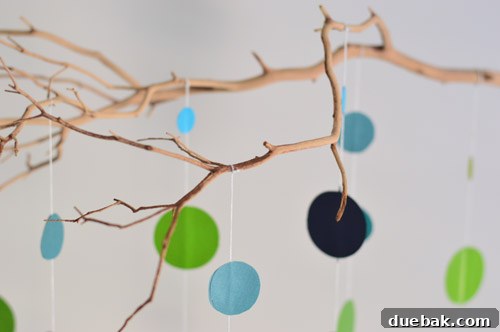
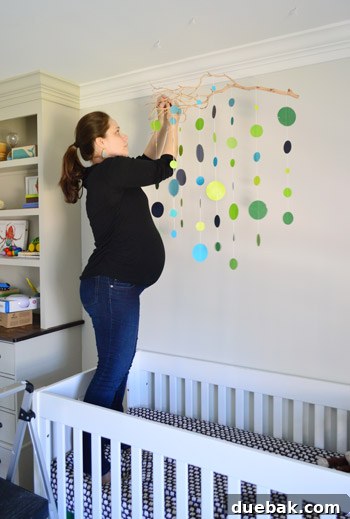
Welcome to our latest nursery project update, where we transform a simple space into a cozy haven for our newest arrival. Today, we’re thrilled to share the creation of a unique, handcrafted mobile – a true labor of love that perfectly blends rustic charm with modern aesthetics. And yes, you might just spot a heavily pregnant lady taking a test run in the crib to ensure everything is just right!
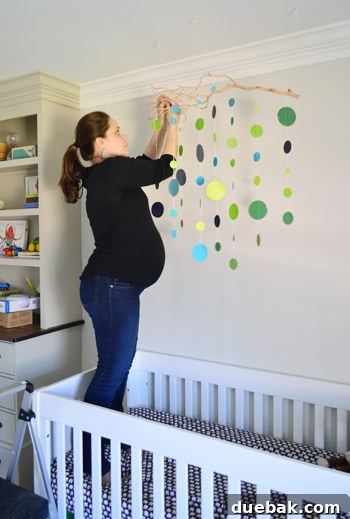
Crafting a Modern Rustic Mobile for Our Little Man
There’s something incredibly special about preparing for a new baby, and for us, that often translates into diving headfirst into DIY projects that add a personal touch to their space. This time, our focus was on creating a captivating nursery mobile for our soon-to-arrive little man. This isn’t just any mobile; it’s a piece that truly encapsulates our style – a harmonious blend of natural, rustic elements and vibrant, modern design.
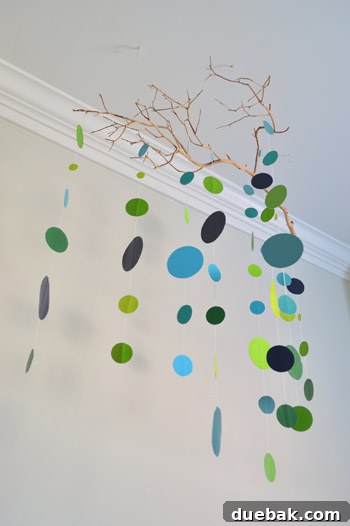
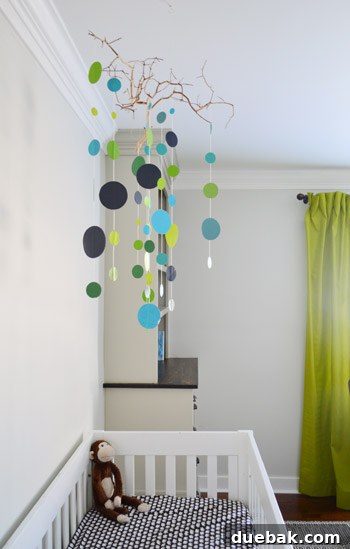
The foundation of this mobile is a beautiful manzanita branch, offering an organic, earthy feel. Complementing this natural base are playful, colorful circles in various sizes, suspended at different lengths to create a dynamic and visually stimulating display. The process of hanging this mobile was surprisingly emotional; it was a moment where the nursery truly began to feel complete, as if putting up this final piece signaled, “Okay, the mobile’s up – now the baby party can truly begin!”

A History of Handmade Nursery Delights
This isn’t our first foray into crafting nursery mobiles. Much like the mobile I lovingly made for Clara’s room – a delicate piece featuring intricate floral orbs fashioned from wire, faux flowers, and glue – this new project proved to be a wonderfully straightforward and enjoyable endeavor. The best part? Clara, our little helper, eagerly joined in the fun!

Her involvement made this project even more meaningful, transforming it into a cherished family activity rather than just a crafting task.

Step-by-Step Guide to Your Own Rustic Modern Baby Mobile
Creating your own stunning baby mobile doesn’t have to be complicated. Here’s how we brought our vision to life:
1. Selecting the Perfect Manzanita Branch
Our project began with a rather unconventional but essential item: a decorative manzanita branch. (And yes, we believe everyone should have one stashed away for such creative emergencies!). This particular branch, a former West Elm acquisition from several years ago, was ideal. It had already been bleached and debarked, ensuring it was beautifully smooth, solid, and free from any flaking bark that could pose a hazard in the crib. The natural, raw color of the branch provided a beautiful, organic contrast to the vibrant, colorful disks we planned to introduce, forming the perfect rustic modern balance.
2. Repurposing & Painting Paper Banners
For the dangling strands, serendipity struck in the form of two paper banners I’d picked up on clearance at Target for a mere $2.18 months ago, with no specific use in mind. Once the mobile idea sparked, they seemed destined for this project. The only hitch? Their original colors and patterns didn’t quite align with our nursery’s evolving scheme. But what’s a DIY project without a little creative adjustment?

A little craft paint was all it took! We spread the banners out on old cereal boxes from our recycling bin, and Clara enthusiastically joined in the painting. They required two coats to completely obscure the underlying patterns, but the process was surprisingly quick and easy, even with a spirited three-year-old assistant. It was a collaborative effort, often involving “we-both-hold-the-brush” moments to prevent paint from getting onto the strings. Clara now takes immense pride in “her baby’s” mobile, and it was a delightful bonding experience.

3. Crafting Custom Paper Circles
While our painted circles dried, it became clear that they wouldn’t be quite enough to achieve the desired fullness for the entire branch, even when cut into shorter strands. So, I grabbed some white embroidery floss and additional decorative paper. Using various round objects readily available around the house – the base of the craft paint bottle for the smallest circles, a slightly larger bottle for the middle size, and a small cup for the largest – I traced and cut out multiple circles. I aimed for similar colors to the paint we used, ensuring an even number of each size.

4. Assembling the Dangling Strands
Having an even number of circles was crucial because we used them to sandwich the white embroidery string. With a few dabs of Aleen’s Tacky Glue, we pressed two circles together over the string. This method proved highly effective, securing the string firmly between the paper disks. I visually spaced them, using the approximate two-inch spacing from the original Target banners as a guide, creating a pleasing and consistent visual rhythm along each strand.

Each completed strand measured approximately 25 inches, matching the length of the pre-made banner sections I had snipped apart. Once all the glue had dried completely, it was time for the final assembly.
5. Attaching Strands to the Manzanita Branch
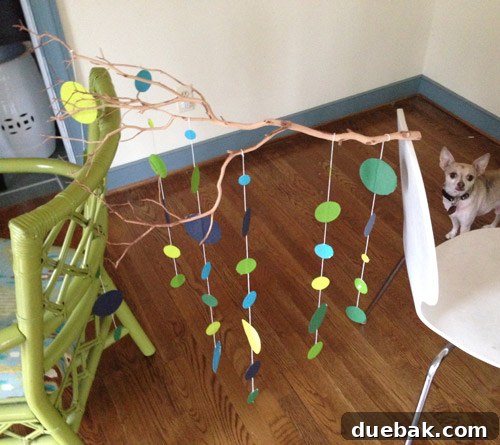
With all the colorful strands ready, the next step was to firmly tie them onto the manzanita branch at varying increments. This staggered placement was key to achieving that beautiful, playful “dangly effect.” To make this process easier, I hung the branch over the backs of two chairs, allowing the strands ample room to hang freely as I tied them. I intentionally spaced them randomly, creating slightly different widths between each, which contributed to the mobile’s organic and handcrafted charm. While Clara had moved on to happily decorating a nearby window with stickers (a rather charming curb appeal, might I add), our furry friend Burger did mosey over to supervise the progress.

Ensuring Nursery Safety: Hanging the Mobile Securely
When it comes to hanging anything over a baby’s crib, we confess to being exceptionally cautious – perhaps even a little neurotic. Our philosophy is always safety first. For instance, in Clara’s nursery, we hung a mirror over her crib, but only after drilling directly through its frame in multiple places to secure it to the wall so robustly that even John couldn’t budge it, despite it being well out of Clara’s reach.
Following this rigorous approach, even though this mobile weighs less than a pound, we took no chances. We utilized three heavy-duty brass-plated plant hooks, each capable of supporting over 10 pounds and featuring extra-long screws. This ensured that two of the hooks anchored directly into ceiling beams, and the third into a heavy-duty anchor we installed. To suspend the mobile, we used extra-strong, nearly invisible fishing wire, which creates a magical illusion that the mobile is floating effortlessly. We knotted the fishing wire to the branch at three strategic points – both ends and the central triangular branch area – connecting them to the securely mounted ceiling hooks directly above these points. And that, dear readers, is precisely how this pregnant lady found herself lounging in a crib to confirm optimal placement and safety.
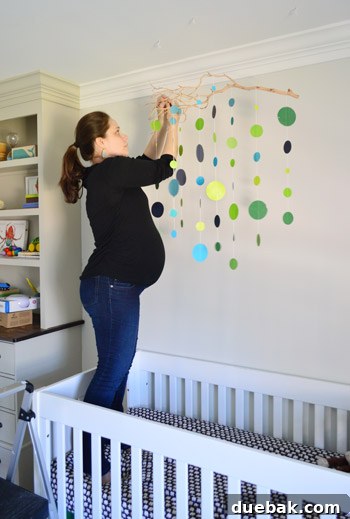
This method of hanging is truly ideal. It ensures the mobile will always remain well out of baby’s reach. Furthermore, it’s incredibly easy to adjust and raise if we ever perceive it to be within grabbing distance. Of course, once the baby becomes more mobile, we’ll lower the mattress, providing an even greater distance between little hands and the mobile. It’s truly amazing how much sweeter and more inviting the crib feels now, as if it’s echoing, “Bring on the baby!”
Reflecting on Size and Future Nursery Enhancements
Initially, after hanging the mobile, there was a fleeting thought that it might be a tad too small, wishing it filled more of the wall space. However, considering its actual dimensions – nearly three feet wide, about 16 inches deep, and 25 inches long – any larger, and its functionality might become a hindrance. As a three-dimensional object, a bigger mobile could easily result in us bumping our heads every time we leaned into the crib. After contemplating for a while, I’ve found peace with its current size, realizing that practicality often outweighs sheer visual dominance.
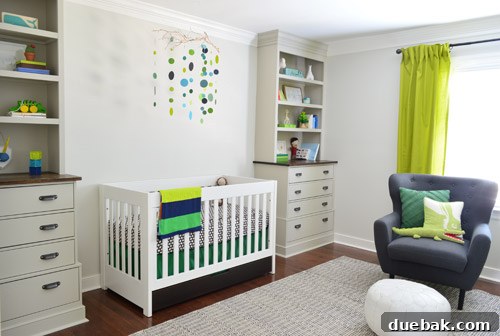
Speaking of filling out the wall, John recently surprised me by ordering two samples of Spoonflower wallpaper! He believes they could add an exciting element to the wall space between the built-ins, potentially serving as a vibrant backdrop for the mobile. It takes about 12 business days for the samples to arrive, and I’m eagerly anticipating their arrival. This could either be a “nope, that’s completely wild” moment or something we both absolutely adore, so we’ll definitely keep you updated. We’ve also discussed the possibility of an accent color painted directly onto that section of the wall, so we’re keeping our options open and embracing the evolving design process.
Nursery Transformation: Before & After
It’s incredibly rewarding to see how far this room has come. What once looked like this…

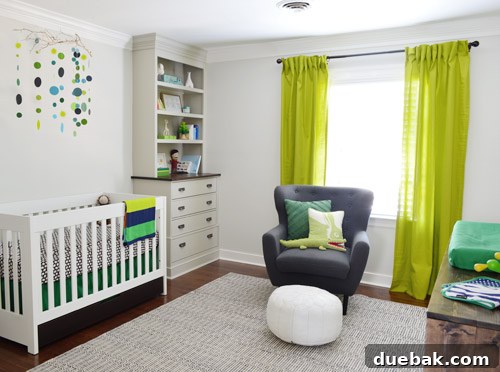
…is now steadily transforming into a beautiful, inviting space that looks more like this these days, with our new mobile as a charming centerpiece.
The Home Stretch: Nursery To-Do List
As we near the completion of the nursery, only a few outstanding items remain on our checklist:
- Possibly tweak the wall behind the crib with wallpaper or some sort of accent color to further define the space.
- Add an overhead light fixture on a dimmer switch, as there’s no ceiling light currently.
- Redo the closet to optimize storage for tiny clothes, which will involve painting, potentially adding a second hanging bar, or incorporating cubby storage solutions.
- Add various finishing touches, such as small art pieces and other accessories to personalize the room.
- And of course, the most anticipated item: just add baby!
Being in the home stretch feels wonderful, both for this pregnancy (still navigating morning sickness at 33 weeks!) and for completing the room. Most importantly, we’re brimming with excitement to finally meet the little guy who’s currently doing the macarena in my tummy. I have a strong feeling he’s going to be a very good dancer!
Considering Baby’s Perspective: What Our Little One Will See
A fantastic tip we received from a few readers was to always view a mobile from below, ensuring it’s engaging and interesting from the baby’s perspective. So, here’s a sneak peek at what our bun will see when he glances up from his crib: little spinning slices of color against a backdrop of natural branch textures. While his eyes won’t focus that high up for a little while, we wanted to ensure the view was captivating from day one.
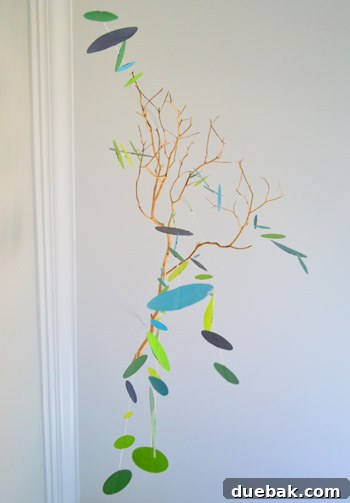
I considered adding something directly facing him at the bottom of each strand – perhaps small, animal-shaped paper cutouts that would appear flat from the side but clearly visible from his in-crib perspective. However, given that his bedding features elephants marching across it, I wondered if a simpler view of just “dancing disks” would be more soothing and less stimulating, especially since the crib is primarily a space for sleep. We’re definitely open to evolving this little creation as he grows, though. If he develops a fondness for a particular creature (remember Clara’s fascination with worms and dragons?), I can always incorporate those elements later. For now, the goal is gentle visual interest.
And just because seeing a grown man in a crib might be even more amusing than a pregnant lady, here’s an extra bonus shot for a laugh:
Are you currently working on a DIY nursery mobile? Or perhaps putting the finishing touches on a different room renovation? What about experiencing the unexpected comfort of hanging out in a crib? I’m telling you, it’s surprisingly quite a good time!
Psst- Curious about where we found something in our home or what specific paint colors we used? Simply click the button below to explore our curated home shopping guide!