

Unlock Your Inner Artist: Creating Stunning DIY Canvas Art on a Budget
There’s an undeniable magic that happens when you pick up a paintbrush – a certain creative spark that transforms a blank canvas into a personal masterpiece. For me, it always evokes a sense of French artistry, making me feel ready for a beret and a coffee! The joy of bringing a vision to life, especially when it’s achieved without breaking the bank, is incredibly satisfying. This guide will walk you through the exciting journey of transforming an oversized, deeply discounted canvas into a vibrant piece of modern art, inspired by compelling design and fueled by creativity.
The genesis of this project began with a fantastic find: a massive 40 x 30″ canvas from Michael’s, originally priced much higher, but snatched up for an incredible $23. This bargain was thanks to a perfect storm of discounts – a 50% off sale combined with an additional 25% off coupon. Such finds are a testament to the fact that beautiful art doesn’t require a hefty investment, just a keen eye for deals and a willingness to get creative. Shortly after this score, I stumbled upon a truly inspirational poster design, discovered through the endless wellspring of ideas that is Pinterest (you can find the original inspiration here). The moment I saw it, I knew I wanted to adapt its unique aesthetic, shifting its vertical orientation to a broader, more expansive horizontal format, and infusing it with my own color palette.
One of the most budget-friendly aspects of this project was the paint. Instead of investing in expensive artist-grade paints, I opted for inexpensive $2 paint samples from Lowe’s. A total of $9 for three pots of paint became the foundation of my entire color scheme. These sample pots, when mixed with white craft paint I already had on hand, yielded an impressive array of tints and shades from just a few core hues. This clever mixing technique not only saved money but also allowed for greater creative freedom, enabling me to explore subtle variations within the chosen palette.
The Artistic Process: Bringing a Vision to Life
Every great piece of art begins with a foundational structure, and for this geometric abstract, precision was key. The initial step involved carefully laying out the vertical lines that would define the artwork’s core segments.
Step 1: Establishing the Grid with Vertical Lines
To ensure even spacing and a balanced composition, I utilized a simple yet effective tool: a yardstick. By using the width of the yardstick itself as a consistent measure, I drew a series of equally spaced vertical lines across the canvas with a pencil. This method ensured a uniform and organized foundation, essential for the geometric precision I aimed for. The pencil lines provided a light guide, easily covered later by paint, but crucial for maintaining symmetry throughout the design.
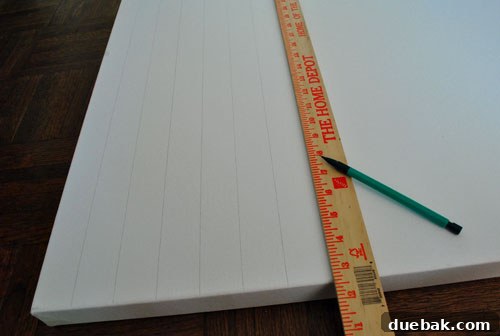
Step 2: Crafting the Angled Peaks for a Prism Effect
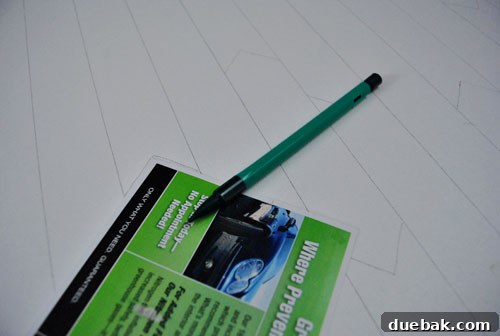
Once the vertical grid was established, the next phase involved introducing the dynamic angled elements inspired by the original poster’s prism-like shapes. For this, I employed another resourceful hack: the corner of a small card received in the mail (in this case, from an oil-change service). This everyday item became my unexpected stencil, allowing me to consistently create sharp, identical angled peaks within each vertical section. The goal was to mimic the faceted, light-refracting quality of a prism, adding depth and visual interest to the composition. This step transformed the simple grid into a complex network of interlocking shapes, ready for color.
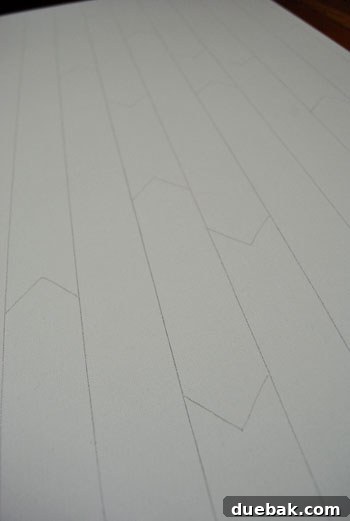
Step 3: Infusing Color – A Symphony of Blues and Greens
With the structural lines complete, it was time for the most exciting part: bringing the canvas to life with color. The chosen palette centered around a refreshing array of blues and greens, all derived from my initial three $2 sample pots from Lowe’s. Specifically, I used testers of Behr’s “Tropical Waters,” “Embellished Blue,” and “Thermal Spring.” These vibrant hues were then skillfully mixed with varying amounts of white craft paint. This technique allowed me to create a vast spectrum of tints – from deep, saturated tones to light, airy pastels – all from a limited number of base colors. Each geometric shape was carefully filled, creating a mosaic of interconnected shades that began to form the envisioned prism effect. This initial layering of color was a crucial step, setting the mood and energy of the entire piece.
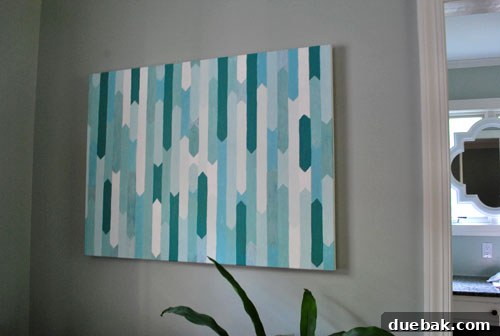
The Power of Refinement: From High Contrast to Subtle Elegance
The first rendition of the painting, while visually striking and energetic, presented a contrast that was a little too stark for my taste. It was bold, certainly, but lacked the subtle sophistication I had hoped for. This moment, however, perfectly encapsulated one of the greatest joys of painting: the freedom to evolve and improve. Unlike many other creative endeavors, painting offers the unique advantage of iteration; if you don’t love it, you can simply paint right over it. This understanding is incredibly liberating and encourages experimentation.
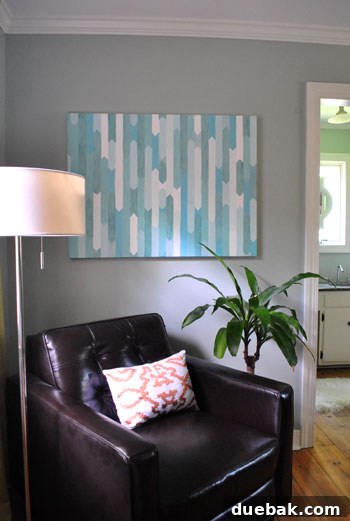
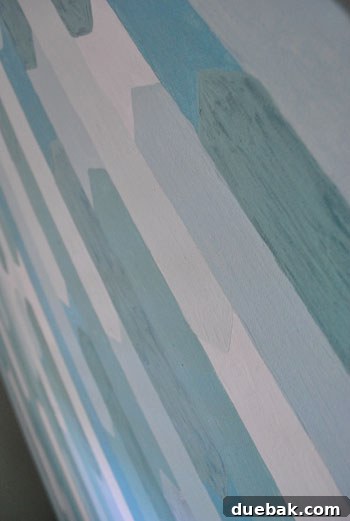
Embracing this philosophy, I decided to refine the piece. I mixed a much lighter, softer shade of greeny-gray – a hue that offered tranquility and depth. This new color was then applied over all the darker green sections of the original painting. The transformation was immediate and profound. The high contrast softened into a beautiful tone-on-tone effect, where the varied shades of blue and green still existed but blended more harmoniously, creating a much more subtle and refined aesthetic. This iterative process highlights the importance of trusting your artistic instincts and not being afraid to make changes, even significant ones, to achieve your desired outcome. The final version presented a calmer, more integrated visual experience, a true testament to the power of artistic refinement.
Finding the Perfect Home: The Art of Placement
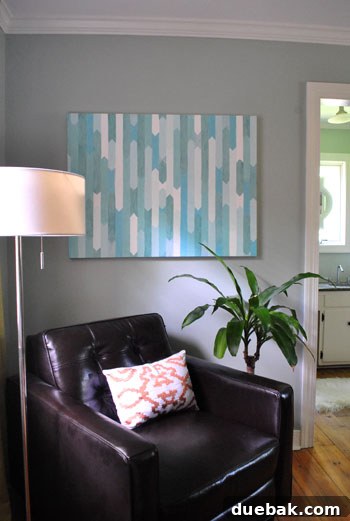
I am absolutely enamored with the finished artwork. The deliberately imperfect lines, the visible painterly brush strokes, and the nuanced variations within the limited color palette create a captivating visual texture. The way the light plays on the different shades, revealing depths and highlights, is exactly what I envisioned. However, despite my affection for the piece itself, I encountered a common interior design challenge: finding its ideal placement within our home. Currently situated in our bedroom, it doesn’t quite resonate with the existing decor. The walls in this room are painted a similar soft blue-green shade, and while I initially thought the tone-on-tone look of the art might layer beautifully, it ended up feeling a bit too monotone, bordering on bland. It simply blends in rather than standing out and making a statement.
This experience underscores an important principle in interior design: art, even if beautiful on its own, must complement and enhance its surroundings. The goal is to create a harmonious space, where each element contributes to the overall aesthetic without being swallowed by it. Therefore, we’ve begun to explore alternative locations. One promising idea is our dining room, particularly above a grand buffet or console table near the front entryway. This space offers a different wall color and ample visual weight, which could provide the perfect backdrop for the canvas to truly shine. The contrast in wall color would allow the subtle tone-on-tone variations within the artwork to pop, creating a focal point that draws the eye without overwhelming the space. It might also find a home in a completely different room, but one thing is clear: it needs a backdrop that isn’t a soft blue-green wall. It seems I appreciate tone-on-tone art most when it’s not placed on a wall of that very same tone – a peculiar but valid design preference!
Reflections on the Creative Journey: More Than Just Paint on Canvas
When I embarked on this painting project, I optimistically anticipated it would take an evening or two. In reality, it stretched into a more substantial commitment – perhaps four or five two-hour sessions. Yet, by the end, I almost didn’t want it to conclude. There’s a profound satisfaction that comes from immersing oneself in a creative endeavor, losing track of time as strokes transform into something tangible and beautiful. It’s a wonderful feeling to paint again, to reconnect with that artistic part of myself. The experience has certainly ignited a desire to tackle another canvas soon, and I sincerely hope I do.
This project truly transported me back to my high school and college art days. I was one of those students who eagerly enrolled in every art class my high school offered, nurturing a deep passion for creation. This passion eventually led me to art school in NYC for college, where, somewhat surprisingly, I ultimately earned a BFA in Advertising Design. While my professional path diverged, the foundational principles of art and design have always remained. And speaking of the cost of art supplies, using those inexpensive paint pots from Lowe’s brought a genuine smile to my face. I’m intimately familiar with the staggering prices of oil paint – a “five million dollars” exaggeration perhaps, but for a perpetually broke college student, even basic supplies felt like a luxury. This DIY approach makes art accessible, proving that you don’t need a professional studio or a limitless budget to create something meaningful and beautiful for your home.
The Narrator of Life: A Humorous Anecdote
Speaking of those art school days, a vivid memory resurfaces. It was in a drawing class that one of my professors, a keen observer, bestowed upon me a rather memorable nickname: “the narrator of life.” Apparently, while deeply engrossed in sketching, I had a habit of audibly commentary on everything happening around me, or perhaps, everything happening in my own creative process. Examples included “oops, I dropped my charcoal,” “now for the foreground,” or a startled “yikes, it’s noon already.” In retrospect, it sounds quite annoying, doesn’t it? Thankfully, most of this running commentary was muttered under my breath. It wasn’t until my teacher had to lean in and specifically ask what I was saying that I realized my “internal monologue” was, in fact, an external dialogue. I was so completely “in the zone,” so absorbed in the act of creation, that I was oblivious to my vocalizations.
At the time, the “narrator of life” nickname filled me with a youthful embarrassment. However, with the passage of time and the twists and turns of a career that now largely involves writing and sharing personal experiences – essentially, narrating my life – I find it utterly hilarious. Who would have thought that a seemingly awkward habit from my art student days would foreshadow my actual profession? It’s a wonderful full-circle moment. Perhaps I should try to hunt down that professor (Facebook might be a good starting point!) and share where my journey eventually led me. Though, I might have to omit the detail about using house paint instead of traditional oil paints. That might be a scandalous revelation for a seasoned art professor!