

Embarking on a home renovation project, especially one as transformative as installing new flooring, is always an adventure. We recently tackled the challenge of laying a floating cork floor, and while we’re not quite ready for the grand “ta-da!” reveal, we’re incredibly close! What we can confidently say is that this project, initially seeming daunting, proved to be surprisingly accessible for DIY enthusiasts. If we can do it, you can too.

Mastering DIY: A Comprehensive Guide to Installing Floating Cork Floors
Our journey to a beautifully updated home has been an open book, and we’re thrilled to share the latest chapter: the near-completion of our floating cork floor installation. From the initial state of our old flooring to the rich, inviting tones of cork now gracing most of our space, it’s been a rewarding transformation. You can catch up on our previous updates and the beginnings of this project here, where we laid the groundwork for this exciting home improvement.

Our space before the cork transformation began.

Significant progress with our new cork flooring in place.
Note on color: While some photos might show the cork with a more reddish or orange tint, its true color in person is a beautiful, rich mocha. For the most accurate representation, we recommend checking out our installation video or the one featuring Clara. We’re committed to capturing its true essence in future photos!
Why Choose Floating Cork Flooring for Your Home?
When considering new flooring, the options can feel endless. For us, floating cork flooring stood out for a multitude of compelling reasons that go beyond mere aesthetics. Cork is an incredibly versatile and sustainable material, harvested from the bark of cork oak trees without harming the tree itself, making it an eco-conscious choice for any homeowner. Its unique cellular structure gives it remarkable properties that contribute significantly to home comfort and functionality, setting it apart from traditional flooring materials.
Firstly, cork is renowned for its exceptional comfort underfoot. Unlike hard surfaces such as tile or traditional hardwood, cork offers a soft, resilient feel that is incredibly gentle on joints and backs. This makes it a fantastic option for kitchens, living rooms, or any area where you spend a lot of time standing. Beyond comfort, cork acts as a natural insulator, helping to keep your home warmer in the winter and cooler in the summer, potentially leading to energy savings. It’s also an excellent sound absorber, significantly reducing echo and noise transfer, which is a blessing in busy households or multi-story homes. We’ve noticed a remarkable difference in the overall tranquility of our space since installation.
Durability is another key factor that often surprises people about cork. Despite its soft feel, cork is remarkably resistant to dents and scratches. We’ve seen firsthand how well it holds up to the playful antics of our pet, Burger, without showing any signs of wear from his nails. Accidental drops of dishes or toys are also far less likely to leave a permanent mark compared to more rigid flooring materials. And once sealed, as we plan to do, its resilience and longevity are further enhanced, protecting it from moisture and everyday spills. The rich, deep mocha color we chose also adds a sophisticated warmth that has completely transformed our formerly white-on-white room, demonstrating cork’s ability to elevate any interior design scheme with its natural beauty and texture.
Getting Started: Essential Preparation for Your Cork Floor Installation
A successful flooring project always begins with thorough preparation. Rushing this stage can lead to frustrating issues down the line, so taking your time here will pay dividends. Before you even think about laying your first plank, ensure your cork flooring has had ample time to acclimate to your home’s environment. This typically means allowing the sealed boxes of flooring to sit in the room where they will be installed for at least 48 to 72 hours. Acclimation helps the cork adjust to your home’s specific temperature and humidity levels, minimizing the risk of warping, gapping, or other dimensional instabilities after installation.
Next, focus on your subfloor. It must be clean, dry, and most importantly, level. Any unevenness in the subfloor, even slight variations, will translate to an uneven finish on your new cork floor. Address any dips or humps with appropriate patching compounds or leveling agents to create a perfectly flat base. A clean surface ensures a proper fit and prevents dust or debris from interfering with the floating mechanism or creating future issues. Vacuum thoroughly and wipe down the area to ensure it’s spotless. You’ll also want to remove any existing baseboards or trim, as these will be reinstalled or replaced after the flooring is down to create a polished, professional finish, ensuring the expansion gap is properly hidden.
Essential Tools for a Smooth Floating Cork Floor Installation
Having the right tools at hand will make your DIY cork flooring project significantly smoother and more efficient. Investing in or renting these items will save you time and frustration, ultimately leading to a more satisfying outcome:
- Cork Flooring Planks: The star of the show! Measure your space carefully and add 10-15% for cuts, potential mistakes, and future repairs.
- Hammer: A standard claw hammer is perfect for tapping planks into place.
- Tapping Block: Crucial for distributing hammer force evenly along the plank edge and protecting the delicate tongue and groove from damage. We sourced ours from a flooring kit from Home Depot, a worthwhile investment.
- Pull Bar: Indispensable for securing planks along walls and in tight spaces where a tapping block can’t fit, allowing you to pull the last plank into a tight fit. Also typically part of a comprehensive flooring kit.
- Spacers: Small, uniform blocks used to maintain the crucial expansion gap around the perimeter of the room.
- Utility Knife or Scoring Tool: Excellent for making precise, straight cuts on cork planks, especially when only a small portion needs to be trimmed.
- Jigsaw or Circular Saw: Essential for making intricate cuts around doorways, cabinets, and other obstacles. A miter saw can be incredibly helpful for perfectly straight and angled cuts on plank ends.
- Measuring Tape: Accuracy is paramount for professional results, so a reliable measuring tape is a must-have.
- Pencil: For marking cuts with precision.
- Safety Glasses and Gloves: Always prioritize safety when working with tools and materials.
Step-by-Step Installation: Laying Your Floating Cork Floor
The beauty of modern floating cork floors lies in their user-friendly click-and-lock system. This innovative design makes installation a gratifying DIY endeavor, eliminating the need for messy adhesives or complex fastening methods. While it requires patience and precision, the fundamental process itself is straightforward. We’ll guide you through the essential steps to achieve a seamless and professional-looking cork floor that will enhance your home’s comfort and appeal.
Understanding the Tongue-and-Groove System
At the heart of floating floor installation is the ingenious tongue-and-groove system. Each cork plank features a precisely milled “tongue” on one side and a corresponding “groove” on the other. The objective is to slide the tongue of a new plank snugly into the groove of the previously installed plank, creating a secure, interlocking bond. When correctly installed, the boards lay flat and tightly together, forming a smooth, monolithic surface that appears to float above the subfloor. It’s an intuitive system designed for both efficiency and long-term stability.

The simple yet effective tongue-and-groove mechanism ensures a tight fit.
To truly grasp the dynamics of installation and see the techniques in action, we highly recommend watching our video tutorial, which visually demonstrates each step. However, for those who prefer a photographic guide or need to keep things quiet at work, we’ve meticulously documented the process below, ensuring you have all the information you need to proceed confidently.
The Art of Securing Planks: Angle, Tap, and Lock
Once you’re familiar with the tongue-and-groove concept, the actual laying process becomes intuitive, relying on a systematic approach for each plank. Here’s how we successfully secured each piece of our cork flooring:
Step 1: Angle and Engage. Begin by sliding the tongue of the new plank into the groove of the previously installed plank at a slight angle, typically between 20-30 degrees. This initial engagement creates a loose but functional connection, allowing for slight adjustments before fully locking it into place.

Engaging the tongue and groove at an angle is the first critical step.
Step 2: Lay Flat and Align. With the long side loosely engaged, gently lower the plank until it lies completely flat on the subfloor. Then, carefully slide it sideways along the length of the row until the short end’s tongue aligns perfectly with the groove of the adjacent plank in the same row. Precision here ensures a seamless appearance.

Lowering the plank flat and aligning the short end for a perfect fit.
Step 3: Tap the Short End. This is where your tapping block comes into play. Place the tapping block against the short end of the new plank, ensuring it’s flush with the edge. Using your hammer, give the block a few solid taps (what we affectionately call a “solid wallop”). The tapping block is designed to absorb and distribute the impact, protecting the delicate cork edges while firmly driving the plank into position. You’ll visibly see the seam between the short ends disappear as the planks lock securely together.

Using the tapping block to secure the short end of the cork plank.
Step 4: Tap the Long Side. Once the short end is secure and flush, repeat the tapping process along the long side of the plank. Place the tapping block against the long edge and deliver a series of firm taps. Observe the slight seam that might still be present; with each tap, you’ll see it vanish, indicating a tight, secure fit along the entire length. This step ensures that the entire plank is fully engaged and locked with its neighbors, preventing any gaps.
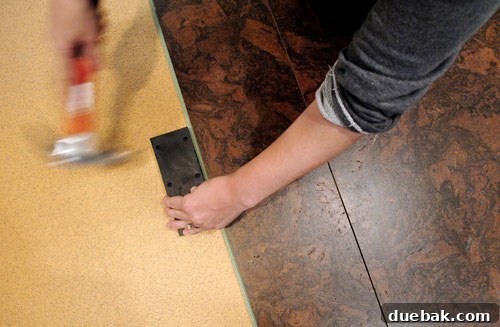
Tapping along the long side to eliminate any remaining seams.
Step 5: Ensure Flatness. Occasionally, after securing both the short and long sides, the outside edge of the newly installed plank might “pop up” slightly, creating an undesirable unevenness. To counteract this and ensure a perfectly flat surface, we found it incredibly effective to apply our body weight directly onto the plank while simultaneously giving it a few additional taps with the hammer and block. This technique helps to settle the plank firmly into place, ensuring it behaves and lays completely flat, contributing to a professional and consistent floor surface.
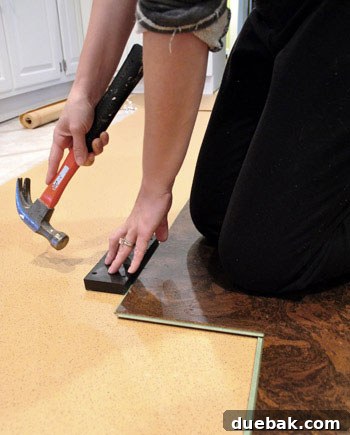
Applying weight to ensure the plank lays perfectly flat and stays put.
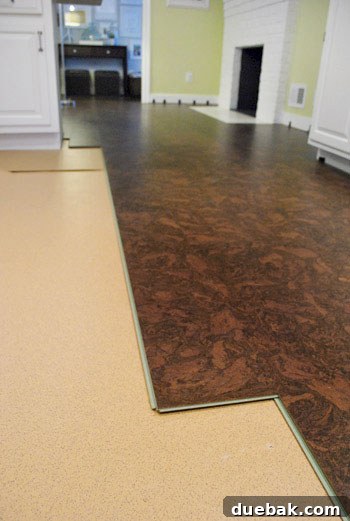
Mission accomplished: a perfectly behaved, flat plank, ready for the next one.
Mastering the Edges: When a Pull Bar Becomes Your Best Friend
As you approach the walls and other immovable objects, you’ll inevitably encounter areas where there isn’t enough space to effectively use a tapping block and hammer in the traditional manner. This is precisely where the pull bar becomes an indispensable tool, allowing you to achieve a tight fit even in the most restricted spaces.
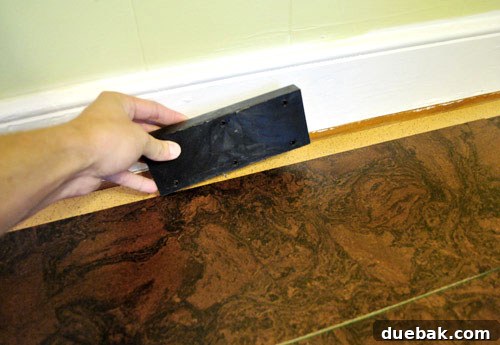
Tight spaces mean rethinking your tapping strategy as you near the wall.
The pull bar, typically a flat metal tool with a hooked end, is designed to hook securely over the edge of the plank closest to the wall. You then use your hammer to tap the other end of the pull bar, effectively leveraging the wall to pull the plank towards it and lock it into place. This ensures a tight seam even in the most challenging areas. Remember, your comprehensive flooring kit from Home Depot should include this essential tool, along with your tapping block and spacers.
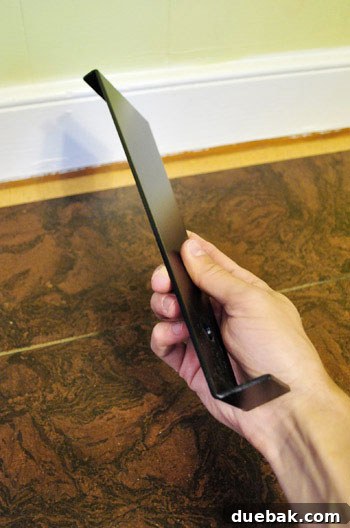
The pull bar: an essential tool for securing planks along walls and in tight spots.
A critical consideration when working along the perimeter of the room is maintaining a proper expansion gap. Floating floors, including cork, are designed to expand and contract naturally with changes in temperature and humidity within your home. A recommended 5/16th inch gap around the entire perimeter of the room is crucial to prevent warping, buckling, or other damage. We meticulously use spacers to consistently maintain this precise distance from the wall throughout the installation process. Don’t worry about the visible gap – shoe molding or baseboards will completely cover these slivers of space, making them undetectable once the project is finished, providing a clean and polished look. For more details on using spacers and managing expansion, you can refer back to our earlier post here, which delves deeper into the foundational aspects of floating floor installation.
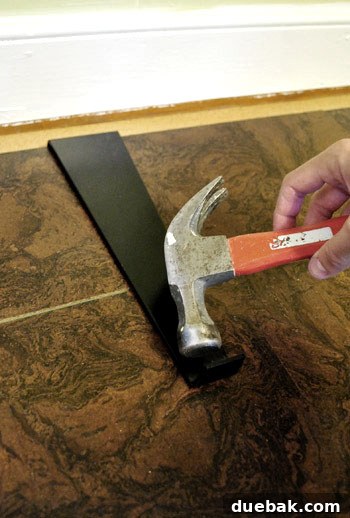
Maintaining the vital expansion gap with spacers is crucial for the longevity of your floating floor.
Navigating Obstacles: Working Around Appliances and Complex Cuts
While the click-and-lock system makes laying planks in open areas relatively quick and satisfying, the real time investment in a flooring project often comes from navigating obstacles. These include making precise cuts around doorframes, tricky corners, kitchen peninsulas, and, notably, managing heavy appliances. The cuts, especially those that snake around irregular shapes, demand significant patience, accurate measurements, and the right cutting tools like a jigsaw or utility knife. It’s a meticulous process where attention to detail truly pays off for a professional, custom-fitted finish.
Moving large, heavy appliances such as refrigerators, stoves, and dishwashers, presents its own set of challenges and requires careful planning. It’s often necessary to slide a few planks underneath them to ensure the appliances remain level and, critically, don’t “pin down” too much of the floating cork floor. A floating floor needs freedom to expand and contract without being restricted by immovable weight. This process requires extreme caution to avoid damaging either the appliances or your newly laid floor. Learning from past experiences (we once grooved our old hardwood floors sliding out a refrigerator), we adopted a “two-layers-of-cardboard-over-a-scrap-piece-of-cork” approach. This provided ample protection and allowed us to carefully maneuver the heavy units without incident, demonstrating that a little extra foresight can prevent costly repairs or aesthetic damage. This careful approach might seem excessive, but protecting your investment is always worth the effort.
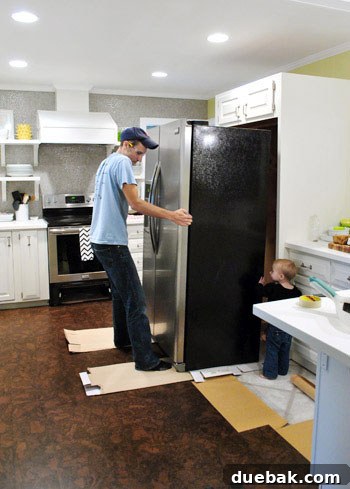
Extreme caution and protection are essential when moving heavy appliances over new flooring.
The Home Stretch: Finishing Touches and Long-Term Care
As you near the completion of laying all the planks, it’s natural to eagerly anticipate the “after” pictures and the satisfaction of a fully transformed space. While we’re not quite there yet – the laundry room still awaits its cork transformation, and transitions and shoe molding need to be reinstalled – the progress is undeniable. We’ve strategically captured glimpses of the installed sections, showcasing the beauty and profound transformation already achieved throughout our main living areas. The shift from bare subfloor to a rich, warm cork surface is truly striking.
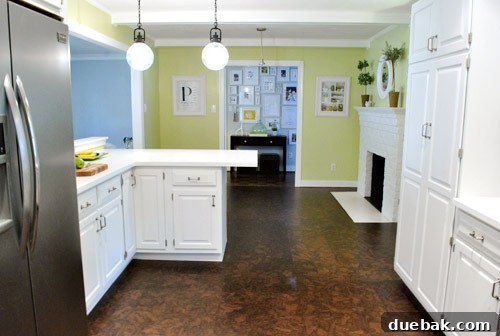
A peek at our almost-finished cork flooring project.
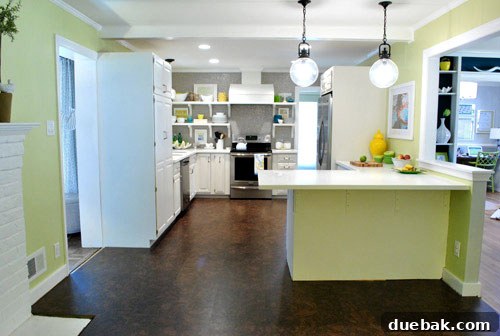
The new cork floor beautifully complements the existing decor.
Beyond the immediate installation, the long-term beauty and durability of your cork floor depend significantly on proper finishing touches and ongoing maintenance. Once all the planks are laid, installing transition strips where your cork floor meets other flooring types (like tile or carpet) and attaching shoe molding along the baseboards will provide a professional, finished look. These elements also serve a practical purpose by concealing the necessary expansion gaps you meticulously maintained during installation, ensuring the floor can move freely beneath. The attention to these details truly elevates the entire project from DIY to professional quality.
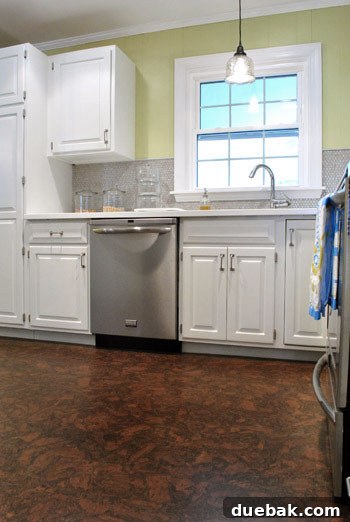
A finished section showing the seamless integration of the new cork flooring.
Perhaps the most crucial step for extending the life and enhancing the resilience of your new cork floor is sealing it. While cork is naturally durable, a good quality sealant provides an additional layer of protection against spills, scuffs, and general wear and tear, especially in high-traffic areas like kitchens. This step is something we highly recommend for added peace of mind and longevity, creating a more impermeable surface. We are very much looking forward to completing this final step, as it will truly lock in the floor’s beauty and robustness, ensuring it stands the test of time and daily life.
A quick, invaluable tip for those embarking on a kitchen renovation: always install your cabinets first, and then lay your floating cork floors around them. Floating floors, by design, need the ability to expand and contract freely without restriction. Heavy, stationary cabinetry resting directly on top of a floating floor can restrict this natural movement, potentially leading to warping or buckling of the planks over time as the cork attempts to react to environmental changes. By installing cabinets first, you ensure the integrity of your floating floor for years to come, allowing it to perform as intended. This is a crucial lesson we adhered to, and we strongly encourage you to do the same for a flawless and lasting installation. More details on this can be found in our previous post here.
Reflecting on the DIY Experience and Living with Cork
Every DIY project brings its own set of learnings and moments of both challenge and triumph. While the process of installing our floating cork floor took a little longer than initially anticipated – mainly due to the intricate cuts required around our peninsula, cabinets, and doorways, and the careful dance of moving heavy appliances – the satisfaction of seeing it come together is immense. It’s a testament to the fact that even complex home improvements are achievable with patience, a methodical approach, and a willingness to learn along the way.
One of the most delightful and often understated aspects of our new cork floor is its inherent sound-absorbing quality. Despite what a particular video with Clara might imply (where a thrown football seems to make an incredibly loud sound, likely an amplification quirk of the camera rather than the floor itself), in real life, the floor is remarkably soft and quiet. It beautifully dampens footsteps and reduces ambient noise, creating a much calmer and more peaceful home environment. Dropped items don’t echo or create jarring sounds, which is a significant improvement over harder flooring types. This unexpected benefit has truly enhanced our daily living experience, contributing to a more serene atmosphere throughout our home.
Clara enjoying the new, quiet cork floor – truly a game-changer for sound!
We’re optimistic that the final section, our laundry room, will be a speedy finish, as it’s a smaller, less complex area. Knock on wood – or in our case, knock on cork! The end is certainly in sight, and we’re excited to see the entire project fully complete.
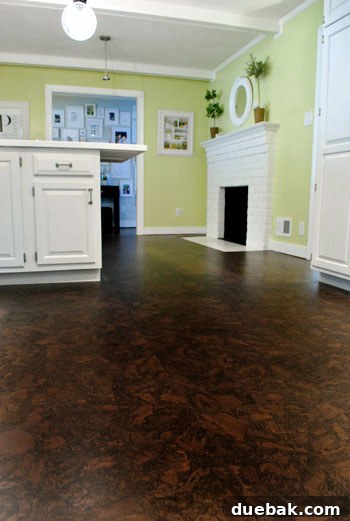
The final frontier: our laundry room, awaiting its cork transformation.
Our Verdict on Cork Flooring: A Resounding Success
Having lived with our partially installed cork floor for some time now, we can confidently share our overwhelming satisfaction. The rich, deep mocha color has not only brought warmth and sophistication to a room that once felt stark but has also proven incredibly forgiving in daily use. Our furry friend, Burger, with his enthusiastic runs and playful antics, leaves absolutely no scratches or dings from his nails – a remarkable feat compared to previous flooring experiences, which often showed wear and tear quickly. Similarly, accidental drops of items, from utensils in the kitchen to toys in the living area, leave no lasting dents, which speaks volumes about cork’s natural resilience and ability to absorb impact.
Beyond its robust durability, the comfort factor is undeniable. The soft, yielding surface is incredibly easy on the back and knees, a blessing for anyone who spends significant time standing in the kitchen or walking through their home. This inherent comfort, combined with its excellent sound absorption properties, creates a truly serene and comfortable living environment, reducing echoes and ambient noise. Once we apply the final sealant, we anticipate even greater durability and peace of mind, knowing our floor is well-protected for years of enjoyment, maintaining its beauty and functional benefits.
Conclusion: Ready to Transform Your Home with Cork?
Are you currently in the midst of a home improvement project that’s testing your patience, or perhaps considering a flooring update? We hope our detailed account of installing floating cork floors inspires and equips you with the knowledge and confidence to tackle your own project. It’s a project that offers significant aesthetic and functional benefits, and it’s genuinely achievable as a DIY endeavor. The comfort, quietness, and remarkable durability of cork make it an outstanding choice for any home seeking an eco-friendly and stylish upgrade. We’ll certainly keep you posted as we cross the finish line and enjoy our fully cork-floored home!