
DIY Bed Canopy: Crafting a Dreamy Retreat for Your Child’s Room
Creating a space that sparks imagination and provides comfort is a joy for any parent. Recently, our daughter Clara encountered a bed canopy at a friend’s house, and it was love at first sight! Her immediate request for “daddy and mommy to build a canopy with a hammer and some blankets” set us on a delightful DIY journey. While we skipped the hammering blankets part, we were fully on board to create a beautiful, whimsical bed canopy that would add a playful personality to her room and hopefully, encourage her transition to her daybed.
Why a Bed Canopy is the Perfect Addition to a Child’s Room
A bed canopy is more than just a decorative element; it transforms a simple bed into a magical haven. For children, it creates a cozy, enclosed space that feels like a private world, perfect for reading, playing, or dreaming. This sense of enclosure can be incredibly comforting, fostering a feeling of security and often making the transition from a crib to a bigger bed much smoother. The whimsical nature of a canopy also encourages imaginative play, turning a bedroom into a fort, a castle, or a secret garden. It’s a design choice that grows with your child, adapting to changing tastes while always retaining its enchanting appeal. Plus, the ability to customize it allows you to perfectly match your existing decor and infuse your child’s personality into their space.
The Inspiration & Initial Design Phase
Clara’s enthusiasm was our primary fuel for this project. Her vision, though rudimentary, ignited our own creative spark. The first step in our DIY bed canopy adventure was practical experimentation. We gathered some spare fabric from our stash, not for its color, but purely to test the shape and drape we envisioned. We were leaning towards a design similar to this, aiming for a soft, flowing aesthetic that would complement Clara’s room without overwhelming it. This initial mock-up was crucial for determining the necessary fabric yardage and ensuring our chosen shape would work in the space.
Interestingly, the initial planning stages for the canopy began even before we embarked on painting her room, closet, and ceiling. However, as often happens with home projects, priorities shifted. We quickly realized that painting the room first would be far more efficient and cleaner than trying to paint around a newly installed canopy. So, the room’s fresh coat of paint rightfully jumped to the front of the project queue, ensuring a clean slate for our upcoming canopy installation.
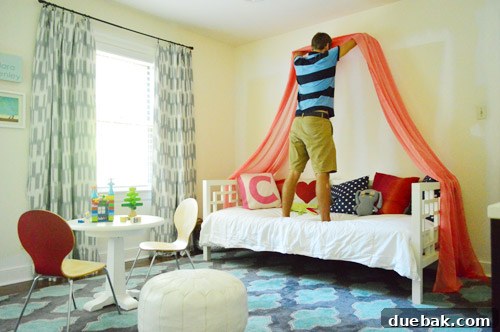
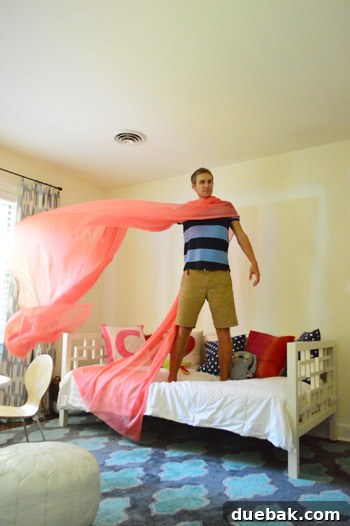
With the practicalities in mind, John, ever the helpful partner, playfully demonstrated the envisioned drape. Sometimes, it takes a bit of humor and hands-on visualization to bring a design concept to life!
Choosing the Perfect Fabric and Trim for Durability and Style
The next day, just before heading to the fabric store, a brilliant idea struck: use some old sheer white curtains we had on hand for a more accurate visual test. This was a game-changer. With Clara’s room already featuring a vibrant rug, patterned curtains, and a collection of art pieces we planned to rehang from her previous nursery, we knew the main canopy fabric needed to be a calming counterpoint. White emerged as the clear winner, offering versatility and a clean canvas. However, we also recognized it needed a playful touch. We envisioned white fabric accented with colorful ticking or fringe to add personality without making the room feel overly busy or “circus-y.” Our goal was a canopy that would remain charming and relevant for years, even as Clara’s tastes evolved and other room accessories changed.
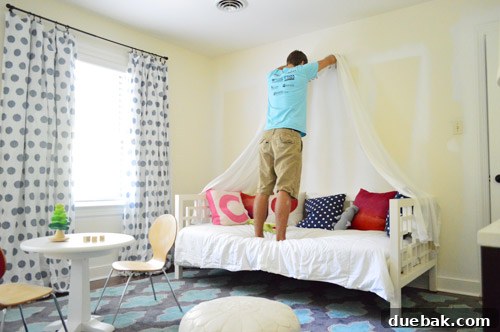
While the white sheers looked lovely, they felt a little bare without any trim, confirming our need for a vibrant accent. They also proved to be slightly too short on each side. Using them as a guide, we carefully measured the additional yardage required to create a canopy long enough to gracefully drape over both sides of the bed. The magic number was six yards.
Finding the Ideal Materials: A Fabric Store Triumph
Our fabric hunt led us to Hancock Fabrics, where we struck gold! We managed to purchase all six yards of a washable cotton/poly blend fabric for an incredible $20.94, thanks to a 50% off coupon found on their website. A quick scan of my phone at checkout made the process effortless. But the fabric wasn’t our only score. We also discovered enough turquoise pom-pom trim – another six yards – to line the entire outer edge of the canopy, adding that much-needed pop of flair. Clara herself spotted and “petted” the trim first, sealing the deal with her approval! The 60% off markdown (bringing the trim to just $9.54) was the cherry on top. I was particularly excited about the pom-pom trim, having admired similar canopies with pink poms; it truly adds a delightful and fun dimension to the design.
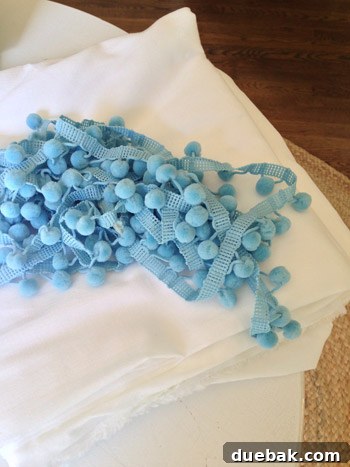
DIY Sewing Steps: Crafting the Canopy Fabric
With our materials in hand, it was time to bring the canopy to life. The first crucial step was washing the fabric. This pre-shrinks the material, preventing any surprises after the canopy is complete and ready for its first wash. Once clean and dry, the substantial task of hemming all four sides began. I opted for a double hem – folding the fabric over once and sewing it, then folding it again and sewing the edge one more time. This technique provides a completely finished, clean look on the inside, ensuring no stray threads or raw edges are visible, which is important since the inside of the canopy would be seen while laying in bed.
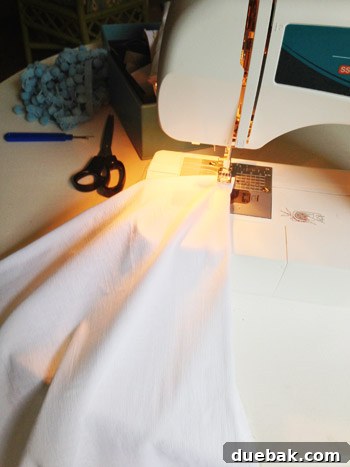
Let me tell you, double hemming a massive 18 by 4-foot sheet of fabric on all sides is quite a commitment, especially for a self-proclaimed #reluctantseamstress like myself. But I found a rhythm, particularly on those two long 18-foot sides, and steadily worked until it was done. Afterwards, a quick calculation on my iPhone revealed I had completed 88 feet of sewing (44 feet around, twice!) – an oddly satisfying bit of trivia, akin to knowing how many hot dogs could circle the Earth’s equator. It’s these small, personal milestones that make a DIY project truly rewarding.
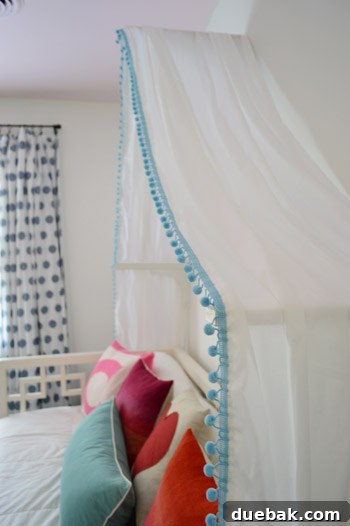
Next came the most exciting part: adding the vibrant pom-pom trim. This was a straightforward process, simply sewing the trim to the front side of the canopy along the entire 18-foot edge. The moment the trim was attached, the fabric transformed from a simple sheet into a truly playful and inviting canopy.
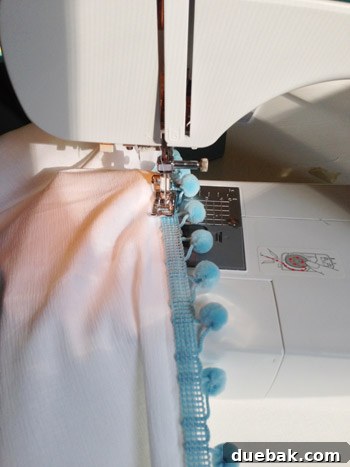
All in all, the sewing probably took me about four hours. As I mentioned, I’m not the quickest sewer, so I’m sure someone more experienced could whip this out in a fraction of the time. Regardless of the hours, I am absolutely thrilled with the result. The fun pom-poms perfectly tie into the existing colors of Clara’s rug and curtains, harmonizing with much of the art we plan to hang. Beyond the aesthetic appeal, they’re simply delightful for Clara to gaze up at, adding another layer of wonder to her personal space.
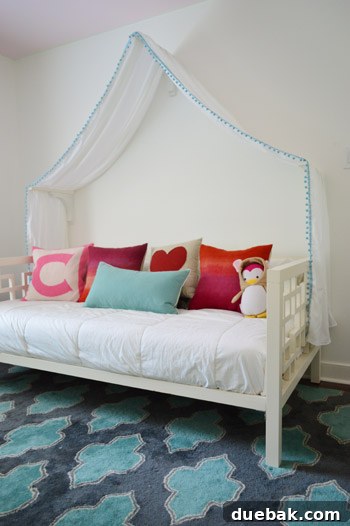
Innovative Hanging Solution: Repurposing and Extending Brackets
For hanging the canopy, we opted for a clever and resourceful approach, reusing the same decorative wooden brackets that once graced our kitchen. We had previously removed these two extra brackets during a kitchen tweak, and they were perfectly suited for a new life in Clara’s room. We repurposed those two and purchased one additional bracket from Home Depot, painting it to match. The original brackets, however, were only 9.5 inches deep, and we desired the fabric to billow out a bit more dramatically. To achieve this, we cut some scrap wood to create longer 17-inch slats.
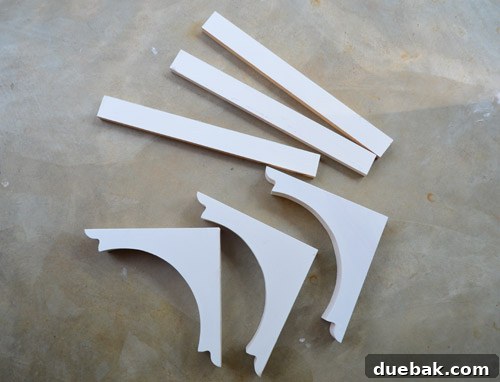
These extended slats were then securely nailed onto the top of the brackets, effectively making them one cohesive, deeper unit. Installation on the wall was straightforward: each bracket assembly was hung using two screw and anchor sets. The backs of the brackets feature two pre-drilled holes, allowing them to slip onto the screw heads and stay firmly in place, ensuring a secure and stable mounting for the canopy fabric.
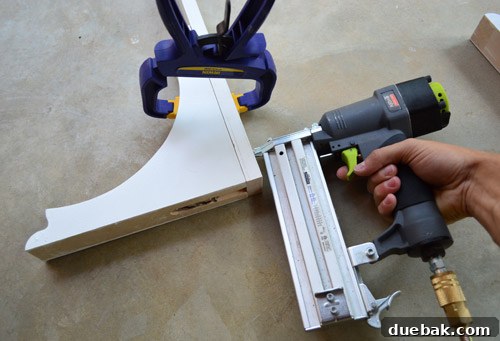
Safety and Optimal Placement: Designing for Comfort and Play
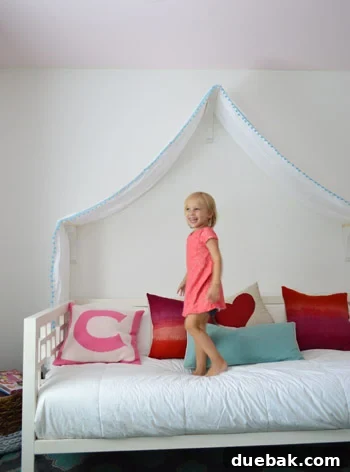
As a “worry-wart mom,” safety was paramount in determining the canopy’s placement. I’m relieved that Clara can’t possibly jump high enough on the bed to bash her head on the top bracket. We put considerable thought into where to place the side brackets to ensure they wouldn’t obstruct or interfere with daily activities. Placing them too low would mean leaning back during story time could result in getting caught in the canopy. To prevent this, we positioned them approximately 32 inches above the top of the mattress. This height keeps the canopy gracefully out of the way for reading, snuggling, and even the occasional “animal-wrestling” session (don’t ask!). Furthermore, by lining the side brackets up with the arms of the bed, we minimized the likelihood of anyone accidentally bumping into them while leaning back or jumping near the inside edge of the bed. It’s a design choice made with both aesthetics and practicality in mind, though we always hope for gentle play!
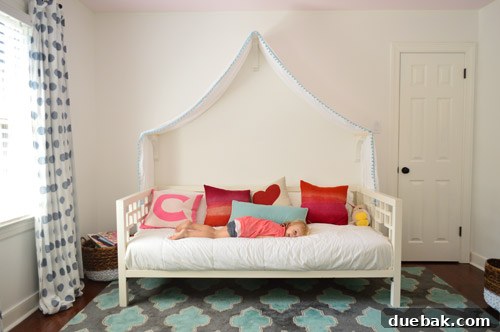
Currently, the large flap of fabric simply rests on the brackets. My initial plan was to use strips of Velcro to hold it firmly in place, perhaps just along the top and allowing it to drape over the two side brackets. However, Clara has been incredibly gentle with her new canopy – gazing up at it with fascination and softly running her fingers delicately over the pom-poms. This thoughtful interaction has led me to embrace the “lazy mom” approach for now: “it works for now, and if it gets yanked or starts to drive me nuts, I’ll add Velcro later.” It’s a reminder that sometimes, the simplest solution is the best, especially when it’s met with such tender appreciation.
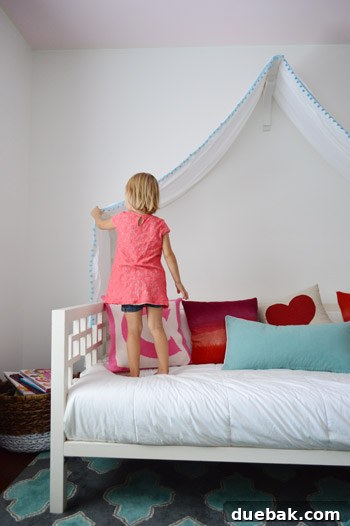
Though a bit blurry in this photo, this image perfectly captures the pure joy Clara finds in her new canopy. She is absolutely smitten, and her happiness makes every minute of the DIY effort worthwhile.
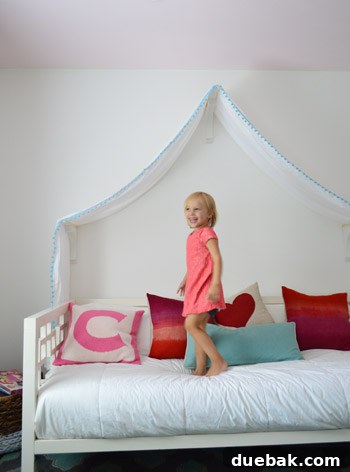
Finishing Touches: Future Wall Decor Plans
We’re not quite finished with this wall yet! Beyond wanting to add some chunky crown molding around the top of the room for a more polished look, we also think it would be fun to hang a mirror, some art, or perhaps a 3D paper mache collection of animals. The goal is to break up the expanse of white triangle created by the canopy, adding another layer of visual interest. The jury is still out on the final selection, but the possibilities are exciting. Just for visualization purposes, I playfully inserted a Target mirror into the space using my good friend Photoshop – a handy trick for any DIY decorator! I’m also considering something like this for a truly unique touch. The beauty of DIY decor is the freedom to evolve and perfect your space over time.
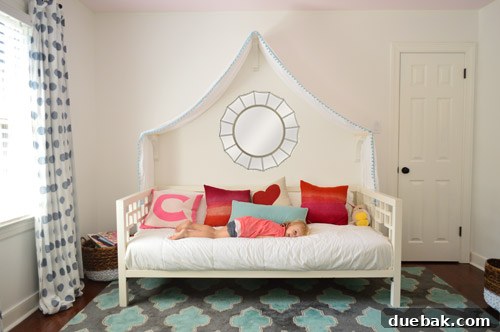
A Joyful Conclusion: The Impact of a Handmade Canopy
In the meantime, I am absolutely thrilled that our new bed canopy is made from kid-friendly, washable fabric, ensuring easy maintenance. It was a project that, while requiring some dedication, was not overly complicated for a determined DIYer. But above all, what truly fills my heart is how incredibly happy it makes Clara. This very morning, I overheard her explaining to our dog, Burger, that he had to wear “a crown and a wand to come into my room because it’s for royal sleepovers.” Burger might not be entirely sold on the idea of headwear just yet, but Clara’s imaginative world has clearly expanded, and that’s the greatest reward of all. A handmade canopy isn’t just fabric and brackets; it’s a doorway to dreams, comfort, and endless childhood adventures.
Update – Wanna know where we got something in our house or what paint colors we used? Just click on this button: