
Transforming Your Indoor Jungle: The Art of Pruning and Propagating Pothos & Philodendron Plants
There’s a special joy that comes from nurturing indoor plants, and few varieties offer as much resilience and beauty as the Pothos (Epipremnum aureum) and Philodendron (Philodendron hederaceum) species. Renowned for their incredible hardiness and lush foliage, these plants are often hailed as ideal choices for both novice and seasoned plant enthusiasts. As we’ve often discussed, integrating fresh greenery into your living spaces doesn’t just enhance aesthetic appeal; it genuinely breathes life into your home, both literally through improved air quality and figuratively by creating a calming, vibrant atmosphere.
However, even the most robust plants need a little guidance to thrive elegantly. While Pothos and Philodendrons are incredibly easy to grow, they can become quite sprawling if left unchecked. Their vigorous growth, characterized by long, trailing vines, can transform a chic green accent into something reminiscent of a scene from ‘Little Shop Of Horrors.’ We’ve all seen examples, perhaps in a charming, rustic eatery like this one we admired during a trip to Savannah, where the plants, though clearly loved, had taken over a bit too much (just try to ignore our crab-like expressions in the foreground of these photos!):


This common scenario highlights a simple truth: even the easiest houseplants benefit from regular maintenance. When our own Pothos or Philodendron plants begin to stretch out a bit too much, threatening to consume every available surface, we know it’s time for a trim. A pair of sharp scissors is all it takes to rein in those ambitious vines and restore balance to our indoor greenery.
Taming the Jungle: Why Pruning is Essential for Pothos and Philodendron
Pruning might sound intimidating to new plant parents, but for Pothos and Philodendrons, it’s a straightforward and highly beneficial practice. Far from harming your plant, strategic pruning encourages healthier, fuller growth and prevents your plant from becoming leggy and sparse. It’s an act of care that rejuvenates your plant and keeps it looking its best.
Aesthetic Appeal
The most immediate benefit of pruning is aesthetic. Overgrown vines can make a plant look messy and unkempt, detracting from its natural beauty. By trimming back excessive growth, you help your plant maintain a more compact, bushy, and visually appealing shape. This allows the plant to fit better into your decor, whether it’s cascading gracefully from a shelf or standing proudly on a tabletop.
Plant Health and Growth
Beyond aesthetics, pruning plays a vital role in your plant’s overall health and vigor. When a plant invests too much energy into growing excessively long vines, it often does so at the expense of new leaf production closer to the base. Pruning stimulates the plant to produce new growth from latent nodes, resulting in a denser, lusher plant. It also removes any damaged or yellowing leaves, directing the plant’s energy towards healthy, vibrant foliage.
The Right Tools for the Job
Before you begin, ensure you have the right tools. A pair of sharp, clean scissors or pruning shears is essential. Clean tools prevent the spread of diseases and make clean cuts, which heal faster. You might also want a small container of rubbing alcohol to sterilize your blades between cuts, especially if you’re pruning multiple plants.
Step-by-Step Guide to Pruning Your Pothos or Philodendron
Knowing where and how to cut is key. The goal is not just to shorten the vines but to encourage new branching. We typically prune when we notice vines getting too long, or when we want to promote a bushier plant. There’s no single “wrong” time to prune, but spring and summer, during the active growing season, are generally ideal as the plant recovers more quickly.
Identifying Where to Cut
Take a good look at your plant. You’ll notice small bumps or nodes along the stems; these are where new leaves and roots emerge. When you prune for bushiness, aim to cut just above a node. This signals the plant to activate the dormant buds at that node, encouraging new growth to sprout from that point, often resulting in two new stems where there was once one. For simple length reduction, you can cut anywhere along the vine, but cutting above a node offers the added benefit of promoting new growth.

Making the Cut for Health and Bushiness
When our plants begin to look a bit sparse or leggy, that’s our cue. We grab our sharp scissors and get clipping! The most amazing aspect of pruning Pothos and Philodendrons is that by clipping close to the root of the plant or anywhere along a healthy vine, you not only improve the mother plant’s health and appearance but also create opportunities for new plants. This is the beauty of propagation.

From Cuttings to Clones: The Magic of Water Propagation
Once you’ve made your cuts, don’t discard those healthy vine segments! This is where the truly magical and rewarding part begins: propagation. Each too-long branch that you snip can be transformed into an entirely new plant through the simple method of water propagation. It’s an almost sci-fi phenomenon; a small cutting, placed in water, will regenerate itself, growing roots and becoming a genetic clone of its parent plant. Talk about free houseplants!
Selecting the Best Cuttings
For successful propagation, choose cuttings that are healthy and vibrant. Each cutting should ideally have at least two to three leaves and a node (or several nodes) where new roots can emerge. Avoid very thin or damaged sections of the vine. A cutting that is about 4-6 inches long is generally a good size.
Preparing Your Cuttings for Water
Carefully remove any leaves that would be submerged in water. Leaves left in water will rot, contaminating the water and potentially harming your cutting. Make sure the lowest node (or nodes) is exposed and ready to be immersed.
The Water Propagation Setup
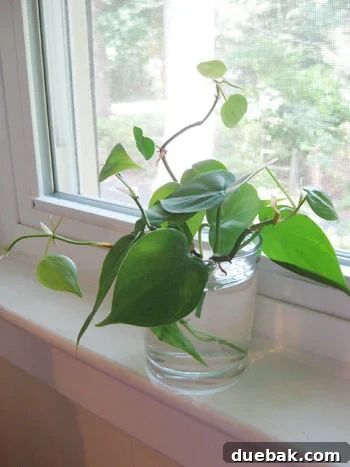
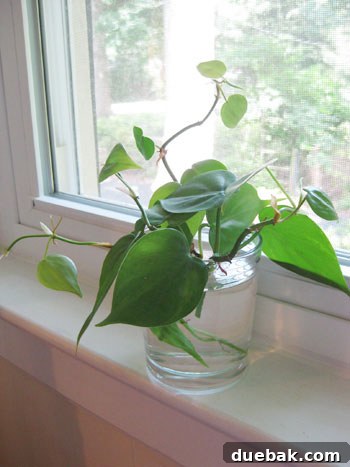
Place your prepared cuttings into a clear glass or jar filled with clean water. The water level should be sufficient to cover the nodes you want to root, but not so high that leaves are submerged. A clear container is helpful because it allows you to observe the root development and also adds a charming, scientific touch to your decor.
Monitoring and Maintenance
Position your glass of cuttings in a spot with bright, indirect light. Direct sunlight can overheat the water and stress the cuttings. Change the water every few days, or at least once a week, to keep it fresh and oxygenated. This prevents bacterial growth and ensures a healthy environment for root development. Within a few weeks, you’ll start to see small, white, spider-like roots emerging from the nodes. This is the exciting part!
Transplanting Your New Plant Babies: From Water to Soil
The sight of robust roots filling your propagation jar is incredibly satisfying. But the journey doesn’t end there! The next step is to transition your rooted cuttings from water to soil, where they can establish themselves as independent, thriving plants. This process, when done correctly, ensures the continued growth and health of your new additions.
When Are Roots Ready for Soil?
Patience is a virtue in plant propagation. While roots might appear quickly, it’s best to wait until they are at least 1-2 inches long, and ideally, have started to branch out a bit. Robust roots give your new plant a much better chance of surviving the transplant shock and thriving in soil. If the roots are too short or fragile, they may struggle to absorb nutrients and moisture effectively in soil.
Choosing the Right Pot and Soil
Select a small pot, perhaps 4-6 inches in diameter, with good drainage holes. Over-potting can lead to excess moisture and root rot, so start small. For soil, a high-quality, well-draining potting mix is crucial. Pothos and Philodendrons prefer a mix that retains some moisture but doesn’t become waterlogged. Look for mixes formulated for houseplants or a general-purpose potting mix with added perlite or coco coir for improved drainage.
The Planting Process
Gently remove your rooted cutting from the water. Create a small hole in the center of your prepared pot of soil. Carefully place the rooted end of the cutting into the hole, ensuring the roots are spread out rather than bunched up. Backfill with soil, gently firming it around the base of the cutting to provide support. Avoid compacting the soil too much, as roots need air.
Post-Planting Care for Success
Immediately after potting, give your new plant a thorough watering until water drains from the bottom of the pot. This helps settle the soil around the roots. For the first week or two, place your newly potted plant in a location with bright, indirect light and slightly higher humidity if possible. This helps ease the transition from water to soil, a period often referred to as “transplant shock.” Monitor the soil moisture carefully, watering when the top inch or two feels dry. Before you know it, these little cuttings will grow up to be a spitting image of their “momma” plant!
Enjoying Your Free Houseplants and a Fuller Home
And there you have it! Through a simple process of pruning and water propagation, you can transform an overgrown plant into multiple new ones. It’s an incredibly cost-effective and environmentally friendly way to expand your indoor garden, refresh your existing plants, and even share the joy of greenery with friends and family. Imagine filling your home with lush, vibrant Pothos and Philodendrons, all for little to no effort or cost beyond your initial plant!
Share Your Green Thumb Secrets!
We love hearing from our community! How about you? Do you have any clever, cheap houseplant tips to share with fellow plant enthusiasts? Are there any other impossible-to-kill varieties that are currently tickling your fancy and bringing joy to your home? We’re all ears! Spill the houseplant dirt in the comments below, or connect with us on social media to share your propagating success stories and favorite easy-care plants!
Explore More Houseplant Care Guides
If you’re eager for more in-depth information on some of our favorite real and faux plants, delve into these comprehensive guides below:
- Golden Pothos Care Guide
- Marble Queen Pothos Care Guide
- Neon Pothos Care Guide
- Monstera Deliciosa Care Guide
- Snake Plant Care Guide
- Fiddle Leaf Fig Care Guide
- Tree Philodendron Care Guide
- How to Build An Easy Plant Shelf
- Protecting Outdoor Plants In A Deep Freeze
- Getting Started With Houseplants: An Expert Interview
- My Favorite Faux Plants
- Easy Houseplants To Keep Alive
- 10 Houseplants For Better Indoor Air Quality
Curious about what other leafy residents call Casa Petersik home? Here’s the long and leafy breakdown of our entire indoor plant collection!