

“I’m Blue Da Ba Dee Dabba Da-eeeeee!” If that catchy tune immediately puts a smile on your face, you’re not alone! It’s been the unofficial anthem of our latest home renovation adventure: transforming our foyer from a sea of outdated blue trim to a bright, welcoming white oasis. Join us as we recount the many hours – and sometimes, days – spent priming and painting, a journey filled with both challenges and immense satisfaction.
Revitalizing the Foyer: Our Journey from Blue to Brilliant White Trim
Our home’s entryway, the foyer, is the first impression visitors get, and for too long, it was defined by its “snazzy” blue trim. While once perhaps a stylish choice, it had begun to feel heavy and dated, creating a less inviting atmosphere than we envisioned for our home. The mission was clear: lighten, brighten, and modernize this crucial space.
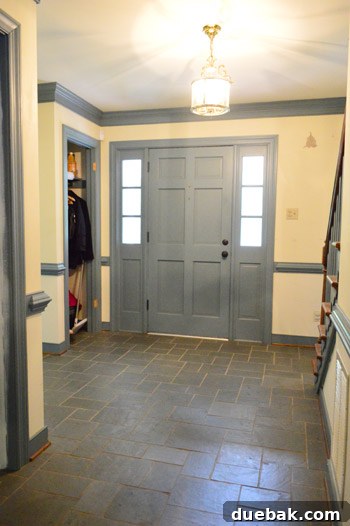
The initial steps of this ambitious project involved more than just paint. We began by stripping down all the existing wallpaper, a task that alone made a significant difference. Following that, we meticulously removed two closet doors and the main bathroom door. This allowed us to transport them to the garage, where we could leverage the efficiency of our reliable paint sprayer. Our plan was to apply a thorough coat of primer followed by two immaculate coats of white semi-gloss paint.
Optimizing Your Painting Process: Sprayer vs. Hand-Painting
One of the recurring questions in DIY painting is whether to use a sprayer or stick to traditional brushes and rollers. Our experience has shown that each tool has its distinct advantages, making a hybrid approach often the most effective, especially in a multifaceted project like a foyer renovation.
The Paint Sprayer: Speed and Smoothness for Removable Elements
Our paint sprayer has proven to be an invaluable asset in specific scenarios, primarily for items that can be easily detached and positioned for optimal spraying. Here’s when we find it most beneficial:
- Detached Items: For elements like doors, cabinetry, or even crown molding before installation, where they can be laid flat or leaned against a drop cloth, a sprayer offers unparalleled speed and a smooth, factory-like finish. This isolation prevents overspray from affecting other parts of the room.
- Minimal Masking Required: In situations where there aren’t extensive adjacent surfaces to protect, such as when we removed upstairs carpeting and could freely spray all the trim and doors without worrying about floor contamination, the sprayer shines. It minimizes tedious taping, saving considerable time.
While the sprayer excels for these tasks, we still opt for rollers when tackling large, flat surfaces like walls and ceilings. The control and specific finish desired for these areas often make rollers a better choice. Think of it this way: you wouldn’t typically spray paint an entire wall, but it’s perfect for achieving a flawless finish on cabinets, doors, or furniture.
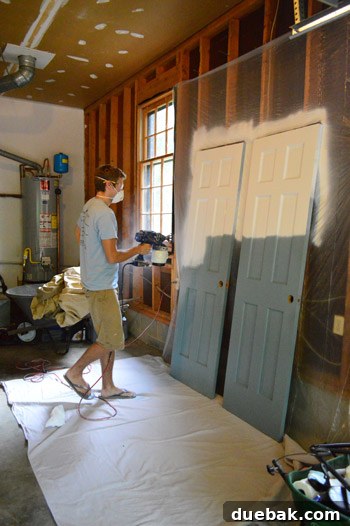
To give you a better idea of the sprayer in action, here’s a visual demonstration. While John in this video is moving at a steady pace, we’ve found that a slightly faster, consistent motion often helps achieve an even smoother finish and significantly reduces the chance of drips. Mastery comes with practice!
Reviewing Our Paint Sprayer: Pros and Cons
We’ve evolved our toolset over time, initially using a Graco True Coat II and now preferring this Wagner model. Based on our extensive experience, here are the key advantages and considerations:
Pros:
- Exceptional Coverage and Finish: Sprayers deliver paint thicker and more evenly than brushes or rollers, leading to a faster, superior finished result with fewer coats. The uniform application minimizes brush strokes and roller marks.
- No Paint Thinning Required: A major convenience with our specific model is that it handles unthinned paint straight from the can. Many other sprayers demand thinning, which adds an extra step and can affect paint consistency if not done precisely.
Cons:
- Overspray: Inherent to all paint sprayers, overspray means paint particles will travel beyond your target surface. This necessitates thorough masking and drop cloths, as evidenced by the paint covering the plastic sheet behind our doors in the image above.
- Learning Curve for Drip Control: Achieving a flawless, drip-free finish requires practice. The key is to maintain a consistent spraying speed and distance from the surface. Holding the sprayer too close or moving too slowly are common causes of drips. It’s less a flaw of the sprayer and more a skill the operator must develop through experience.
Hand-Painting Fixed Trim: Precision and Practicality
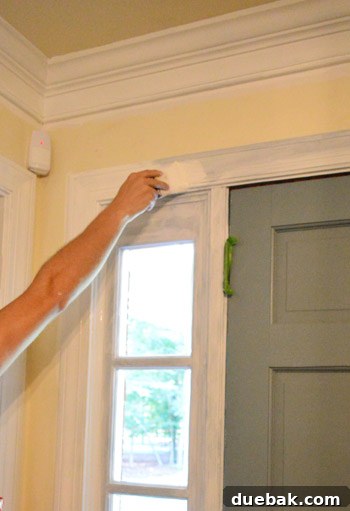
While the sprayer handled our doors beautifully, tackling the remaining fixed trim in the foyer required a different strategy. Removing and then reinstalling all the baseboards, chair rail, and crown molding – not to mention the trim around seven doorways in this single space – would have been an undertaking of monumental proportions. The time and effort involved simply weren’t practical.
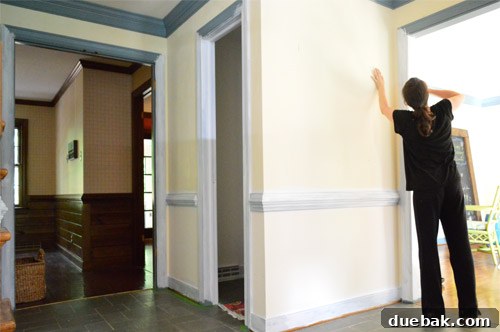
Another option we considered was attempting to spray paint the fixed trim directly in the foyer. However, our foyer connects to the kitchen, dining room, office, portico, two closets, and a bathroom. The sheer amount of masking and protective taping required to shield these adjacent spaces from overspray would have taken an exorbitant amount of time, likely turning a weekend project into a multi-week saga. Therefore, hand-painting emerged as the most sensible and controlled approach for these intricate, immovable elements.
The Meticulous Process: Preparation, Priming, and Painting
Successfully transitioning from a dark, bold color like blue to a crisp white requires meticulous preparation and careful application, ensuring excellent adhesion and a vibrant final finish.
Essential Surface Preparation
Before any primer or paint touches your trim, proper surface preparation is non-negotiable, especially when dealing with previously painted or finished wood. If your existing trim is shiny, glossy, or lacquered, it’s crucial to lightly scuff the surface with fine-grit sandpaper. This creates a “tooth” for the primer to adhere to. Following sanding, a thorough wipe-down with a liquid deglosser will remove any remaining sheen and ensure optimal adhesion. For raw wood, a high-quality stain-blocking primer is essential to prevent knots or tannins from bleeding through your new paint finish.
Fortunately, our existing blue trim had a chalky, matte finish. This meant we could bypass the sanding and deglossing steps, moving directly to the priming phase. This saved us a considerable amount of time and effort.
Priming for Perfection: Two Coats Over Blue
The transformation from blue to white hinges heavily on proper priming. Given the intensity of the original blue, a single coat of primer simply wouldn’t suffice. We applied two diligent coats of primer to all the blue baseboards, trim, chair rail, and crown molding. Each coat was allowed to dry completely before the next was applied, ensuring maximum coverage and opacity. This critical step effectively neutralized the underlying blue, providing a clean, neutral canvas for our final white paint color.
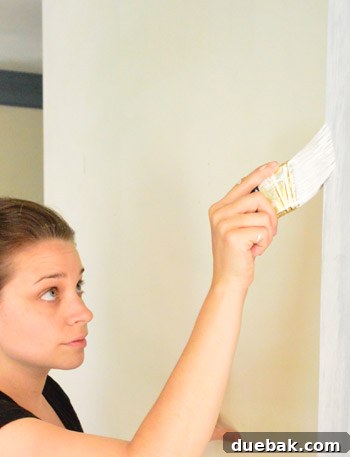
The number of primer and paint coats you’ll need ultimately depends on the starting color and the quality of your chosen products. For us, moving from a deep blue to a bright white, it translated to a total of four coats: two coats of primer followed by two coats of paint. This layering ensures full coverage and a durable, lasting finish.
Choosing the Perfect White: Benjamin Moore Simply White
For our final color, we chose Benjamin Moore’s Simply White in a semi-gloss finish. This decision wasn’t arbitrary; we’ve used this shade for the trim and doors upstairs, ensuring a cohesive look throughout our home. Simply White is a remarkably versatile white, offering a crisp, clean feel without being overly stark or cold. Its subtle warmth prevents it from feeling clinical, making it a favorite among designers and homeowners alike.
If you’re still exploring white options, there are many beautiful choices available. For inspiration, you might explore some of designers’ top white paint recommendations, which can help you find the perfect shade to complement your home’s unique lighting and existing decor.
The Grand Reveal: A Brighter, More Inviting Foyer
After all the painstaking preparation, priming, and painting, the moment arrived to reassemble our revitalized entryway. Once everything was perfectly dry, we carefully rehung the freshly painted doors. We also took the opportunity to install new door knobs, selecting a style that seamlessly matched the ones we’d previously installed upstairs, adding another layer of polish and consistency.
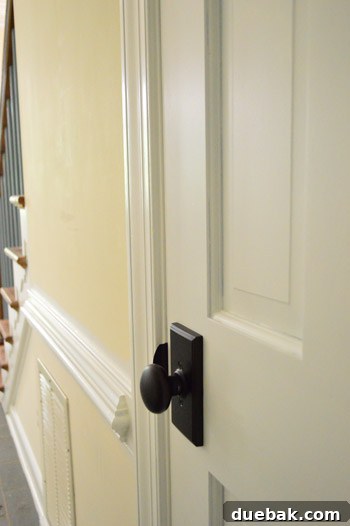
While our foyer’s transformation is largely complete, a few elements remain on our to-do list. We still plan to paint the back of the front door in the same vibrant teal as its exterior. Additionally, the stair railing awaits its ebonization, and those blue spindles are destined for a fresh coat of white paint.
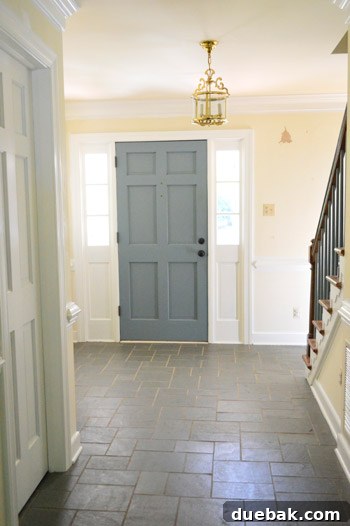
Even with these minor tasks outstanding, the impact of the white trim is undeniable. The foyer already feels significantly lighter and far more open than it did when we first inherited it, dominated by its blue trim and an abundance of wallpaper. The shift has breathed new life into the space, creating a sense of calm and modernity.
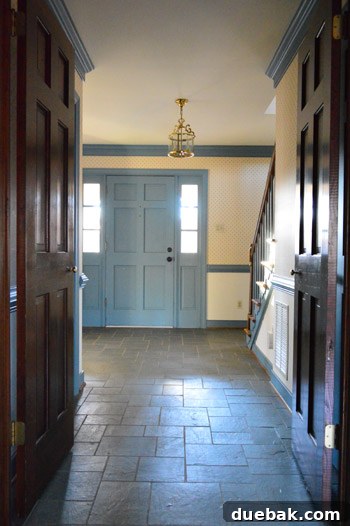
For a striking visual comparison, observe this “before” picture taken from an alternative angle, highlighting the previous aesthetic.
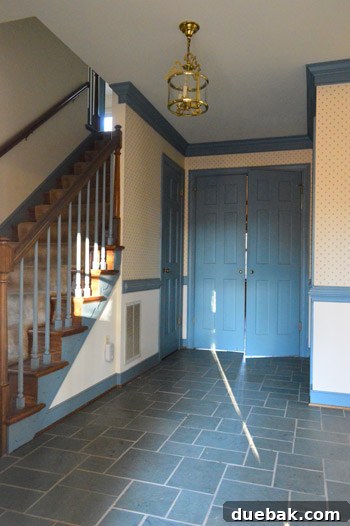
And now, behold the transformation with the crisp white trim and doors. It’s truly remarkable how the absence of the blue trim affects the perception of other elements in the room. The slate flooring, for instance, now appears much less blue. While it still retains some subtle blue undertones, the overall effect is far more neutralized, no longer reflecting the intense blue from the surrounding trim. This subtle yet powerful change underscores how interconnected elements in a room are, and how a single design decision can ripple through the entire space.

The Ongoing Journey: A Home Transformed, One Room at a Time
While the stairs continue to “mock” us with their current state, we are steadily making progress towards a fresher, more cohesive-looking foyer. Our next major step will be to address those yellowed walls, bringing them into harmony with the bright new trim.

If you’re thinking our blue trim painting saga might be drawing to a close, rest assured, there’s more to come! Blue trim still graces our office and dining room. Both these spaces not only feature extensive window trim and baseboards but also boast elegant crown molding, along with blue chair rail and built-ins in the dining room. This means there’s a good chance you’ll be reading about our ongoing blue trim painting adventures for some time to come, perhaps with a soft, melancholic sigh into our paint brushes. But with each finished section, the satisfaction grows, making every stroke worthwhile.

Ultimately, the transformation to glossy white trim brings an immense sense of accomplishment and joy. The things we do for love—the love of a beautiful, revitalized home.