

If you’ve been dreaming of a laundry room that’s both functional and beautiful, especially one that accommodates a top-loading washer without compromising on style, then you’ve landed in the right place. Most online inspiration showcases sleek front-loaders with expansive countertops, leaving many top-loader owners wondering about elegant solutions. Well, our recent beach house laundry room and mudroom transformation is here to answer those questions and more!
Transforming Our Beach House Laundry & Mudroom: A Top-Loader Friendly Makeover
After months of meticulous planning and diligent sourcing, our beach house laundry room, which doubles as a mudroom, has finally emerged from its chrysalis. What was once a forgotten, disheveled space is now a remarkably functional and aesthetically pleasing area. This journey began way back in December 2017, but other pressing projects like constructing the walk-in pantry shelves and building the wall-to-wall bunk beds took precedence. With those major tasks successfully completed, it was a genuine relief to clear out the remnants of construction—lumber, tools, and pervasive dust bunnies—and officially welcome this room into its working, functional state. The improvement? Approximately 89% nicer to behold, and 100% more efficient for our coastal lifestyle.

From Eyesore to Oasis: The Grand Before & After
To truly appreciate the transformation, let’s rewind to the beginning. When we first acquired the beach house, this particular area held the undisputed title of “ugliest space.” And trust us, given the formidable competition throughout the property, that was no small feat.

A History of Neglect: The Original Enclosed Porch
This room wasn’t originally part of the main house structure; it was once an outdoor porch that someone, at some point, attempted to “enclose.” We use quotes because the execution was far from professional. Instead of proper exterior siding, interior flooring materials were used on the exterior, leading to catastrophic results. Over time, this entire section of the house became waterlogged and began to rot. By the time we took ownership, there were fist-sized holes in the walls and floor, a clear testament to the structural integrity issues. Compounding this, the foundation for this section was failing; it had been set directly in sand without concrete footers, leading to a gradual, uneven sinking. This dire situation necessitated that this entire side of the house be rebuilt entirely, a massive undertaking that laid the groundwork for its current rebirth.

Laying the Foundation for a Fresh Start
By the end of the previous summer, the room was beginning to take shape, thanks to critical improvements like new drywall and the installation of durable floor tile. We opted for a budget-friendly yet stylish tile option from Lowe’s, paired with Mapei Warm Gray grout. This combination provided a resilient, easy-to-clean surface ideal for a mudroom that would inevitably see its share of sand and wet footprints. The neutral tones also created a calming backdrop, a stark contrast to the previous chaos.

The Interlude: A Storage Hub for Renovation Projects
For the better part of six months, despite the new drywall and tile, the space continued its temporary role as a storage zone. Aside from hanging some light fixtures we designed (in a beautiful onyx color), the room was largely a dumping ground for all our project supplies. Without a dedicated garage or shed (a shed is next on our list!), this area became the reluctant home for tools, scrap wood, empty boxes, and various renovation remnants. It was far from glamorous, but entirely necessary for the ongoing beach house renovation.

Even after our new laundry appliances arrived around Black Friday, the room still looked more like a construction site than a functional laundry space. We chose the current models of the washer and dryer we’d installed in our main home’s laundry room four years prior. Our positive experience with their reliability and performance made them an easy choice for the beach house.

The Finished Laundry Room: A Modern Coastal Retreat
So, how did we transition from that cluttered workspace to the serene, organized room you see today? It all came down to smart storage solutions, clever hacks, and a clear vision for the space.

Innovative Storage: Hiding the Tankless Water Heater with an IKEA PAX Hack
One of the most significant design challenges was the unsightly tankless water heater, prominently mounted on the wall to the left of the washer. While essential, it was an undeniable visual obstruction (you can spot it more clearly in the “appliances and tools” photo above). Our goal was to seamlessly integrate it into the room’s design while maintaining easy access for maintenance and, crucially, for turning off the water whenever the house is vacant—a vital step for peace of mind in an unoccupied home.

The Perfect Fit: Customizing an IKEA PAX Wardrobe
Our solution came in the form of a classic IKEA hack, utilizing the versatile PAX wardrobe system. We discovered that a 20-inch wide PAX unit would fit almost perfectly into the space available between the wall and the washer. The 24-inch depth was also ideal, allowing the cabinet to comfortably sit in front of the water heater without protruding awkwardly past the washing machine. This created a cohesive, built-in look for the entire laundry area.
Despite the nine-foot ceilings in this room, we deliberately chose the shorter 79-inch height option for the PAX, rather than the taller 93-inch version. This choice was made for visual balance; the cabinet now aligns better with the height of the nearby window and doorways, preventing it from becoming an overpowering, overly tall element in the space. The result is a harmonious visual flow, where the cabinet on the left perfectly counterbalances the window on the right, framing the laundry appliances beautifully.

The DIY Process: Modifying the PAX for Water Heater Access
We picked up the PAX unit in late January, but it wasn’t until early March that we carved out time for assembly. The task of modifying the PAX for water heater access was a crucial step. While the two side panels of the PAX system provide the majority of its structural integrity, the back panel is much thinner, more akin to a veneer. My approach was to cut a large section out of the back panel, leaving the surrounding material intact. This strategy ensured the unit remained square and still offered valuable storage space, rather than simply making it completely backless.
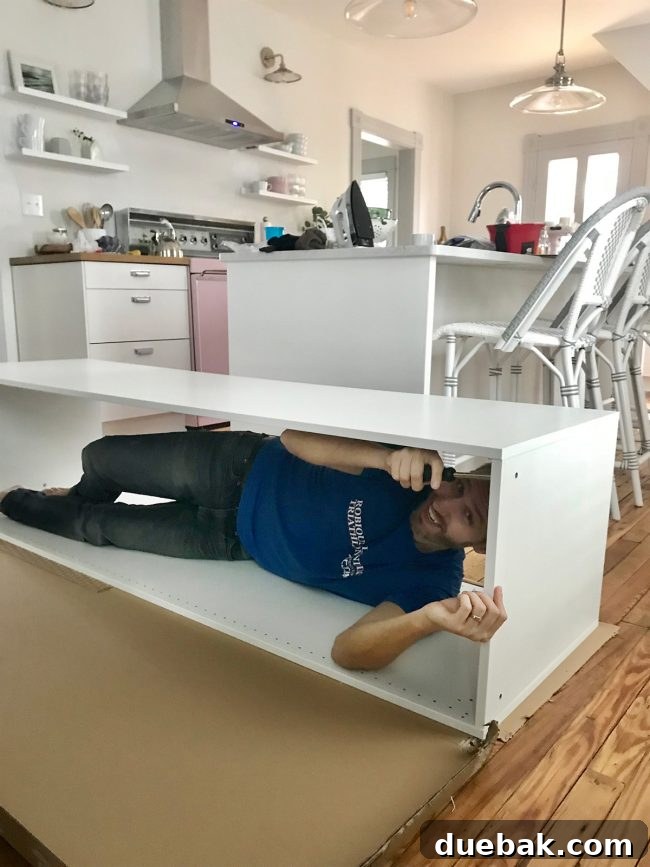
Before attaching the back panel, I used a jigsaw to carefully cut out the desired section, following pre-marked lines. Once assembled, the cabinet’s structural integrity felt completely uncompromised, even with this large opening. A word of caution for fellow DIY enthusiasts: avoid making large cuts in the side panels, as these are critical for the unit’s support.

After nailing the remaining pieces of the back panel in place, we were left with a generously sized access hole, perfect for reaching the water heater. We even had a bit of fun testing the scale of the opening.


Accessing the Breaker Box: A Precise Cut
To ensure full functionality, we also needed to cut a smaller, rectangular hole in the side panel of the PAX to access the water heater’s breaker box. This was a critical step, requiring careful measurement. To make sure the cutout was in precisely the right spot, we took meticulous measurements, marked the lines, and then taped along the cut lines. This taping technique is invaluable for achieving cleaner cuts and minimizing splintering when working with a jigsaw. For cuts in the middle of a panel, drilling holes in each corner (we used a 3/4-inch bit) makes it easier to maneuver the jigsaw blade around turns, after which you can square off the corners for a crisper edge if desired.


Securing the Cabinet and Achieving a Built-In Look
Since IKEA’s standard mounting involves anchoring to the back wall, which wasn’t feasible with our water heater setup, we planned to secure the PAX unit to the side wall instead. The final step before positioning the PAX was to add some blocking against the wall. We screwed these boards into the wall studs, making sure the vertical piece was positioned 3/4 inch behind where the front of the PAX would eventually sit. This foresight allowed us to later add a 3/4-inch white filler piece directly against it, effectively concealing the 2×4 blocking and giving the entire unit a seamless, custom built-in appearance.

In the image below, you can clearly see the white filler piece – a primed 1×3-inch board cut to size – that we added against the wall to cover the blocking. A final bead of caulk would then make everything appear perfectly smooth and integrated.

On the opposite side, we added a large flat panel to create the illusion that the cabinet extends all the way to the back wall, even though it doesn’t. This was simply a 1/4-inch sheet of plywood, cut to size and painted to perfectly match the PAX door using Behr’s “White” (literally, that’s the name!).

Before installing this side panel, we also added more 2×4 blocking against the back wall, creating a sturdy anchor point for the plywood’s back edge. We even utilized some leftover plywood to add a top piece to the PAX, primarily to prevent anything stored on top from accidentally falling behind the unit into the void.

Smart Solutions for Top-Loaders: Custom Floating Shelves
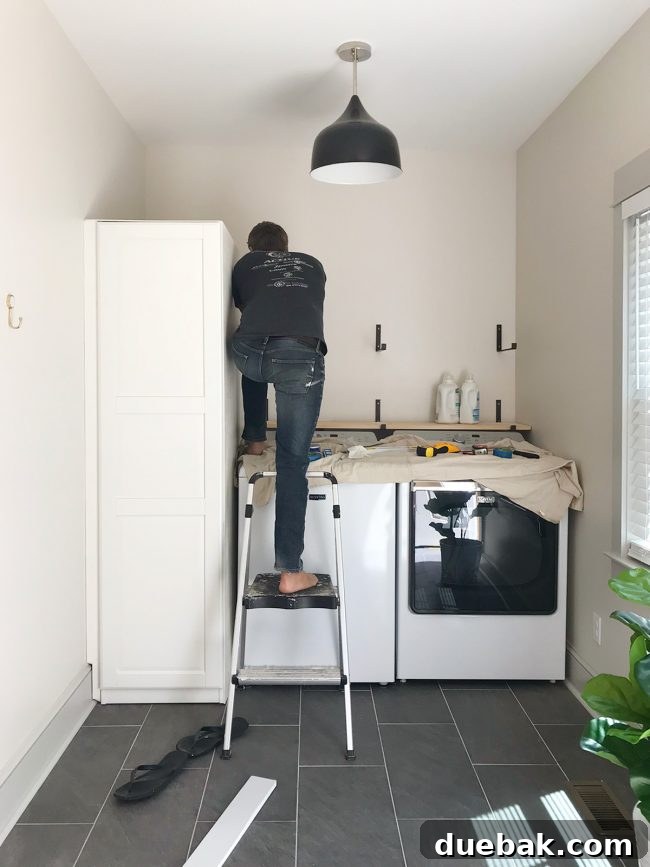
With the cabinet portion largely complete (hardware and interior organization are still on the to-do list!), our focus shifted to adding functional and aesthetic shelves above the appliances. This was a particularly exciting aspect, as finding elegant storage solutions for top-loading washing machines can be tricky, given that you can’t simply install a solid counter over them as you would with front-loaders.
Dual-Purpose Design: Storage and Concealment
These floating shelves serve a dual purpose: practical storage and cleverly concealing the less attractive elements of the laundry setup. The bottom shelf is strategically positioned to obscure the washer hook-ups and dryer plug, which are often eyesores. More importantly, it bridges the annoyingly large gap that typically exists behind top-loading appliances. Due to the dryer hose, washers and dryers rarely sit flush against the wall, often leaving an 8-inch or even 12-inch gap where small items can (and inevitably do) fall, vanishing into the abyss. Our dryer vents directly out the right wall, and due to some studs, we actually have a 12-inch gap, making these 12-inch deep shelves a perfect fit to fill that space and prevent lost socks.

Crucially, the shelves are designed not to interfere with the washer’s functionality. They begin right above the back edge of the appliances, ensuring full access to the washer knob and allowing the lid to open completely without obstruction. This is a vital consideration when selecting shelf depth for top-loaders.
This isn’t our first rodeo with this clever solution; we implemented a similar shelf design in our main home’s laundry room, finding it to be an excellent way to cover unsightly elements and fill awkward gaps specifically for top-loading machines. It’s a testament to its effectiveness and aesthetic appeal.
Materials and Finishing: Iron Brackets and Stained Wood
For the shelves, we sourced these beautiful iron brackets from Etsy, which Sherry discovered via Little Green Notebook. They were perfect for our needs, available in various sizes (we chose the 12-inch depth with a “natural waxed” finish). A key benefit of these brackets is their design: the shelf board simply rests on top, cradled by a front lip. This allows us to easily lift and remove the bottom shelf whenever we need quick access to the plugs or valves behind the appliances, making maintenance a breeze.

The shelves themselves are simple 1×12-inch whitewood boards from Home Depot. To integrate them with the beach house’s existing aesthetic of old pine doors and floors, we carefully stained them. The process involved one coat of wood conditioner, followed by a light application of Minwax Puritan Pine stain, and then several thin coats of Safecoat Acrylacq to seal and protect the wood, ensuring durability in a high-humidity environment.

Styling the Shelves: Function Meets Flair
While the shelves offer ample room for functional items like laundry supplies stored in baskets and readily accessible detergent, they also provide an opportunity for decorative accents. Sherry added charming touches like gold frames and an orchid, balancing practicality with personal style. We always leave a little extra space for future functional needs, but for now, we’re particularly delighted to display the coffee cup that inspired the beach house’s signature pink hue. An Instagram follower wisely suggested putting it in a glass cloche to prevent it from being mistaken for trash and discarded – a brilliant idea we plan to implement!

The Mudroom Zone: A Welcoming Entry
While the mudroom section of the room still requires a few tweaks to maximize its hardworking potential, we’ve made significant progress. We brought down one of our wood benches from upstairs (a Target find from a while back, but similar options are available). Last winter, we installed some hooks for winter coats, which will now serve as a convenient spot for beach towels – like this lovely blue Turkish towel that Sherry is particularly fond of. Our future plans for this area likely include more hooks and additional storage to truly optimize it for its mudroom function. We’ll keep you updated on those developments!

More Than Just Laundry: A Primary Entrance
While doing laundry might not be considered “exciting,” transforming this room has certainly made the chore infinitely more pleasant. No longer do we have to navigate around saws and piles of scrap wood just to reach the washer and dryer. In the near future, our outdoor pathway will be completed, leading directly to this side door, as well as the back patio and an outdoor shower (which hasn’t even begun, mind you!). This mudroom entrance is anticipated to become a primary entry point, especially after sandy beach trips. The thought of stepping into a beautifully organized, inviting space, rather than a disheveled “wood graveyard,” is incredibly satisfying.

Sources and Paint Colors: Your Guide to Our Beach House Style
For those interested in replicating elements of our beach house laundry room design, Sherry has compiled a handy mood board with all the key sources. The wall color is Sherwin Williams “White Heron,” and the trim is Sherwin Williams “Stone Isle,” providing a serene and cohesive palette for this functional yet stylish space.
1 /2 / 3 /4 / 5 / 6 / 7 / 8 / 9 / 10 / 11 / 12 / 13 / 14 / 15 / 16 / 17
***P.S. If you’re interested in bonus photos, tips, project ideas, and behind-the-scenes info delivered straight to your inbox, you can click here to subscribe to our free newsletter.***
*This post contains affiliate links*