

Embarking on an IKEA kitchen cabinet installation can seem like a monumental task, but with the right preparation, tools, and insider tips, it transforms from daunting to decidedly doable. Having navigated the assembly and installation of three IKEA kitchens in a short span, we’ve amassed a treasure trove of knowledge that we’re eager to share. This comprehensive guide is designed to equip you with twenty essential tools and savvy tips, making your IKEA kitchen project smoother, faster, and ultimately, more satisfying. Get ready to achieve professional-grade results with confidence!

Our personal experience with IKEA SEKTION cabinets spans five different rooms, including our home’s laundry room, bonus room, beach house kitchen, and two recent duplex kitchen renovations. These cabinets consistently impress us with their intelligent design, exceptional durability, and competitive pricing, often saving homeowners thousands compared to alternative options. Beyond their attractive price point, IKEA cabinets boast a generous 25-year warranty and thoughtful standard features like soft-close drawers, along with a vast array of customization possibilities. While some IKEA furniture might have a reputation for being less robust, their cabinet systems stand apart, offering unwavering stability and quality.
This post is dedicated to simplifying your IKEA cabinet installation process. We’ll cover both absolutely necessary tools and those optional additions that significantly enhance efficiency, reduce frustration, and contribute to a superior final product. As you explore this list, you’ll also gain valuable insights into the sequential steps involved and common challenges to anticipate, further empowering your DIY journey.

For your convenience, a comprehensive bulleted checklist of all tools and tips will be provided at the end of this article, serving as a handy reference as you prepare for your project. Let’s dive right into the details.

1. Your Itemized Receipt and Order List: The Foundation of Organization
Before you even think about assembling the first cabinet, thorough organization is paramount. Your itemized receipt and order list are your most valuable assets for this initial step. Imagine having over 200 boxes delivered for two kitchens, as we did – chaos can quickly ensue without a systematic approach. Dedicate time to meticulously inventory and organize every single box upon arrival. This proactive sorting helps you identify any missing components or discrepancies with your order before construction begins, saving immense time and stress later on.

We typically sort boxes by item type – all SEKTION frames in one area, Maximera drawers in another, and cabinet fronts consolidated elsewhere. Alternatively, you might find it more efficient to sort by individual cabinet unit, grouping the box, drawers, hinges, and front for a single cabinet together. IKEA’s order forms often break items down this way, which can simplify the process. Whichever method you choose, this organizational phase is crucial for a streamlined build and for confirming all necessary parts are present and accounted for, preventing frustrating pauses mid-project.
2. Power Driver (with Philips Head Bit): Your Primary Assembly Tool
A reliable power driver, specifically fitted with a Philips head bit, will be your most frequently used tool during the entire IKEA kitchen installation. It’s indispensable for constructing your cabinet boxes (the SEKTION pieces). Starting with the boxes is incredibly rewarding, as you quickly see the foundational structure of your new kitchen take shape. Despite IKEA’s association with Allen wrenches for many of their furniture pieces, you won’t need them at all for a standard kitchen cabinet installation! Forget about specialty drill bits; a common Philips head is all that’s required to efficiently screw these components together, dramatically speeding up assembly compared to manual methods.

3. Hammer: For Backings and Anchors
Keep a hammer readily accessible throughout the installation. Its primary role will be to securely nail the thin MDF backings onto the rear of your assembled cabinet boxes. These backings provide structural integrity and a finished look. Additionally, a hammer proves invaluable if you need to gently tap any drywall anchors into place when it comes time to mount your cabinets, ensuring they are flush and secure before you fasten them to the wall.
4. Magnetic Drill Bit Holder: A Small Tool with Big Impact
This inexpensive accessory can prevent significant frustration and save precious time. A magnetic drill bit holder, often costing around $2 or included in quality drill/driver sets, magnetizes your drill bits. This means the countless screws IKEA provides will conveniently stick to your drill bit, allowing for hands-free placement. This feature is particularly helpful when working in tight, awkward spaces where your fingertips can’t comfortably hold a screw steady. It ensures screws are precisely started and driven without fumbling or dropping, accelerating both cabinet and drawer assembly.

5. Measuring Tape: Precision for Placement
Accurate measurements are the cornerstone of a successful kitchen installation. Your measuring tape will be essential for every phase, especially when attaching cabinets to the wall. IKEA’s ingenious SEKTION system relies on a metal suspension rail that you first secure to your wall, from which the cabinet boxes then hang. The brilliance of this system is that if your rail is perfectly level, all your cabinets hanging from it will automatically be level too – a significant advantage over traditional installation methods. While this rail is a game-changer, remember that for islands or cabinets without a back wall, you may need to construct custom bases from 2x4s, a topic we’ll revisit later.
The measuring tape is vital for determining the precise horizontal placement of your cabinets along each wall and, crucially, the correct height for hanging the suspension rails. Always refer to your IKEA kitchen plan/schematic for specific dimensions and guidelines for rail placement. Precision at this stage ensures your entire kitchen layout aligns perfectly with your design.

6. Dremel or Hacksaw: Cutting the Suspension Rails to Size
Once you’ve finalized the layout and determined the length of each cabinet run, you’ll need to cut the metal SEKTION suspension rails to match. These rails are typically sold in long, standard lengths, so customization is required. While a hacksaw can get the job done manually, we highly recommend using a power tool like a Dremel Multi-Max equipped with a metal cutting blade for faster, cleaner, and less strenuous cuts. Always mark your cut line clearly, perhaps with painter’s tape, and protect any surfaces underneath, such as a piece of cardboard on top of an assembled cabinet box, to prevent accidental damage during cutting.

7. Stud Finder: Locating Your Structural Support
For maximum security and stability, your suspension rails must be firmly anchored into wall studs. A reliable stud finder is an absolute necessity. Use it to accurately locate and mark all studs within the area where your rails will be hung. Since studs are typically 1.5 inches thick, it’s good practice to mark the full width indicated by your stud finder. This gives you a broader target area, accounting for the varying positions of the pre-drilled holes on the SEKTION rail and ensuring you hit solid wood every time. Proper stud attachment prevents future sagging or instability, safeguarding your investment.

8. Medium-Size Level: For Initial Rail Alignment
Once your studs are marked and your rail is cut, a medium-sized level, such as a 24-inch model, becomes invaluable. Hold the cut-to-size metal rail against the wall, position the level on top of it, and mark the precise top line of your rail. Simultaneously, mark where the rail’s holes align with your previously identified studs. A medium level is ideal for this step because it offers a good balance of accuracy and maneuverability, making it easier to handle and adjust the rail while marking. Remember, a perfectly level rail is the secret to perfectly level cabinets.

In addition to marking stud locations, identify and mark several other points along the rail where you’ll use screws paired with drywall anchors. While IKEA recommends a screw every 12 inches for optimal support, for shorter sections, ensure you hit at least two studs and use anchors at either end of the rail. This redundancy provides superior hold and peace of mind.
9. Heavy Duty Screws & Anchors: Ensuring Structural Integrity
After experimenting with various fasteners, we’ve found GRK Fastener Cabinet Screws to be superior for securing the SEKTION rails into wall studs. These screws are designed for easy driving, provide an incredibly tight hold, and even include the necessary star-head bit. Don’t be tempted by cheaper alternatives; we’ve experienced firsthand the maddening frustration of cheaper “cabinet screws” with heads that strip or break off, jeopardizing the entire installation. Investing in quality fasteners here is non-negotiable for safety and longevity.

For additional support points where studs aren’t available, keep a supply of reliable drywall anchors, such as E-Z Ancor packs, on hand. These anchors, which typically come with their own screws, are crucial for adding extra fastening points, especially for upper cabinets that will bear significant weight. Aim for a combination of stud-fastened screws and well-placed anchors to ensure your cabinets are rock-solid.
10. Long Level: The Key to Overall Alignment
Achieving perfect levelness across an entire kitchen run is often the most challenging aspect of cabinet installation. While the suspension rail helps immensely, imperfections like sloping floors or bowed walls can throw unexpected curveballs. Your best defense against these challenges is patience and a high-quality, long level, such as a 4-foot level. We specifically acquired one for this task after learning that smaller levels simply aren’t adequate for addressing issues over longer spans.

While your medium-sized level is useful for checking individual cabinets front-to-back, the longer level is essential for verifying levelness across multiple cabinets. This is particularly important when spanning gaps left for appliances like a 30-inch stove or a 24-inch dishwasher, ensuring a continuous, level countertop surface. While even longer levels exist, a 4-foot model strikes a good balance between effectiveness and cost, providing sufficient accuracy for most kitchen layouts.
11. Shims: Correcting Imperfections
Many minor level discrepancies can be corrected by simply adjusting the adjustable plastic feet that come with your base cabinets or by fine-tuning the metal suspension rail’s position. However, if you encounter more significant challenges, such as bowed walls (easily detected by placing your long level against them), you’ll need wood shims. These thin, tapered pieces of wood are inserted behind the metal rail to fill gaps and bring the cabinet run perfectly flush and level with the wall. In older homes, dealing with uneven surfaces is common, and shims become indispensable tools for achieving a professional, seamless finish.

12. Jigsaw: For Custom Cuts and Utility Access
When it’s time to install your sink base cabinet, you’ll inevitably need to create openings for plumbing. While smaller pipes like water supply lines can be accommodated with a large drill bit (a 3/4-inch bit from a quality set usually suffices), the larger drain pipe often requires a more substantial opening. For this, you can either invest in a dedicated hole saw or, more flexibly, use a jigsaw. The jigsaw offers greater flexibility, allowing for slightly larger or irregular cuts that provide crucial wiggle room when positioning the cabinet, especially since drain pipes are less forgiving than flexible supply lines. This tool is also perfect for cutting openings for electrical outlets along the wall, such as those powering a garbage disposal under the sink.

Before cutting, always measure meticulously. A helpful trick is to apply a layer of painter’s tape around the cutting area; this allows you to mark your cut without damaging the cabinet finish and helps prevent the white finish from chipping or cracking during the cut. Remember, these cuts will be hidden under the sink, so perfection isn’t strictly necessary, but clean edges always help.
13. Clamps: Your Extra Pair of Hands
As your cabinets begin to take their final positions and achieve levelness, securing adjacent units together is the next critical step. While IKEA provides screws for this purpose, you’ll find that quality bar clamps are indispensable. They hold cabinets tightly and precisely flush against each other before you drive the connecting screws, ensuring a seamless and gap-free installation. Clamps are surprisingly versatile and act as an invaluable “extra pair of hands” throughout the project, whether you’re joining cabinets, holding panels, or even temporarily supporting brackets, like those for exhaust hoods over stoves.

14. Circular Saw and/or Table Saw: For Professional Panel Cuts
Beyond assembling the cabinet boxes, you’ll likely need to install cover panels and filler pieces. Cover panels are used on exposed cabinet ends to conceal the suspension rail or to create custom enclosures, such as boxing in a refrigerator for a built-in look, as we did in the duplexes. For these tasks, you’ll require a larger saw capable of making long, straight, and precise cuts. A circular saw is excellent for trimming large panels, especially when dealing with pieces that are too wide or tall for a standard table saw. It’s also more portable for on-site adjustments.

For smaller pieces, like filler strips that are only a few feet long or require minor shaving, a table saw often provides more precision and ease of use, particularly for achieving perfectly parallel cuts. If budget or space is a concern, a circular saw with a steady hand and a good guide can often suffice for most tasks, but a table saw offers a significant advantage for finish carpentry work.
15. 2×4 Inch Boards: Versatile Framing Material
Two-by-four inch boards are surprisingly versatile and often essential for custom modifications during an IKEA kitchen installation. At our beach house, we used them to construct sturdy bases for island cabinets, creating simple box frames slightly narrower than the cabinets to allow for toekick installation. These bases were then securely fastened to the floor using pocket holes. More recently, for the duplex kitchens, 2x4s were utilized to build extension frames for the above-fridge cabinet, allowing it to be mounted further from the wall and flush with the fridge front. These custom frames provide both a mounting surface for the metal rail and a stable resting spot for the cabinet base, preventing it from tipping backward. They also create a robust structure for attaching large cover panels to fully box in the refrigerator, achieving a seamless, integrated look.

16. Kreg Jig: For Strong, Concealed Joinery (Optional)
While not strictly mandatory, a Kreg Jig is an excellent tool for creating strong, concealed pocket-hole joints, particularly useful when working with 2x4s to build custom bases or framing. Having owned one for years, we consistently find it valuable for such tasks, as it allows for professional-grade joinery without visible fasteners. While the cost of an additional tool might not always fit into every budget, especially after purchasing a new kitchen, its ability to create robust and clean connections for custom framing or modifications can be a worthwhile investment for serious DIYers. Its application in extending cabinet depth or creating island structures makes it a powerful asset.

As mentioned, it was instrumental in creating the 2×4 frames that extended the wall for the above-fridge cabinet, providing both a secure mounting point for the metal rail and a stable base for the cabinet. These frames were also essential for attaching the large cover panel to box in the fridge seamlessly, highlighting the jig’s utility in achieving a truly custom, built-in appearance.

17. Manual Screwdriver: For Fine-Tuning and Adjustments
Once your cabinets and panels are securely hung, leveled, and joined, the focus shifts to installing doors and drawers. While your power driver will handle the bulk of assembly, a good old-fashioned manual Philips head screwdriver is indispensable for the crucial final stages of tweaking and adjusting. IKEA’s drawer assembly instructions require close attention to screw placements, as there are subtle differences depending on whether a drawer is positioned at the top, middle, or bottom of a stack. Efficiency suggests assembling multiple drawers at once, but always double-check the instructions for the first few to avoid errors.
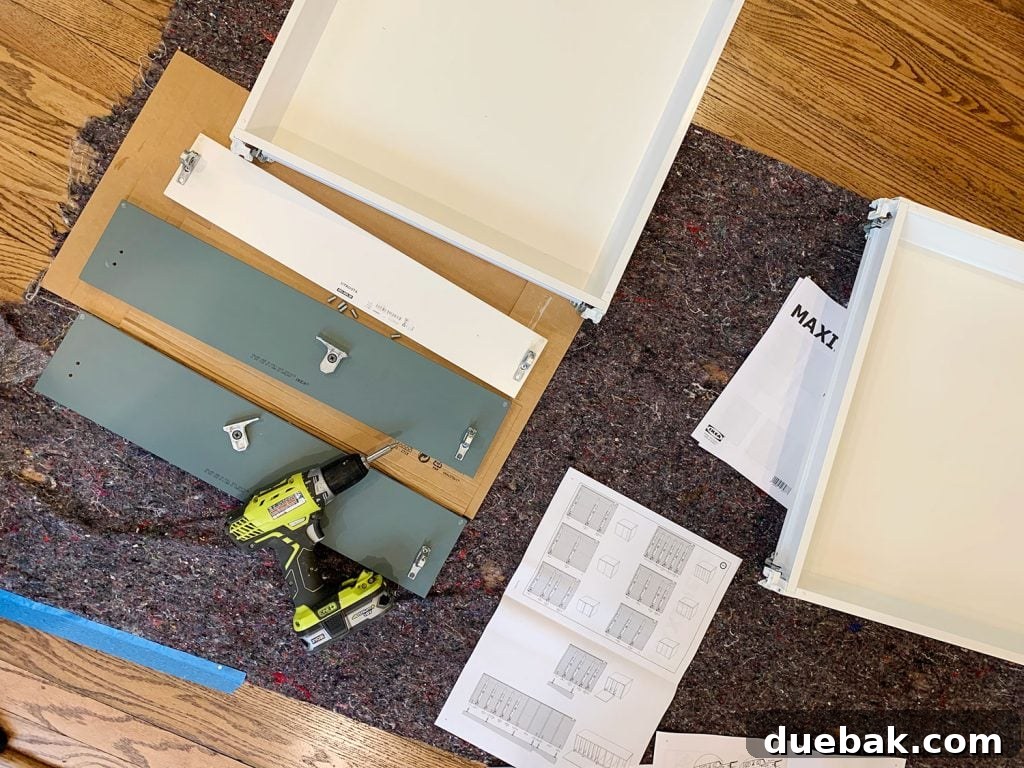
The manual screwdriver truly shines when it comes to the tedious but essential task of adjusting doors and drawers for perfectly even spacing and alignment. This process can be frustrating, but taking your time here ensures a polished, high-end look. Many IKEA hinges and drawer slides feature small adjustment screws that require a manual touch for precise calibration. Additionally, a flathead screwdriver is necessary earlier in the process to twist the small plastic locking pieces that secure each cabinet onto the metal suspension rail, ensuring they don’t accidentally lift off.

18. Miter Saw: For Precise Angles and Finish Details
A miter saw significantly streamlines the process of cutting 2x4s, filler pieces, and especially toekicks. Its ability to make accurate, angled cuts is invaluable for creating clean joints and transitions. IKEA offers toekicks designed to match your cabinet fronts, which conveniently clip onto the adjustable plastic feet of your base cabinets. A miter saw ensures these pieces are cut to the exact length and angle needed for a seamless finish around corners and cabinet runs.

In our beach house kitchen, where we constructed custom island bases and encountered floor level issues, we used standard wood baseboard trim and quarter round instead of IKEA toekicks around the island, cutting them with the miter saw for a custom look. This also helped disguise some floor imperfections. However, in the duplex kitchens, with more level floors and forgiving wood and blue cabinet finishes, the IKEA toekicks alone sufficed, clipping on beautifully and completing the look without extra trim.

19. Nail Gun: For Trim and Small Details
A nail gun can be a significant time-saver and provide a professional finish for various trim elements. While IKEA’s standard toekicks simply snap on, if you choose to add decorative molding like quarter round to your baseboards, a nail gun will be essential for quick and secure attachment. It’s also incredibly useful for fastening small filler pieces that might be too thin or delicate to accommodate screws without splitting or visible fasteners. Its speed and precision for finish work elevate the overall quality of your installation.
20. Other Essential Tools and Supplies
Beyond the core tools, a few other items will ensure a smooth and efficient IKEA kitchen installation. Many of these are simple household items, but having them readily available can prevent unnecessary interruptions:
- Pen or Pencil: For marking measurements, cut lines, and stud locations.
- Painter’s Tape: Crucial for marking cuts on delicate finishes and protecting surfaces during drilling or sawing.
- Step Ladder: Absolutely essential for reaching upper cabinets, installing wall rails, and accessing higher areas safely.
- Utility Knife or Scissors: For quickly opening boxes, cutting tape, and trimming various materials.
- Crowbar: Useful for carefully removing existing baseboards or molding if your renovation requires it, minimizing damage to walls.
- Broom, Dustpan, and/or Vacuum with a Hose: Installation can be messy! Keeping your workspace clean is vital for safety, visibility, and an efficient workflow. A shop vac is particularly effective for collecting sawdust and debris.

Your IKEA Kitchen Installation Tool Checklist
As promised, here’s a consolidated checklist of all the tools and supplies mentioned, organized for easy reference. This comprehensive list covers most scenarios, but remember that specific project circumstances might require additional or fewer items.
- Your itemized receipt / order list (essential for inventory)
- Hammer (for backings and anchors)
- Manual screwdrivers (Philips and flathead for adjustments and rail locks)
- Crowbar (for demolition/removal, if needed)
- Measuring tape (for all measurements and layout)
- Pen or pencil (for marking)
- Painter’s tape (for marking and protection)
- Step ladder (for reaching high areas)
- Power driver (with Philips head bit for assembly)
- Drill bit set with magnetic bit holder & 3/4″ bit for plumbing holes
- Dremel Multi-Max or Hacksaw (for cutting suspension rails)
- Stud finder (for locating wall studs)
- Medium level (24″, for initial rail placement)
- Large level (48″, for ensuring overall levelness)
- Wood shims (for correcting uneven surfaces)
- Heavy-duty cabinet screws (roughly 4 per cabinet, for studs)
- Screws with anchors (roughly 2 per cabinet, for drywall)
- Jigsaw (for plumbing and electrical cuts)
- Circular saw and/or table saw (for cover panels and filler pieces)
- Miter saw (for toekicks, 2x4s, and trim)
- Utility knife or scissors (for general cutting)
- Nail gun (for trim and small filler pieces)
- Clamps (your extra set of hands)
- 2x4s (optional, for custom bases or extensions)
- Kreg Jig (optional, for pocket holes)
- Broom, dustpan, and/or vacuum with hose (for cleanup)
Good luck with your IKEA kitchen installation – we wish you happy and successful building!
P.S. For more detailed insights into our IKEA cabinet projects, explore these related posts: our original laundry room cabinet installation from five years ago, and how we used IKEA cabinets to create a stunning wall of built-ins for our bonus room.
*This post contains affiliate links*