

The final touches can truly transform a kitchen, and nothing brings a sense of completion quite like freshly installed cabinet hardware. This often-overlooked detail is pivotal in defining your kitchen’s aesthetic, making it look and feel like a truly finished space. However, the prospect of drilling into brand new or beautifully refinished cabinets can be daunting. There’s little room for error when creating permanent holes, and a mistake can mean the costly replacement of a cabinet door or drawer front. The pressure to get it right the first time is real, but with the right approach, it’s a perfectly achievable DIY project.

Having navigated multiple kitchen hardware installations, we’ve refined a system that ensures professional results every time. This comprehensive guide will walk you through a foolproof method to install cabinet pulls and knobs, guaranteeing everything is perfectly centered, level, and consistent across your entire kitchen. We’ll help you conquer that fear factor and achieve a polished, cohesive look for your cabinetry, whether it’s a new build or a renovation project.

To further assist you, we’ve embedded a video demonstration that illustrates each step in real-time, offering a visual complement to our detailed instructions. Let’s prepare to elevate your kitchen’s functionality and style with perfectly installed hardware.
Essential Tools and Supplies for Cabinet Hardware Installation
Before embarking on your installation project, gathering the correct tools and supplies is crucial. Having everything at hand will ensure a smooth, efficient process and help you avoid unnecessary interruptions. Here’s a list of what you’ll need to achieve impeccable results:

- Cabinet Pulls or Knobs: Select your desired hardware. We opted for brushed nickel pulls for the blue Kallarp doors and the same style in brass for the wood Askerlund doors. Pro tip: Purchasing hardware in bulk often leads to significant cost savings.
- Cabinet Hardware Jig/Template: A two-pack of these templates is highly recommended. These are the unsung heroes of precision installation.
- Tape Measure: For accurate width and drop measurements.
- Screwdriver: Choose the appropriate head (e.g., Phillips) to match the screws provided with your hardware.
- Power Drill: Essential for drilling holes efficiently.
- 3/16″ Drill Bit: This is a common size for most hardware screws and is often included with quality hardware templates.
- 5/64″ Drill Bit (or smaller): For drilling pilot holes. A smaller bit from a versatile drill bit set is ideal.
- Pen or Pencil: For marking the template and cabinet fronts.
- Painter’s Tape: Protects cabinet surfaces and provides a clear marking area.
- Clamp: To securely hold the hardware template in place, preventing movement during drilling.
Video Guide: Installing Cabinet Pulls with Confidence
To give you a complete understanding of the installation process, we’ve created a detailed, start-to-finish video. This footage captures the real-time installation of cabinet pulls on a set of drawers, allowing you to visualize each step precisely. While we also provide comprehensive photo instructions below, the video offers invaluable insight into the nuances of the process, including a sneak peek at the duplex’s wood kitchen. You can watch the full video directly below:
For those who prefer a step-by-step visual guide through images, continue reading below. However, the video truly brings the entire process to life, making it easier to follow along and grasp the flow of the installation.
Step 1: Customize Your Hardware Template for Precision
The cabinet hardware templates are undeniably the cornerstone of this project. If you’re contemplating whether to invest a small amount in them, let us assure you: they are absolutely indispensable. These templates are engineered to save you countless hours of measuring, marking, and, most importantly, stress. They come equipped with pre-drilled holes for all standard handle spreads (our pulls had a 4″ spread) and offer a variety of options for vertical placement or “drop” from the cabinet’s top edge (we consistently chose a 2″ drop for all our cabinetry). If you’re installing knobs, the templates simplify the process by providing a central column of holes, ensuring perfect vertical alignment and consistency.
Once you’ve determined the ideal holes for your specific hardware’s spread and desired drop, it’s critical to clearly mark these on the template. We use painter’s tape and a pen to circle and draw a large arrow pointing to the chosen holes. These templates feature many closely spaced holes, and accidentally drilling through the wrong one is a mistake you definitely want to avoid. Taking a few extra seconds to “idiot-proof” your template will prevent costly errors later on. Below, you can see how we marked our template for 4″ pulls with a 2″ drop.

Step 2: Protect and Prepare Cabinet Fronts with Painter’s Tape
Before any drilling commences, the next crucial step is to apply painter’s tape to your cabinet and drawer fronts. Position the tape roughly where your hardware will be installed. This serves a dual purpose: firstly, it provides a sacrificial surface where you can make all your pencil marks without directly marking your beautiful cabinets. Secondly, and perhaps more importantly, the tape acts as a protective layer, significantly reducing the risk of your cabinet’s finish cracking, splintering, or chipping when the drill bit penetrates the material. For maximum efficiency, we recommend taping off all the drawer fronts or cabinet doors within one section of your kitchen simultaneously. This allows you to work systematically, tackling one area at a time and maintaining a consistent workflow.

Step 3: Precisely Mark a Center Line on Each Cabinet Front
Achieving perfect symmetry is paramount, especially on drawer stacks where even a slight misalignment will be glaringly obvious. This step demands patience and meticulous attention to detail. A properly marked center line ensures that all your pulls or knobs are perfectly aligned, creating a harmonious and professional appearance. Take your time here; rushing can lead to errors that are difficult to correct.
Begin by accurately measuring the full width of your cabinet door or drawer front. For instance, while a base cabinet might be 24″ wide, the actual drawer front could be slightly narrower, perhaps 23 7/8″. Always measure the specific piece you are working on, not the cabinet frame itself.

Next, perform the necessary calculation to determine the exact midpoint of your measurement (e.g., half of 23 7/8″ is 11 15/16″). Once you have this measurement, mark it clearly on the painter’s tape. Now for the crucial part: **double-check your measurement by measuring again from the *opposite* side of the drawer front.** This redundant step might seem excessive, but it has saved us from misplacing holes more than once. When working on numerous drawers, it’s surprisingly easy for numbers to blur (e.g., 12 15/16″ can look like 11 15/16″). This second measurement acts as a vital safeguard against costly errors.

After marking the center on each drawer, enlarge your marks slightly to make them more visible in the subsequent steps. Then, step back and perform a quick visual inspection to confirm that all the lines appear perfectly aligned with one another. This visual confirmation is surprisingly effective at catching inconsistencies.

Step 4: Securely Align Your Hardware Template
With your center lines established, it’s time to position the hardware template. For your first drawer, carefully rest the template’s lip along the top edge of the drawer front. Then, meticulously center the template over the line you just marked on the painter’s tape. While a clear template (which some older models featured) makes seeing the underlying line easier, even with opaque templates, a bit of careful squinting through the center holes will help you align it perfectly with your pre-marked line.

Once you are absolutely certain that the template is both perfectly centered on your marked line AND evenly seated on the top edge of the drawer, it’s crucial to secure it. We strongly recommend using a clamp to hold the template firmly in place. This prevents any unwanted shifting or movement during the drilling process, which is critical for maintaining precision and avoiding misaligned holes.
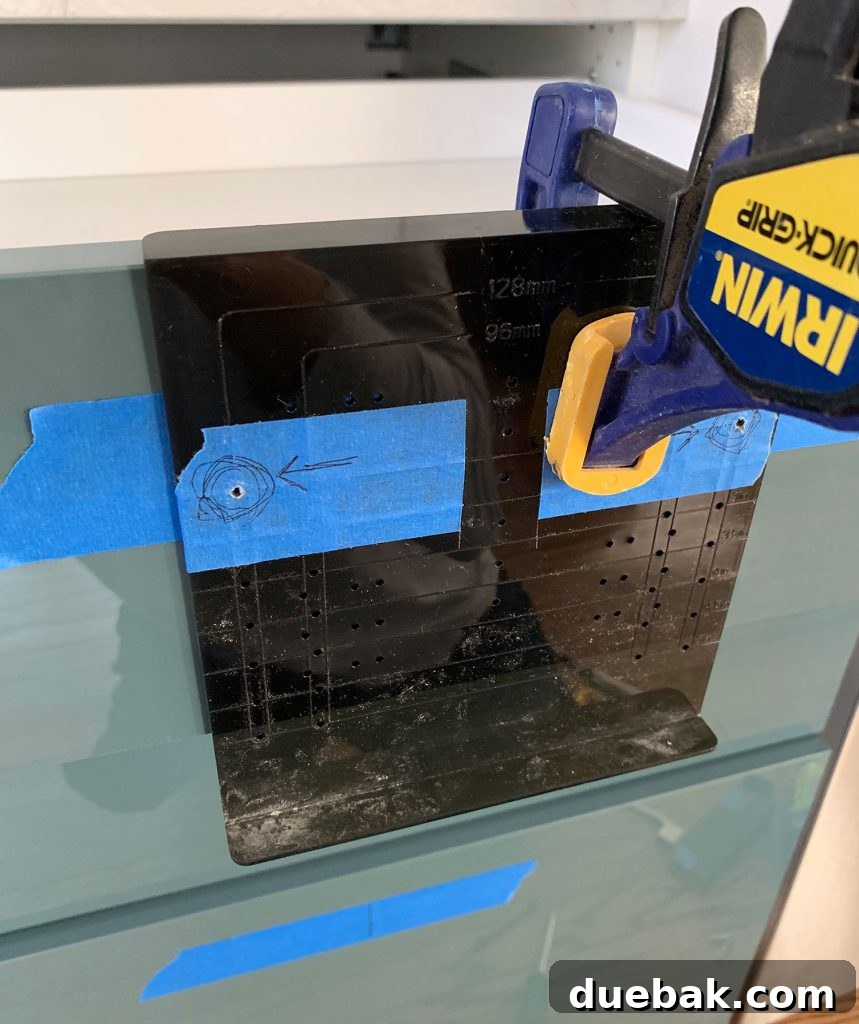
Step 5: Drill Precise Pilot Holes Through Your Hardware Template
While some DIYers prefer to simply mark their drilling points through the template with a pen, we’ve found that drilling directly through the designated holes in the template yields significantly more precise results. For this step, you’ll need a relatively small drill bit – typically around 5/64″. This initial drill creates a “pilot hole,” which serves as a guide for the larger bit that will follow. The convenience of drilling this pilot hole directly through the template’s marked points ensures perfect alignment from the very start.
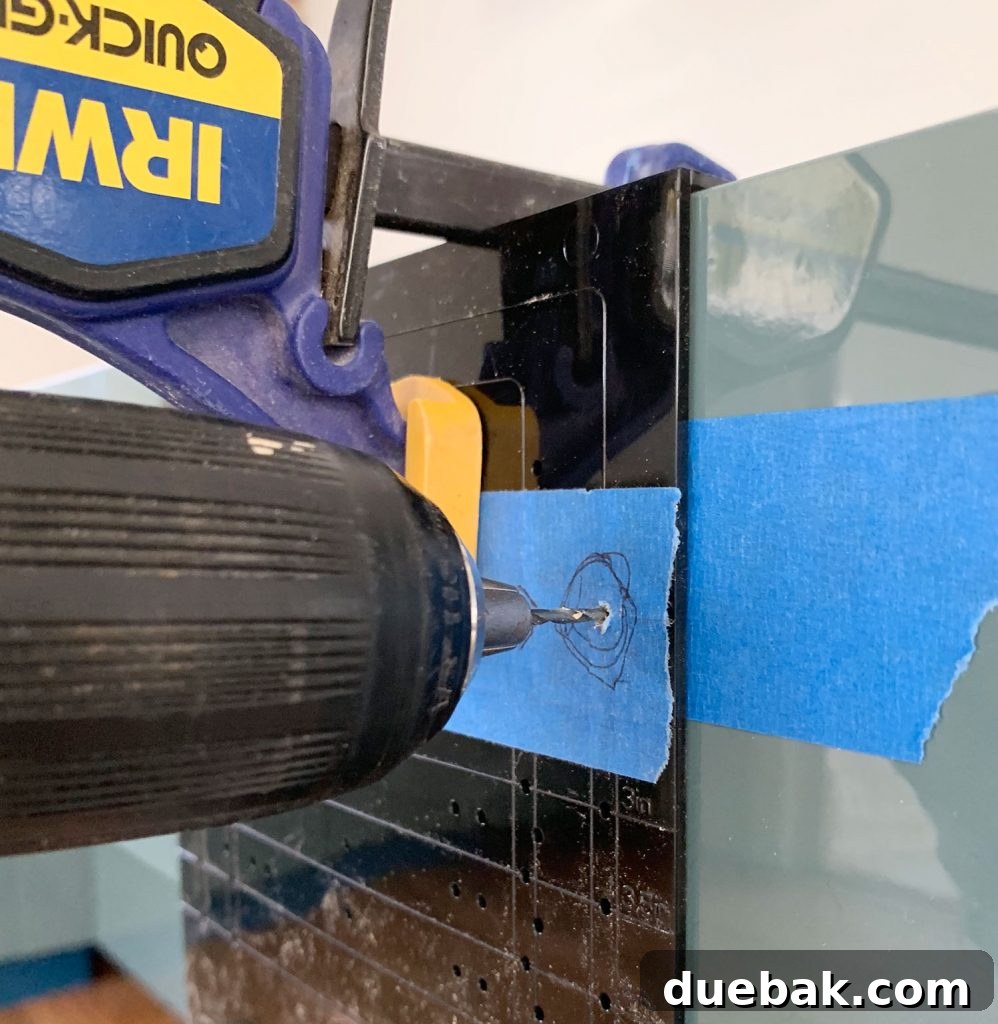
Assuming your cabinet hardware attaches with screws from the back of the drawer or door, ensure your pilot hole penetrates all the way through the material, just poking out the backside. When the drill bit is about to exit the back, slow your drilling speed considerably and apply gentle pressure. This technique helps to minimize any potential cracking or splintering on the cabinet’s interior surface. For an extra layer of protection, you can even apply painter’s tape to the back of the drawer where the bit will emerge. However, in most cases, any minor splintering on the back will be completely covered by the screw head and washer, making it an aesthetic concern rather than a structural one.
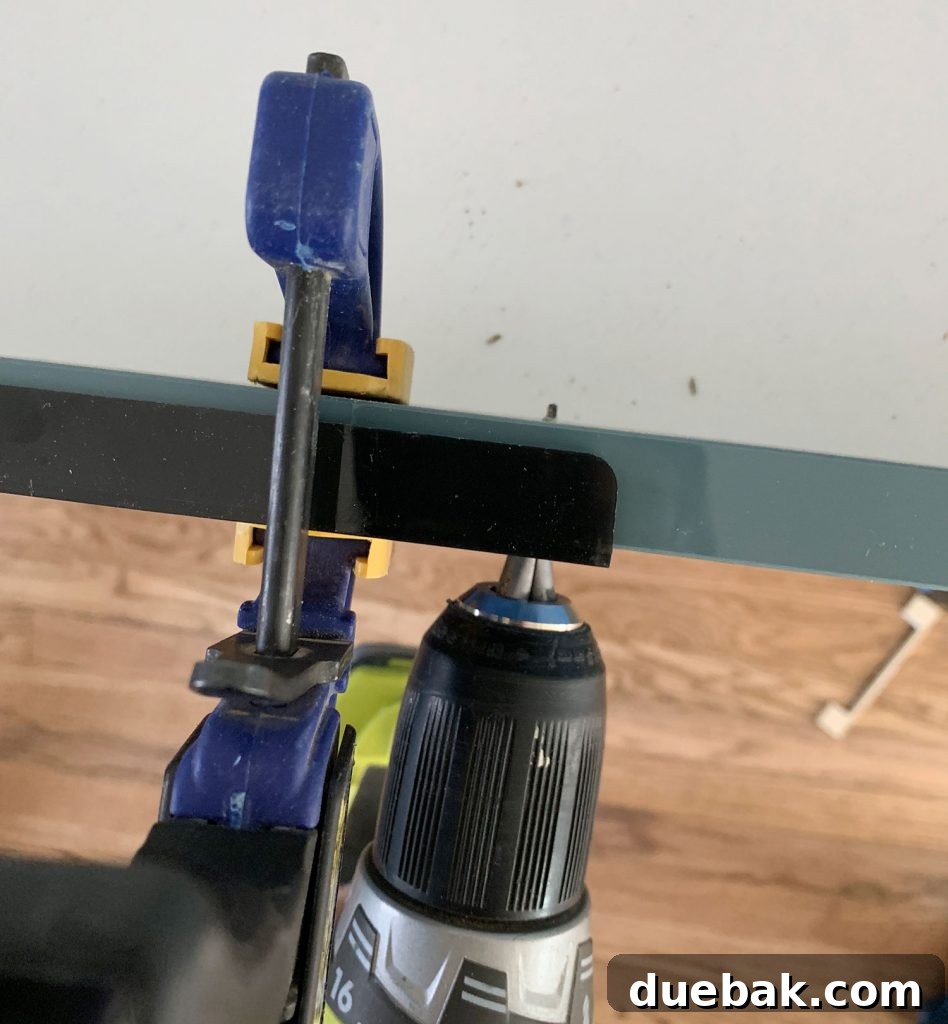
To optimize your workflow, after completing the pilot holes for the first drawer, repeat Steps 4 and 5 (centering your template, clamping it, and drilling pilot holes) for all other drawers within the same cabinet section. This batching approach saves time by eliminating the need to constantly switch drill bits between each individual drawer, allowing you to develop a consistent and efficient rhythm.
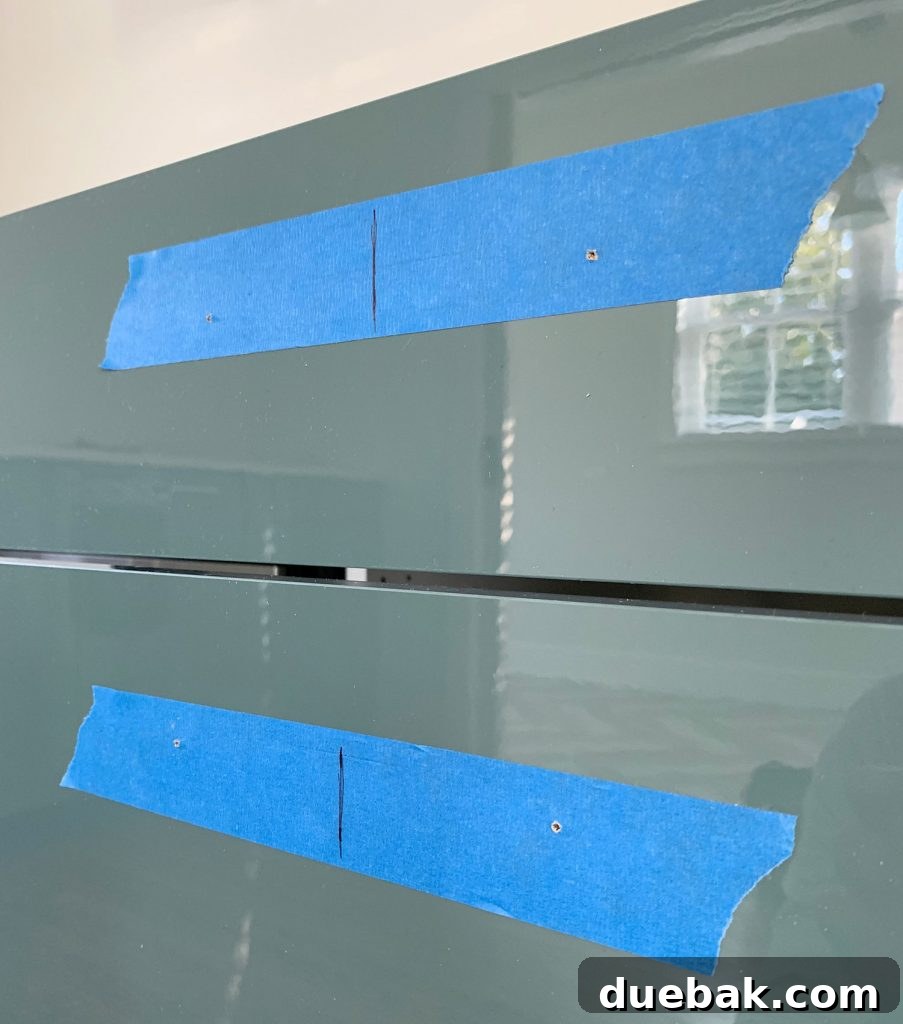
Step 6: Drill Your Final, Full-Sized Holes
Once all your small pilot holes are precisely drilled across the entire cabinet section, it’s time to remove your hardware template – but keep the painter’s tape in place! Now, switch out your small drill bit for a larger, 3/16″ bit. This size is commonly provided with most hardware templates as it’s the standard diameter for the majority of hardware screws. However, it’s always wise to double-check that this bit creates a hole large enough for your specific screws to pass through comfortably, without being too loose.
Carefully guide the larger drill bit through each of the existing pilot holes. Remember to maintain a controlled, steady hand and avoid applying excessive force, especially as the drill bit passes through the back of the door or drawer. The pilot hole will ensure your larger bit follows the correct path, minimizing any risk of splintering or cracking the cabinet material. Drilling slowly and steadily is key to a clean exit hole.
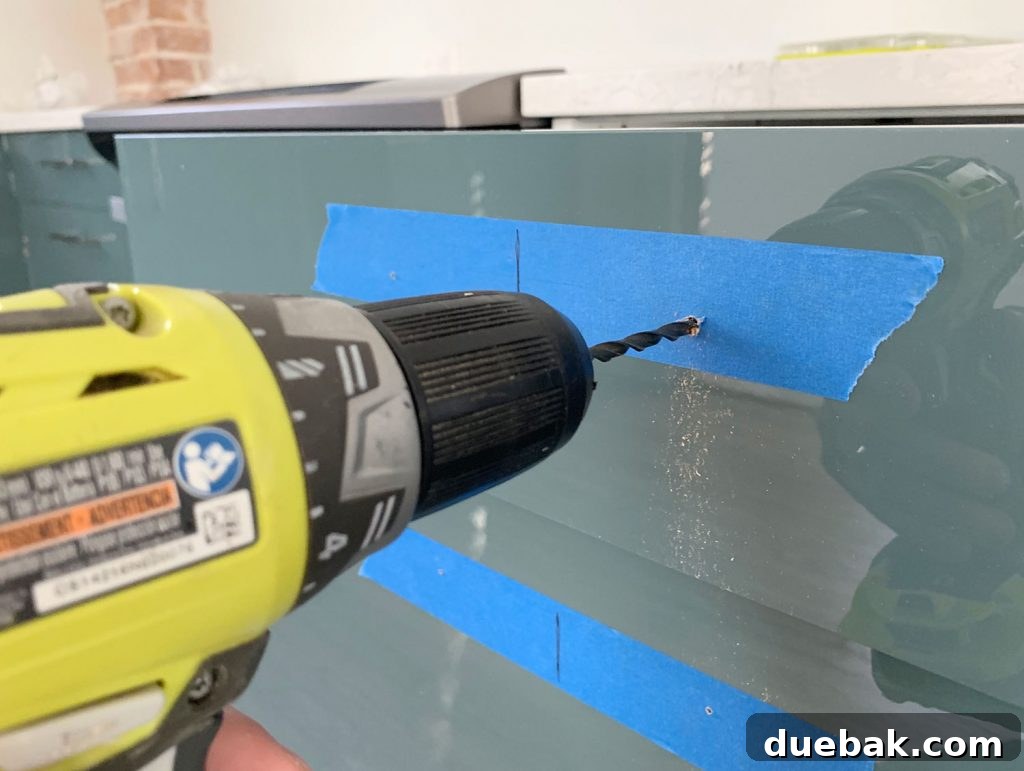
With all the larger holes successfully drilled, you can finally peel away the painter’s tape from your cabinet fronts. You’ll reveal clean, perfectly spaced holes, ready for your new hardware. The tape will have done its job protecting the finish, and now it’s time for the exciting part – seeing your vision come to life.

Step 7: Attach Your Cabinet Hardware Securely
With the drilling complete, it’s time to bring your cabinet hardware to life. Take your chosen pulls or knobs and the corresponding screws. Position a pull over its holes on the exterior of the door or drawer front. Then, from the interior of the cabinet, insert the screws through the pre-drilled holes, aligning them with the attachment points on the pull. We recommend loosely connecting both ends of the pull before tightening any screws completely by hand. This allows for minor adjustments and ensures the pull sits flush against the surface.
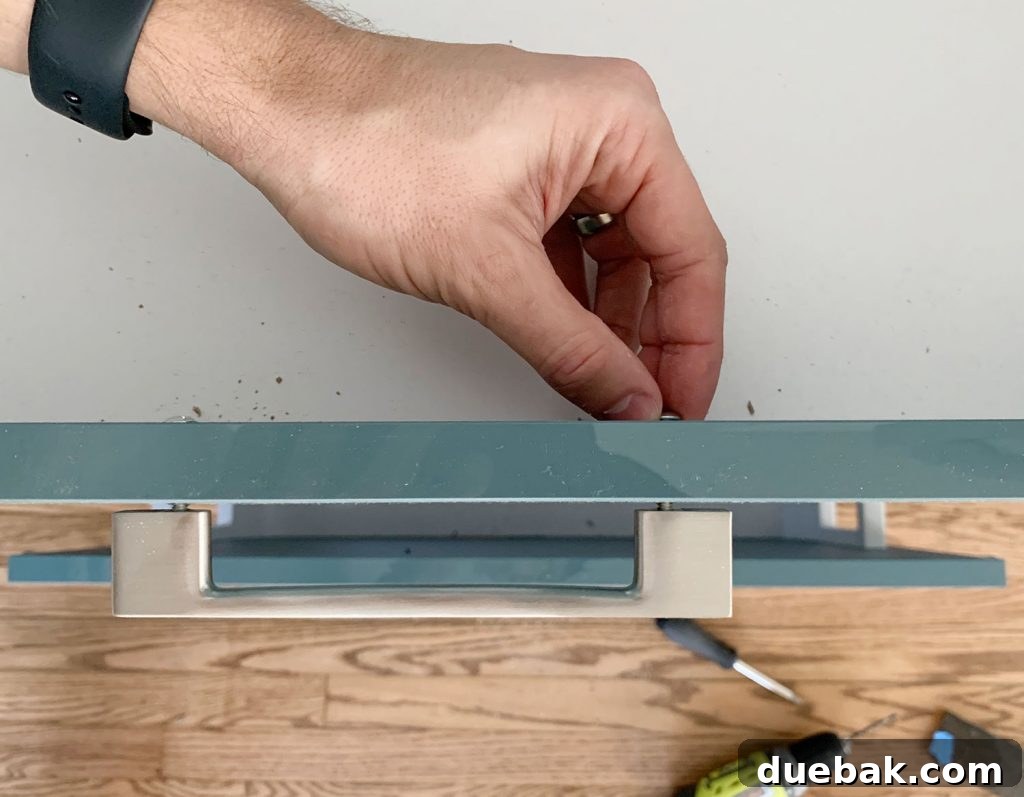
Once all your pulls or knobs are loosely attached across the entire cabinet section, go back with a traditional screwdriver and firmly tighten each screw. This step is crucial for securing the hardware in place, preventing any wobbling or loosening over time. It’s highly advisable NOT to use a power drill for this final tightening. A power drill, especially on a high torque setting, can easily strip the screws, damage the hardware, or even crack the cabinet door or drawer front if overtightened. Hand-tightening provides the necessary control to ensure a snug, secure fit without causing any damage.
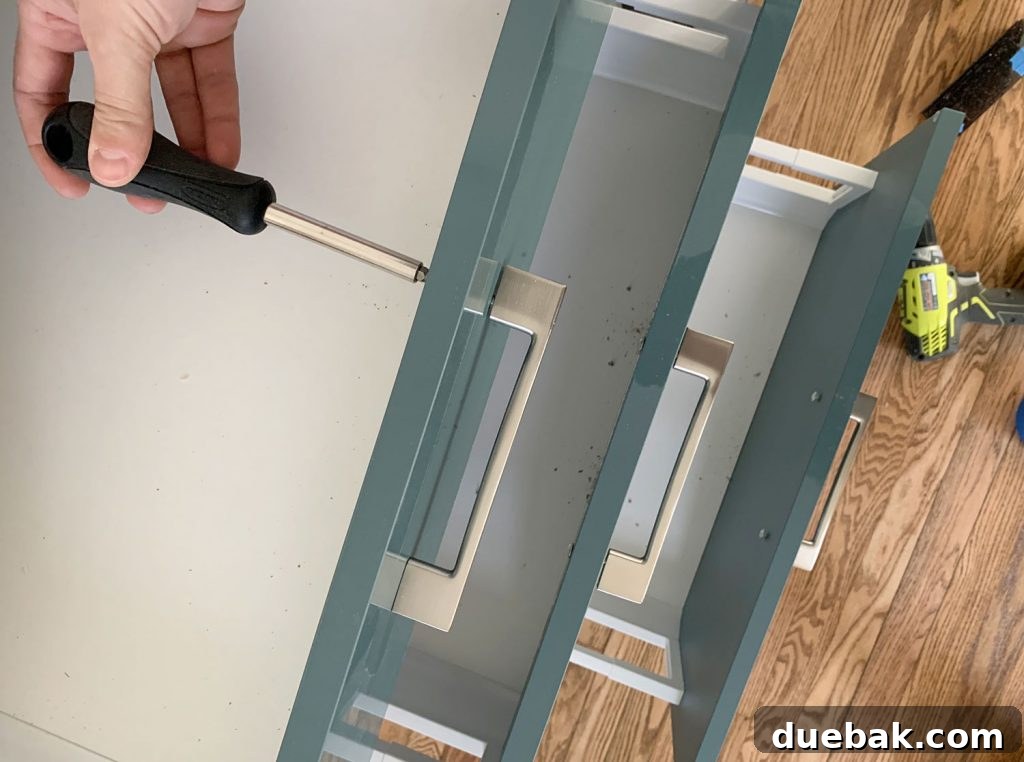
Step 8: Final Cleanup and Enjoy Your New Look!
The final step in your cabinet hardware installation journey is a simple yet satisfying one: cleanup. Drilling inevitably creates wood dust and shavings, which can accumulate inside drawers, on cabinet shelves, and across your kitchen floor. Grab your vacuum hose and thoroughly clean all affected areas, ensuring no debris is left behind. This meticulous cleanup marks the true completion of your project.
Congratulations! You’ve successfully installed your cabinet hardware. Now, you can step back and admire the crisp, finished look of your kitchen. If you have more cabinets to tackle, simply repeat these steps, leveraging the rhythm and confidence you’ve gained from this initial installation.

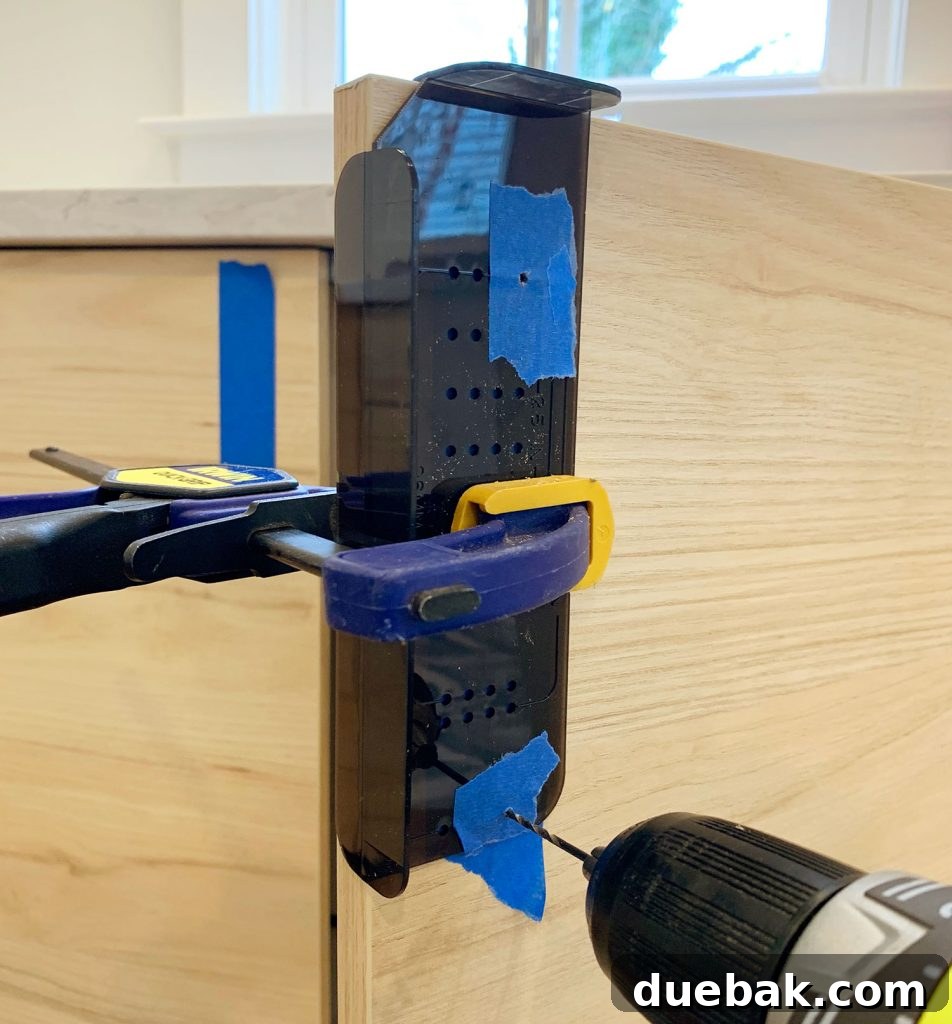
It’s worth noting that this process is largely the same for installing knobs or pulls on cabinet doors, such as those found under a sink. The only difference is the specific template you’ll use. Most template sets include a second template designed to rest along the corner of your cabinet door, as seen below, providing precise placement for corner-mounted hardware.
We truly hope this detailed guide helps demystify the process and alleviate any apprehension you might have about installing your own cabinet hardware. While a slight wince might still accompany the first drill hole into a new cabinet, following these proven steps significantly boosts confidence and efficiency. For our duplex kitchens, this method allowed us to install all hardware in under two hours – achieving perfectly aligned and centered handles every single time!

For those eager to see the full kitchen transformation and learn more about installing Ikea cabinets, stay tuned for an upcoming post where we’ll delve deeper into that process, sharing our accumulated tips and tricks. Given our extensive experience with Ikea kitchen installations, we have valuable insights to pass along. In the interim, you can find a previous guide on installing Ikea cabinets here for additional information.
Looking for more kitchen how-to guides and DIY inspiration? Explore these related posts below:
- How To Paint Kitchen Cabinets
- Make Your Own Cabinet Hardware Template
- Installing Under Cabinet Lighting
- How to Hang A Subway Tile Backsplash for $200
*This post contains affiliate links*