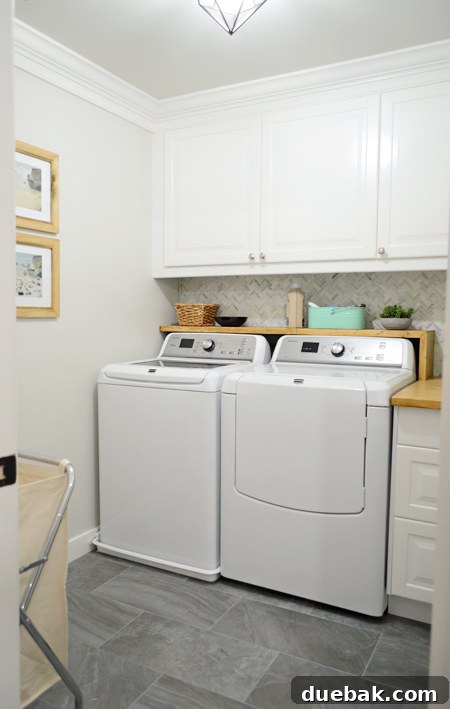
Tackling drywall installation might seem like a daunting task, a project typically reserved for professional contractors or at least requiring a team of helpers. However, with the right approach and a few clever tools, it’s entirely possible to achieve impressive results all by yourself! I recently transformed our entire laundry room, including the ceiling, in a single day, and I did it without an extra set of hands. Today, I’m excited to share my step-by-step process, revealing the ‘secret weapon’ that made this solo endeavor not just feasible, but surprisingly efficient and stress-free.

Essential Tools and Materials for DIY Drywall Installation
Before you dive into your drywall project, gathering the right tools and materials is crucial. While some items might be optional depending on the complexity of your specific job, having a well-stocked arsenal will make the process smoother, safer, and more enjoyable. Here’s a comprehensive list of what you’ll want to have on hand to conquer your drywall installation:
- Drywall Sheets: We opted for 4 x 8′ UltraLight Sheetrock. The “ultralight” feature is a significant advantage for solo installers, making panels easier to maneuver, especially for ceiling work. Consider the appropriate thickness for your project – typically 1/2-inch for walls and ceilings in residential applications, or 5/8-inch for fire-rated assemblies or enhanced soundproofing.
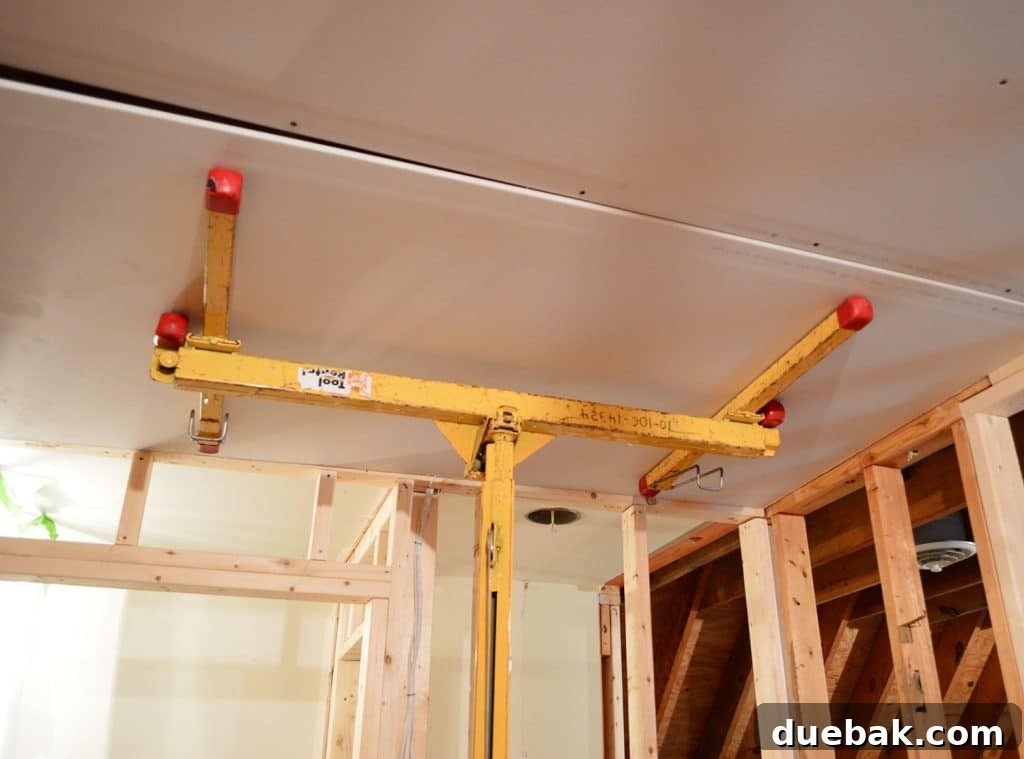
- Drywall Lift: This is my absolute secret weapon and a non-negotiable item for solo drywall installation. We highly recommend renting one for around $40 per day, as it provides invaluable support for lifting and holding heavy sheets, particularly on ceilings and upper wall sections. It’s a true back and time saver!
- Electric Drill: Essential for driving screws. While a standard electric drill works, in hindsight, I wished I had invested in a dedicated drywall screw gun. These guns are designed for continuous use and have an adjustable clutch to prevent over-driving screws, ensuring consistent countersinking.
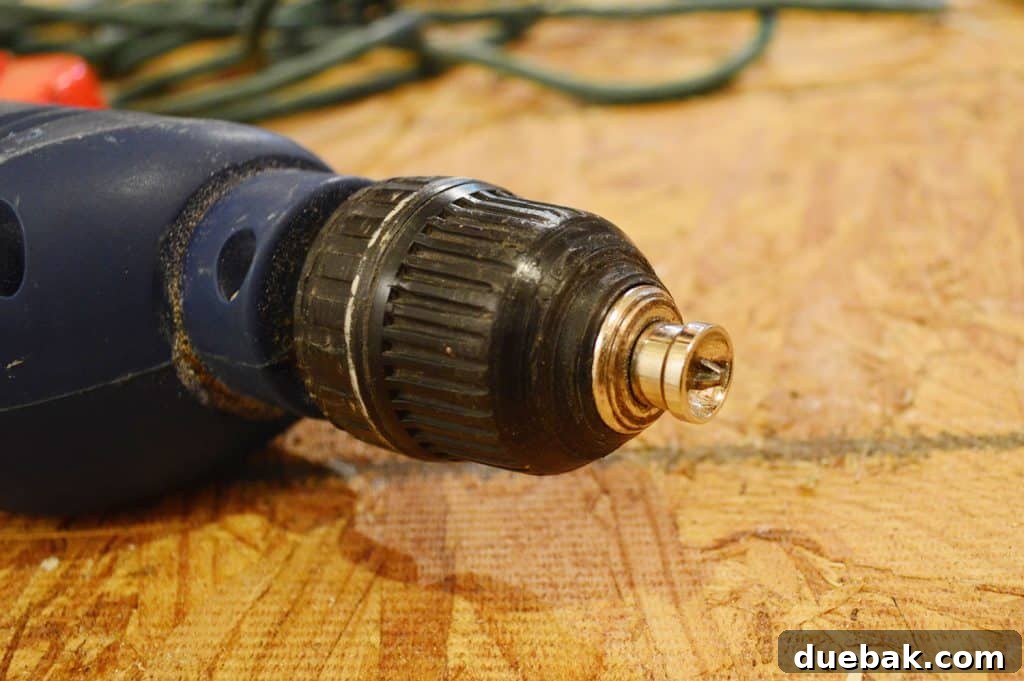
- Drywall Setting Drill Bit: This specialized bit is designed to countersink screw heads just below the paper surface of the drywall, but without breaking through it. This creates a small dimple, perfectly prepared for mudding, and is essential for a smooth finish.
- Coarse-Thread Drywall Screws: Use the correct length for your application. I used 2″ screws for the ceiling to ensure a strong hold into the joists, and 1 5/8″ screws for the walls, which are ideal for securing drywall to wood studs. Coarse-thread screws are designed for wood framing, providing superior grip compared to fine-thread screws.
- Measuring Tape: Accuracy is paramount in drywall installation. A reliable tape measure will be used constantly for precise cuts.
- Chalk Line: Indispensable for marking long, straight cut lines on drywall sheets, ensuring your cuts are precise and square.
- Utility Knife: A sharp utility knife is your primary cutting tool for scoring and snapping drywall. Keep spare blades handy, as dull blades can lead to ragged cuts.
- Straight Edge: A metal yardstick, T-square, or a long level will serve as an excellent guide for making perfectly straight scores with your utility knife.
- Drywall Saw (or Keyhole Saw): Essential for cutting out irregular shapes, small holes, or making cuts around obstacles like electrical boxes and pipes where a utility knife won’t suffice.
- Hole Saw Drill Bit (optional but recommended): For perfectly round cuts, such as recessed lighting or certain vent openings, a hole saw provides a clean and quick solution.
- Pencil or Marker: For making temporary marks and measurements on your drywall panels.
- Step Ladder: Crucial for reaching upper wall sections and for detailed work on the ceiling, even with the drywall lift.
For our project, I conveniently picked up the UltraLight Sheetrock and other large supplies when I rented the $19 Home Depot truck. The “ultralight” aspect of the fourteen 4 x 8′ sheets proved incredibly beneficial, making what could have been a physically demanding job much more manageable, even for a single person. While it’s certainly lighter than traditional drywall, it still requires proper lifting techniques and tools to prevent strain.

The lightweight characteristic of the drywall was helpful, but let’s be realistic – it’s still not something you can easily hold in place with one hand while screwing it into studs with the other. This is precisely where the drywall lift truly shines. I rented mine from Home Depot for $40 for a 24-hour period, and it was money incredibly well spent. The best part? It disassembles easily, fitting comfortably into a standard car for transport, proving that even substantial tools can be accessible for DIYers.
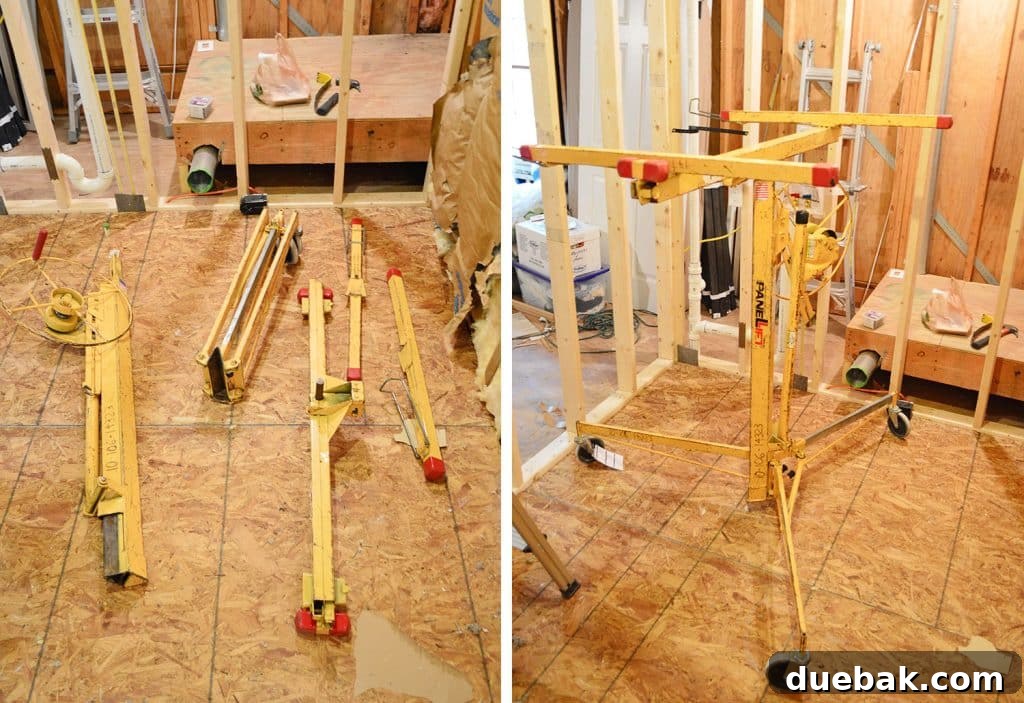
Hanging Drywall on the Ceiling: A Solo-Friendly Approach
Starting with the ceiling is a common recommendation, and for good reason. It allows you to work downwards and ensures any minor imperfections at the top of the wall panels will be covered by the ceiling sheets. This is where the drywall lift transforms a multi-person job into a surprisingly manageable solo task. Once a piece of drywall was cut to the appropriate size, I simply placed it onto the lift’s arms. With a few effortless spins of the wheel, I could raise the panel smoothly and precisely into its ceiling position. This mechanical assistance was an absolute lifesaver, not only for my back but also for maintaining accuracy.

With the lift holding the heavy drywall sheet firmly against the ceiling joists, both of my hands were completely free. This allowed me to focus entirely on fastening the panel securely with screws, without the added strain or worry of fatigued arms (mine or a human helper’s!). This freedom is invaluable, enabling precise placement and proper screw patterns, which are critical for a strong and stable installation. I started from one corner of the room, working my way across, ensuring each panel was snug against the previous one and well-supported by the joists.
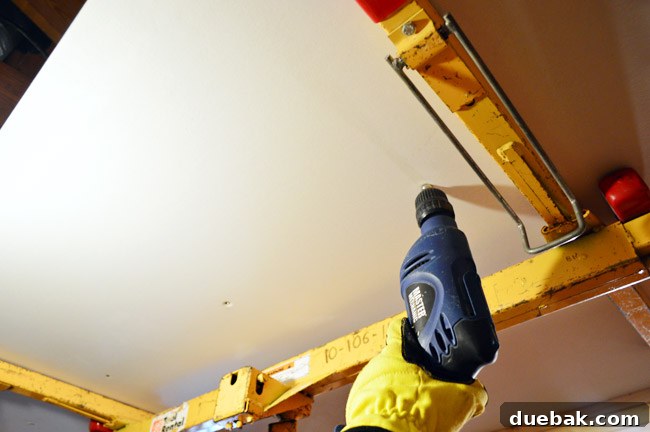
I utilized coarse-thread drywall screws, using 2″ screws for the ceiling for maximum bite into the joists, and reserving 1 5/8″ for the wall studs. The special drywall setting drill bit proved indispensable, ensuring that each screw head was perfectly countersunk just below the surface of the drywall, creating a uniform dimple ready for mudding. This prevents screw heads from protruding, which would create bumps, or sinking too deep, which compromises the drywall’s integrity. While a standard drill worked, looking back, I can’t emphasize enough how much faster and more efficient a dedicated drywall screw gun would have made this step. The consistent depth control and faster driving speed would have significantly cut down installation time.
The general process for ceiling installation, once you have the lift, is quite straightforward: accurately measure the area, cut the drywall sheet to fit, position it on the lift, crank it into place, and then secure it with screws into the ceiling joists. This systematic approach, combined with the drywall lift, demystifies what many consider the most challenging part of solo drywall installation.
Mastering Drywall Cutting Techniques for a Seamless Finish
Rarely will a full sheet of drywall fit perfectly into every space without requiring some cuts. Learning effective and clean cutting techniques is paramount for a professional-looking finish. When a full sheet needed trimming, my go-to method involved a utility knife and a straight edge. First, I would take precise measurements and mark my cut line clearly on the drywall. Using a chalk line is fantastic for creating long, perfectly straight guides. Then, I’d position a straight edge (like a metal yardstick or T-square) firmly along the chalk line and use my utility knife to score deeply through the top layer of paper. The goal is to cut through the paper and slightly into the gypsum core.
Once the score line is established, you can often run your knife along that ridge a second time without the straight edge, deepening the cut. The magic happens next: with the scored side facing up, position the drywall over a scrap piece of wood or a sturdy edge (like a sawhorse) such that the score line is just beyond the edge. Apply firm, even pressure to the hanging portion, and the sheet will ‘snap’ cleanly along your score line. Finally, you just need to cut through the back layer of paper with your utility knife, and you’re left with a perfectly sized panel. Always wear gloves and exercise caution when using a utility knife.

Beyond straight cuts, home renovation projects inevitably present various obstacles that require intricate cuts, such as light switches, electrical outlets, HVAC vents, and plumbing pipes. For these, a combination of precise measurement and strategic cutting tools is essential to ensure perfect hole placement.
Cutting Precise Holes for Vents and Outlet Boxes
Cutting precise openings for electrical boxes, vents, and other fixtures can be intimidating, but I discovered a brilliant trick that ensures perfect alignment every time. Since I started with the ceiling, my first challenge was the electrical box for our main ceiling light. To mark its exact location onto the drywall panel, I dabbed a small amount of spare paint (any readily available paint will do) onto the edges of the electrical box.
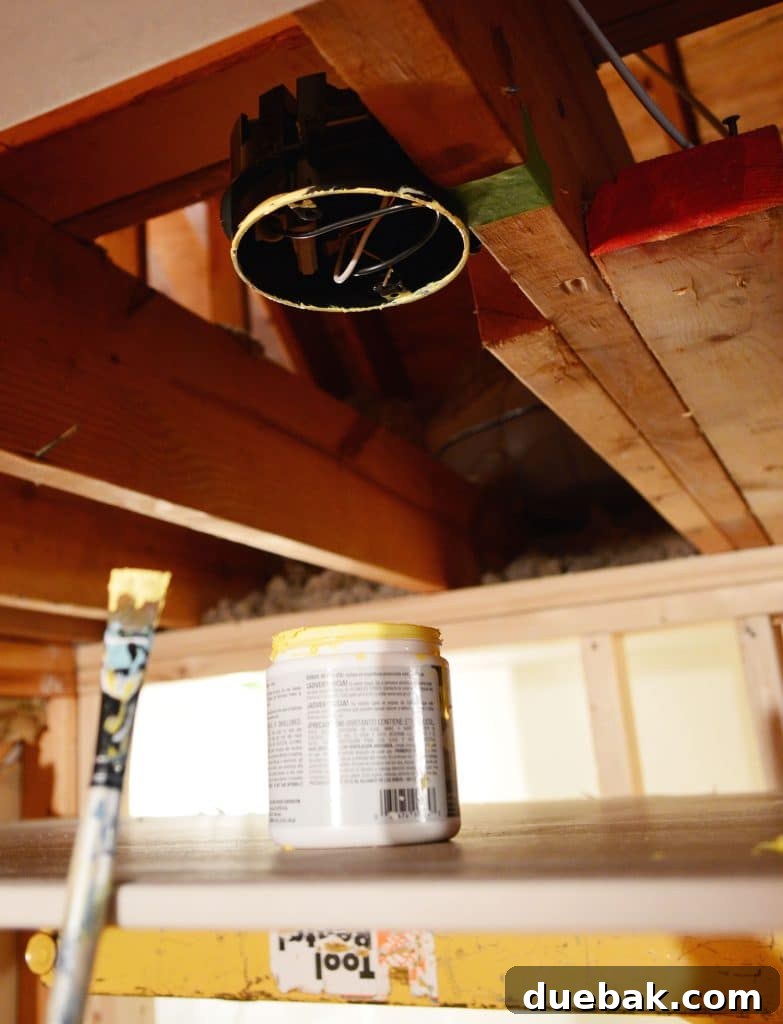
Then, with the paint still wet, I carefully raised the drywall sheet to the ceiling using the lift and pressed it gently against the joists. This action transferred a faint, but accurate, paint outline onto the drywall panel, marking the exact position and dimensions of the electrical box. This method eliminates the need for complex measurements and minimizes the risk of error.
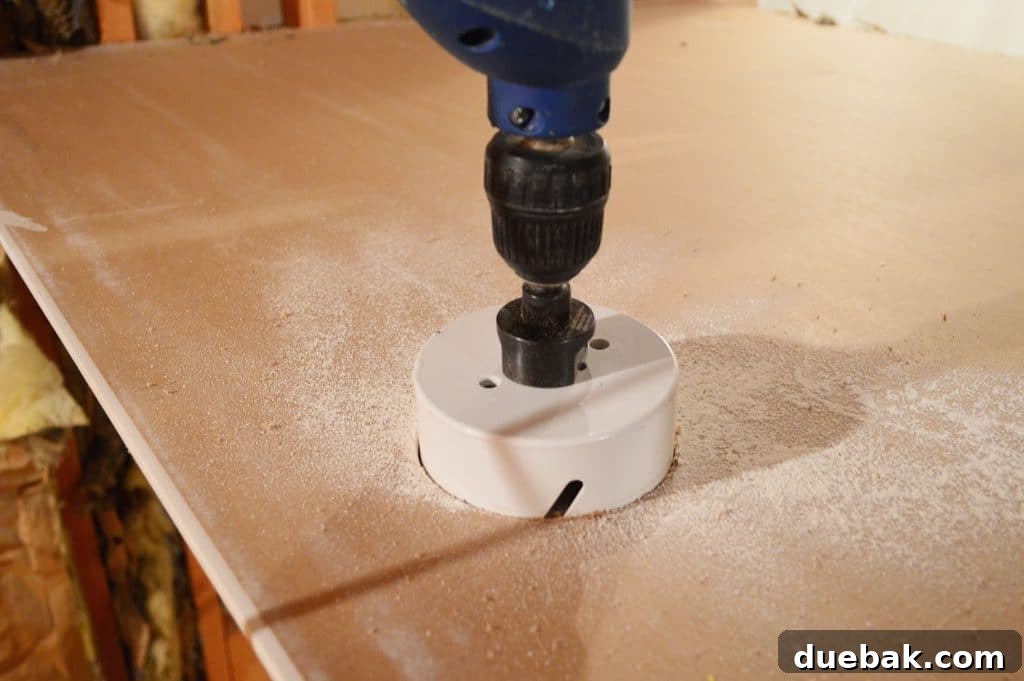
Once the outline was transferred, I could confidently cut a perfectly placed, clean hole using a hole saw drill bit. Hole saws are ideal for round openings, providing a smooth, consistent cut that fits snugly around fixtures.
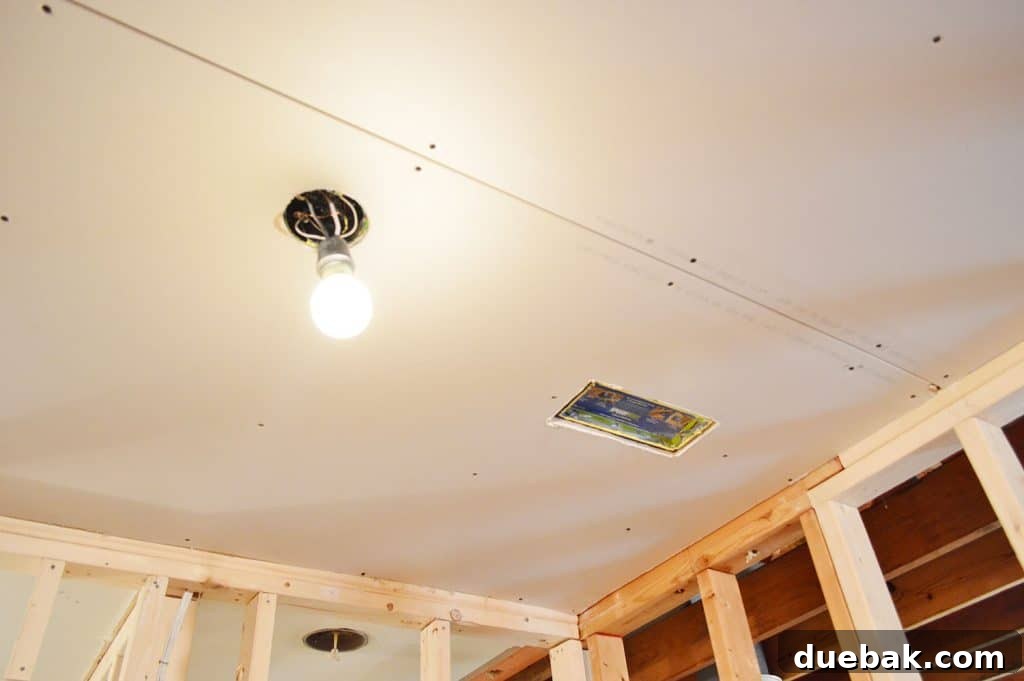
I applied this ingenious paint trick for other round or square openings, such as the HVAC vent hole, as you can see in the completed ceiling section below. This versatile method works equally well for electrical outlets and switch boxes on walls.
For all non-round holes, such as those for plumbing pipes or rectangular vents, the drywall saw (or jab saw) became my tool of choice. After marking the outline using the paint trick or precise measurements, I’d carefully cut along the lines. Whenever feasible, I found it beneficial to cut from the front face of the drywall panel. This technique helps to keep the edges of the hole cleaner and minimizes tearing of the paper backing, which contributes to a neater finish.
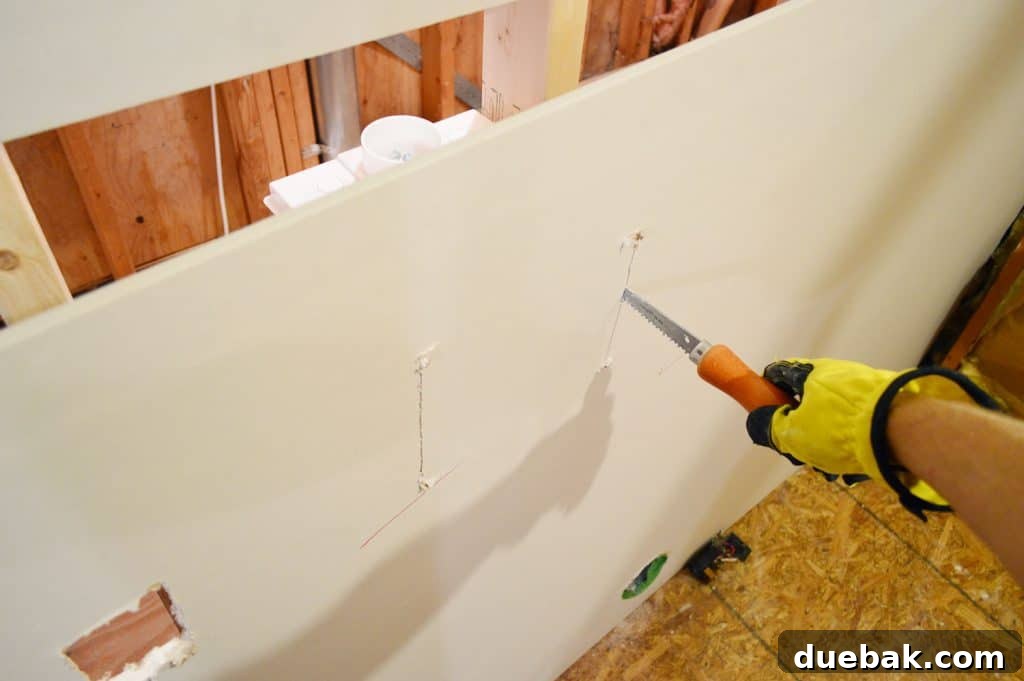
Installing Drywall on Walls: Tips for Efficiency and Strength
Once the ceiling was complete, I moved onto the walls. The drywall lift proved to be just as invaluable here, as many models pivot to assist in holding sheets horizontally against walls. Our laundry room measured approximately 8′ deep by 7′ wide, which meant each wall typically required two 8′ sheets of drywall, cut slightly shorter lengthwise to fit snugly. Working systematically around the room, I found that having pre-cut pieces ready significantly sped up the process.

NOTE: It’s generally recommended by professionals to hang drywall sheets horizontally across your wall studs. This method offers several advantages: it creates fewer overall seams to tape and mud, helps to better hide any bowing or irregularities in the studs, and ultimately provides a stronger, more stable wall that is less prone to sagging over time. While vertical installation is sometimes done in specific situations, horizontal hanging is the preferred standard for residential projects.
As straightforward as the process was made by the drywall lift, it still demands attention to detail and a steady pace. Between meticulous measuring and marking, precise cutting, hauling panels up to the room, using the lift for positioning, cutting around various obstructions, and securely screwing the drywall into place, I estimated an average of about one board installed every 45 minutes. However, given that our laundry room isn’t a massive space, this efficient pace still allowed us to completely drywall the room within a single day. This illustrates that even solo, a focused approach can yield quick results.

Efficiently Cutting Around Doorways and Openings
Cutting around doorways, surprisingly, turned out to be one of the simpler tasks. My preferred method was to hang the drywall sheets directly over the door opening, one at a time, extending fully across the frame. Once the sheet was securely screwed into place, I would then use my drywall saw to cut out the portion of the panel that covered the door opening. This “hang and cut” technique is remarkably foolproof because it naturally conforms the drywall to the existing opening, eliminating the need for incredibly precise pre-measurements for the cutout itself. It’s a method that minimizes errors and ensures a clean, tight fit around the door frame.
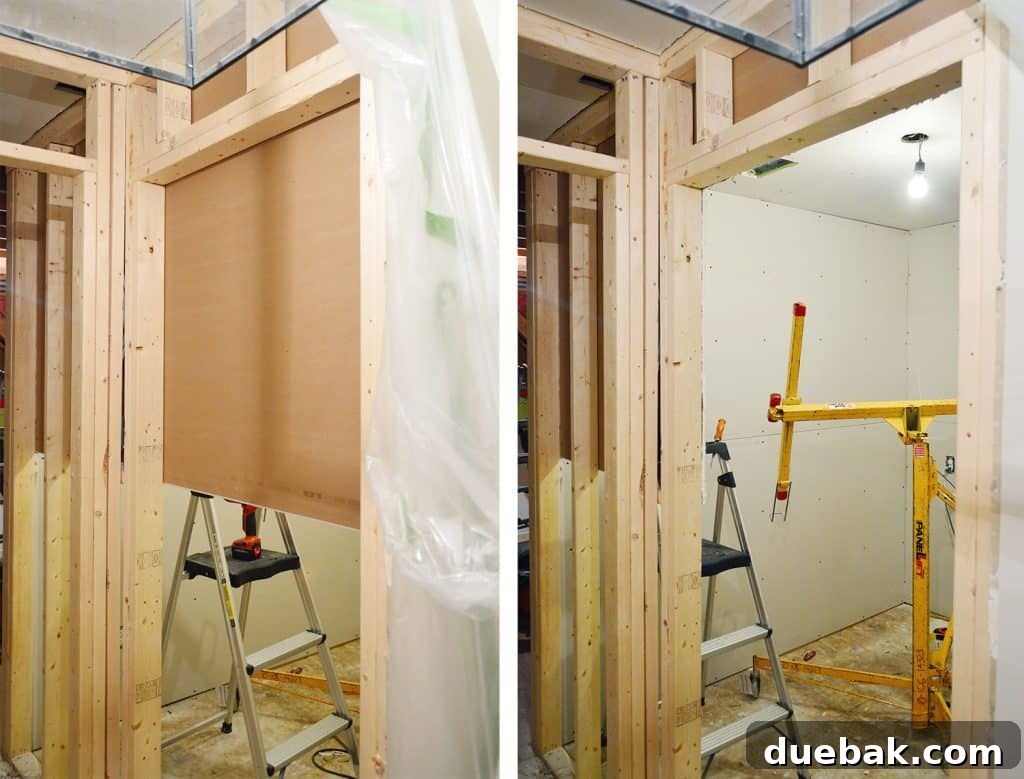
While the drywall saw worked perfectly for this method, I do think that investing in a spiral saw (also known as a RotoZip or drywall router) would have significantly expedited the cutting process around these larger openings. For projects involving multiple doorways or window openings, the speed and accuracy of a spiral saw can be a worthwhile investment. Given that we had four total doorway holes to cut (two doors, each with two sides), the foolproof nature of this process was greatly appreciated, ensuring consistent and clean results.

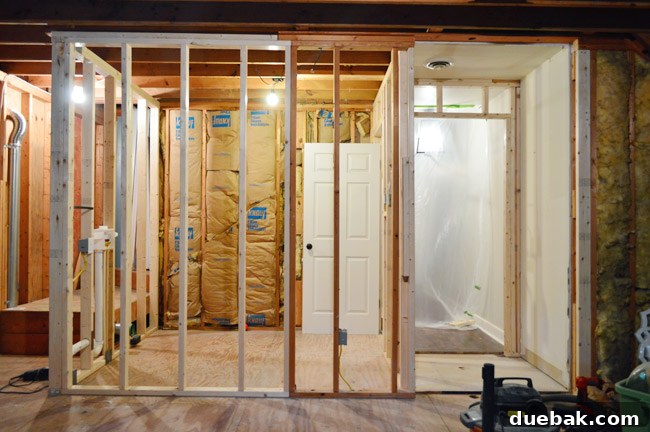
Eventually, all 14 pieces of drywall found their place: 10 within the laundry room itself, 2 in the adjacent hall, and another 2 in the storage room vestibule. With each panel secured, the space truly began to transform from bare studs into a defined and functional room. Here’s a look at where we started, viewed from the adjoining attic space, showcasing the raw framing before any drywall was installed:
And this is the impressive progress we achieved. This view, again from the attic looking into the laundry room, explains why you still see exposed framing on the outside – the internal structure of the laundry room is now fully enclosed with drywall.
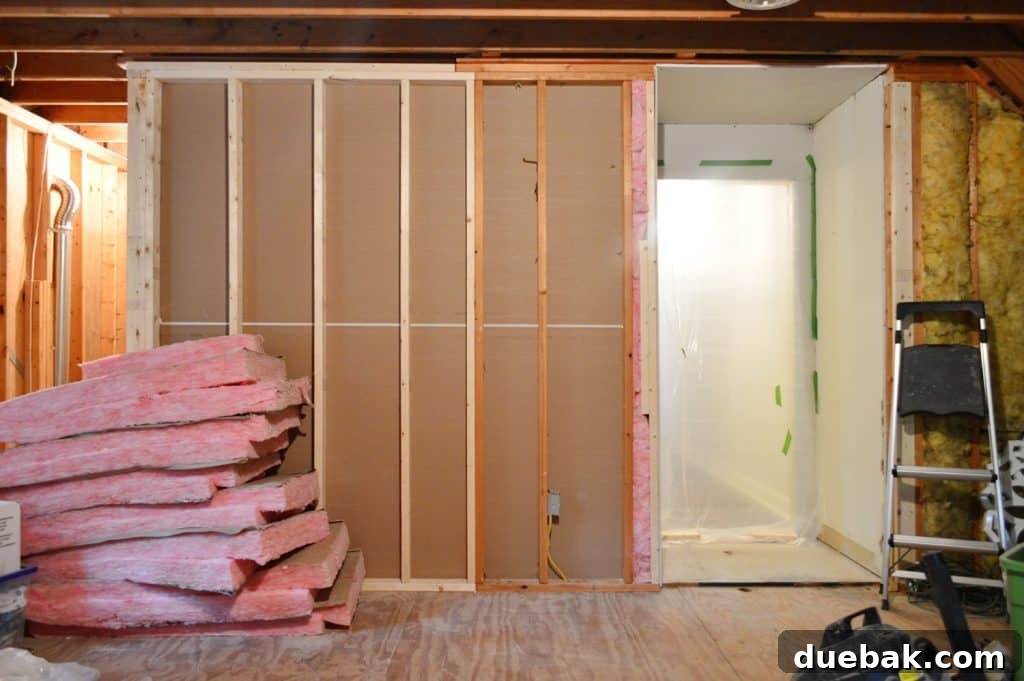
Stepping inside the newly drywalled laundry room, you can see the results of our solo effort. While our drywall hanging isn’t absolutely 100% flawless (I did have a slightly angled cut up in that top corner), we are immensely proud to have completed this significant task entirely on our own. As many experienced DIYers will attest, the hanging phase is often considered the easier part compared to the intricate art of mudding and taping. We kept this encouraging thought in mind, bolstering our spirits as we prepared for the next, more detail-oriented stage of our renovation. Completing the hanging portion provides a huge sense of accomplishment and visual progress.

The Next Step: How to Mud & Tape Your Drywall Seams
Speaking of the subsequent steps, we have indeed officially embarked on the process of mudding and taping the drywall joints. This phase is undeniably more challenging and requires patience and a keen eye for detail, especially when dealing with numerous internal and external corners, as our laundry room presents. The goal is to create perfectly smooth, seamless walls and ceilings that are ready for primer and paint, effectively hiding all the joints and screw heads.
UPDATE: We’ve since discovered some fantastic tricks and techniques that significantly streamline and simplify the mudding and taping process. If you’re ready to advance to the next critical stage of your drywall project, be sure to check out our detailed guide on how we taped, mudded, and sanded the drywall – it even includes a helpful video demonstration to walk you through each step!
And for those who are eager to see the grand finale, you can jump ahead and admire how our newly drywalled laundry room ultimately turned out in its fully finished glory, complete with paint, flooring, and fixtures, by visiting this exciting laundry room reveal post. Witnessing the transformation from bare studs to a beautiful, functional space is incredibly rewarding and offers a wonderful source of inspiration for your own home improvement projects!