
Diving into the world of vintage rugs offers a unique blend of charm, history, and sustainability. Many enthusiasts, ourselves included, have embraced the convenience of purchasing these timeless treasures online, often sight unseen. While this method frequently yields delightful discoveries, it inherently carries an element of risk. A single photograph, no matter how professionally taken, can’t always convey the true essence of a rug in person. Factors like the specific lighting conditions in the seller’s space versus your own, or even your computer monitor’s calibration, can subtly alter the perceived color, texture, and wear of the piece. What appears as a vibrant hue online might arrive looking muted, or a subtle wear pattern could seem more pronounced upon closer inspection.
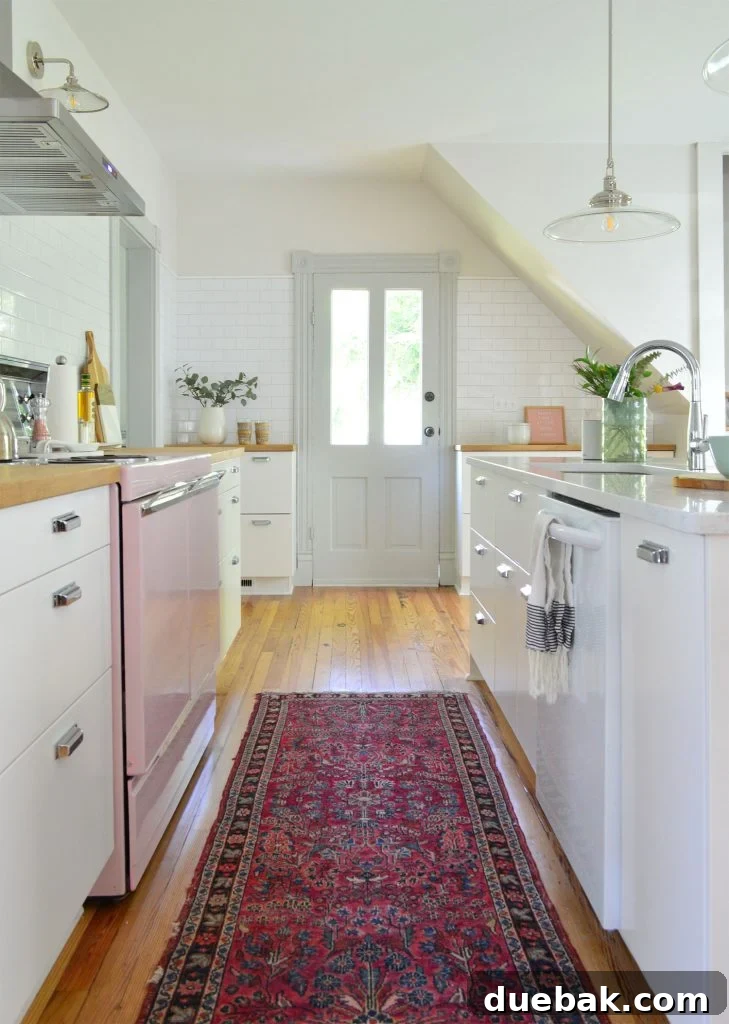
However, with an understanding of these variables and a willingness to adjust expectations, buying secondhand rugs online remains an exceptionally rewarding endeavor. It’s a fantastic option for acquiring unique pieces that add character and warmth to any home without the hefty price tag of new, mass-produced alternatives. Over the years, we’ve successfully sourced numerous rugs using this approach, including a large area rug for a duplex bedroom, a runner for our own kitchen, and another charming runner for the pink house’s kitchen (as seen below), each adding an invaluable layer of personality to its respective space.
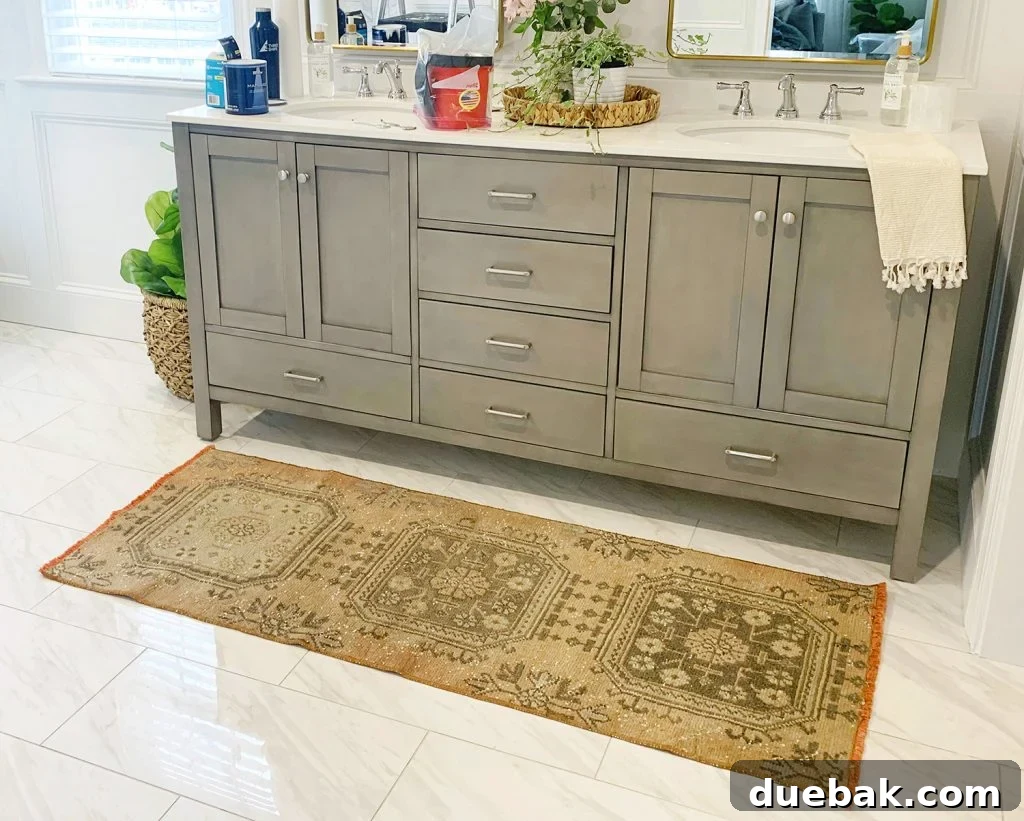
Yet, even with ample experience, the occasional surprise can arise. A few months ago, we ordered a rug for our bathroom/closet area. The listing photograph depicted a beautiful, muted peachy-pink. Upon its arrival, however, the rug presented itself with a distinctly yellower and somewhat dingier appearance than anticipated. Could our dimmer indoor lighting be solely responsible, especially compared to the bright outdoor shot often used in online listings? Absolutely. (As a quick tip, rugs almost always appear brighter and more colorful when photographed outdoors compared to indoors). Regardless of the exact cause, the rug simply didn’t evoke the desired aesthetic when laid in our bathroom. The image below, a quick iPhone snap taken upon arrival, captures our initial deliberations over placing it in front of the vanity or within our closet—the latter, spoiler alert, is where it ultimately found its home.
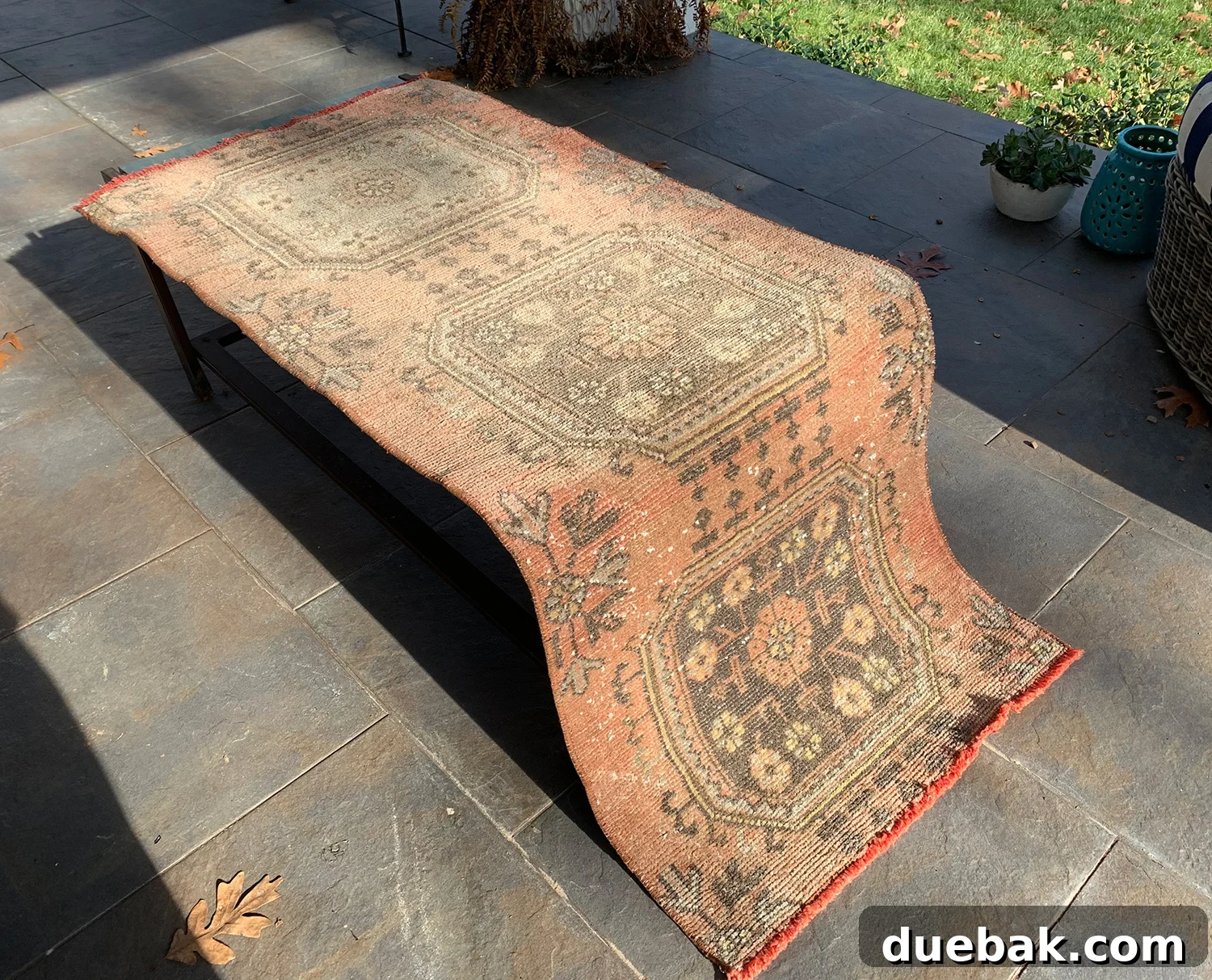
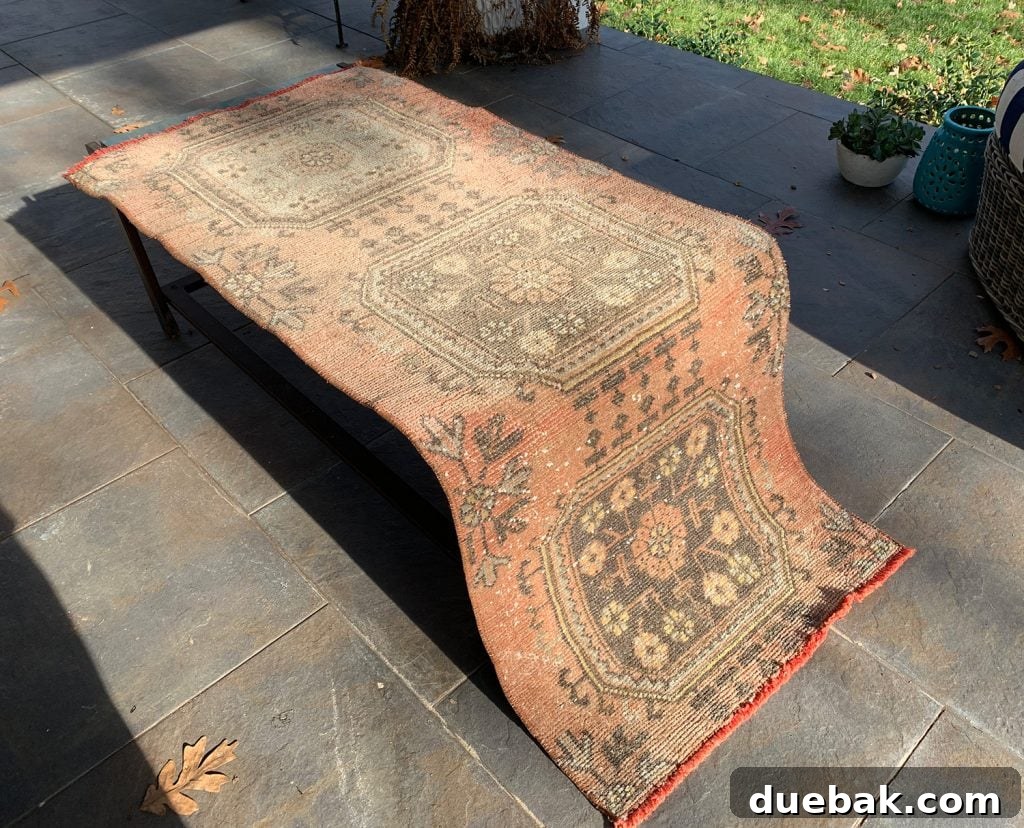
What followed was a journey of transformation, one that ultimately led us to fall completely in love with the rug. It required a little ingenuity and elbow grease, but the results were nothing short of amazing. Our adventure began by delving into an incredibly satisfying rabbit hole of online videos, observing countless individuals successfully revitalizing their rugs with pressure washers. Inspired by the dramatic before-and-after transformations shared by so many, we decided to embrace this surprisingly effective method. The process, as we discovered, involves a nearly identical set of steps commonly demonstrated across various tutorials, and we were thrilled to find that it worked wonders for us! In essence, we literally power-washed our rug back to life. Witness the dramatic shift in its hue; the once dingy piece now boasted a vibrant pinker tone. The photo below shows the rug drying outdoors after its intensive cleaning session. This vividly illustrates our earlier point about rugs appearing brighter outside—its renewed pinkness truly shines under the natural light!
Now, fully dried and nestled comfortably inside our closet, the rug has shed its dingy, yellowed appearance. While it maintains a muted character, its undertone has unequivocally shifted from a drab brown/yellow to a soft, inviting peachy pink. We couldn’t be more delighted with the outcome, and surprisingly, the entire process proved to be both enjoyable and deeply satisfying. This revival technique isn’t exclusively reserved for vintage or secondhand finds; it serves as a powerful “Hail Mary” for any dingy rug, new or old, that might otherwise be destined for the trash. Attempting to breathe new life into it before discarding it is a worthwhile endeavor, and we wholeheartedly recommend giving it a try.
To provide a clearer visual guide, we captured our entire process in a short video, demonstrating the surprising effectiveness of power washing (or pressure washing, terms we use interchangeably). This powerful tool, our pressure washer, is often questioned for its PSI. Many ask if a unit with 1800 PSI is necessary. Our consistent answer is that even the third nozzle setting on our model is incredibly strong, capable of stripping paint from wood and brick. We’ve never found ourselves needing more power and primarily utilize the medium or light settings. It’s a legitimate, highly effective piece of equipment.
NOTE: For an immersive viewing experience of our rug cleaning process, you can watch our video tutorial here on YouTube.
Prior to embarking on this rug-revival journey, we conducted extensive online research to ensure that power washing an old rug wasn’t an outlandish idea. It turns out to be a widely accepted practice, but like power washing any surface, it demands a cautious approach. Always proceed slowly and test the method on an inconspicuous area first to avoid irreparable damage. This technique is best suited for dingy secondhand rugs or inexpensive newer rugs that you’re looking to save, not priceless antique heirlooms—for those, a professional cleaner is always the recommended route. If you’re considering this method for a value-priced rug you’d otherwise discard, keep these crucial disclaimers in mind:
- Test First: Always begin by testing this method on a hidden section of the rug, such as an area that will be covered by furniture, to confirm it won’t harm the fibers.
- Start Low, Stay Low: Initiate the process with the lowest-pressure nozzle. Gradually, if needed, you can move up to the medium setting, but never use the high-pressure nozzle, as it will almost certainly damage rug fibers. When in doubt, stick with the gentlest setting.
- Maintain Distance: Even with low pressure, avoid holding the nozzle too close to the rug’s surface. Excessive proximity concentrates the pressure too much on the fibers, potentially causing damage.
- Thorough Drying is Paramount: It is absolutely essential that your rug is completely dry before being brought back indoors. Failing to heed this warning can lead to permanent damage, including unpleasant odors, mold growth, and even harm to your indoor flooring. Ensure it is fully, thoroughly dried out.
- Embrace the Process: Beyond its practical benefits, this cleaning method is often described as oddly fun and deeply satisfying. Prepare to enjoy the transformation!
While this was our first foray into power washing a rug, we’ve utilized this powerful technique for years to meticulously clean outdoor furniture cushions and pillows, always achieving impressive results. Here’s a detailed breakdown of the steps we followed for our rug:
1. Prepare and Saturate with Soapy Water
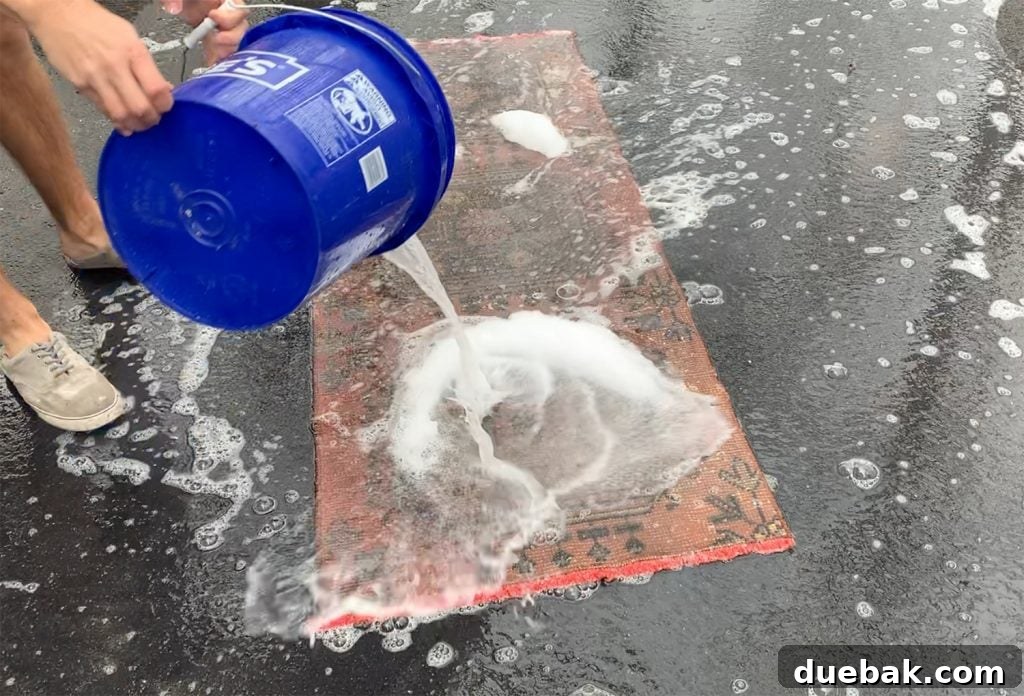
Our cleaning station of choice was our driveway, offering a relatively clean and flat surface ideal for the task. We prepared a bucket filled with water and a generous squirt of Dr. Bronner’s soap, a gentle yet effective cleaning agent. As demonstrated in our video, we then systematically poured this solution over every inch of the rug, ensuring it was completely saturated. Allowing the soapy water to penetrate the fibers for a few minutes helps to loosen embedded dirt and grime, preparing it for the next stage of cleaning.
2. Deep Scrub the Rug for Optimal Cleanliness
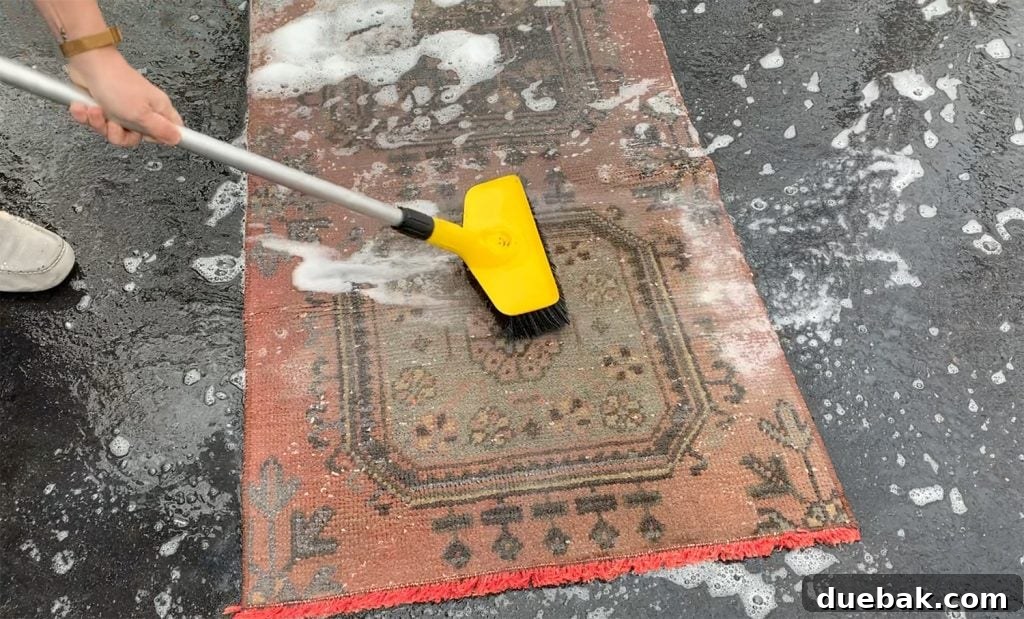
To effectively work the soapy solution deep into the rug’s fibers and generate the necessary suds for lifting dirt, we followed the advice from numerous rug washing tutorials found on YouTube. This involved scrubbing the rug vigorously with a stiff-bristled brush. It’s crucial to select the right tool—avoid wire brushes or anything excessively harsh that could damage the delicate fibers. A standard stiff-bristled broom or even a smaller hand brush will suffice. To ensure comprehensive cleaning, scrub in both directions: side-to-side and front-to-back, addressing the fibers from all angles and dislodging trapped particles.
3. Power Rinse with Precision
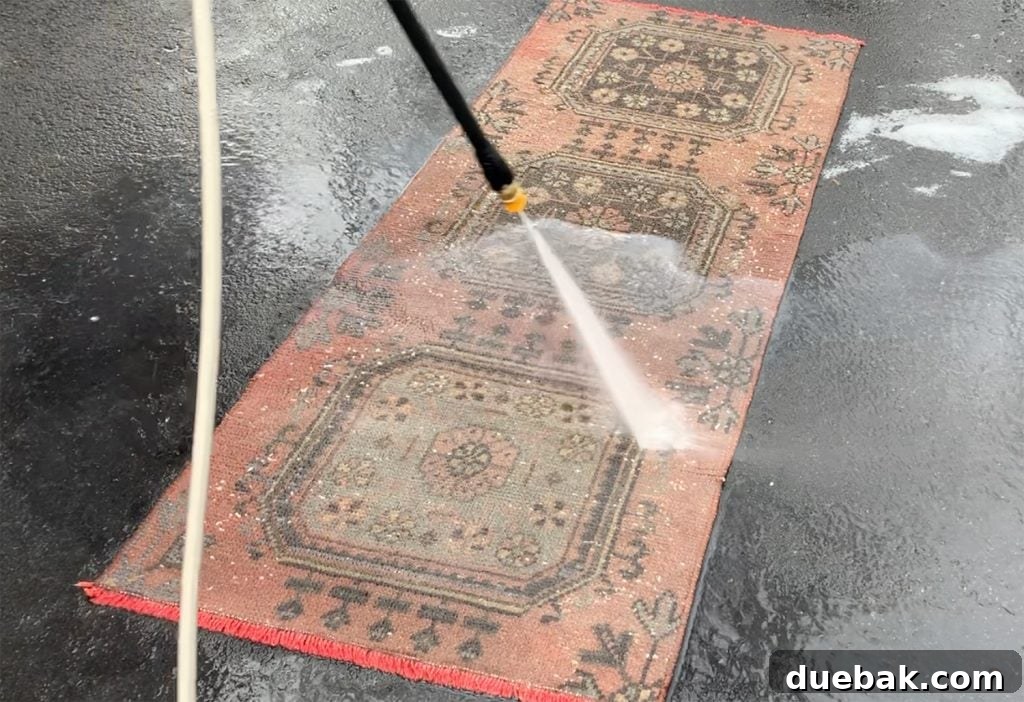
With the scrubbing complete, it was time to deploy the pressure washer for a high-powered and thorough rinse. Our unit comes equipped with three distinct nozzles. We began with the lightest pressure setting, carefully observing the rug’s fibers to ensure no damage occurred. Once confident, we cautiously escalated to the medium setting. Throughout this step, maintaining an appropriate distance from the rug was paramount to prevent fiber damage or tearing. Our objective extended beyond simply washing away grime; we aimed to completely flush out all residual soapy water. Similar to the scrubbing phase, rinsing in both directions—side-to-side and front-to-back—guaranteed that no soap residue was left behind, which is critical for proper drying and preventing future issues.
4. Critical Step: Ensure Thorough Drying
This stage cannot be overstated in its importance. After a complete saturation, your rug is holding a significant amount of water. It is absolutely vital to ensure it is fully and completely dry before returning it indoors. Rushing this step risks unpleasant odors, mold and mildew growth, and potential damage to your home’s flooring. As we undertook this project in December, direct heat wasn’t abundant, so we improvised. We began by draping the rug over a series of chairs, allowing gravity to facilitate the initial drip-drying. To enhance drainage, we strategically placed paint cans under the back legs of the chairs, tilting them forward so excess water could more efficiently run off the front of the rug, a setup clearly visible in our video.
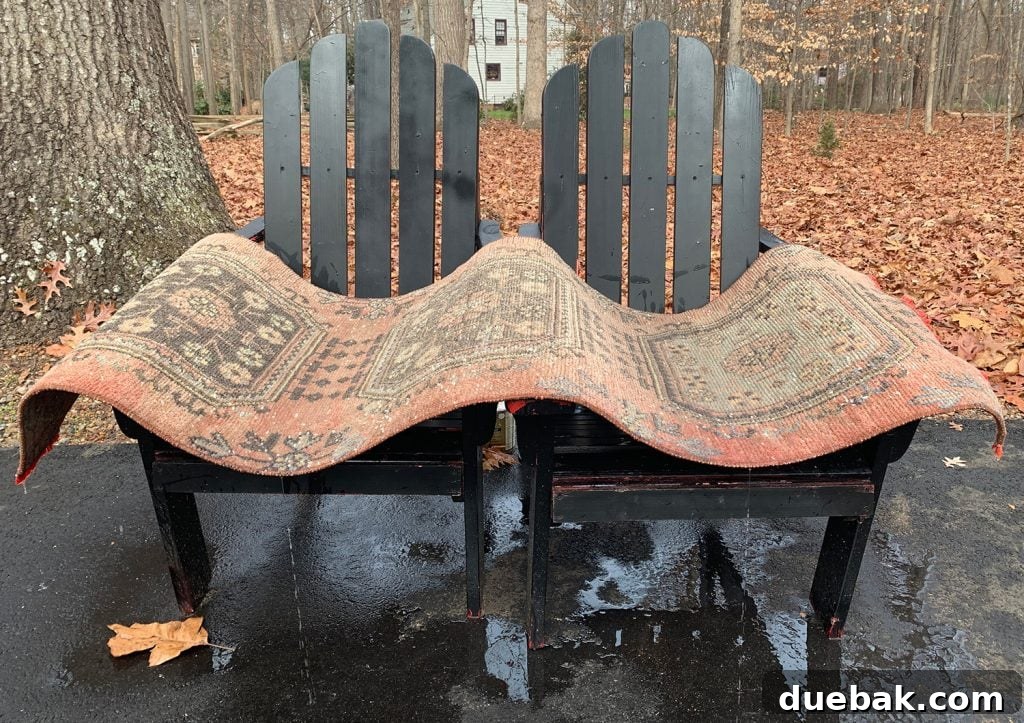
Once the majority of the water had drained, we relocated the rug to a sunnier spot—as soon as the sun emerged!—to capitalize on natural warmth and air circulation for its final drying phase. This natural sun exposure is highly effective at eliminating any lingering moisture.
5. Deodorize for Freshness (Optional)
Fortunately, our particular rug didn’t harbor any unusual or lingering odors. However, if your rug still retains a faint smell after drying, a highly effective trick is to liberally douse the fully dried rug with baking soda. Allow it to sit in direct sunlight for a while, which helps to absorb and neutralize odors, then simply vacuum up the powder. We previously employed this method on another rug, and while it provided significant improvement, a single application wasn’t a complete solution. Repeating the baking soda treatment after a few more days of sun exposure typically does the trick, leaving your rug fresh and clean.
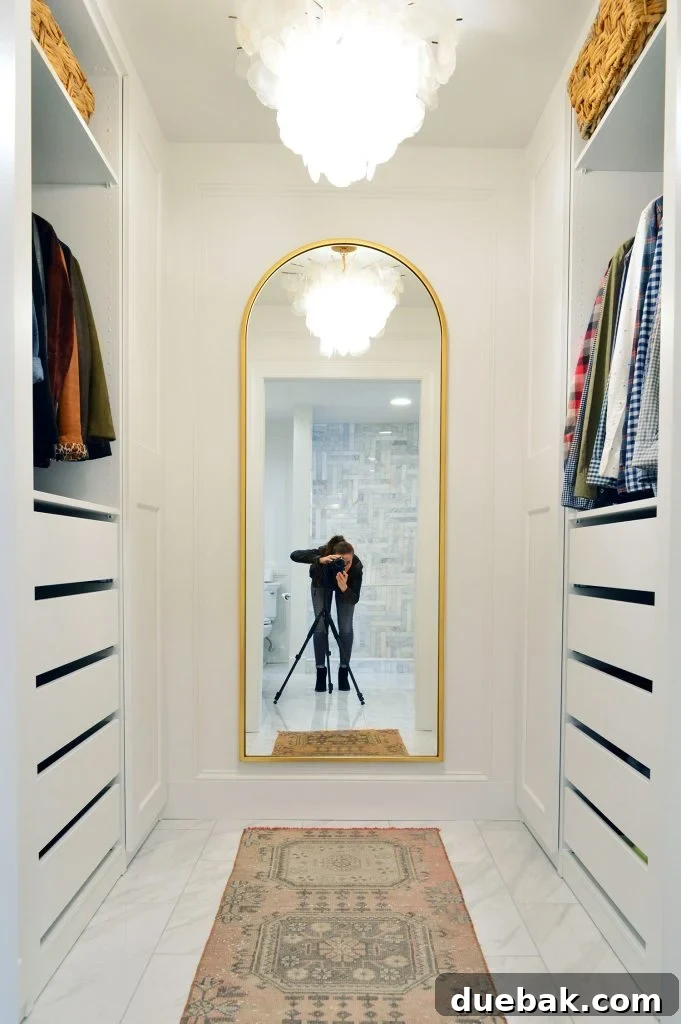
Now, for the big reveal! Here is our runner after undergoing this transformative cleaning process. You might notice that the cleaning results, while noticeable, weren’t drastically dramatic. We weren’t suddenly met with blindingly vibrant pinks, but the subtle shift in undertone from gold/yellow/brown to a soft peach was exactly what we had envisioned and hoped for. It’s a testament to the power of a deep clean in restoring a rug’s original charm. Oh, and another fascinating fact about rugs, both vintage and new, is their ability to appear lighter or darker depending on the viewing direction. They inherently possess a “dark side” and a “light side,” which explains why the rug might look different in a mirror reflection than when viewed directly from a doorway. More on this optical phenomenon in just a moment…
If, despite a thorough cleaning, your rug still doesn’t quite capture your heart, don’t despair! We have two more straightforward tips that can dramatically alter its perceived appearance and potentially elevate it to a beloved status.
Optimize Your Rug’s Lighting Environment
As briefly touched upon earlier, you likely observed how much more vibrant our runner appeared in the outdoor photographs. Natural light possesses an extraordinary ability to bring out the richest, truest colors in textiles, whereas artificial lighting, particularly low-level or improperly balanced light, can often diminish a rug’s vibrancy and make it appear dull. While relocating your rug outdoors permanently isn’t practical, strategically placing it within your home can make a significant difference. For instance, our newly cleaned rug found its ideal home in our closet, which benefits from brighter lighting. A rug that feels dreary and less vibrant in a dimly lit bedroom might suddenly come alive and be adored when moved to a brighter living room with ample windows or higher-wattage bulbs. Experiment with placement to harness the power of light in transforming your rug’s aesthetic.
Discover the “Light Side” and “Dark Side”
An intriguing characteristic of many woven rugs, whether newly made or vintage, is the phenomenon of a “light side” and a “dark side.” This means that when viewed from one end, the rug will appear noticeably lighter than when viewed from the opposite end. This optical effect is due to the direction of the rug’s pile. Understanding and identifying which end presents the “light side” can be incredibly useful in orienting your rug to achieve the best visual impact in your specific space. For example, in the duplex living room shown below, we meticulously oriented this particular rug (ours is the rust color) so that its “light side” is prominently displayed from this vantage point.

Why this specific orientation? Because when viewed from the opposing side of the room, the rug’s colors and intricate patterns appear more defined and exhibit a higher contrast—this is what we affectionately refer to as “the dark side,” as illustrated in the photo below.

Our decision to lay the rug in this specific direction was intentional: the abundant sunlight streaming in from the two front windows helps to brighten the rug from that particular side, effectively counteracting the inherent darkness of its “dark side.” Had we rotated the rug 180 degrees, the sunlight from those windows would have exacerbated the differences, making the “light side” appear even brighter and the “dark side” seem even more pronounced. While this concept might sound complex, the key takeaway is simple: always experiment by spinning your rugs on the floor before settling on their permanent placement. You’ll often find that one orientation is significantly more aesthetically pleasing than the other. This intriguing “light side/dark side” phenomenon is the scientific reason behind this preference.
Given that we primarily view the rug in our closet from a single direction—the closet doorway—it made perfect sense to position its “light side” towards the door. From this vantage point, it appears lighter and more pleasantly pink, aligning perfectly with our desired aesthetic.
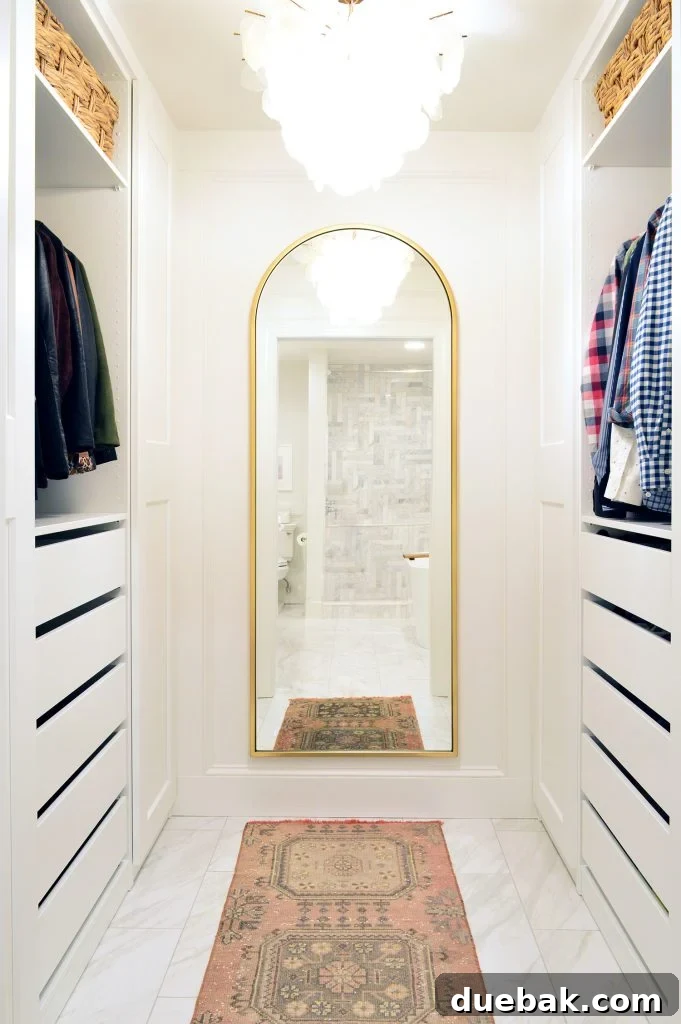
As you can observe in the image below, the rug does indeed appear darker in the mirror’s reflection. However, this is a minor detail that we rarely notice in our daily lives, accounting for perhaps 0.5% of our viewing experience. While it might be more pronounced in photographs, the good news is that we don’t spend most of our time viewing this room through a camera lens! Interestingly, when we initially shared our closet reveal, a few astute followers inquired, “Wait, why is the rug a different color in the mirror?!” This very “light side/dark side” phenomenon is precisely why!
For those eager to discover their own unique secondhand rugs, we highly recommend exploring platforms like Etsy. Look for shops with excellent ratings, such as this trusted vendor and this equally reputable one, known for their curated selections and quality items. Additionally, we’ve had fantastic experiences purchasing from New England Loom on Instagram. Following their account offers a constant source of inspiration as they uncover and meticulously ship out an incredible array of vintage treasures. Remember, with a little patience and these valuable tips, you can transform a seemingly lackluster rug into a cherished centerpiece in your home, embodying both beauty and a rich sense of history.
*This post contains affiliate links, so we may earn a small commission when you make a purchase through links on our site at no additional cost to you.