

Our recent kitchen transformation brought a cascade of significant changes – a reimagined layout, a grander entryway to the living room, brand-new cabinetry, and gleaming countertops. Yet, amidst these prominent upgrades, it’s remarkably easy to overlook one of the most impactful elements: the new hardwood floors. But every so often, we pause and realize just how profoundly these floors have reshaped the entire space, giving our kitchen – and indeed, the entire first floor – a fresh, modern, and expansive feel. For anyone contemplating a similar home renovation, we’ve compiled a comprehensive account of our journey, detailing the process, timeline, and associated costs, to help guide your decisions.

This striking before-and-after comparison vividly illustrates the dramatic difference our new floors have made. The “before” photograph below captures the exact same perspective as the “after” shot above, showcasing a transformation that still amazes us. And no, we certainly don’t miss that dated, faux brick linoleum—not one bit. Its departure was long overdue, paving the way for a truly remarkable change.

From another vantage point, specifically looking in from the front door, the true extent of our downstairs flooring’s fragmented nature becomes even more apparent. Our home originally featured beautiful hardwoods in three primary rooms: the living room, dining room, and office. However, the continuity was jarringly broken by slate in the foyer and the aforementioned linoleum in the kitchen. This created a disjointed aesthetic, severely interrupting the natural flow between spaces. We counted no fewer than five doorways that presented awkward transitions from one flooring type to another, often punctuated by unsightly metal strips that were more prone to stubbing toes than adding any elegance. The overall impression was a chaotic patchwork rather than a cohesive design.

Our ultimate vision, which we are thrilled to have achieved, was to unify the entire first floor under one continuous, even expanse of hardwood. This meant eliminating all transitions, steps, color variations, and any lingering evidence of the previous fragmented layout. Hardwood floors inherently bring warmth and character, especially to a kitchen, a feature we cherished in our first home. Beyond aesthetics, cohesive flooring throughout multiple rooms is a powerful design tool, enhancing flow and making every space feel considerably larger and more integrated. However, realizing this vision was far from a swift or simple endeavor, involving considerable effort and meticulous planning.
We made the deliberate decision to entrust this project to professionals, and as you’ll soon discover, even with seasoned experts at the helm, it spanned several weeks. Reaching a functional kitchen state was contingent upon the completion of this flooring overhaul. While we successfully installed prefinished hardwoods upstairs ourselves, the intricate task of seamlessly blending existing boards with new ones, followed by precise sanding and staining to achieve a perfect match, felt like a challenge best left to specialists. Fortunately, we had a positive prior experience with a local company, Howdyshell Flooring, on some of our builder spec projects. This existing trust significantly mitigated our usual anxieties and meticulous scrutiny, allowing us to proceed with confidence.

Demolition: Clearing the Path for Transformation
The first crucial step involved the removal of the old linoleum and slate flooring. Initially, we considered tackling the slate demolition ourselves. However, after receiving a quote from Howdyshell Flooring, we learned their team could complete the entire demo in approximately a day. Crucially, their quote included the removal and reinstallation of quarter round moldings and plumbing fixtures, such as our powder room toilet and sink. Considering the cost of renting specialized tools for DIY demo, our potential savings margin dwindled significantly. Witnessing the speed, dust, and sheer noise generated by their professional team, we are profoundly grateful we didn’t attempt to squeeze this arduous task into a few evenings after the kids were asleep. Let’s just say, their slumber would have been short-lived.

It took a dedicated team of professionals a full day and a half to meticulously clear out all the old flooring. This left us with a clean, empty plywood subfloor extending throughout the foyer, half bath, and kitchen. To our immense relief, all the underlying plywood was in excellent condition, eliminating any need for patching or costly subfloor replacement. This was a rare stroke of luck for us, and we truly savored it, given our usual experiences with home renovations!

Here, you can see the view looking back into the kitchen, with some of the original living room hardwood flooring visible on the right side. This perspective highlights the challenge of integrating new flooring with existing sections.

Those irregular portions of existing hardwood, which are even more clearly visible in an older photograph, marked the previous footprints of our wet bar (in the center) and the living room’s built-in bookcase (on the left). Notably, the wood beneath the bookcase had never been stained, as it was directly covered. Patching in new hardwood to achieve a truly seamless transition with these old, irregular sections was a primary factor in our decision to forgo a DIY approach. Any imperfect attempt on our part, resulting in cracked or uneven boards, would have been undeniably visible—not something that could be hidden under a rug, but rather right in the middle of a high-traffic doorway.

To achieve this coveted seamless transition, the skilled team from Howdyshell Flooring meticulously removed specific existing hardwood planks. This strategic removal allowed them to install the new flooring in a staggered pattern, rather than simply cutting a straight line which would create an obvious demarcation between old and new. You can faintly discern the outline on the subfloor, indicating where the old coverings were and where new sections were carefully integrated. This “feathering in” technique is crucial for a professional, undetectable finish.

Seamless Installation: Crafting the Foundation
With the entire area cleared and prepared, the installation process commenced with the careful patching of new boards. Wood putty was expertly used to fill any minor grooves or imperfections, ensuring a perfectly smooth surface. This putty also proved invaluable in repairing any boards that might have been slightly nicked or damaged during the meticulous process of removing the old flooring. Attention to such fine details is paramount for a high-quality finish.

Once the new boards were skillfully “feathered in” where they met the existing flooring, two dedicated installers spent the remainder of the day laying the rest of the new hardwood throughout the kitchen area. Their progress by the end of this initial day was impressive, transforming a previously empty space into the foundation of our new kitchen.

It’s important to mention a critical pre-installation step: the new wood was delivered to our home a full week prior to installation. This period allowed the hardwood to properly acclimate to our home’s specific humidity and temperature conditions. Wood is a natural material that expands and contracts based on moisture content in the air. Allowing it to adjust before nailing it down is essential to prevent future issues like gapping, buckling, or warping, ensuring the longevity and stability of the new floor.
The same two skilled installers dedicated another full day to complete the remaining flooring in the kitchen, bringing that section to a polished state.
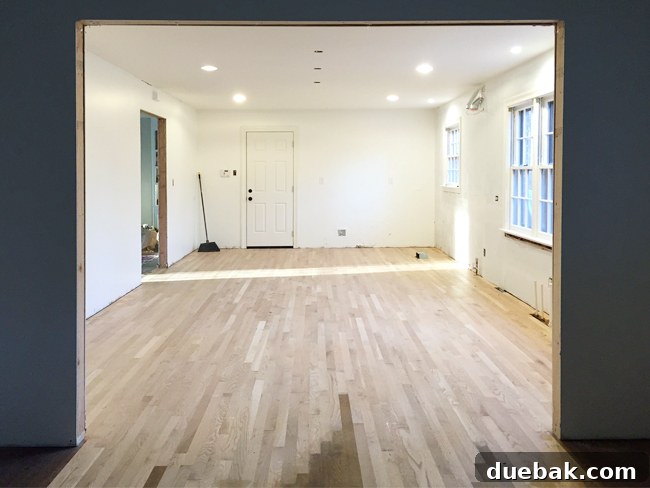
Following the kitchen’s completion, they moved on to the foyer, which included our half bath and two closets. This phase extended into day three of the installation, systematically covering every inch of the designated areas.

The installers explained that they couldn’t guarantee perfect alignment with the existing floors in the office and dining room. The starting point for laying new flooring dictates where alignment is guaranteed – in our case, it was the doorway between the living room and the kitchen – and the rest of the flooring naturally falls into place from there. To address this, we opted for “turnboards” at each of these doorways. These are essentially two planks positioned perpendicularly at the thresholds. Crucially, they are not raised, ensuring a completely smooth and seamless transition underfoot. Once everything was stained to match, these turnboards transformed into a subtle yet elegant decorative detail, gracefully replacing the unloved metal strips of the past.

Strategic Sequencing: Cabinets Before Final Finish
One might naturally assume that sanding and staining would be the immediate next steps. However, our flooring professionals actually preferred to install the kitchen cabinets first. This raised a common question in our minds: “Won’t the wood under the cabinets then remain unstained?” Both the flooring and cabinet installers unequivocally agreed that this sequence was superior. Cabinet installation can be notoriously rough on new floors, so having them in place before the final stain meant we wouldn’t have to worry about scratching or damaging a *brand new finish* while sliding heavy cabinets into position. Furthermore, this approach significantly condensed our overall project timeline. We were able to get our countertops templated and put into production simultaneously with the floor staining process. Since both these steps typically require a week or so of waiting time, having them happen concurrently was a huge advantage over back-to-back scheduling. Finally, they offered a practical perspective: by the time a kitchen remodel is extensive enough to expose previously covered, unstained floor areas, the floors are likely due for a refinishing anyway. This staggered approach proved to be an incredibly efficient and protective strategy.

The Grand Evacuation: Preparing for a Flawless Finish
Once the cabinets were securely installed, we embarked on the (definitely not fun, exciting, or mouthwatering) arduous task of completely emptying our entire first floor. This undertaking was, quite frankly, annoying. The sheer scale of moving everything out was a significant reason why we hadn’t undertaken a full floor refinish to achieve seamless, uniform color and height in our previous two houses. Those were ranches, meaning such a project would have required moving out *entirely*. However, reflecting on it now, I can unequivocally admit it was absolutely worth every bit of inconvenience. A small part of me even wishes we had taken this plunge in our earlier homes.
Cue the empty room shots, which perfectly convey the scale of the operation.

The dining room presented perhaps the most significant logistical challenge, as much of the kitchen’s contents had been temporarily relocated into it, resulting in an overloaded, makeshift storage area.
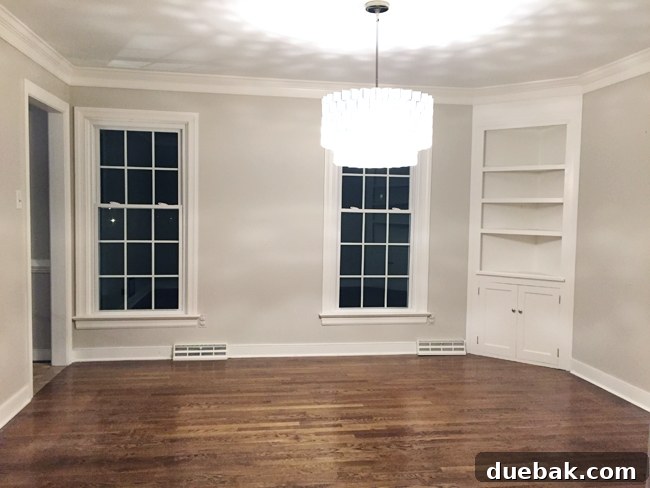
Most of our small to medium-sized items were simply “dumped” upstairs into various rooms: frames and pillows found temporary homes in the guest room, the microwave migrated to our bedroom, and couch cushions took up residence in the upstairs hallway. You get the picture of the organized chaos. Larger appliances, meanwhile, were safely stowed in the garage. For the truly bulky furniture, we rented a storage pod, placed conveniently in our driveway. Opting for the smallest size proved sufficient, as we discovered we didn’t possess an overwhelming quantity of “big” furniture. Sherry and I managed the entire move ourselves in a single day, utilizing a trusty dolly. There was a minor incident where her desk might have, shall we say, “experienced gravity” facedown in the driveway, but aside from that, arguments were kept to a minimum.

Take note of the noticeable wear on the office floor. The distinct worn-down mark in the middle of the room was pre-existing, but those two prominent donut-shaped marks? Those were entirely our doing, a testament to countless hours spent rolling around in our wheeled office chairs while working (and possibly contemplating actual donuts). GAH! We were completely oblivious to the damage we were inflicting until it was far too late. But fear not, we’ll reveal our ingenious solution for this common problem at the very end of this post, so patience, young grasshopper.

The Art of Refinishing: Sanding to Perfection
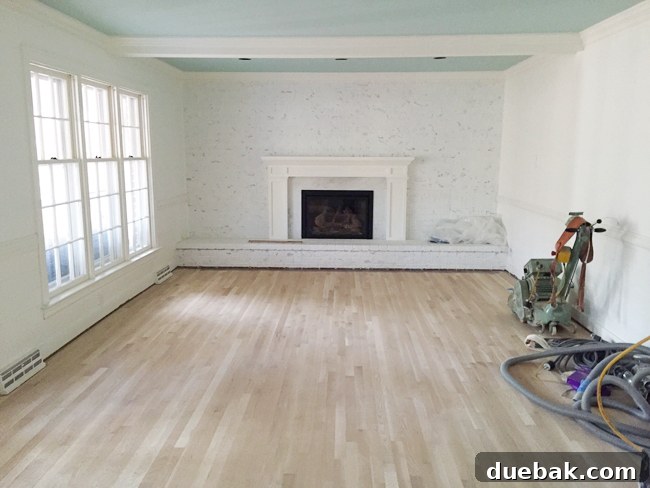
We endured one final day in the house as the sanding process commenced. Sanding is essential to strip away the old stain and finish from the existing floors, preparing them for a fresh start. However, it also unleashes what feels like ten million dust particles, permeating every nook and cranny. Be warned: the top ledges of your doorway and window trim will remain perpetually dusty unless thoroughly wiped down before furniture returns. To mitigate this airborne invasion, we “holed ourselves up” upstairs, behind a makeshift plastic bubble we meticulously taped at the bottom of the stairs. This ingenious, albeit crude, containment system proved surprisingly effective in keeping the vast majority of the dust confined to the first floor.

Sanding was a precise, two-man operation. One technician skillfully operated the large, heavy-duty sander, efficiently covering all the major areas in each room. This powerful machine is designed for broad coverage and deep removal of old finishes.

Simultaneously, a second technician meticulously used a smaller hand sander to address the edges and corners, areas inaccessible to the larger machine. This intricate detail work ensures a uniformly prepared surface across the entire floor. This part of the process, particularly seeing the sheer power and expertise required for that colossal sanding machine, solidified our gratitude for having hired professionals. It’s truly a specialized skill.

Once the sanding was complete, we were left with pristine, raw wood. The darker lines visible around the edges are not missed spots by the sander, but rather unpainted portions of the baseboards and brick. These areas were previously covered by the quarter round molding, which was temporarily removed during demolition and would be reinstalled and painted later. This attention to detail ensures a clean finish right up to the walls.
Bringing Color to Life: Staining and Sealing
Our final task before being completely displaced from our house was selecting the perfect stain color. Our primary objective was to match the existing stain on our stairs, as they were not part of this refinishing project. The flooring team expertly applied several test spots near the stairway to help us find the closest match: the bottom sample was Jacobean, followed by Special Walnut, then Provencial, and finally a blend of Jacobean + Provencial. We ultimately chose Provencial (the third one up) as it offered a beautiful, classic medium stain that appeared remarkably similar to our stairs. (Spoiler alert: the finished product looks nearly identical, a huge relief!)

Given that walking on the floors during the staining process was strictly prohibited (and being confined upstairs for a week held little appeal), we made ourselves scarce for the next several days. We spent a couple of nights at my parents’ nearby home, followed by a short family trip for a few more nights. Before leaving town, we briefly popped by to check on the progress. I’ll be honest, our initial reaction was one of significant nervousness.

It’s challenging to fully convey in these photos, but the floors looked very… “French Countryside.” They appeared somewhat patchy, with a rustic, weathered finish. While pretty in its own right, it wasn’t the refined look we were striving for.
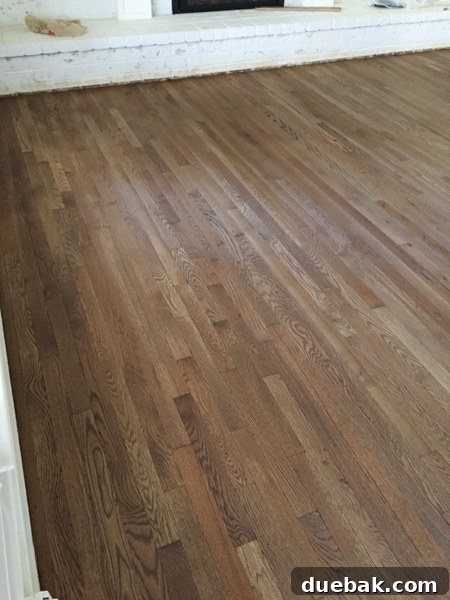
After a few deep breaths into a paper bag, we called the flooring team, who reassuringly explained that the look was due to the absence of the final sealer. The sealer, they explained, would add the desired richness and a subtle hint of shine, evening out the color. This made perfect sense, though I’d be lying if I said a touch of anxiety didn’t linger. Nevertheless, we gave them the green light to proceed while we embarked on our family getaway.
The reason for our extended absence was the multi-step sealing process. After the stain had thoroughly dried, they applied three coats of polyurethane sealer. Each morning, the team would return, lightly sand the previous coat, apply a new coat of sealer, and then allow it to dry overnight. This meticulous process was repeated three times. Even after all three coats were applied, we were advised to refrain from walking on the floors for an additional 48 hours to allow for proper curing.
Six nights later, we finally returned home to discover a dramatically improved outcome. The sealer had worked its magic, evening out the color beautifully and adding just the right amount of gloss (we opted for a satin finish). The floors now looked precisely like the stairs, a perfect match. We decided to spend the seventh night away as well, primarily due to some lingering odor, but the sheer joy of peeking inside and witnessing everything come together so exquisitely was immense.

The Grand Reveal: Moving Back In and Enjoying the Transformation
The saga, however, did not conclude there. We were given strict instructions to wait an additional ten days before placing any heavy furniture or rugs back onto the floors. The freshly cured sealer, while durable, could still be susceptible to imprints from heavy objects. Consequently, we retreated to our upstairs sanctuary for another week or so, venturing downstairs only to quickly pass through in our socks when leaving the house. (At this point, we still didn’t have a functioning sink or appliances, adding to the temporary inconvenience.)
During this final waiting period, we also tackled a series of smaller, yet essential, tasks. This included diligently cleaning up the residual layer of sanding dust that, despite the use of “dust mitigation machines,” managed to settle everywhere. We also meticulously caulked and touch-up painted all the quarter round moldings throughout the first floor, ensuring they looked impeccably fresh and clean against the rich, newly finished wood floors. These finishing touches truly elevate the overall aesthetic.

Ultimately, this story has a profoundly happy ending. Just look at how incredibly seamless the floors are! Even in recounting this journey, I’m reminded of what an involved and extensive process it was. From the initial demolition to finally being able to walk on the cured floors, it spanned roughly 16 days, plus another 10 days before we could safely move our furniture back in. But on the bright side, we managed to avoid dropping any furniture off the dolly during the move-back-in process! #happywifehappylife

We truly cannot overstate how completely undetectable the transition is between the new floors in the kitchen and the existing floors in the living room. I would honestly need to consult an old photograph to pinpoint where the new boards begin and the old ones end. There is literally zero indication that we ever added hardwoods in sections, and when visitors see it in person, they often can’t believe it wasn’t always this way (except, of course, for those who are still traumatized by the memory of our faux brick floors!).
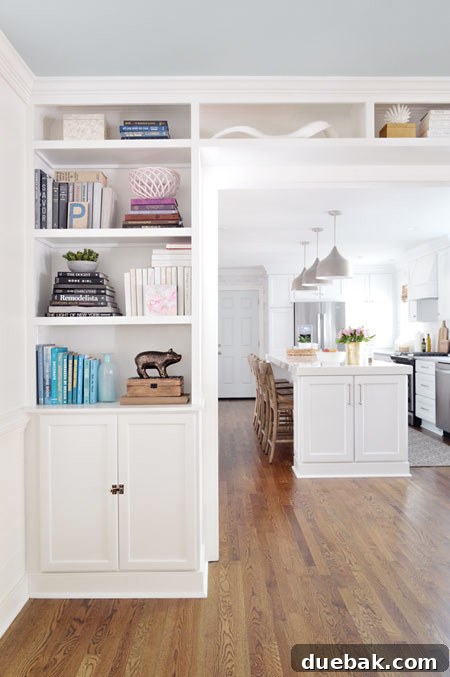
We are also absolutely reveling in having continuous hardwoods in the foyer now. Beyond simply making the entire first floor feel more connected and expansive, there are practical benefits. The new floors are noticeably smoother and warmer underfoot compared to the previously craggier slate. We also worry far less about our kids slipping and scraping their knees—the slate, let’s just say, was not very forgiving to little ones. The transformation has enhanced both the aesthetics and the functionality of our entryway.

You can somewhat discern in this festive holiday picture how the transition into the office now appears. The “turnboards” we implemented now look less like a functional necessity and more like an intentional decorative detail that perfectly aligns with the doorway, adding character rather than interruption.

You’ll also notice the rolling office chair prominently featured in the image above. But fear not, we’ve implemented a simple yet highly effective modification to both of our wheeled office chairs, ensuring they no longer pose a threat to our pristine new hardwood floors. We weren’t keen on using those large, rectangular plastic floor protectors that can be visually jarring. Our solution was straightforward: we carefully pried off the wheels and replaced them with felt furniture pads. This has proven to be a perfect, understated fix. The chairs still glide around easily (and the spinning function remains intact), making them just as convenient to use without the constant worry of creating more accidental “floor donuts.” This small hack has saved our floors and our peace of mind.

Investment in Excellence: Time, Cost, and Lasting Value
In summary, this extensive first-floor hardwood flooring project demanded a significant investment of time, caused considerable temporary inconvenience, and required a financial outlay that, while painful at first, has proven to be entirely worth it. The material costs amounted to approximately $3,400 for 3/4″ solid oak hardwood flooring for three rooms. The labor, which was around $4,100, covered a comprehensive scope of work including demolition, removal and reinstallation of quarter round moldings and plumbing fixtures, laying and patching the new hardwoods, the extensive sanding, staining, and sealing of the entire first floor, and the final reinstallation of plumbing and new quarter round upon completion. *UPDATE: Many readers on social media inquired about the total square footage. Our entire first floor measures approximately 1,300 square feet, with about half (~650 sq ft) consisting of existing hardwoods and the other half (~650 sq ft) being replaced with new hardwood flooring.*
Having navigated through this comprehensive renovation, and fully understanding the considerable commitment it entailed, I can completely empathize with why we hesitated to undertake such a leap in our last two homes. However, we are now basking in the immense satisfaction of witnessing the gigantic step forward our entire first floor has taken towards feeling truly finished, cohesive, and utterly transformed. Every corner now resonates with a renewed sense of warmth and sophisticated style.
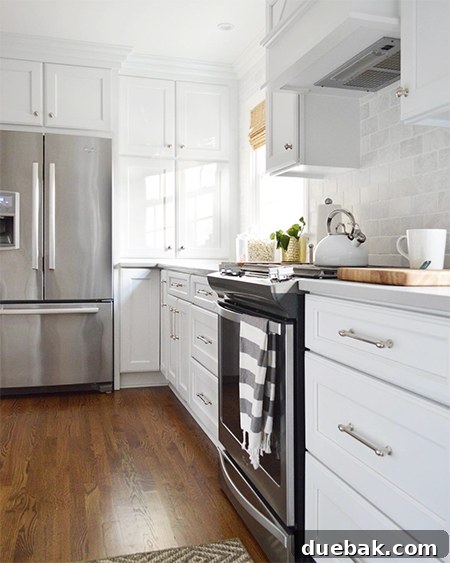
Moreover, I am incredibly grateful that the next time we need to refinish any floors (for instance, at the beach house), we won’t have to endure the arduous process of moving furniture out or living in the house while the work is underway. Yesssssssssss!
More Hardwood Floor Refinishing Projects
If you’re interested in delving deeper into our specific hardwood floor refinishing projects and learning from our experiences, please explore the posts linked below. These articles cover a range of scenarios, from perfectly matching original hardwoods to integrating new prefinished flooring, and even the challenging yet rewarding restoration of 100-year-old pine floors!
- Refinishing Mid-Century Oak Floors in Our First House
- Refinishing Historic Heart Pine Floors in Our Beach House
- Repairing Historic Oak & Pine Floors In Our Duplex
- Clear Sealing Our Refinished Floors In Our Florida House