
Updated 2024
Effortless Fluorescent Light Replacement: A Comprehensive DIY Guide to Modern Ceiling Fixtures
Dated fluorescent light fixtures can often be an eyesore in an otherwise updated home, especially in a functional space like the kitchen. Swapping them out for sleek, modern alternatives like pendant lights or flush mount fixtures can dramatically transform the ambiance and aesthetics of your space. While the task might seem daunting, it’s a completely achievable DIY project for homeowners with basic electrical knowledge and adherence to safety protocols.
In this in-depth guide, we’ll walk you through two common scenarios for upgrading your kitchen lighting: replacing a fluorescent fixture where a ceiling junction box already exists, and the slightly more involved process of installing a new fixture when there’s no pre-existing box. We recently tackled both situations in our own kitchen, encountering an unexpected “wires-just-coming-out-of-the-drywall” scenario for one of our fixtures. So, rest assured, we’ll provide you with practical, step-by-step instructions to ensure a smooth and successful lighting upgrade.
Why Upgrade Your Fluorescent Lighting?
Before diving into the how-to, let’s consider the compelling reasons to ditch those old fluorescent fixtures:
- Aesthetics: Fluorescent lights often have an industrial, utilitarian look that clashes with modern interior design. Upgrading to a stylish pendant or flush mount can instantly elevate your kitchen’s visual appeal.
- Light Quality: Fluorescent bulbs are known for their harsh, often cool-toned light and potential flickering, which can be straining on the eyes. Modern LED-compatible fixtures offer warmer, more natural light, improving comfort and clarity.
- Energy Efficiency: While newer fluorescent tubes are more efficient, older models consume significantly more energy than contemporary LED bulbs. Transitioning to LED-compatible fixtures can lead to substantial savings on your electricity bill.
- Noise Reduction: The subtle hum of an old fluorescent ballast can be surprisingly irritating. Modern fixtures eliminate this distracting noise, contributing to a quieter home environment.
- Maintenance: Fluorescent tubes can be cumbersome to replace and dispose of. Modern fixtures with long-lasting LED bulbs require minimal maintenance.
Essential Tools and Materials You’ll Need
Having the right tools on hand will make this project much smoother and safer. Here’s a list of what you’ll likely need:
- Screwdrivers (Phillips and Flathead)
- Cordless Drill/Driver (optional, but highly recommended for speed)
- Wire Strippers
- Wire Nuts (often included with new fixtures, but good to have spares)
- Voltage Tester (Non-contact is ideal for safety)
- Step Ladder
- Drywall Jab Saw (for installing “old work” boxes)
- Spackle and Putty Knife
- Primer and Paint
- Paint Roller and Brush
- Measuring Tape or Ruler
- Pencil or Marker
- Safety Glasses
- New Light Fixture(s) (Pendant, Flush Mount, Semi-Flush, etc.)
- “Old Work” Electrical Box (if no existing box)
Part 1: Removing a Large Fluorescent Light Fixture (Existing Junction Box)
This section outlines the process for removing a standard fluorescent light fixture that is mounted to a ceiling electrical box, a common setup in many homes. We tackled one such fixture near our stove, and the process was quite straightforward.
Step 1: Prioritize Safety – Turn Off the Power!
Electrical safety is paramount. Before you touch any wiring or components of your light fixture, you MUST turn off the power to that specific light at your home’s main electrical panel (circuit breaker box). Simply flipping the wall switch off is not enough, as someone could inadvertently turn it back on while you’re working. Locate the corresponding breaker and switch it to the “OFF” position. For an added layer of security, use a non-contact voltage tester to confirm that no current is flowing through the wires before proceeding. This simple step can prevent serious injury.
Step 2: Carefully Remove the Plastic Shade and Fluorescent Bulbs
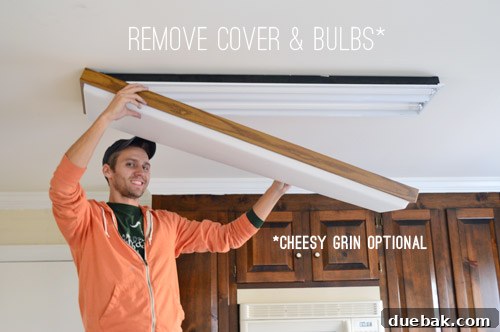
Begin by removing the decorative plastic shade or diffuser covering the fluorescent tubes. These are typically held in place by small clips or tabs and can often be gently pulled or unsnapped. Once the shade is removed, carefully twist and remove the long fluorescent light bulbs. Place them aside in a secure location where they won’t accidentally break, as they contain mercury and require proper disposal.
Step 3: Detach the Metal Panel
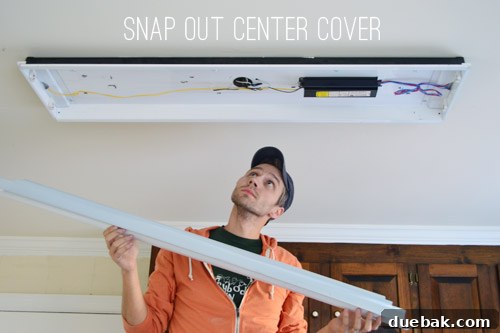
Most fluorescent fixtures have a metal cover or panel that conceals the internal wiring and ballast. This panel is usually secured with screws or clips. Carefully remove it to expose the internal components and, more importantly, the wiring connecting the fixture to your home’s electrical system. During this step, observe where the ceiling wires enter the fixture. Ideally, they’ll come through a centered hole, directly into an existing junction box. If they’re off-center, it might require more extensive ceiling repair later to properly position your new fixture.
Step 4: Disconnect Wires from the Old Fixture
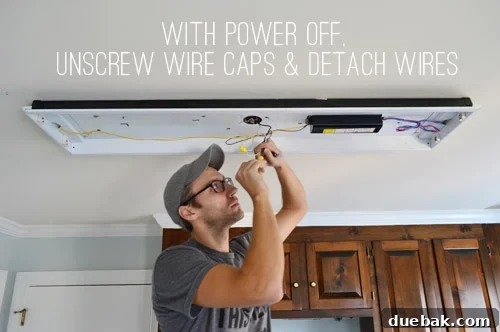
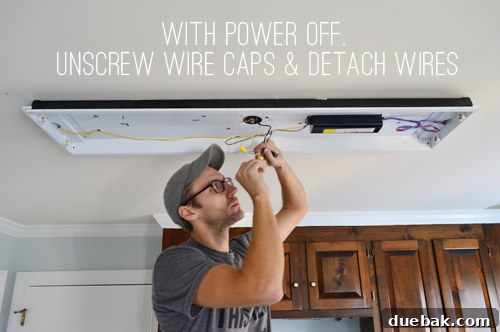
With the power confirmed OFF and the internal wiring exposed, you can now disconnect the fixture. You’ll typically see a set of wires from the ceiling (black, white, and bare copper/green) connected to matching wires from the fluorescent fixture using plastic wire nuts. Unscrew these wire nuts counter-clockwise and carefully separate the wires. Remember: you only need to disconnect the wires connecting to the ceiling; leave the internal fixture wiring (often blue and red) intact within the old fixture itself. This step is usually done once the fixture’s internal panel is open.
Step 5: Unscrew and Remove the Fixture from Your Ceiling
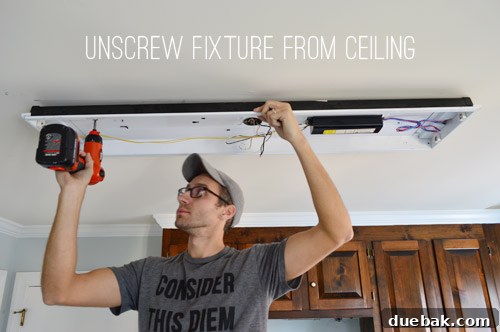
The main fluorescent housing is typically held to the ceiling (and often to a central junction box) by a few large screws, usually at either end or corners of the fixture. Use your screwdriver or cordless drill to remove these screws. Once all fasteners are loose, carefully lower the entire fluorescent fixture from the ceiling. It might be heavier than it looks, so be prepared to support its weight. After removal, inspect the ceiling area for any additional mounting hardware or debris.
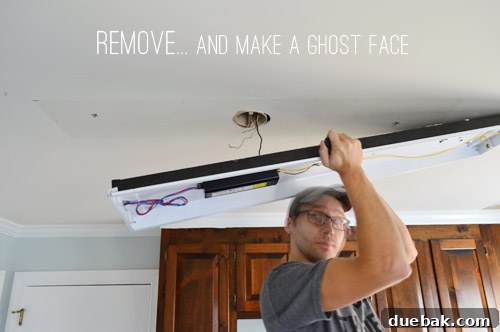
If your old fluorescent fixture is still in working condition, consider donating it to a local Habitat for Humanity ReStore or another charitable organization. This is an excellent way to reduce waste and give your old fixture a second life.
Step 6: Prepare the Ceiling for Your New Fixture – Patch and Paint
With the old fixture gone, you’ll likely find screw holes, discoloration, or an unfinished patch of ceiling. Since your new, smaller fixture probably won’t cover the entire footprint of the old fluorescent unit, proper preparation of the ceiling is crucial for a professional finish. Fill any screw holes or minor imperfections with spackle. Allow it to dry completely, then sand smooth. Apply a good quality primer over the repaired areas and any stained sections of the ceiling. Finally, paint the entire ceiling area to ensure a seamless blend with the rest of your kitchen. We’ll detail our own patching and painting process later in this guide, but remember that this step is essential for eliminating any lingering evidence of your old fixture.
Part 2: Installing a Modern Light Fixture (With an Existing Junction Box)
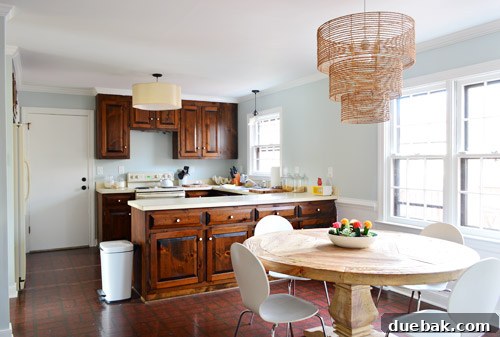
Once the old fluorescent fixture is removed and the ceiling prepared, you’re ready to install your stylish new pendant, semi-flush, or flush mount light. For our kitchen, we chose a beautiful burlap quatrefoil shade, suspended from a dual-bulb pendant. If you’re hesitant at any point, don’t hesitate to consult a qualified electrician; however, most DIYers find this part of the project quite manageable.
Step 1: Trim Any Excess Wire from Your New Fixture
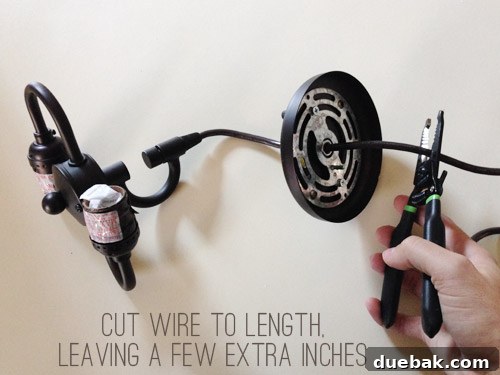
Many new pendant lights come with ample wiring to accommodate various ceiling heights. If you desire a flush-mount or semi-flush look, or simply a shorter pendant, you’ll need to trim the excess wire. Measure the desired length carefully, accounting for the canopy and how it mounts to the ceiling. Cut the cord with appropriate wire cutters, ensuring you leave enough length to comfortably work with the individual wires when making connections. This step can also be used to convert a plug-in light to a hard-wired fixture.
Step 2: Prepare Wires by Using Wire Strippers
After trimming the main cord, you’ll need to separate the individual insulated wires (typically black, white, and a bare copper or green ground wire) and strip about 1/2 to 3/4 inch of insulation from the end of each. Use a wire stripper tool designed for the specific gauge of wire you’re working with. Be careful not to nick or cut any of the copper strands within the wire. The exposed copper ends will be used to make secure electrical connections with the ceiling wires.
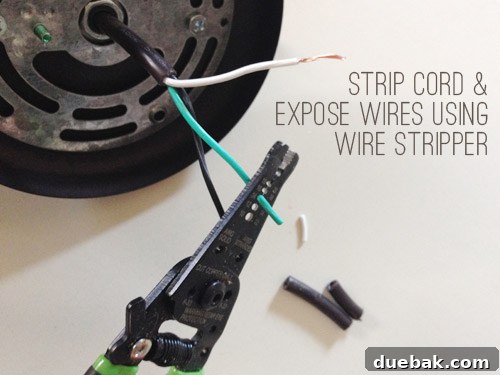
Step 3: Install Your New Fixture
With the wires prepared, you can now mount your new light fixture. Ensure the power is still OFF at the breaker. Most fixtures come with a mounting bracket that first attaches to the existing ceiling junction box using screws provided. Once the bracket is secure, connect the wires: twist the bare copper/green ground wire from the fixture to the bare copper/green ground wire from the ceiling, securing with a wire nut. Repeat this for the white (neutral) wires and then the black (hot) wires. Ensure all connections are tight and secure. Gently push the connected wires up into the junction box. Finally, align the fixture’s canopy with the mounting bracket and secure it in place with the decorative screws or nuts provided. Once installed, restore power at the circuit breaker and test your new light!
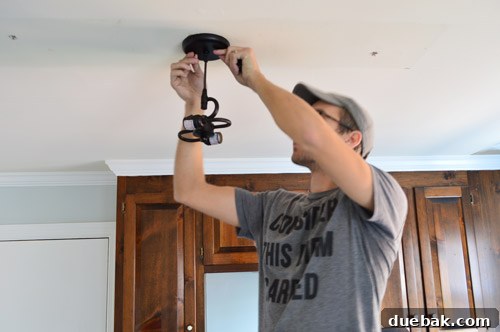
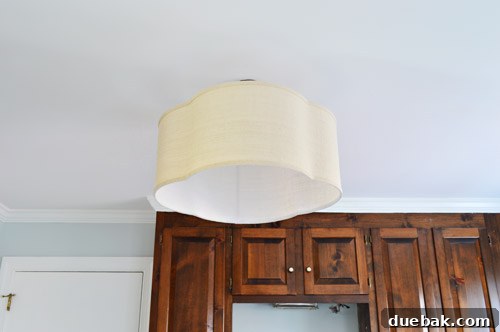
Here’s our beautiful new pendant light, complete with its shade, after we completed the patching and painting of the ceiling. Notice how the unsightly holes and discoloration from the old fixture are completely gone, replaced by a fresh, clean look!
Part 3: Dealing with No Fixture Box – Installing an “Old Work” Ceiling Box
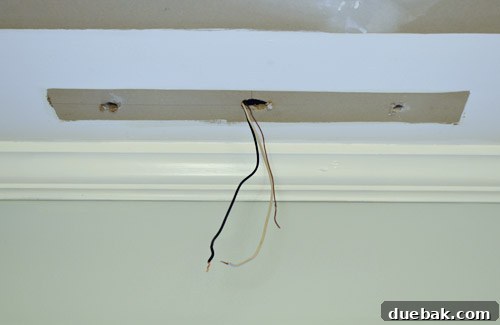
After successfully upgrading the first light, we moved on to a smaller fluorescent fixture above our kitchen sink. This light, previously hidden by cabinetry, became highly visible after we removed the cabinets in preparation for open shelving. We repeated the initial steps of power disconnection and fixture removal. While the centered wiring was a relief, we discovered a common DIYer’s challenge: no electrical junction box in the ceiling, just wires poking through a gaping hole!
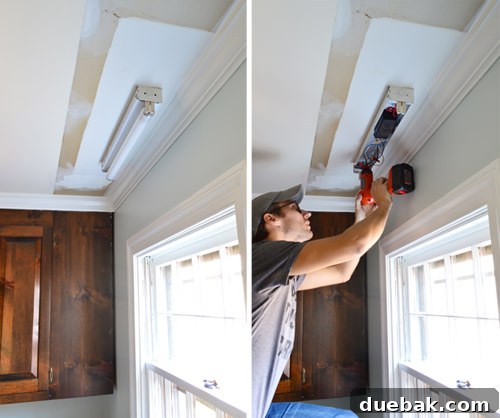
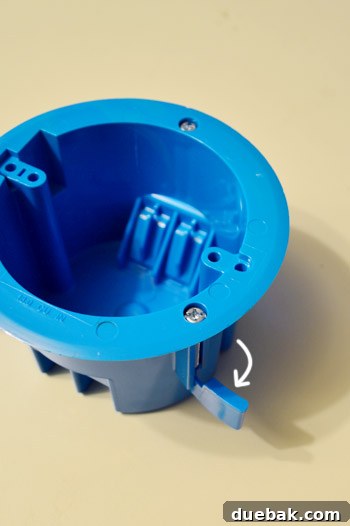
Installing a new fixture requires a proper junction box for safety and code compliance. Since there was no structural support (like a joist) nearby to attach a “new work” box, we opted for an “old work” ceiling box. These boxes are specifically designed for retrofitting into existing drywall or plaster, securing themselves in place without needing to attach to framing. They achieve this using internal wings or clamps that tighten against the back of the drywall.
It’s important to note that while “old work” boxes are excellent for lightweight fixtures like our glass funnel pendant, they are generally not recommended for heavy fixtures such as ceiling fans or chandeliers, which require direct attachment to structural framing. For these heavier applications, a specialized fan-rated box or direct joist attachment is necessary. However, for most standard ceiling lights, an old work box provides a secure and compliant solution. Our pendant, being lightweight, worked perfectly with this type of box and held securely for years until our full kitchen remodel.
Step 1: Double-Check Power is Off!
As always, before working with any electrical components, confirm that the power to the circuit is off at the breaker box. Use your voltage tester to verify. This step cannot be overstated.
Step 2: Mark the Placement of Your New Fixture Box
To install the “old work” box, you first need to cut a precise hole in the ceiling. While these boxes often come with a paper template, you can easily create your own. Trace the outer perimeter of the box onto a piece of paper, then cut slightly inside this line, ensuring the template is just a bit smaller than the widest part of the box’s lip. This lip needs to rest firmly against the drywall once the box is inserted.
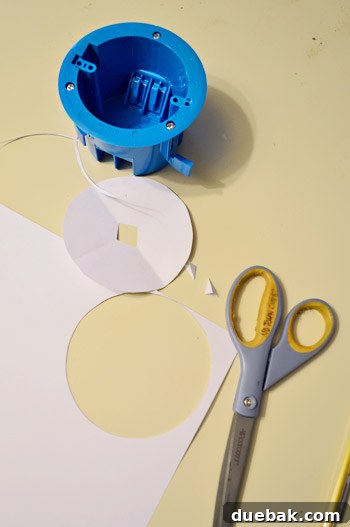
Step 3: Precisely Cut Your New Hole in the Ceiling
Carefully transfer your template onto the ceiling, ensuring the existing electrical wires are centered within the marked area. Use a pencil to trace the outline. Then, using a drywall jab saw, meticulously cut along the traced line. Take your time to make a clean cut. A snug fit for the box is ideal, so try to be as accurate as possible.
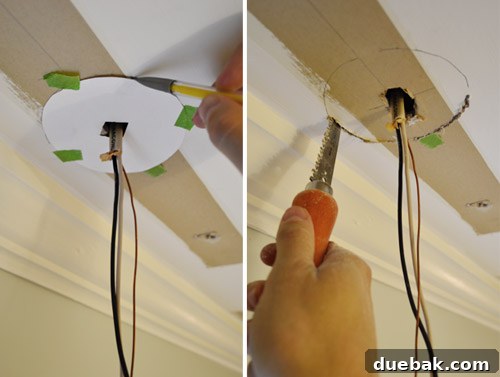
Step 4: Feed the Wires Through the Box and Trim
Once the hole is cut, feed the existing electrical wires from the ceiling through one of the designated knock-out holes in the back of the “old work” box. If the wires are excessively long, carefully trim them to a workable length, leaving about 6-8 inches extending from the box. Remember to strip about 1/2 to 3/4 inch of insulation from the end of each wire, just as you did for the new fixture’s wires.
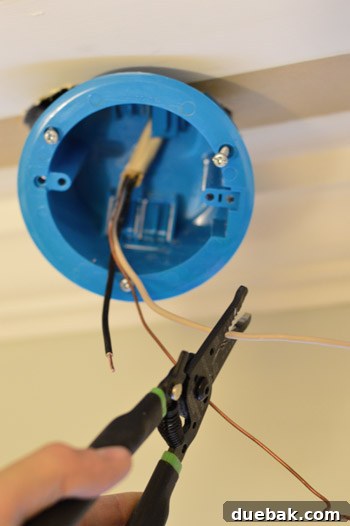
Step 5: Secure the Box by Tightening Screws
Insert the “old work” box into the cut hole in the ceiling, ensuring the front lip of the box is flush with the ceiling surface. Once in place, you’ll see small screws on the face of the box. Using a screwdriver, slowly tighten these screws. As you turn them, internal wings or clamps will pivot outwards and pull forward, firmly pinching the drywall between the box and the wings. Tighten until the box is securely held in place and doesn’t wiggle.
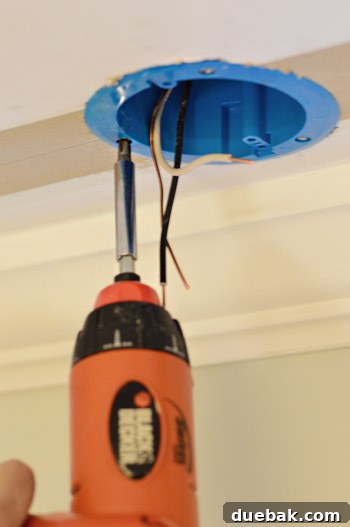
Step 6: Install Your Lightweight Fixture into the New Box
With the “old work” box securely installed, the remainder of the installation process for your new light fixture is identical to Part 2, Step 3. Connect the corresponding wires (ground-to-ground, white-to-white, black-to-black) using wire nuts. Tuck the connections into the box, attach the mounting bracket and canopy, and finally, secure your new fixture. Re-enable power at the breaker and enjoy your updated lighting! We love how our new glass funnel pendant is simple and allows the view out the window to remain unobstructed, adding subtle elegance to the space.
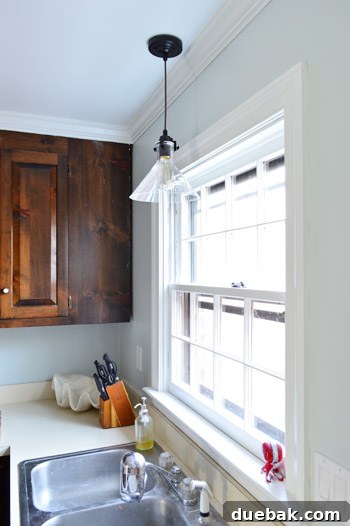
The Final Touches: Patching, Priming, and Painting Your Ceiling
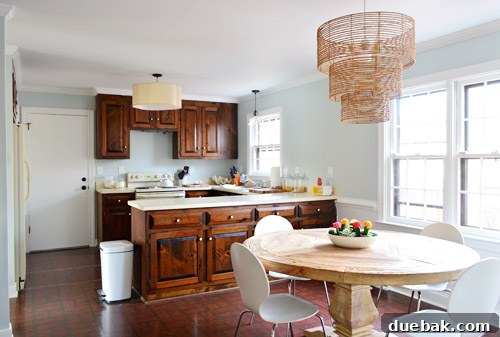
Once both fluorescent fixtures were gone and the new lights were installed, our attention turned to perfecting the ceiling. This crucial step ensures a polished, professional finish that truly makes your new lights shine. We began by thoroughly patching any remaining holes or minor imperfections with spackle, ensuring a smooth surface once dry. After sanding the spackled areas flat, we applied a high-quality primer to any raw drywall sections and areas where the old fixtures had caused discoloration. This step is vital for paint adhesion and preventing stains from bleeding through. Finally, we painted the entire ceiling with Benjamin Moore Simply White in a flat finish, matching our existing trim. My partner Sherry expertly handled the “cutting in” around the crown molding, while I took on the role of the roller man, covering the larger surfaces. The difference, though subtle in photographs, dramatically brightened and freshened the entire room in person.
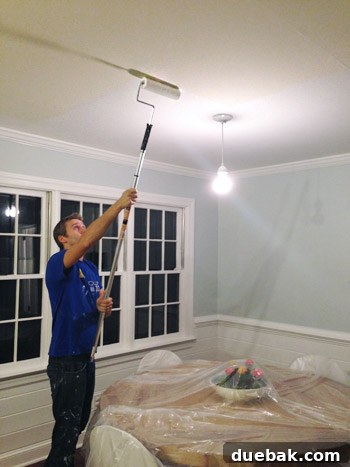
The visual impact of painting the ceiling was more significant than we anticipated. The old, yellowish ceiling contrasted poorly with our glossy white crown molding. Now, with a crisp, uniform white, the whole kitchen feels cleaner and more inviting. We’re still deliberating on the cord color for one of our larger fixtures; we might spray the white cord with an oil-rubbed bronze finish for added visual interest, similar to a previous project. However, we also appreciate how the white cord near the dining area seems to disappear, offering a different aesthetic. We’ll keep you updated as the room continues to evolve!
Conclusion: Embrace Your DIY Lighting Transformation
Upgrading your kitchen lighting by replacing outdated fluorescent fixtures is a highly rewarding DIY project that significantly impacts your home’s aesthetic and functionality. By following these detailed steps for both scenarios – with and without an existing junction box – you can confidently tackle this transformation yourself. The satisfaction of seeing your once-dated kitchen illuminated by modern, energy-efficient fixtures is unparalleled.
Checking off these lighting upgrades brings us closer to completing our kitchen renovation, with the exciting (and slightly daunting) task of cabinet painting next on the agenda. But with each completed project, we’re one step closer to our dream kitchen!
Here’s an updated look at our kitchen renovation checklist:
Remove wallpaperMove fridge cabinet forwardRemove upper cabinets on window wall to prep for open shelvesReinstall crown moldingPrime & paint the pantry and the door to the garagePrime & paint the trim, crown molding, & baseboardsPrime & paint the panelingPrime and paint the wallsRemove the existing microwave and get a countertop one we can eventually install in the pantry- Install a cheap range hood to lighten up that wall
Patch, prime, and paint the ceilingReplace the fluorescent light in the cooking area and the pendant over the sinkReplace and center the light over the dining table- Hang floating shelves on the window wall
- Paint the cabinets
- Update the old cabinet hinges and knobs
- Get a rug for eat-in area? Possibly install peel and stick tiles everywhere?
- Curtains for windows?
We hope this guide empowers you to tackle your own fluorescent light replacement project. What home improvement tasks have you checked off your list recently?
Update – Interested in other items in our home or our exact paint colors? You can find more details by clicking here:
*This post contains an affiliate link.