
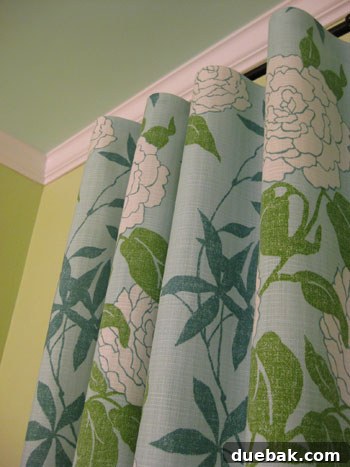
We’re back with our homemade nursery curtain panel how-to.

Remember the punchy patterned fabric we found in last week’s shopping post? Here’s how we transformed a single bolt of P Kaufmann fabric into three floor-length curtain panels—two for the main window and one for the doorless closet—without using a sewing machine.
Supplies were simple: tape measure, scissors, iron-on hem tape (I use Heat N’ Bond Ultra Hold), and an iron. We also added a few kid-safe features, which I’ll mention as we go.
To help our baby sleep, we decided we also needed a true light-blocking solution. We found chic white faux-wood blinds at Home Depot that felt substantial—almost like real shutters—and promised excellent blackout performance when lowered. They were not an exact fit for our oddly sized window (39 1/4″ wide), but Home Depot will cut them to size for free. We handed the measurements to an employee and had a custom-cut set back in about five minutes. The blinds cost $37, but they look like pricier wood and the darkness they provide should be priceless for extra sleep.
These blinds also came with kid-safe separated cords instead of a continuous loop, reducing strangulation risk. We still plan to wrap the cords and secure them high and out of baby’s reach, but the loop-free design is a welcome safety feature.
Before installing curtains or blinds, here’s what the window looked like in its raw state.
John installed the blinds quickly, though they were initially too long—about two feet extra—which made them heavy to raise and lower because many slats bunched at the bottom. Fortunately the instructions explained how to shorten them: he popped out the plastic end caps, removed extra slats, trimmed the excess string, and reinstalled the bottom pieces. That made the blinds much easier to operate.
Once John finished the blind adjustments, it was my turn to make the curtains.
I measured the curtain length to be just under 8 feet for a near floor-to-ceiling look, then added 1.5 inches at the top and bottom for hems. In the end, cutting two eight-foot sections from the bolt gave me the exact finished length I wanted. For straight cuts, I simply used the edge of our new 5 x 8′ rug as a guide: roll the bolt across the rug, line up the fabric edge, and cut a clean straight line. For width, I left each panel as wide as the bolt allowed to avoid trimming those edges.
Next I used Heat N’ Bond Ultra Hold iron-on hem tape. It creates polished, washable hems without stitching and is inexpensive and reliable. I laid an eight-foot fabric panel on the ironing board, positioned hem tape along each raw edge, folded and pressed to create clean hems, and repeated for all four sides. The result was a finished panel with neat edges and no sewing required.
Without sewn rod loops, I attached the panels to an oil-rubbed bronze curtain rod using inexpensive clip-on curtain rings and clips from Target. The clips create pretty uniform waves in the fabric, giving a high-end look without rod pockets or sewing. I love how seamless the hemmed edges look when clipped.
John mounted the curtain rod using heavy-duty anchors to ensure the fixture stays secure. While he hung the rod, I made the third panel for the closet at seven feet long and created a simple rod pocket by folding over about four inches at the top and ironing hem tape to form a loop.
Because the window sits a little left of center on the wall, we purposely offset the curtain mounts to visually balance the room. John mounted the left support only about four inches away from the trim, while the right support sits about fifteen inches wider than the trim. Hanging full panels and drawing them slightly to the right hides the awkward shift and gives the space a more balanced, polished look.
We found our oil-rubbed bronze rod and curtain rings on clearance at Target for less than $12. The dark finish ties in with the mocha floor and a few future darker accents, preventing the nursery from feeling too sugary and matchy-matchy.
Clip-on rings also double as a safety feature. Because the rings hold the fabric rather than threading it onto the rod, a heavy pull can release the panel from the clips while leaving the rod and rings secure on the wall. We tested this and confirmed that the panels came down without the hardware pulling away from its anchors, which is reassuring with little climbers around.
This P Kaufmann pattern appears to be discontinued, but the process works for any fabric. The fabric we used happens to be indoor/outdoor material, which adds fade and stain resistance—helpful in a nursery where sticky fingers and messy faces are inevitable. We spent about $35 per panel and still have nearly a yard of fabric left over.
The closet panel benefits from a simple swag technique. I installed a $3 screw-in tension rod across the closet opening, attached an Ikea coat hook to one side of the trim, and made a small fabric loop secured with hem tape and a safety pin. The loop slips over the hook to hold the curtain neatly to one side.
Adding these floor-length panels makes the ceilings feel taller and brings pattern and warmth to both the window and the tiny aqua closet nook. The closet now feels much sweeter and more finished; we still plan to add bins, baskets, extra hanging rods, and a small storage piece on the floor.
So that’s how we made our off-centered window appear balanced, achieved blackout coverage for better sleep, and introduced a bold pop of pattern without sewing. Have you made curtains before or used a fabric panel in place of a door? Share your tips and tricks—hem tape confessions welcome.
