
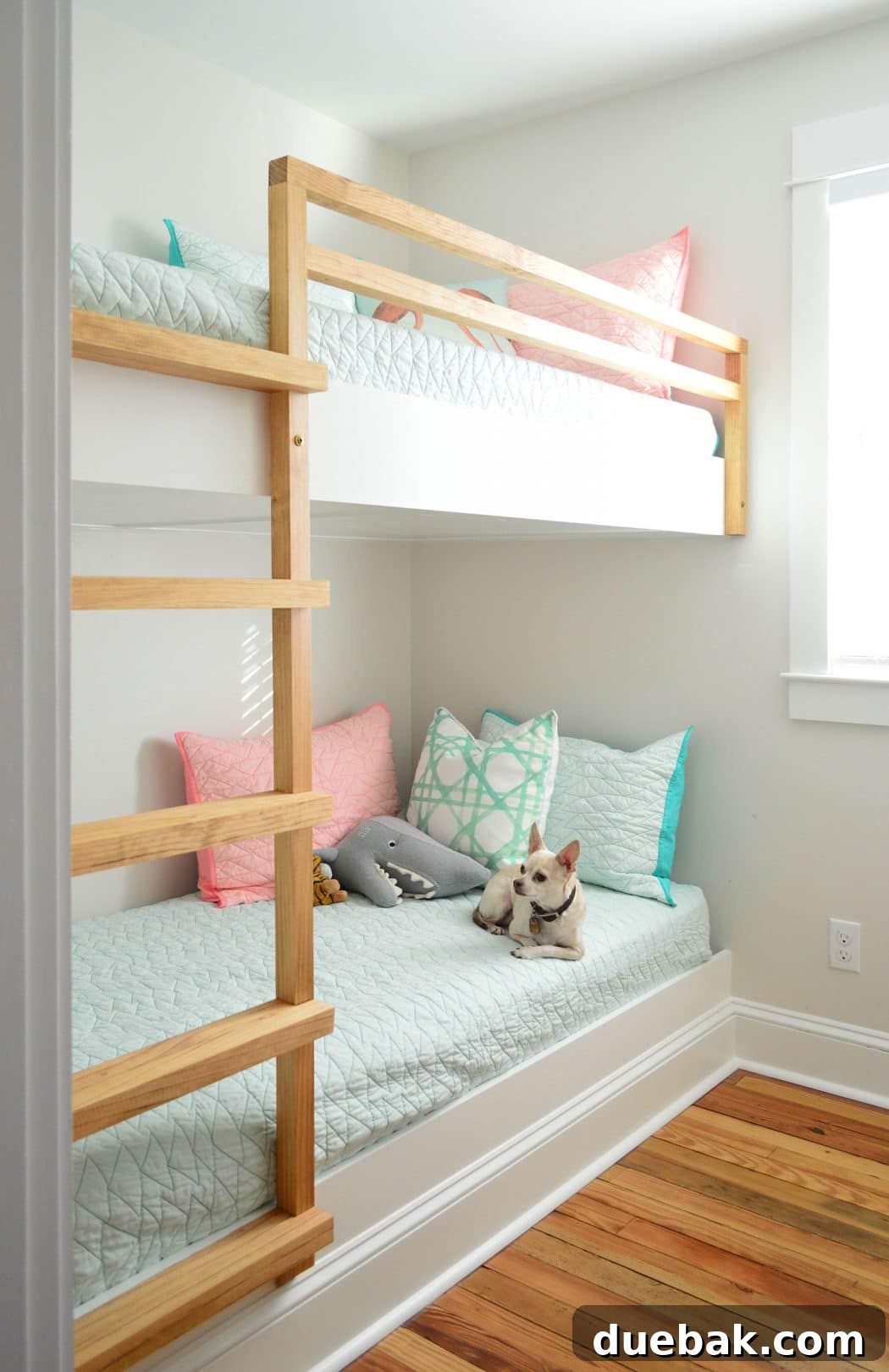
Transforming a compact space into a functional and fun retreat can be one of the most rewarding home improvement projects. We’re absolutely thrilled to unveil the custom built-in bunk beds we designed and constructed for the bunk room at our beach house. This isn’t just any small room – it measures a cozy 7 feet wide – yet we successfully maximized every inch to comfortably accommodate two XL twin mattresses. This DIY endeavor has not only provided practical sleeping arrangements but has also created a vibrant hub for our children, quickly becoming their go-to spot for everything from peaceful slumber to imaginative play and cherished hang-out sessions. Join us as we share the journey of building these sturdy, space-saving bunk beds, perfect for any small bedroom or guest area seeking a smart and stylish solution.
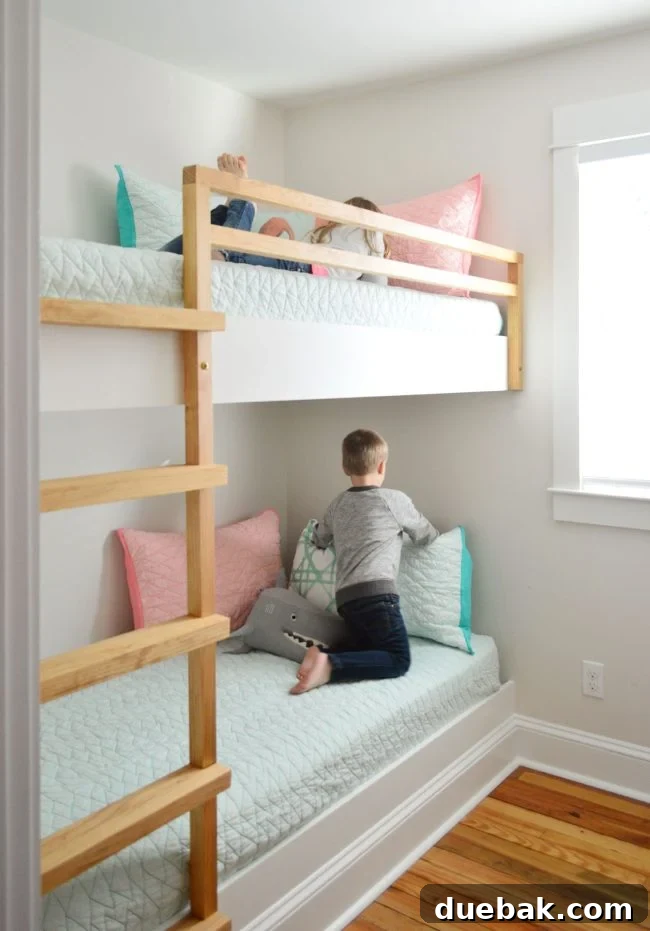
Embarking on this project, I admit, brought a unique blend of excitement and apprehension. Unlike crafting a simple bookcase or a sturdy table, building a bed that literally ‘floats’ in the air, supporting one person (or an occasional family chihuahua!) above another, felt like a significant undertaking. Safety and structural integrity were paramount. However, let me assure you, the detailed plan we followed proved to be incredibly solid and robust. What might seem daunting at first glance is, in fact, remarkably straightforward to execute with the right approach and materials. This guide will walk you through every step, demystifying the process and empowering you to create your own dream bunk setup.
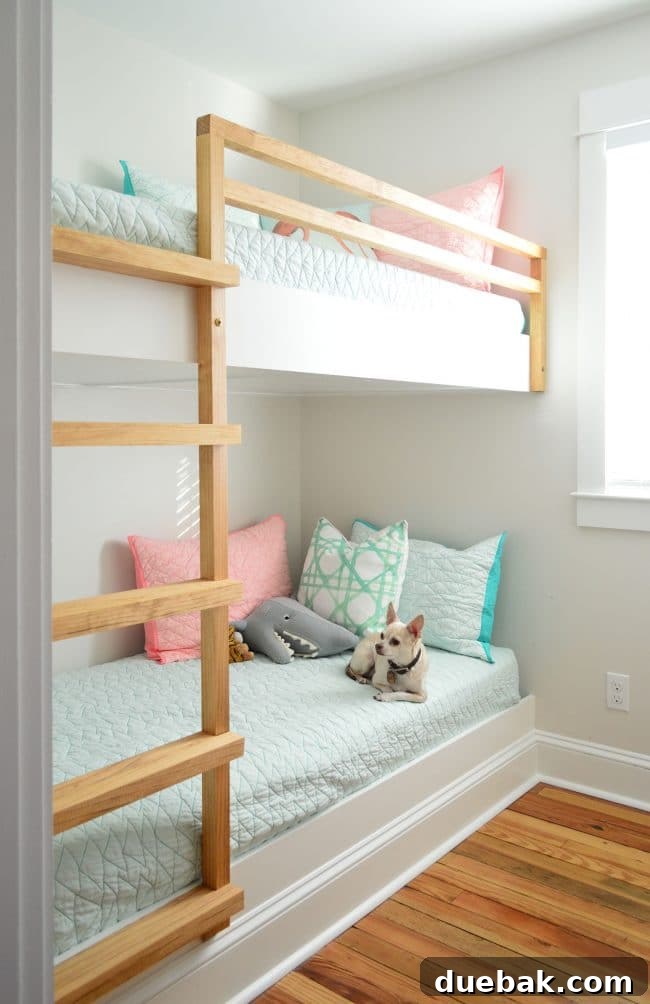
This comprehensive article delves into all the essential aspects of constructing your own custom built-in bunk beds. Here’s a detailed overview of what we’ll cover:
Building Your Dream Bunk Beds: A Step-by-Step Guide
We’ve meticulously packed this guide with detailed instructions and practical tips, ensuring you have all the information needed for a successful project. Here’s a quick look at the core stages we’ll walk you through:
- Designing the Foundation: How to construct a stable and secure platform for the bottom bunk.
- Creating the ‘Floating’ Effect: Techniques for securing a robust, cantilevered platform for the top bunk without traditional legs.
- Optimizing Space and Comfort: Essential considerations for choosing the ideal height and spacing between your bunks.
- Safety First: Detailed instructions for installing a strong ladder and a protective railing.
- Achieving the Integrated Look: Expert tips for adding trim and molding to seamlessly blend your bunks into the room’s architecture.
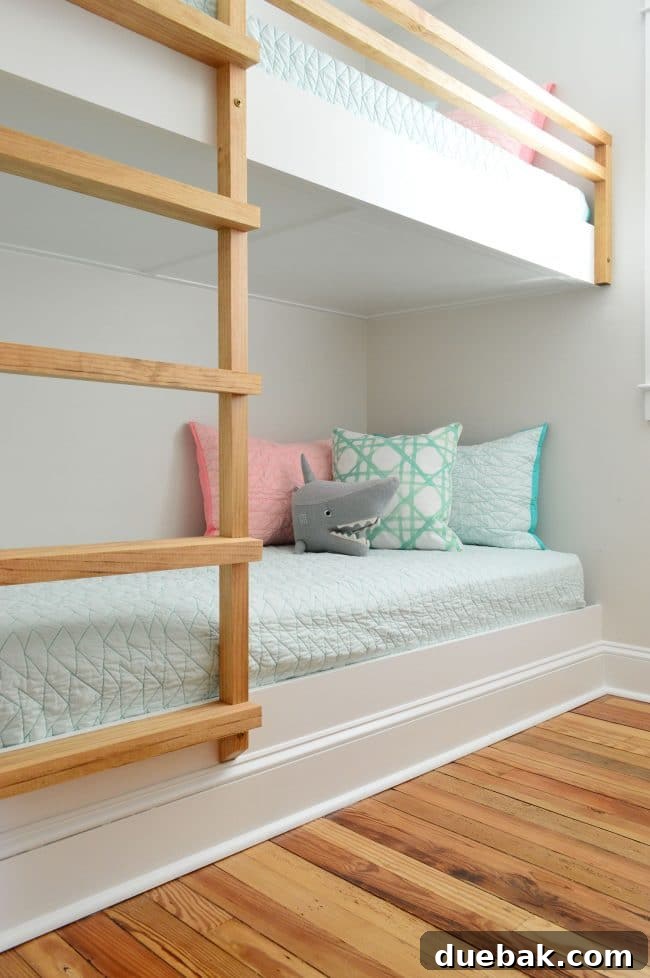
Our bunk room, measuring precisely 81 inches wide, presented itself as the ideal canvas for a wall-to-wall 80-inch twin XL mattress. This perfect alignment became clear during a recent renovation, sparking the idea for a dedicated small bunk room. While our beach house boasts two other bedrooms available for the kids, the undeniable charm and playful allure of built-in bunk beds made this project an absolute must. For months, this space simply held a mattress on the floor, waiting for its full potential to be unleashed, and now, we’re excited to share how we transformed it into a captivating and highly functional area.
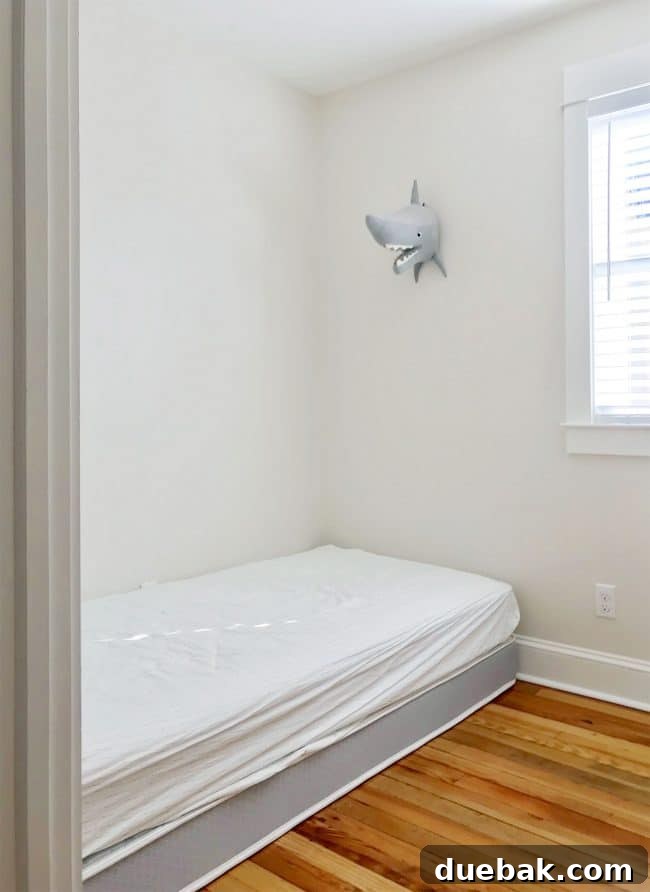
Ready to elevate your space with custom built-in bunks? Let’s dive into the construction process and show you exactly how we brought these incredible beds to life!
Essential Materials & Supplies for Built-In Bunk Beds
Our innovative design focuses on creating two robust floating platforms, elegantly connected by a custom-built ladder. Due to the compact dimensions of this room and the snug fit of the mattresses, we had the distinct advantage of securing three out of the four sides of each platform directly into the wall studs. This strategic anchoring method provides an unparalleled level of sturdiness and stability, ingeniously eliminating the need for any unsightly posts or vertical floor supports, contributing to a cleaner, more open aesthetic. Below is a comprehensive list of all the materials and tools you’ll need for this rewarding DIY project:
- 2×4″ Boards: The primary structural lumber for your platforms.
- 1/2″ Plywood Panels: Used for creating the solid mattress surfaces on top of each platform.
- 1/8″ Plywood Panels: Ideal for finishing the underside of the upper platform, providing a clean look from below.
- Primed 1×8″ Boards: For adding decorative trim and facing the front of your bunk platforms.
- 2×2″ Pine Boards: Essential for constructing the sleek ladder and safety railing.
- Primed Lattice Strips: For refined finishing touches and hiding seams on the underside of the top bunk.
- Baseboard: To be installed around the bottom bunk, matching existing room trim (can be reused if carefully removed).
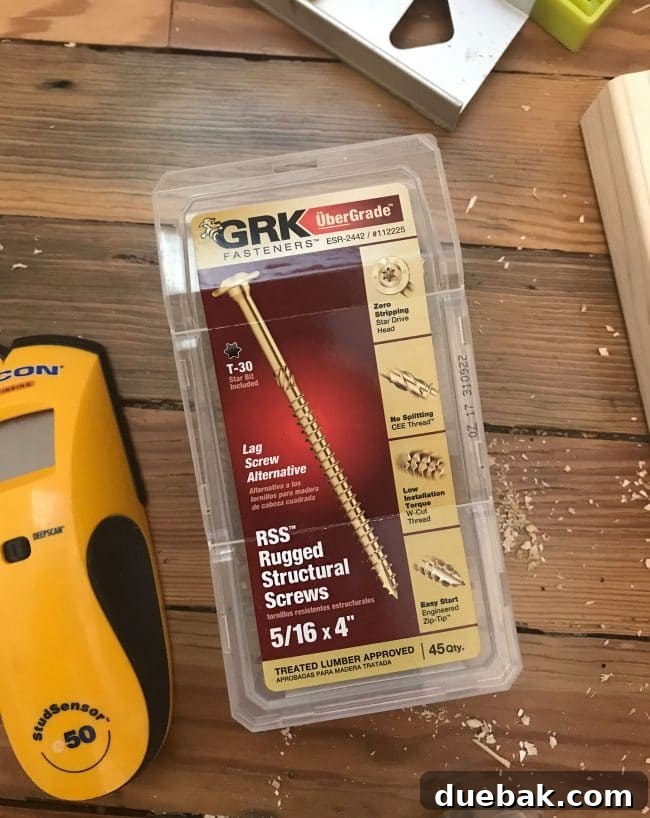
- 4″ and 5″ Structural Screws (e.g., RSS Screws): These heavy-duty screws are critical for securely anchoring the platforms to wall studs.
- Miter Saw: For precise angled and straight cuts on lumber.
- Circular Saw: Perfect for cutting plywood panels to size.
- Power Drill: An indispensable tool for driving screws and pre-drilling holes.
- Nail Gun: For quickly and securely attaching plywood and trim pieces.
- Stud Finder: Absolutely crucial for locating wall studs to ensure maximum structural support.
- Bar Clamps: Invaluable for holding pieces in place while you secure them.
- Pocket Hole Jig (optional but highly recommended): For creating strong, concealed joints, especially useful for internal framing.
- Long Levels: Essential for ensuring both platforms are perfectly horizontal and true.
For our specific beach house bunk room, the total material cost for this project came in at approximately $250. Please note, this figure does not include the cost of mattresses and bedding, which are separate investments. This budget-friendly approach demonstrates that a custom, high-quality built-in solution is achievable without breaking the bank.
Step 1: Constructing the Bottom Bunk Bed Platform
Our initial design contemplation for the bottom bunk involved building the mattress platform directly on the floor. The primary motivation behind this was to maximize headroom for both bunks, providing ample space for occupants. However, after laying out the framework, we made a stylistic decision to raise it slightly for improved aesthetics, allowing for seamless baseboard integration. I’ll still guide you through the initial build process, as it perfectly illustrates the fundamental construction techniques applicable to both platforms. We opted to build both platforms in situ – directly within the room – to ensure the most precise, wall-to-wall fit, thereby avoiding the challenging maneuver of large, pre-assembled wooden frames in such a compact space.
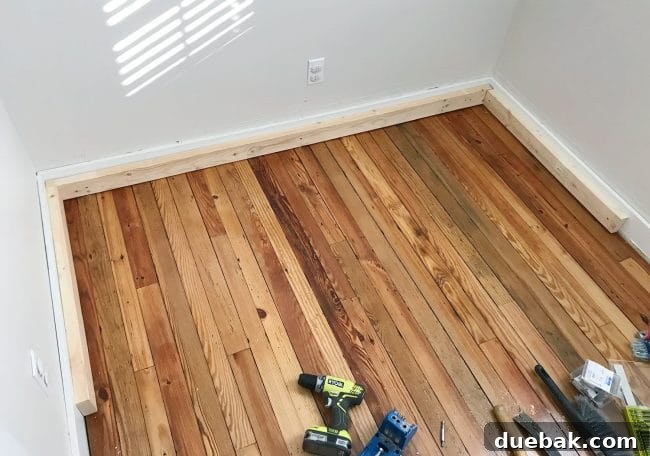
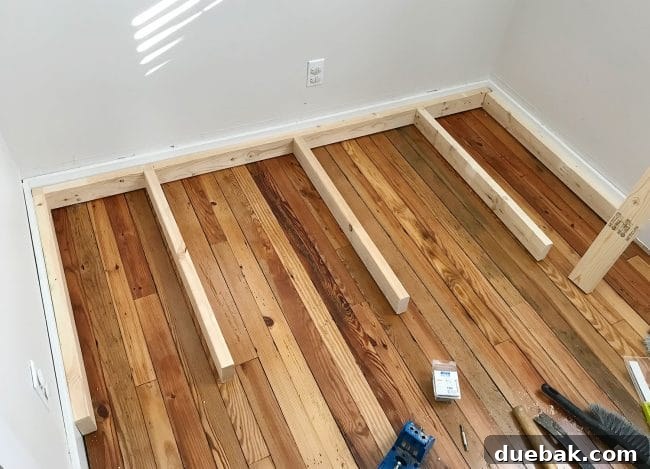
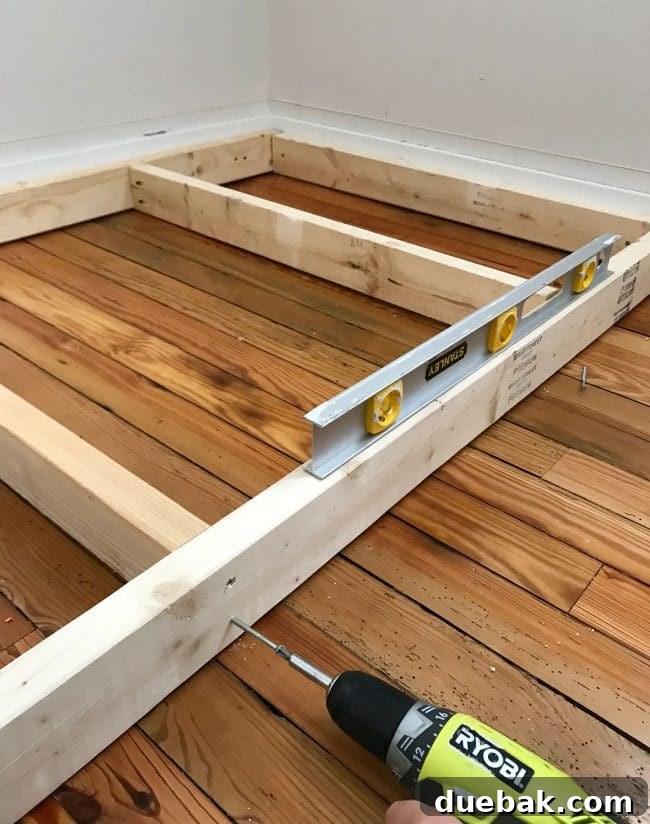
We began by constructing a robust frame using 2×4-inch boards, meticulously cut to fit the room’s dimensions precisely, stretching from wall to wall. After securing the back and side pieces, which form the perimeter of our platform, we then cut additional shorter pieces. These were strategically added to create essential cross-bracing underneath the platform, significantly enhancing its strength and stability. As you can observe in the image below, this process of adding internal supports is crucial. Ideally, you’ll want to place these cross-braces approximately every 12 inches to ensure even weight distribution and prevent any sagging over time, creating a truly solid foundation for the mattress.
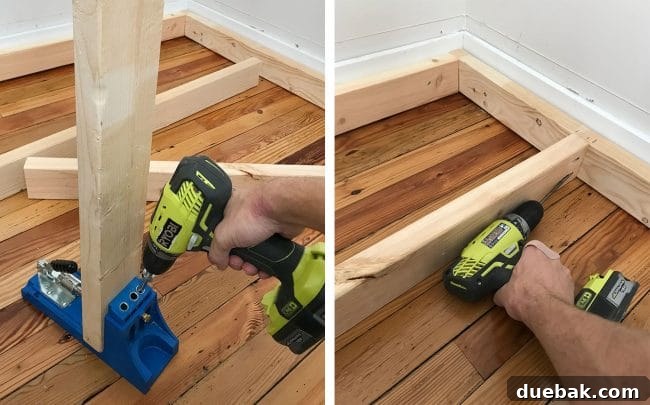
As I don’t own a framing nailer, I leveraged the incredible versatility of my Kreg Jig for attaching all these structural components. This ingenious tool creates strong, concealed pocket holes in your wood, allowing you to join pieces together with exceptional tightness and rigidity. Its ability to create professional-grade joints without visible fasteners has made it an indispensable asset in countless projects over the years, and I wholeheartedly recommend adding one to your DIY toolkit. It truly simplifies complex joinery tasks, making them accessible to woodworkers of all skill levels.
Once all the vital cross-braces were securely attached within the frame, I proceeded to install the fourth and final side of our platform – the front piece. This completed the rectangular structure, creating a fully enclosed and immensely strong base for the bottom bunk. During this stage, it’s critical to double-check that all corners are square and all connections are tight. A level is your best friend here, ensuring that your base frame is perfectly horizontal and ready for the next layer. Precision at this stage is key to a stable and aesthetically pleasing final product.
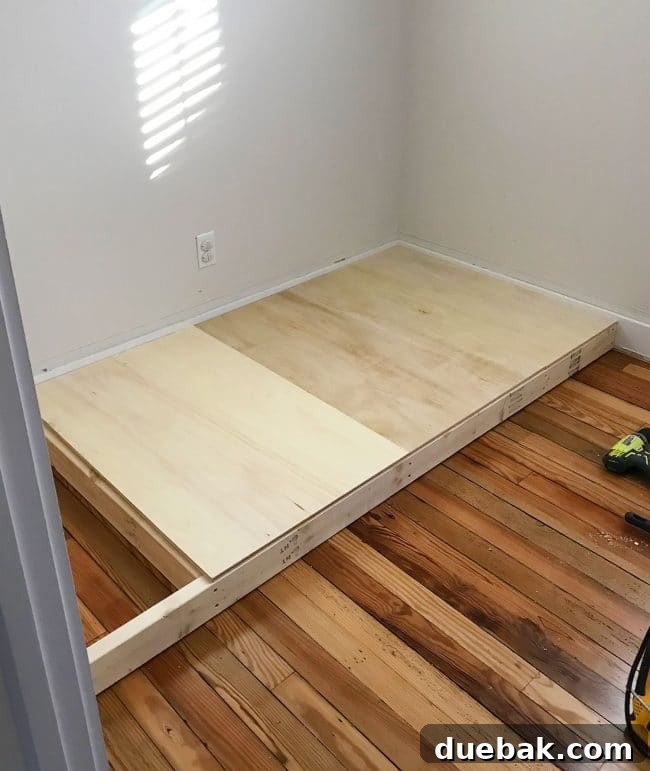
With the robust framing fully assembled and leveled, the next step was to create a solid, continuous surface for the mattress to rest upon. We achieved this by adding 1/2-inch plywood panels. Using our trusty circular saw, we carefully cut these panels to the exact dimensions of the frame, ensuring a snug fit. They were then securely fastened into place using our nail gun, driving nails into the 2×4 frame beneath. A critical tip here is to ensure that any seams between adjacent plywood pieces are precisely aligned to rest directly over one of your internal cross-braces. This prevents any weak points and ensures the plywood is fully supported across its entire surface, guaranteeing a firm and durable mattress base.
While the completion of the plywood surface might have marked the end of the bottom platform construction, a fresh perspective the following morning led us to a design refinement: we decided to raise the platform a few inches off the floor. This seemingly minor adjustment significantly enhanced the room’s aesthetic, creating space to seamlessly run a continuous baseboard across the front, integrating the bunk more fluidly into the room’s trim. To achieve this, we carefully detached the platform just enough to reposition and screw it into the wall at the desired, slightly elevated height. Additionally, we installed discreet 2×4-inch legs underneath the platform, providing robust support from the floor. Finally, a long 2×2-inch board was securely attached across the front of the platform, creating the perfect anchor point for the new baseboard. This thoughtful modification ensured both structural integrity and a refined, custom built-in appearance.
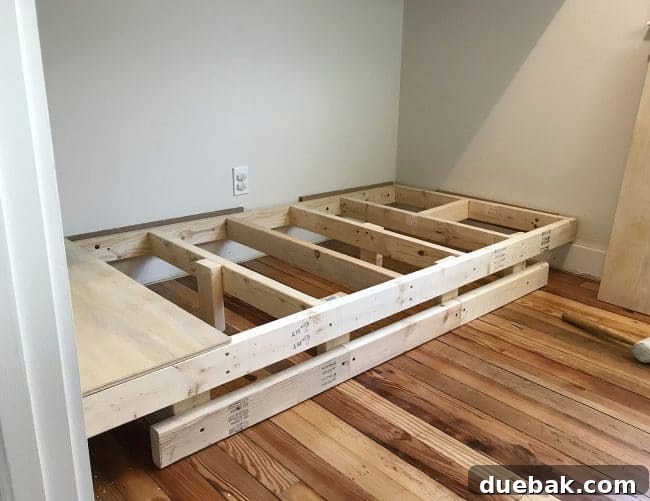
Despite the various components and modifications visible in that photo, we assure you the process was far less complicated than it might appear. Each step builds logically upon the last, making the entire construction manageable for even intermediate DIY enthusiasts. The key is careful measurement, patience, and a methodical approach, ensuring each piece is accurately cut and securely fastened.
Step 3: Determining the Optimal Height for Your Top Bunk
Before we could begin constructing the upper bunk platform, a crucial decision had to be made: establishing its ideal height. Given that our room features standard 8-foot ceilings, our height selection was guided by several key criteria, carefully balancing functionality, comfort, and safety:
- Balanced Headroom: Our primary goal was to achieve roughly equal headroom for both the top and bottom bunks. This ensures comfort for all occupants, regardless of where they sleep.
- Adult Comfort on Bottom Bunk: We wanted to ensure ample space on the bottom bunk for an adult to comfortably sit upright without brushing their head against the upper platform. This is especially important for those cherished bedtime stories or quiet moments.
- Safety and Play Prevention on Top Bunk: While comfort is important, we intentionally aimed for the top bunk to be “cramped” enough to discourage any horseplay, jumping, or attempts to stand up. Safety for younger children is paramount, and a lower ceiling on the top bunk acts as a natural deterrent for unsafe activities.
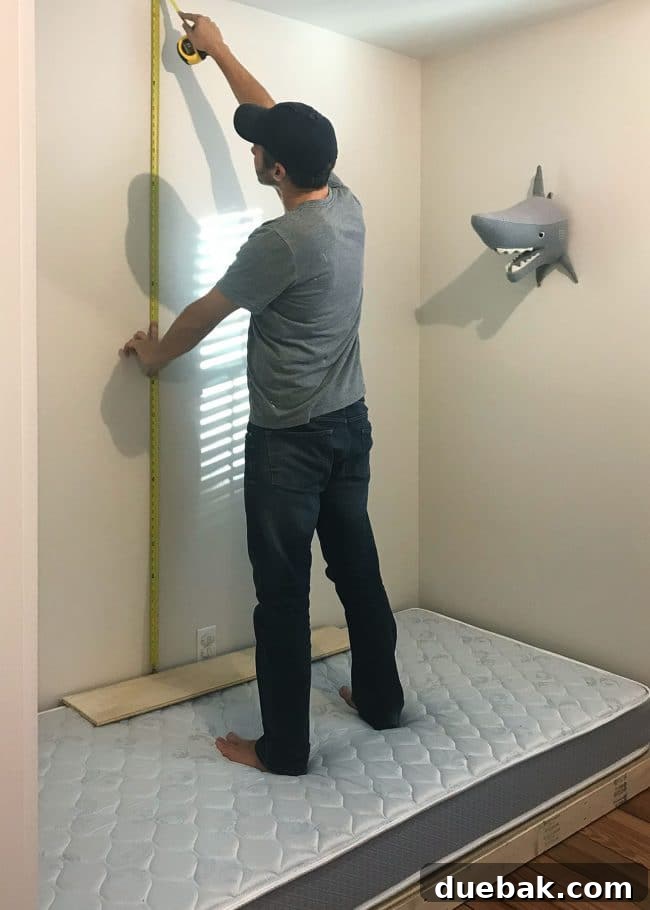
To cut a long story short, we ultimately positioned the top bunk slightly higher than the exact halfway point. This strategic adjustment was crucial for achieving criteria #2 and #3 – providing sufficient sitting height on the bottom bunk while subtly limiting vertical space on top for safety. We are incredibly pleased with this decision, as it also allowed for the later, minor adjustment of raising the lower bunk without compromising overall comfort or the intended design, as described earlier. It’s worth noting that we built and installed the upper bunk *before* making that final adjustment to the bottom bunk, showcasing the flexibility of this design.
Step 4: Building Your Sturdy Floating Top Bunk
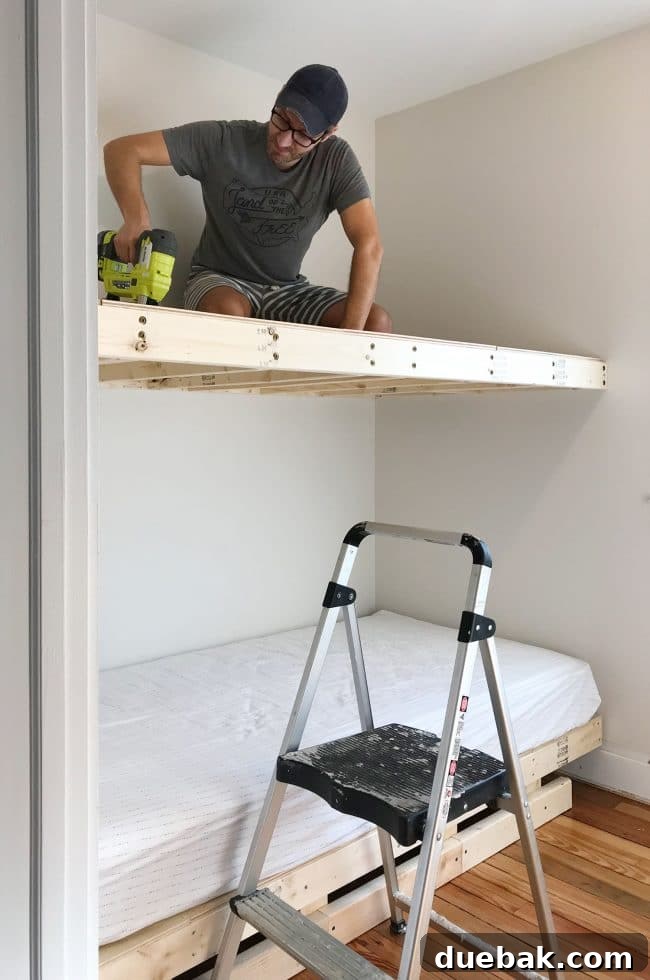
The construction of the upper bunk followed a similar process to the lower one, but with the added engineering challenge of securing it robustly to the wall without the aid of any vertical supports or ‘legs’ touching the floor. To achieve this impressive floating effect, we relied heavily on these heavy-duty “Rugged Structural Strength” screws (often abbreviated as RSS screws). These specialized fasteners were driven directly into the wall studs, creating an incredibly strong and secure cantilevered structure. Seriously, they are absolutely exceptional for this type of demanding application.
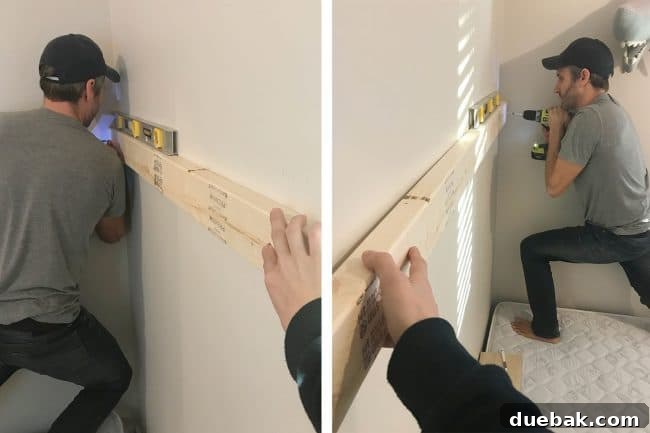
Installing these robust structural screws still required a bit of concerted effort and ‘oomph’ (as evidenced by my determined lunge in the photo!). It was particularly important to ensure that each 2×4-inch board was pulled tightly and securely against the wall stud as the screw was driven in. However, their design makes them significantly simpler and faster to use compared to bulkier lag screws. Crucially, no pilot holes were needed for these self-tapping screws, and our regular power drill handled the task with surprising ease, proving their efficiency and user-friendliness even for heavy-duty applications.
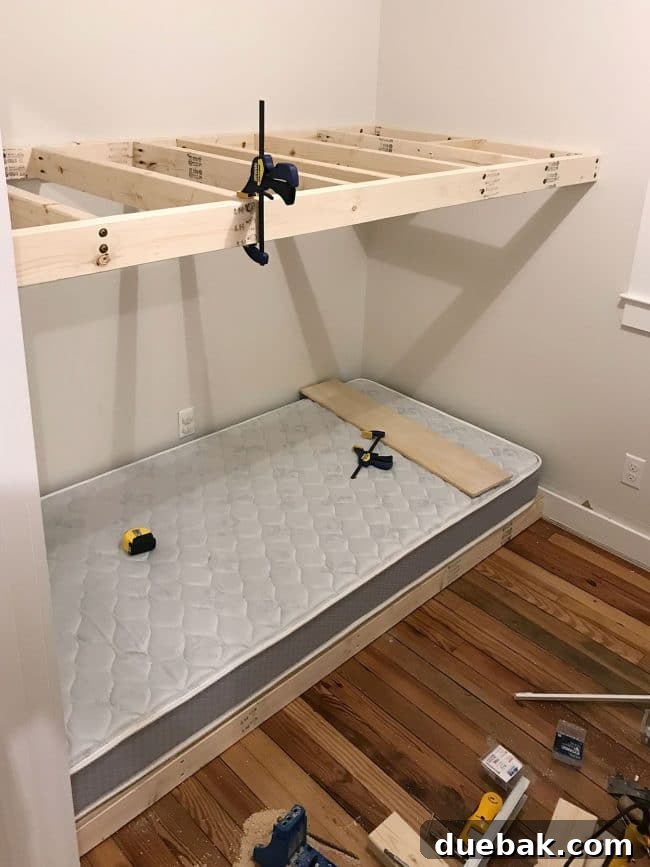
Once again, the core process for constructing the upper platform’s frame mirrored that of the lower bunk, focusing on creating a sturdy 2×4 structure. We utilized those indispensable heavy-duty structural screws to firmly secure all of the 2×4 boards to the three walls where the platform makes contact. This robust wall-anchoring is what gives the bunk its incredible floating strength. Additionally, these same powerful screws were employed to connect the front-facing 2×4 piece to the rest of the frame, ensuring a cohesive and unyielding structure. The visible framework in the image below illustrates this secure, integrated approach, ready to support years of use.
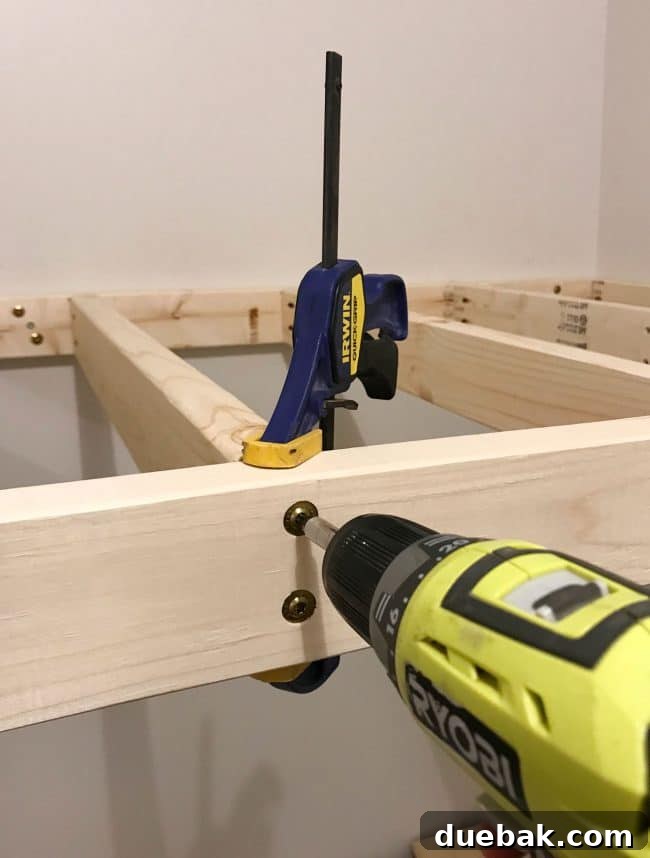
If the Rugged Strength Screws are undoubtedly the heroes of this robust bunk bed build, then these bar clamps are their indispensable sidekicks. These clamps were an absolute game-changer, providing crucial assistance in holding the heavy 2×4 components precisely in place against the wall studs while we worked to securely drive in the screws. Their ability to apply consistent pressure and free up an extra set of hands made the challenging task of installing a floating platform significantly easier and safer, ensuring every connection was tight and accurate.
Finally, mirroring the process for the platform below, we proceeded to nail down the 1/2-inch plywood panels onto the upper frame. This created a solid and stable surface, ready to comfortably support the mattress. This stage also served as an excellent opportunity to perform a crucial test: assessing the overall solidity and sturdiness of the newly constructed top bunk. We put it through its paces, confirming that it met our rigorous safety and durability standards. The result was a rock-solid platform, ready for its intended purpose and providing peace of mind.
With the structural ‘bones’ of these custom built-in bunk beds now meticulously completed and thoroughly tested for stability, the foundational construction is behind us. What remains is the exciting phase of transforming these robust frames into beautifully integrated furniture pieces. It’s now time to shift our focus from raw construction to refined aesthetics, enhancing their visual appeal and making them truly shine within the bunk room.
Step 5: Enhancing Aesthetics with Trim & Molding
To elevate the appearance of the exposed 2×4 framing and achieve that coveted built-in look, we meticulously applied pre-primed 1×8-inch boards across the front face of both the upper and lower bunk platforms. These broader trim pieces instantly lend a finished, furniture-grade quality to the structure. Furthermore, we carefully reinstalled the existing baseboard – which we had temporarily removed during construction – now running gracefully across the front of the bottom bunk. These thoughtful finishing details, though seemingly small, are absolutely crucial in transforming raw lumber into a seamless, integrated component of the room’s architecture, truly defining them as custom built-in bunk beds rather than freestanding units.
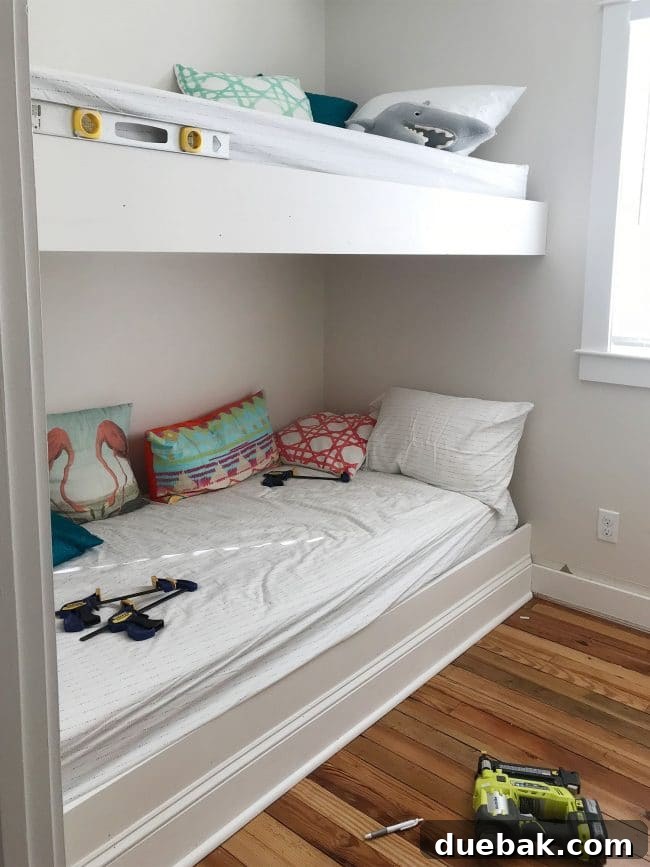
To further refine the appearance, especially when viewed from the bottom bunk, we applied thinner 1/8-inch plywood panels to the underside of the top bunk. This created a smooth, clean ceiling for the lower sleeping area, vastly improving the overall aesthetic. To give it a truly polished finish, we then used primed lattice strips to frame the edges of this plywood, neatly concealing any raw edges and, importantly, covering the seam where plywood panels met in the middle. All these decorative elements were secured with a combination of small finish nails and wood glue, providing both immediate hold and long-term durability, ensuring they remain perfectly in place over time, even with active use. This attention to detail significantly contributes to the high-end, custom look.
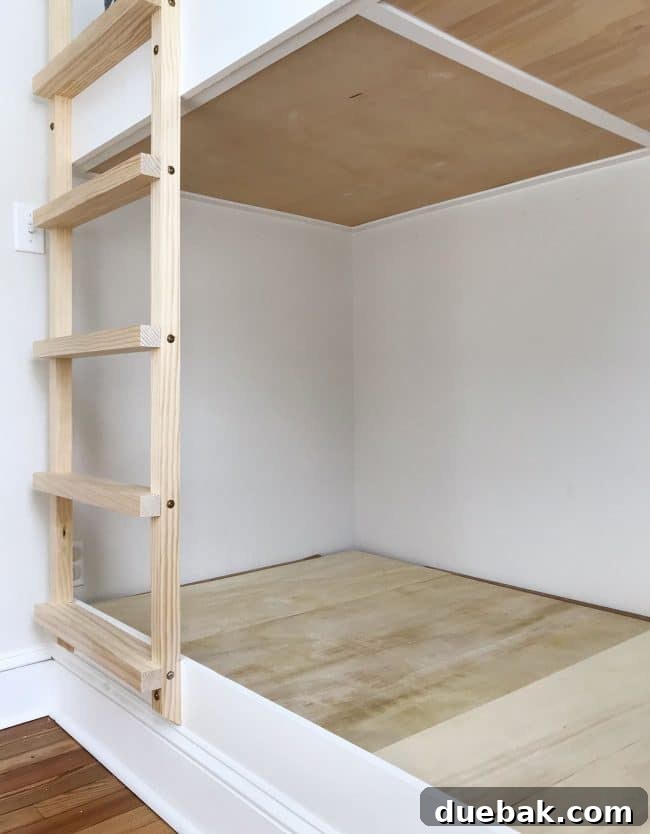
While all of these newly installed trim pieces would eventually receive a fresh coat of paint to seamlessly match the existing trimwork in the room, our immediate focus shifted to the next exciting phase of the project: designing and constructing the ladder. This element is not just functional but also a significant design feature, promising to add character and accessibility to our custom bunk beds.
Step 6: Crafting Your Custom Bunk Bed Ladder
For the aesthetic inspiration behind our ladder and the modern railing design, we turned to these stunning bunk beds from Studio McGee. We were particularly drawn to their clean lines and the sophisticated blend of natural wood tones with crisp white elements. To faithfully recreate this contemporary look, we opted for readily available 2×2-inch square pine boards from Home Depot. These dimensions provided the perfect balance of visual lightness and structural strength, ensuring our ladder would be both beautiful and fully functional.
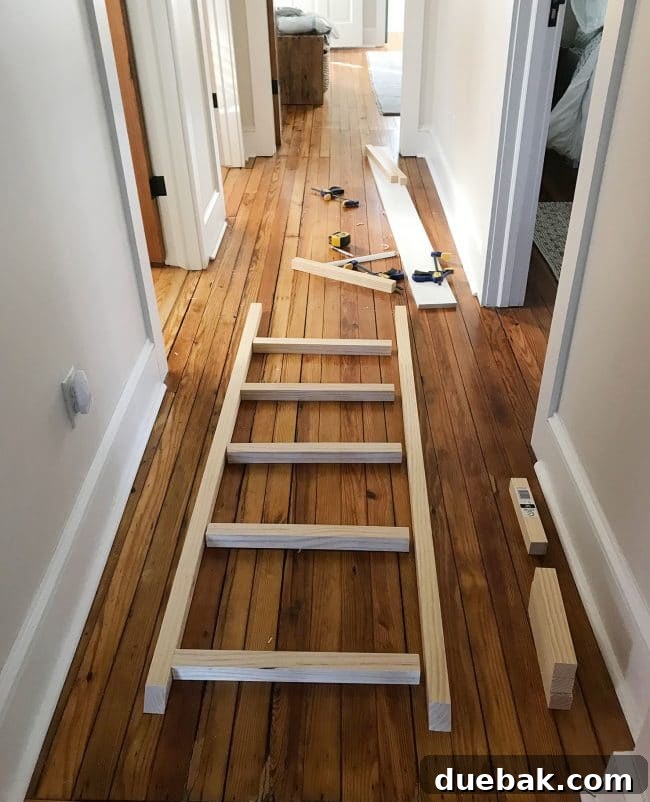
Each rung of our custom ladder was precisely cut to a width of 18 inches. To ensure absolute uniformity and a professional finish, we cut all the rungs in groups, minimizing any slight variations in size. For a robust and unyielding connection, we secured these rungs into the vertical ladder pieces using the same heavy-duty Rugged Strength Screws that proved so effective in the bunk platforms. An invaluable trick during assembly was the use of scrap wood ‘spacing blocks’ placed between the rungs as we attached them. This ingenious method guaranteed perfectly even spacing (our rungs are 12 inches apart from top to top, meaning the spacers were 10.5 inches). Additionally, I used another scrap piece of wood, resting it on top of the rung and pressing down, to ensure everything remained perfectly flush as I drove in each screw, eliminating any wobbles or misalignments. This attention to detail is paramount for both safety and appearance.
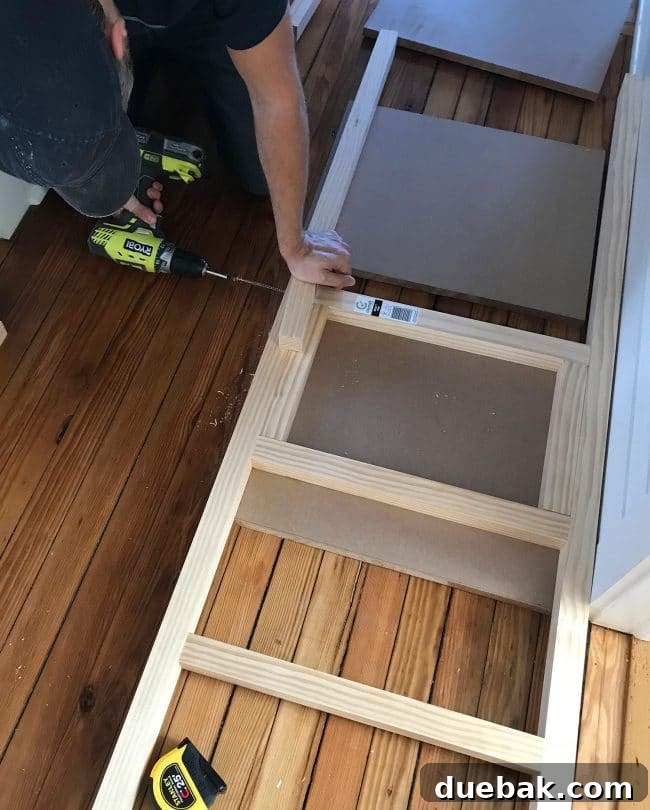
Given the charmingly imperfect nature of our historic beach house floors, which are not perfectly flat, we took a crucial preventative measure during the ladder construction. To ensure the entire assembly process was carried out on a truly level and stable surface, we placed a large, flat piece of scrap MDF, leftover from another project, underneath our work area. This simple step prevented any twisting or warping of the ladder frame during assembly, guaranteeing a perfectly square and straight final product – a vital consideration for both safety and ease of use.
After the initial construction, we realized that the 2×2-inch rungs, while aesthetically pleasing, felt a little narrow underfoot for comfortable climbing. To enhance both comfort and security, we made a thoughtful modification: we decided to double-up the rungs. After the ladder was already hung in place, we cut additional, slightly longer 2×2-inch pieces and attached them horizontally across the front of each existing rung. This was done by screwing them in from the backside, ensuring a clean front appearance. This simple yet effective enhancement not only provided a wider, more stable stepping surface but also added an extra layer of structural integrity to the entire ladder, making it feel even more robust and safe.
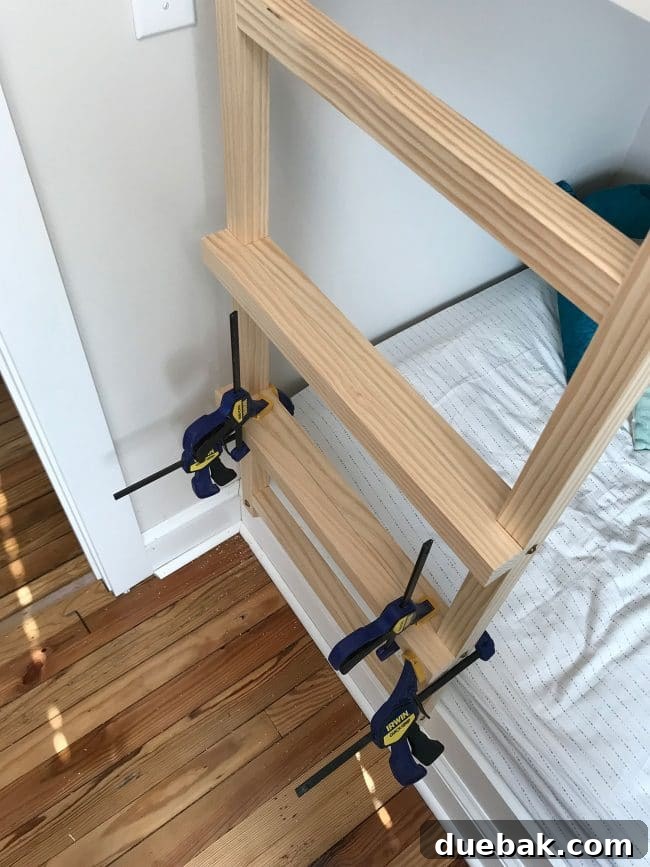
Beyond the structural and comfort enhancements, we also dedicated time to refining the tactile experience of the ladder. We meticulously sanded all the sharp corners of the wood rungs and vertical supports. Our aim was to achieve a soft, rounded square edge rather than a crisp, sharp one. This subtle detail significantly improves user comfort, making the ladder much more pleasant to grip and climb, and adds to the overall handcrafted quality of the built-in bunk beds.
Step 7: Installing the Ladder & Constructing the Railing
With the ladder meticulously crafted, the next crucial step was its secure attachment to the bunk bed frame. We carefully positioned the ladder and then used robust clamps to temporarily hold it firmly in place, ensuring optimal placement and alignment. Once satisfied, we permanently secured it using more of those incredibly strong, heavy-duty structural screws, driven directly into the bunk’s framework. With the ladder now firmly in position, we could then confidently begin mapping out and constructing the protective railing for the top bunk, an essential safety feature for any elevated sleeping area. This methodical approach ensures both stability and a seamless transition to the railing installation.
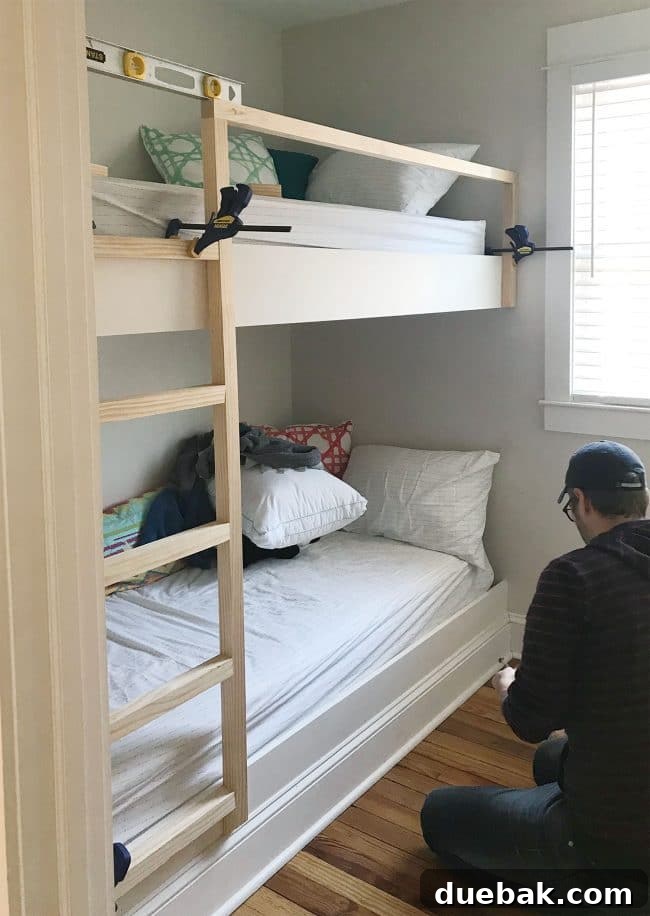
The top rails for the bunk bed were secured from the topside using additional RSS screws, ensuring a strong and dependable connection. Pictured below is the installation of the shorter top rail, positioned on the wall side of the ladder opening. Our initial thought was to place the ladder directly against the wall, but we quickly realized this would obstruct the light switch. Instead, we decided to float it a couple of inches away from the wall. This turned out to be a fortunate adjustment, as it provides a comfortable hand-hold when climbing, allowing users to wrap their fingers around the side of the ladder. This unforeseen design evolution worked out exceptionally well, combining practicality with improved ergonomics.
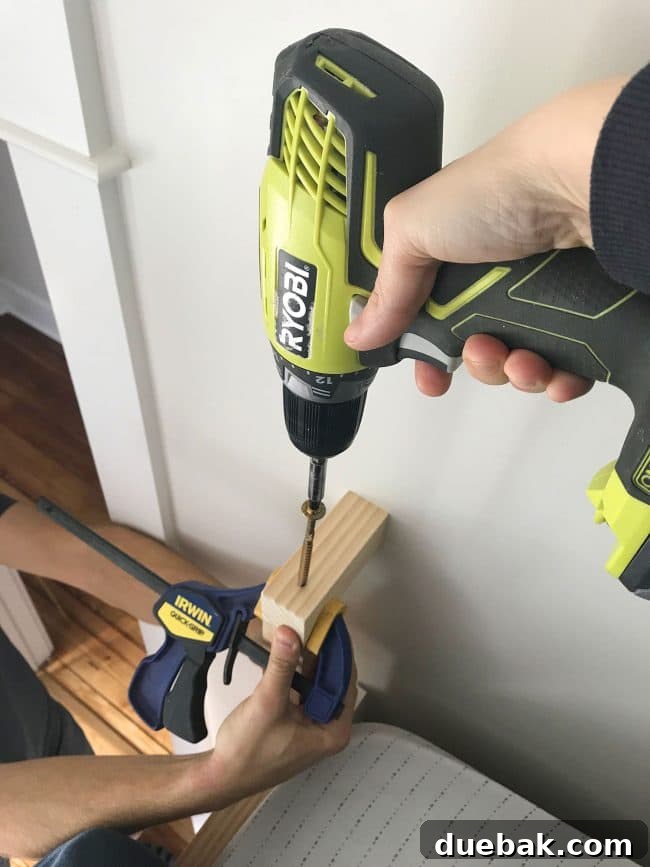
The longer top rail, spanning the opposite side of the bunk opening, was attached using the identical secure method – driven into the top of the ladder on one end and anchored into a small vertical 2×2-inch rail that we added specifically for this purpose on the other end. To enhance both safety and aesthetics, we then introduced a second, middle rail. This intermediate support was strategically installed using pocket holes drilled from the backside of the vertical supports, ensuring that the fasteners remain completely invisible from the front-facing view. This technique creates a clean, seamless appearance, emphasizing the custom craftsmanship of these built-in bunk beds and providing added security without compromising on style.
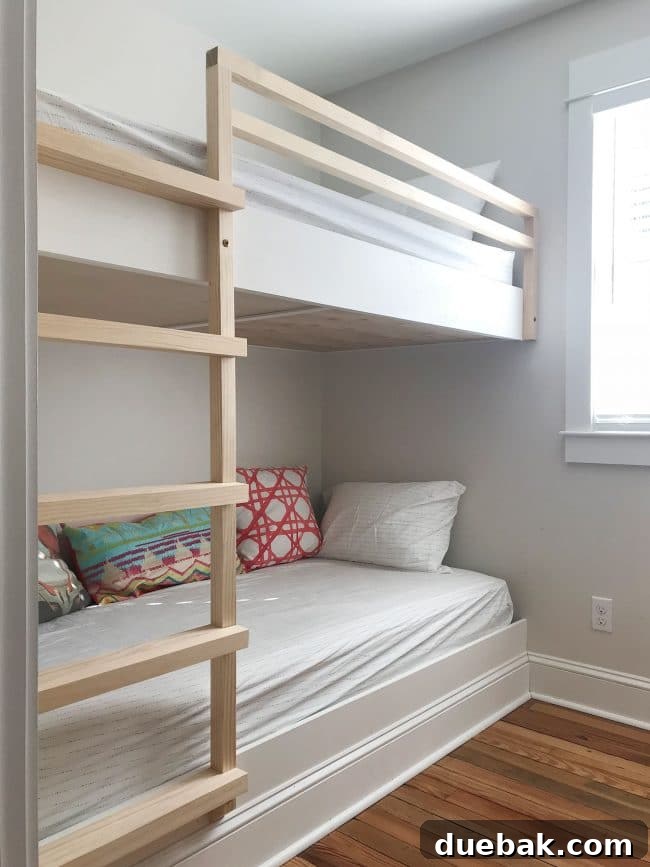
Speaking of visible fasteners – in retrospect, if I were to tackle this project again, I might explore options to conceal those two screw heads on the front-facing rail. Part of us enjoys the industrial charm they lend, especially with their brass color resembling elegant gold rivets, which are also visible along the sides of the ladder. However, when viewed from certain angles, like the one below, only a couple of them are prominent, making them appear more random than intentionally integrated. We could have easily avoided their visibility by screwing the rail into place from the backside, offering a cleaner, more seamless aesthetic for those aiming for a completely unblemished finish. It’s a design choice that truly personalizes the final look of your custom bunk beds.
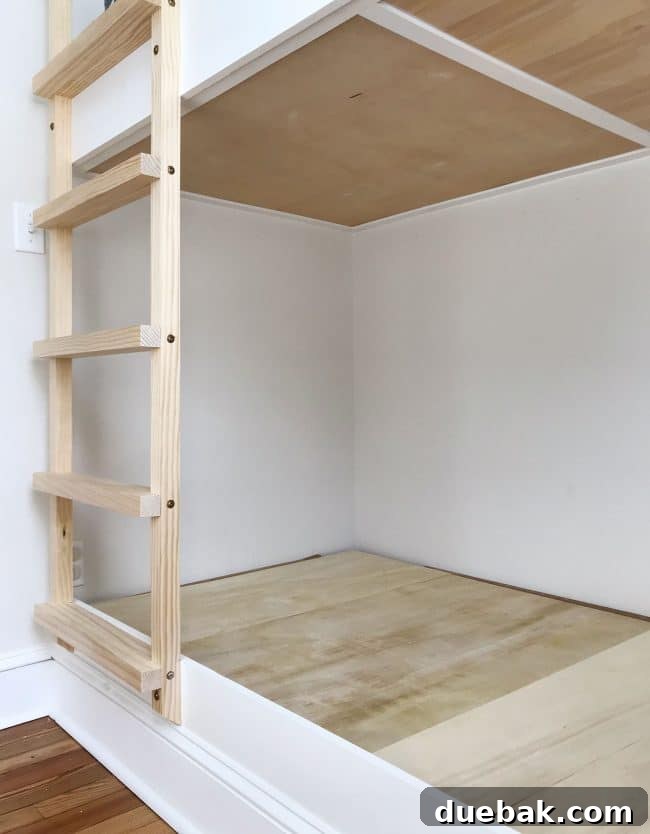
The good news is that once all the wood elements were meticulously stained, we found that the brass screw heads actually enhanced the overall aesthetic, adding a touch of rustic industrial charm that complemented the chosen wood tone beautifully. However, if this visible fastener look isn’t to your preference, you always have the option to countersink your screws, driving them slightly below the wood surface, and then filling the holes with wood putty before sanding and staining. This method allows for a completely smooth, blemish-free finish, offering full control over the visual details of your custom built-in bunk beds.
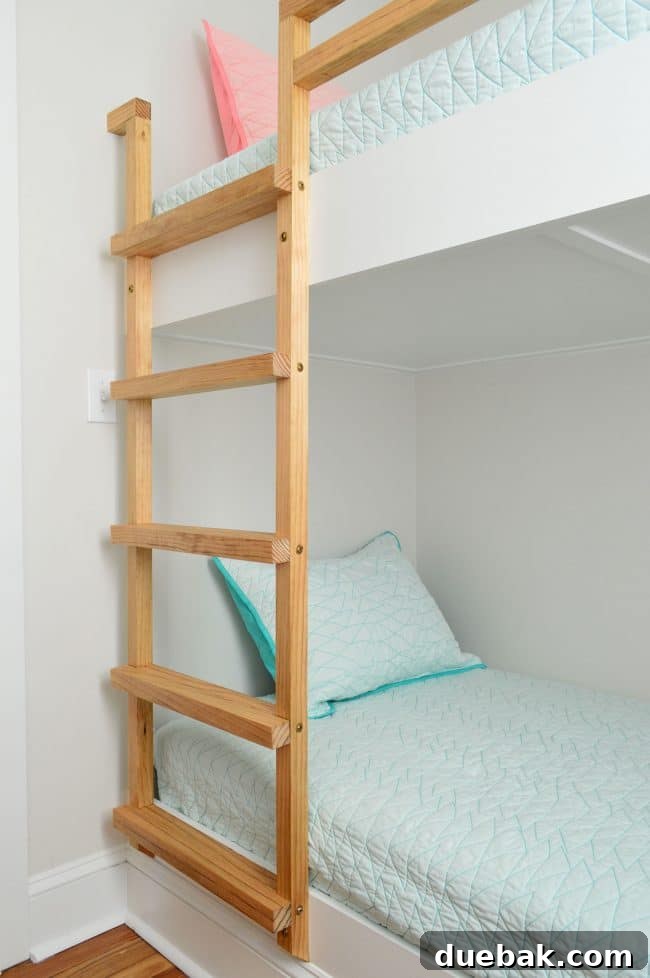
Speaking of staining, let’s delve into the process of achieving that perfect wood finish for our ladder and railings…
Step 8: Staining the Ladder and Railings to Perfection
Achieving the precise wood tone we envisioned for the ladder and railings was a crucial part of integrating them seamlessly into our beach house aesthetic. We had a very specific color in mind – one that would beautifully complement and ideally match our existing floor tones. This required a bit of experimentation. After several tests on scrap pieces of wood, diligently trying various combinations and techniques, we successfully developed a unique, multi-step process that delivered the rich, nuanced look we were striving for. This custom approach ensured the final result was exactly what we desired, adding warmth and character to the bunk room.
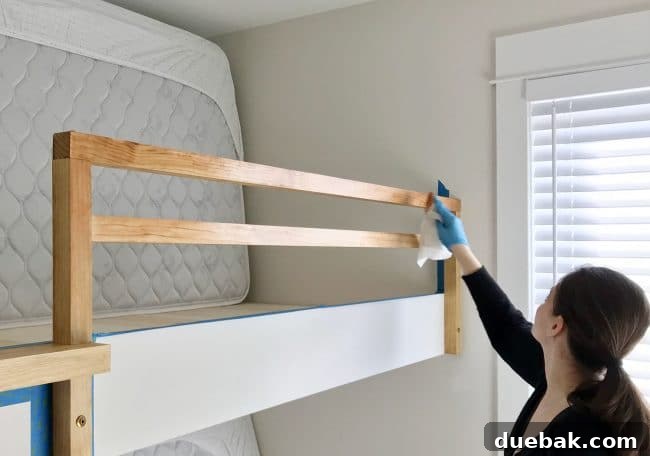
The intricate yet rewarding staining process we developed ultimately involved a comprehensive four-step application, designed to achieve depth and evenness in the wood tone:
- Pre-Stain Conditioning: We initiated the process with a thorough coat of pre-stain wood conditioner. This vital step is instrumental in preparing the wood surface, allowing for a more even absorption of the subsequent stain and significantly reducing the likelihood of blotchy or inconsistent results, particularly on soft woods like pine.
- Targeted Lighter Stain for End Grains: Next, we carefully brushed on a coat of Minwax Natural specifically onto all the raw cut ends of the wood. The end grain of lumber tends to absorb stain much more aggressively, often resulting in noticeably darker areas. By applying a lighter shade here, we counteracted this effect, ensuring a more uniform color across the entire piece.
- Primary Stain Application: Following the lighter end-grain treatment, we applied a generous coat of Minwax Puritan Pine to all other surfaces using a brush. After allowing it to set for approximately 15 minutes – crucial for proper penetration – we carefully wiped off any excess stain. This allowed the wood’s natural grain to shine through while imparting the desired foundational color.
- Final Color Adjustment for Warmth: To introduce the subtle reddish cast we desired, which was slightly lacking after the previous steps, we performed a quick, light application of Minwax Colonial Maple. This was sparingly applied everywhere using a rag, adding just enough warmth to achieve the perfect, nuanced tone that beautifully matched our floors.
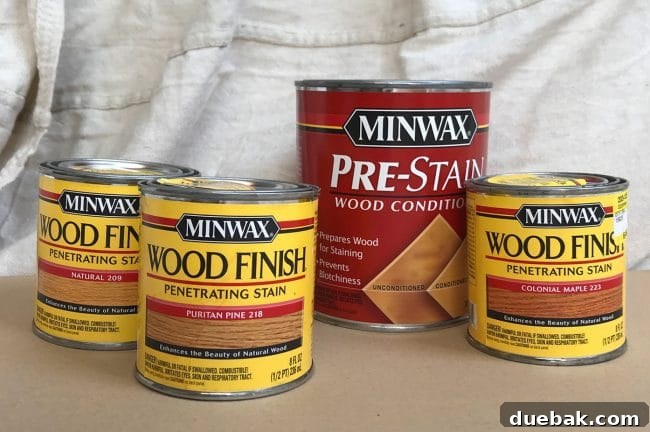
Despite the slightly involved and multi-faceted nature of this staining technique, we are genuinely delighted with the final outcome. The richness and depth of color achieved, perfectly complementing the room’s existing elements, made every step of the process worthwhile. This custom stain job truly elevates the built-in bunk beds, turning them into a polished and inviting feature within our beach house bunk room.
Step 9: The Grand Reveal – Adding Mattresses & Bedding!
With all the paint fully cured and the custom stain beautifully dry, the moment we, and especially our eager kiddos, had been waiting for finally arrived! It was time to complete the transformation of this sweet, small bunk room by adding the mattresses and all the cozy bedding. This final touch truly brought our vision for the built-in bunk beds to life, making the space instantly inviting and functional. And, of course, no family project reveal is complete without the enthusiastic approval of Burger, our beloved dog, who wasted no time in making himself at home!
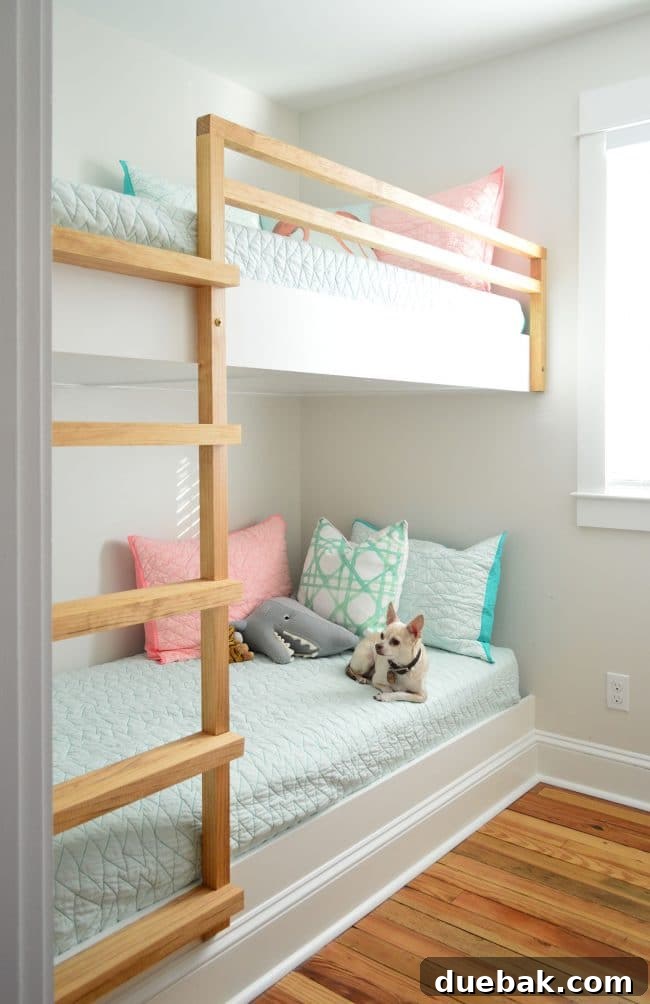
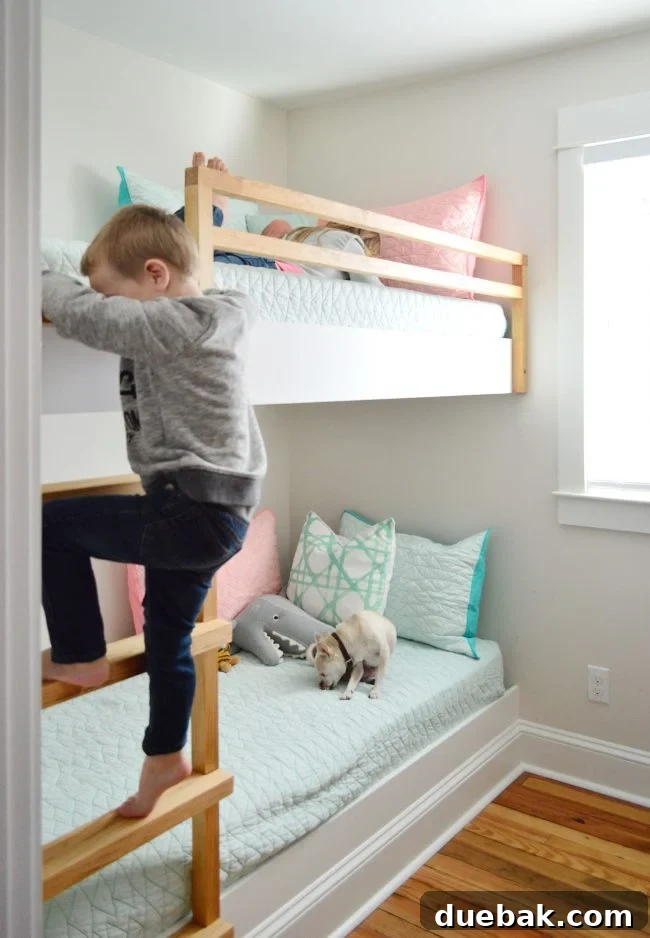
As I mentioned at the very beginning of this journey, these custom built-in bunk beds have swiftly ascended to the top of our kids’ favorite spots in the entire house. The novelty, comfort, and sheer fun factor have made them an instant hit. What’s more, our furry family member, Burger, seems to share their enthusiasm, having claimed the bottom bunk as his preferred napping spot! He even graciously joined us during our photoshoot, striking a pose before promptly settling down for a thorough grooming session – a sure sign of complete contentment. It’s truly heartwarming to see the space so well-loved by everyone, two-legged and four-legged alike.
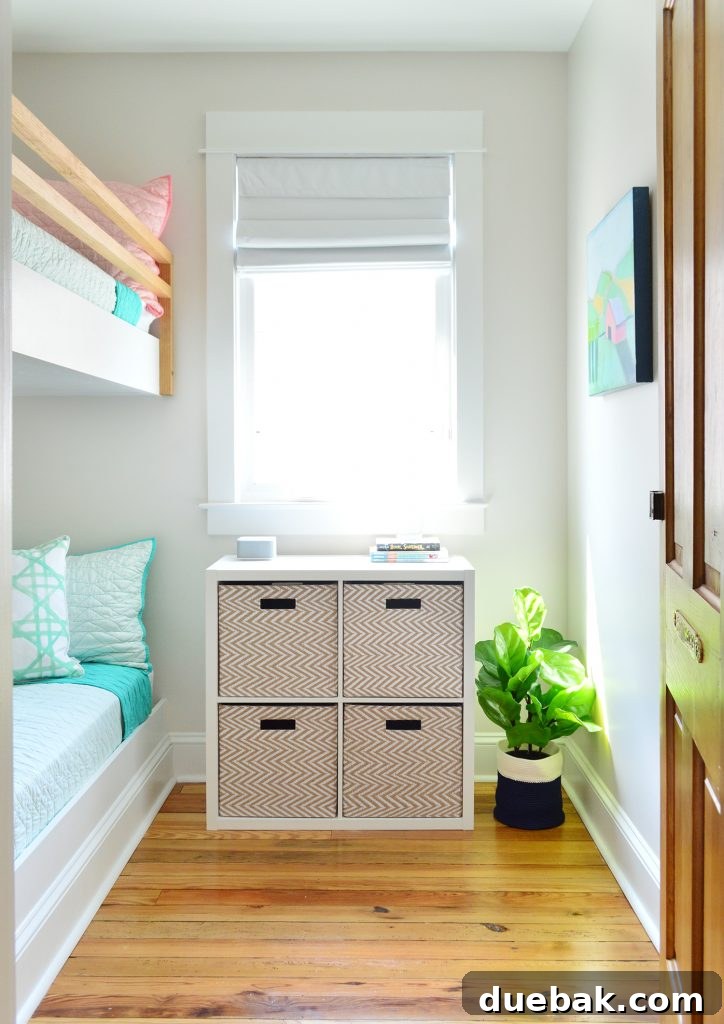
A few weeks after the successful completion of these stunning built-in bunk beds, we revisited the room to address a crucial element for any functional kids’ space: storage. We proudly introduced a compact cube organizer shelf, cleverly placed under the window. This practical addition provides designated spots for toys and clothes, ensuring the room remains tidy and organized. Given that our family primarily utilizes the beach house for weekend getaways and summer vacations, this amount of storage is perfectly ample for the children to neatly stash their belongings, contributing to a harmonious and clutter-free bunk room experience. It’s the final touch that makes the space not just beautiful, but truly livable.
Comprehensive Final Measurements for Our Built-In Bunk Beds
As promised, for those of you planning your own custom built-in bunk bed project, here are the detailed final measurements that guided our construction, conveniently compiled in one place for your reference. These dimensions accommodate twin XL mattresses and are designed to maximize comfort and safety within a compact footprint:
- Platform Dimensions: Both the upper and lower platforms measure 81.5 inches in length by 40 inches in width. These dimensions are specifically tailored to comfortably accommodate an 80 x 38-inch twin XL mattress, ensuring a snug and secure fit.
- Bottom Bunk Configuration: The top surface of the bottom bunk platform sits 10 inches off the ground. With a standard mattress, this places the mattress top at approximately 17 inches from the floor, providing a generous 34.5 inches of comfortable headroom for the occupant.
- Top Bunk Configuration: The top surface of the upper bunk platform is positioned 56 inches off the ground. This results in the mattress top being around 63 inches from the floor, with 32.5 inches of headroom – a height thoughtfully chosen to balance comfort with safety, discouraging standing.
- Ladder Specifications: Each individual ladder rung is 18 inches wide, making the entire ladder assembly 21 inches wide from outer edge to outer edge. The rungs are precisely spaced 12 inches apart from the top of one rung to the top of the next, ensuring comfortable and consistent climbing.
- Top Railing Dimensions: The safety railing for the top bunk extends 7 inches above the top surface of the mattress (exceeding the required 5-inch safety standard). A thoughtful 3-inch gap is maintained between the two horizontal railing bars, providing security while maintaining an open feel.
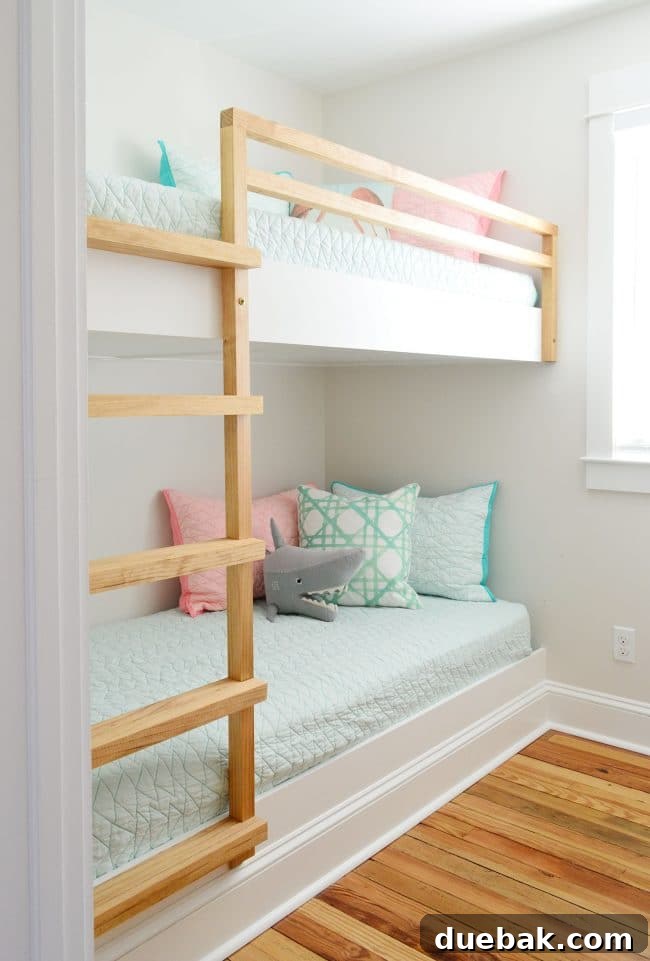
Reflecting on the entire journey, I can confidently say that the process of building these custom built-in bunk beds was approximately 88% less nerve-wracking than anticipated. Compared to monumental tasks like constructing an entire deck or installing a complex irrigation system, this project felt almost like child’s play. And that, my friends, is an exceptionally good thing! Our most recent renovation plans for a duplex include a similar compact space perfectly suited for DIY bunk beds. This means we may very well have two more sets of these fantastic bunks in our future. It looks like it’s time to stock up on my weight in those incredible gold structural screws!
P.S. For those inspired by this built-in furniture project and eager to explore more of our custom builds and clever furniture hacks over the years, you might find these related posts particularly engaging:
- Creating Functional Built-in Pantry Shelves
- DIY Storage Shelves for a Shed or Garage
- Installing Floating Shelves in Our Bonus Room
- Building Wall-To-Wall Bookshelves Around a Doorway
*This post contains affiliate links, which means we may earn a small commission on purchases made through these links at no extra cost to you. We only recommend products we genuinely use and love.*