
Transform Your Home: A Comprehensive DIY Guide to Building Stunning Built-In Bookshelves Around a Doorway
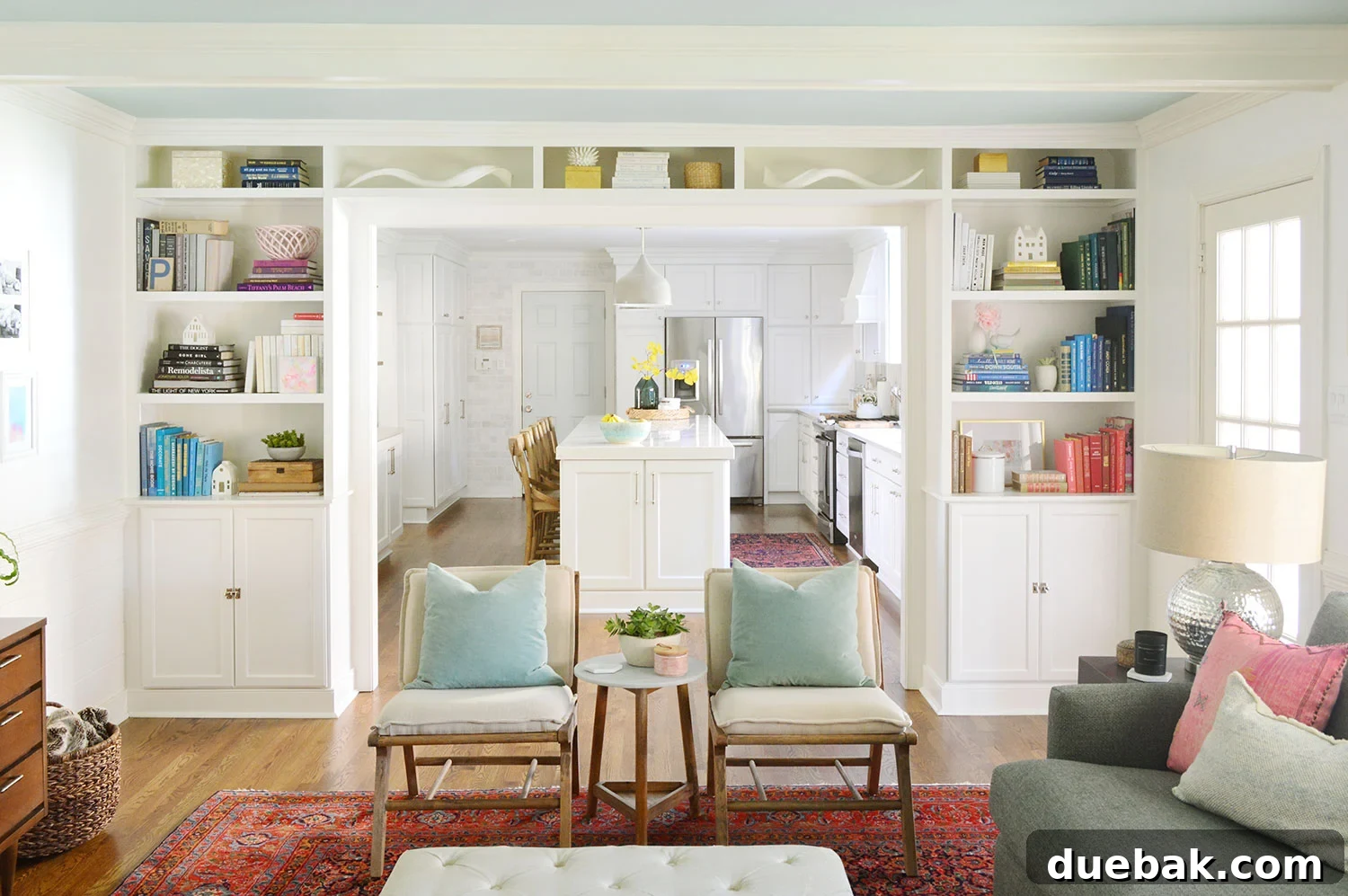
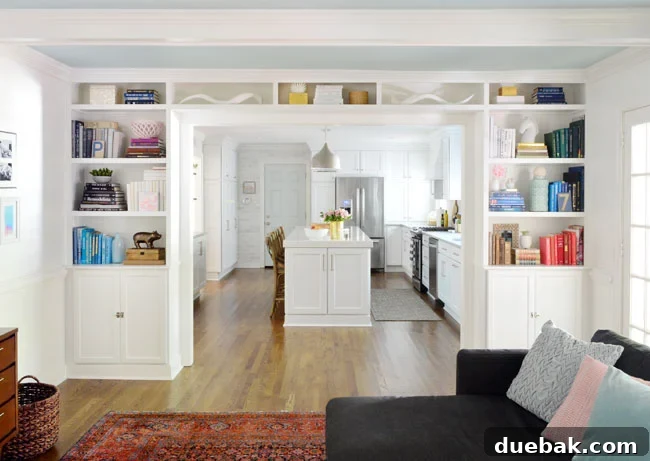
Achieving the classic, elegant look of custom floor-to-ceiling shelving around a doorway might seem like a daunting task, reserved only for seasoned professionals. However, this detailed DIY tutorial proves that adding built-in bookshelves is far simpler than it appears, making this aspirational design feature accessible to any enthusiastic homeowner. We meticulously planned and integrated these beautiful bookcases as a cornerstone of our extensive kitchen remodel, and frankly, they’ve become my absolute favorite part of the entire home transformation.
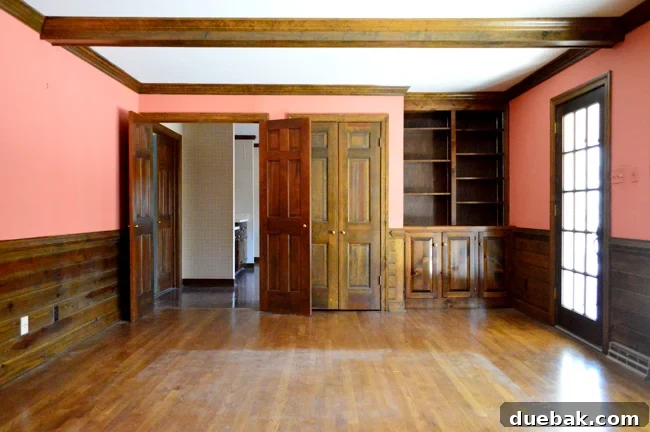
This particular wall once housed a more traditional, freestanding bookcase, as evident in its prior state. However, during our renovation, we embarked on a significant demolition and reframing project to create a more open and cohesive flow into the adjacent kitchen area. This modification provided the perfect canvas for our vision of integrated shelving.
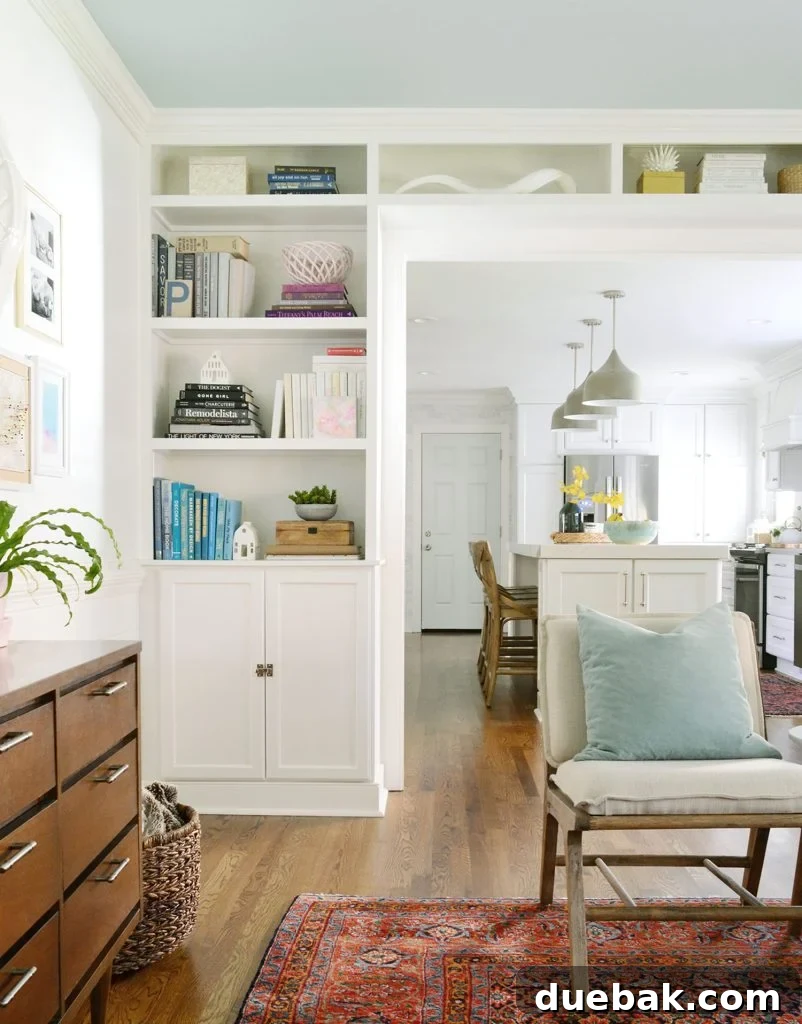
Beyond providing a step-by-step building tutorial, this guide will also furnish you with all the essential measurements and considerations required to achieve optimal shelf height and depth. This ensures your new built-ins not only look fantastic but also offer maximum functionality for showcasing your cherished books, decorative accents, and personal treasures. Prepare to elevate your home’s aesthetic and storage capabilities with this rewarding DIY project!
Table of Contents
Tools & Materials for Built-In Bookshelves
Embarking on a built-in bookcase project like this one is a rewarding endeavor that typically spans several days, demanding patience and a keen eye for detail. While the timeline might suggest complexity, the actual construction process is surprisingly straightforward, requiring only fundamental DIY skills. To ensure a smooth and efficient build, gather the following tools and materials before you begin:
- Stock cabinets for bases: These pre-built units significantly simplify the foundation of your bookshelves, offering a quick and sturdy start.
- 1/2″ MDF for the shelves: Medium-density fiberboard (MDF) is an excellent choice for shelves due to its smooth surface, stability, and ease of cutting, providing a superior paint finish compared to plywood.
- 1×2″ and 1×4″ pine for facing: These pine boards will be used to create the professional-looking trim and face pieces, giving your shelves a substantial and polished appearance.
- 2×4″s and scrap wood for miscellaneous blocking: Essential for structural support, leveling, and creating necessary depth behind cabinets or between walls.
- Baseboard and crown molding: These finishing touches integrate your built-ins seamlessly with your existing room trim, enhancing their custom look.
- Measuring tape: An indispensable tool for precise measurements, critical for accurate cuts and a flush fit.
- Stud finder: Absolutely crucial for locating wall studs, ensuring your built-ins are securely anchored to the structural framing of your home.
- Long level: Vital for ensuring all shelves and vertical panels are perfectly straight and plumb, preventing a crooked appearance.
- Clamps: Handy for holding pieces together securely while glue dries or during fastening, preventing movement and ensuring accurate assembly.
- Nail gun with finish nails: Speeds up assembly and leaves small, easily concealable nail holes for a professional finish.
- Miter saw: Perfect for making precise angled cuts for trim and molding, as well as straight cross-cuts for shelving components.
- Table saw or circular saw: Essential for ripping larger sheets of MDF or plywood down to the required widths for your shelves and panels.
- Power drill/driver: For pre-drilling holes and driving screws to secure structural components.
- Wood glue: Provides extra strength and stability to joints, creating a more robust and lasting structure.
- Paintable caulk: For filling gaps and seams, achieving a seamless, professional, and built-in look.
- Primer & paint: The foundation and final color for your bookshelves, ensuring durability and a beautiful finish.
- Painting supplies: Brushes, rollers, paint trays, and painter’s tape for a clean and efficient painting process.
Step 1: Plan Your Bookshelf Design
Thorough planning is undoubtedly the most critical stage in any successful DIY building project, and built-in bookshelves are no exception. Begin by meticulously taking measurements of your designated space. Record these measurements carefully in a notebook or, even better, create a detailed rough sketch. In our case, this blank wall represented the starting point for our ambitious project.
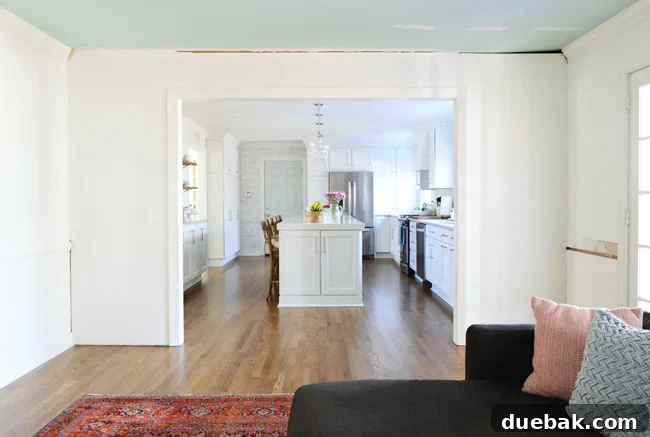
You might already have a clear vision for your built-ins, or you may need to dedicate some time to browsing design blogs and Pinterest for inspiration. Pay close attention to various elements: shelf spacing that accommodates different book sizes and decorative objects, intricate trim details, appealing paint colors, and the specific types of items displayed on shelves that captivate your eye. For us, our inspiration was loosely drawn from the elegant built-in bookcases found in our second house, which offered a proven aesthetic we wanted to recreate.
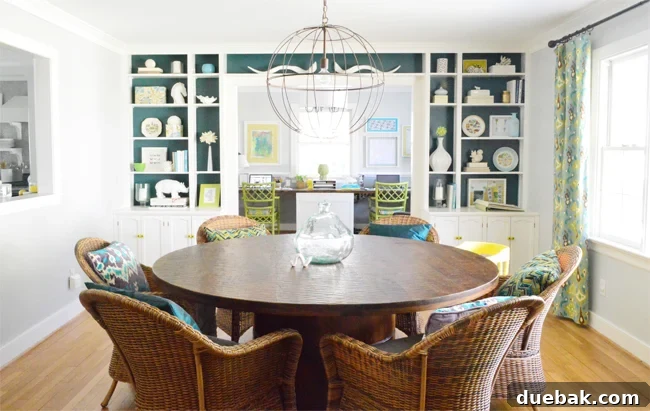
With that inspiring image firmly in mind, we were able to translate our vision into a detailed sketch, complete with precise measurements. This crucial step allowed us to begin accurately estimating the quantity of materials we would need to purchase, ensuring efficiency and minimizing waste. More on material procurement will follow in later sections!
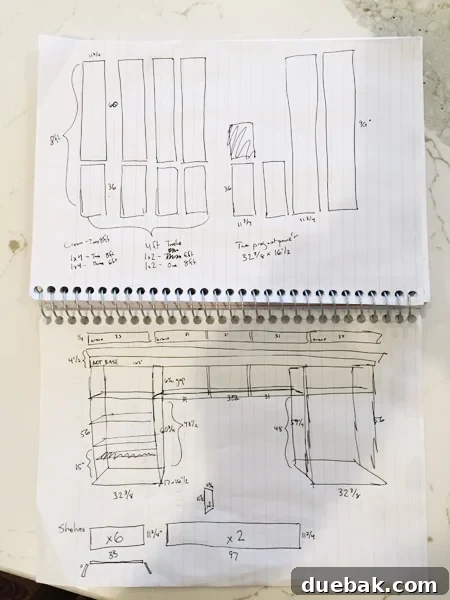
While some prefer sophisticated tools like Photoshop or 3D CAD software for design mock-ups, a simple pen and paper can be incredibly effective, as our experience demonstrates. We even employed blue painter’s tape directly on the wall to double-check our shelf spacing measurements during the build, allowing us to visualize and adjust before making any permanent cuts. As you can see below, we debated between two spacing options and ultimately opted for the one on the right, which offered a more balanced aesthetic and practical functionality.
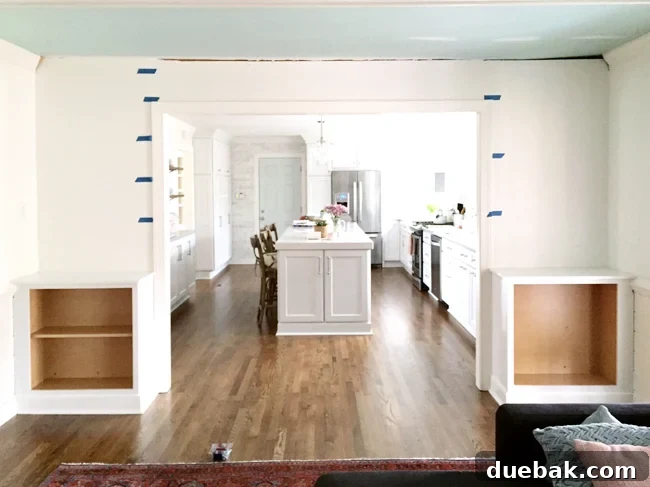
In short, never underestimate the power of a comprehensive planning process. Investing time upfront will save you countless hours, prevent potential headaches, and minimize unnecessary trips to the home improvement store, ultimately leading to a more satisfying and successful project.
Step 2: Build In Your Bases
For the foundation of our built-ins, we specifically desired closed cabinet storage to neatly conceal items like cherished old photo albums and yearbooks, keeping clutter out of sight. Conveniently, these 30″ x 30″ stock upper cabinets from Home Depot proved to be an almost perfect fit, offering an easy and budget-friendly starting point for this ambitious build.
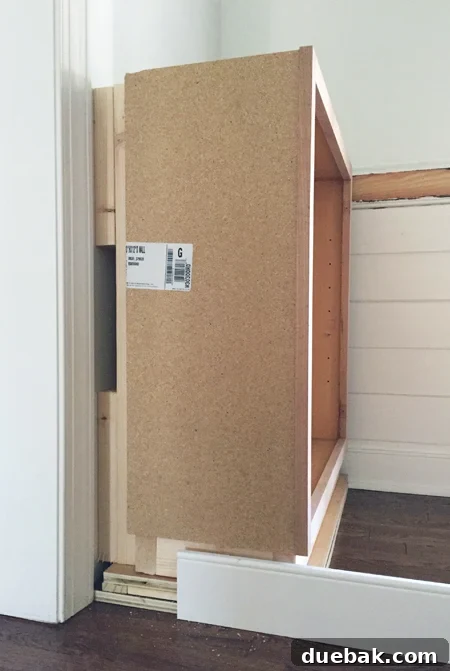
A common characteristic of upper cabinets, however, is their typical 12″ depth. While standard bookcases often range from 10-12″ deep, we envisioned our shelves to be a more generous 13″ deep to comfortably accommodate larger books, substantial decorative objects, and even small storage bins. To achieve this desired depth, we strategically added two layers of 2×4″ blocking directly against the wall behind each cabinet. This simple yet effective modification extended the cabinet depth to perfectly align with our design. We securely attached this blocking into the wall studs using robust 2.5″ wood screws, ensuring a stable and long-lasting foundation.
You’ll also observe in the photograph below that additional blocking was utilized under the cabinet. This clever technique serves a dual purpose: it elevates the cabinet slightly, allowing for the seamless installation of matching baseboard trim around the bottom without obstructing the cabinet doors’ operation. Typically, a single 2×4″ piece suffices for this elevation. However, in our specific scenario, we aimed to meticulously match the exact height of the room’s existing wainscoting. This required a bit more ingenuity and improvisation, necessitating the use of various scrap plywood pieces to achieve the precise desired height for a truly integrated look.
While the blocking arrangement depicted above might appear a bit unconventional, rest assured it will all be beautifully concealed. We utilized these unfinished end panels to neatly cover all the exposed blocking, providing a clean and finished look. Additionally, I securely nailed a 1 x 2″ piece along the very bottom edge of the cabinet. This small but crucial addition provides a solid surface for the baseboard to rest against along the front, ensuring a flush and professional installation. And yes, those are matchbox cars you see inside – the joys of building with toddlers around, right?
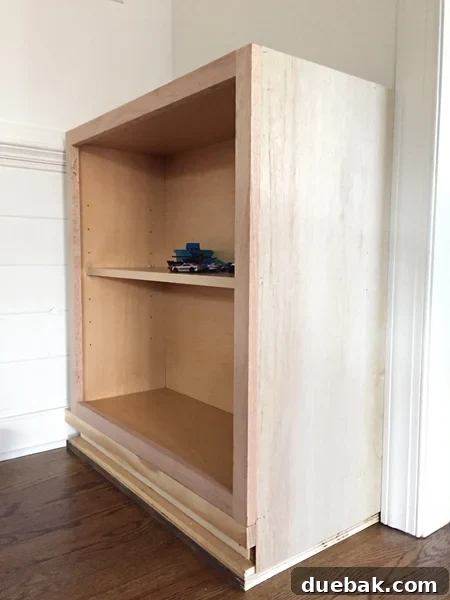
Depending on your wall and cabinet dimensions, you may also find it necessary to incorporate filler pieces between your cabinet and the adjacent wall to seamlessly close any unsightly gaps. We opted for some stock filler pieces for a perfect match, but any suitable wood plank could be cut to size and used effectively for this purpose.
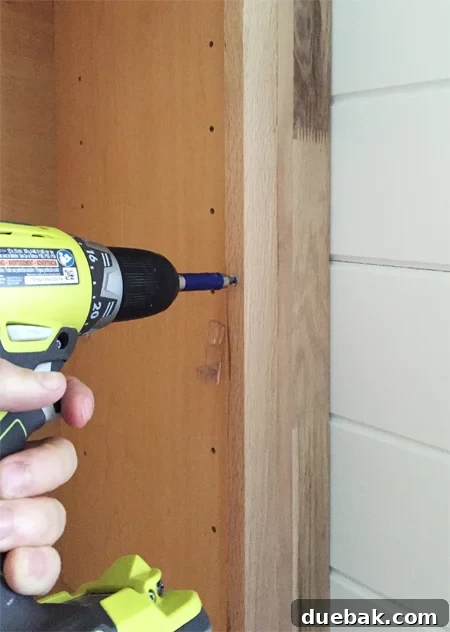
To finalize the cabinet bases, our next step involved precisely cutting and installing baseboard trim to wrap around the bottom of each cabinet. Utilizing a miter saw for accurate angle cuts and a nail gun for secure attachment, this step is crucial for giving the bases a truly built-in, furniture-grade appearance. The only thing not strictly required for this step is an adorable toddler – though they certainly make for charming company!
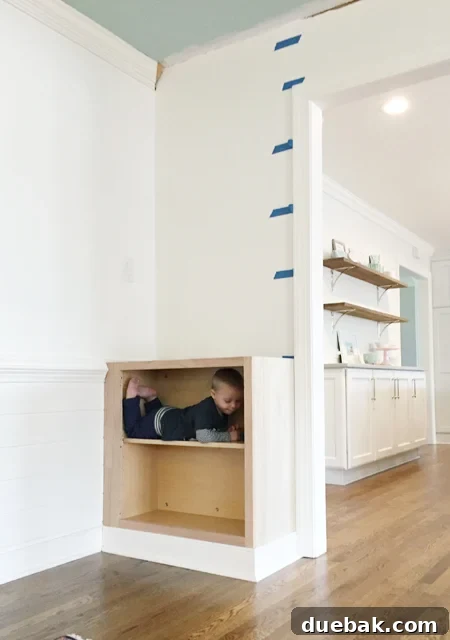
Here’s a visual update of our progress with both cabinet bases now fully installed. It’s important to note that these cabinets originally came equipped with doors and interior shelves. We temporarily removed these components, as it significantly streamlined the installation process and allowed for easier access during construction.
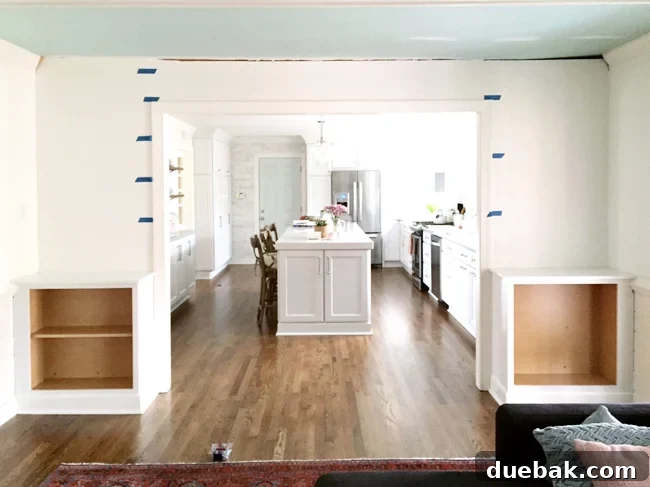
This initial setup also cleverly paved the way for our subsequent step, making the entire workflow more efficient and manageable…
Step 3: Prime & Paint Your Components
Before diving into the full construction of your built-in bookshelves, we’ve found it immensely more efficient and practical to prime and paint your shelving components first. This means handling them while they’re still flat on the ground, before assembly. While cuts don’t necessarily need to be absolutely precise at this stage, we did make sure to rip all of our MDF sheets to their approximate final sizes before applying any finishes. I’ll elaborate on the cutting process in due course.
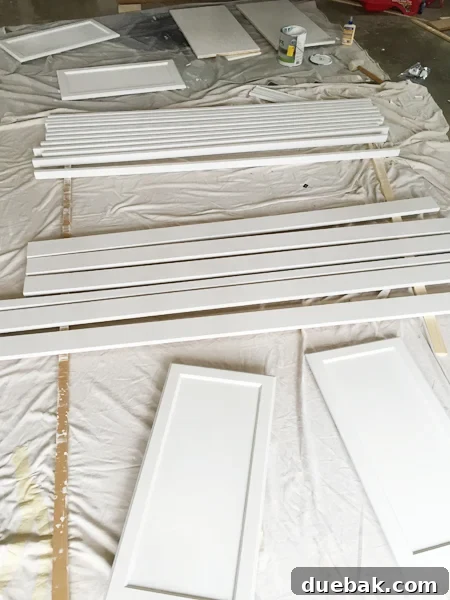
Although you’ll still need to perform touch-ups after assembly, pre-painting allows you to apply most of your coats with a roller, minimizing the risk of drips, paint pooling in corners, or the tedious task of meticulously brushing into tight nooks and crannies once the structure is built. As you can observe, we simultaneously painted the cabinet doors, the individual shelves, and all the facing pieces. We chose “Simply White by Benjamin Moore” in a semi-gloss finish, a color that perfectly matches the existing trim throughout the room, ensuring a cohesive and professionally integrated look for our new built-ins.
Step 4: Construct Your Side Shelves
For the open bookshelf sections themselves, we adopted a proven construction method previously used for our son’s built-ins. While that linked post offers more in-depth detail, I’ll provide a comprehensive overview of the process here. We meticulously constructed these open shelves using 1/2″ MDF panels. MDF is an ideal material choice because it’s remarkably easy to cut and consistently provides a smoother, more refined finish when painted compared to traditional plywood, which often shows grain patterns.
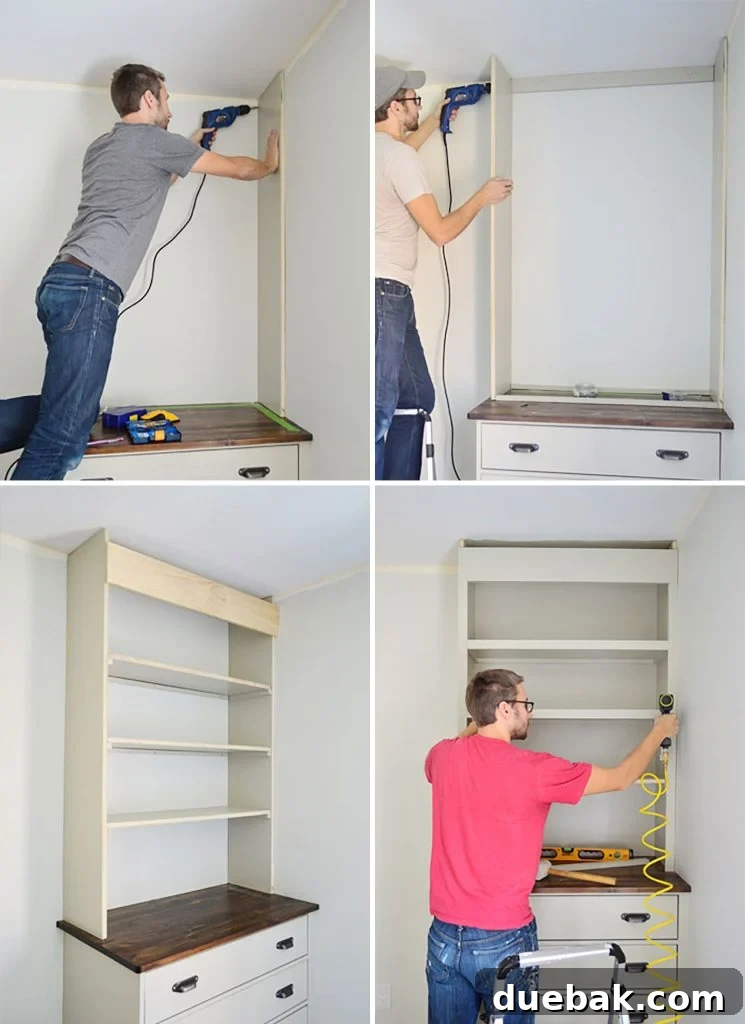
The construction of the open bookshelves proceeds as follows:
- Screw one MDF vertical panel directly into the side wall: Ensure this panel is plumb and securely fastened to studs for maximum stability. This forms the outer boundary of your first bookshelf unit.
- Add a 1×4″ brace piece to the back wall across the top: This horizontal brace provides crucial support and a sturdy anchor point for the opposing vertical panel. It should be level and firmly attached to studs.
- Screw a matching MDF vertical panel on the other side into the brace piece: This completes the basic frame of your first bookshelf section, creating the interior dividing wall. Verify it’s parallel to the first vertical panel.
- Add another brace piece across the front of the shelves: This piece, typically a 1×4, runs horizontally along the front top of your bookshelf unit, adding rigidity and serving as a mounting point for decorative trim.
- Rip 1×1″ strips of pine on a table saw to create shelf supports: These thin strips will be glued and nailed along the interior sides and back of your bookshelf unit, providing a strong, hidden ledge for your shelves to rest upon. Consistent dimensions are key here.
- Wherever you want a shelf, nail support strips on 3 sides: Carefully measure and mark the desired shelf heights. Attach the support strips firmly with wood glue and finish nails on the back and both side vertical panels. Ensure these strips are perfectly level across all three points.
- Add MDF shelves: Once the support strips are in place and the glue has dried, slide your pre-cut MDF shelves into position. You can optionally secure them with a few small finish nails from underneath into the support strips for added stability.
- Nail and glue 1×2″ face pieces on all exposed edges: This final step transforms the raw edges into thick, finished-looking trim, making your built-ins appear custom and high-end. Apply wood glue to the edge and secure with finish nails, ensuring clean alignment.
I understand this is a concise overview, so for more exhaustive instructions and visual aids, please don’t hesitate to consult this in-depth tutorial. After applying this method to construct both side bookshelf units (excluding the final face pieces at this stage), we successfully created this integrated framework around our doorway, establishing the robust foundation for our floor-to-ceiling vision.
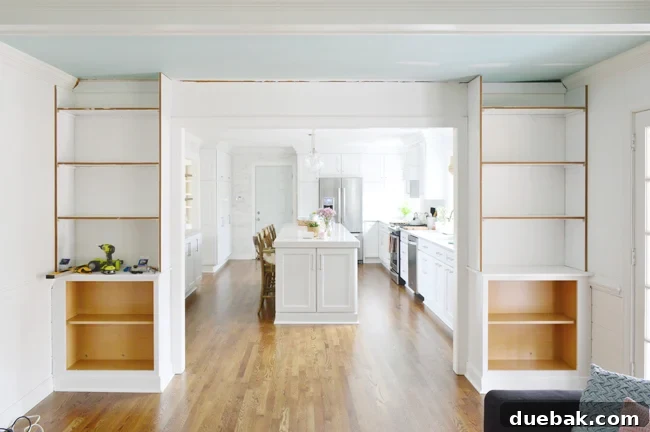
While the side sections felt like familiar territory, the real design and construction challenge – and indeed, the exciting new frontier for this project – lay in the subsequent step: successfully spanning a substantial shelf across the cased opening of the doorway itself!
Step 5: Add The Shelf Across The Doorway
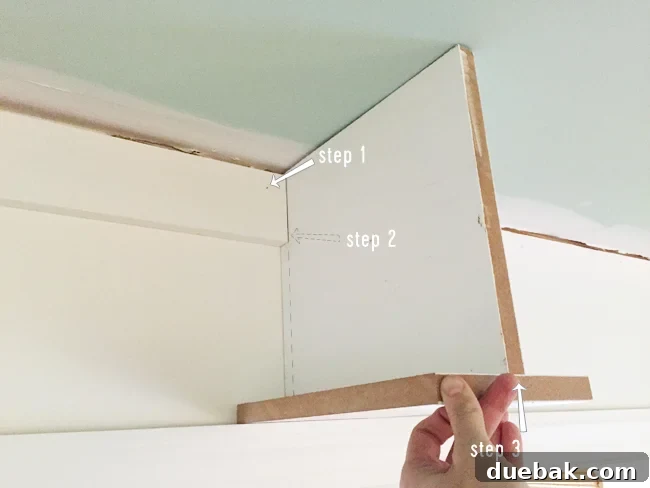
Building the expansive middle shelf that spans gracefully over the doorway required a strategic approach, leveraging every available surface for secure attachment and adding supplementary blocking for enhanced stability. My process began by installing sections of 1×4″ “header” boards across the back wall (STEP 1). These sturdy horizontal pieces served as a reliable anchor, providing a solid edge to precisely nail the vertical divider panels into (STEP 2). Once these vertical dividers were firmly in place, I could then confidently screw the bottom of the shelf into them from below (STEP 3). You can visualize this foundational mock-up of the structure below.
As the construction progressed from mock-up to reality, I found it beneficial to incorporate an additional scrap piece of wood directly onto the ceiling above the doorway. This piece proved invaluable, serving two key functions: it helped to maintain perfect squareness throughout the structure, which is crucial for a professional look, and it provided an excellent surface for securely attaching the final decorative facing and crown molding later on. As highlighted by the arrows in the photo below, I also cleverly utilized the existing door casing as supplementary support for the underside of this spanning bottom shelf, screwing components together at multiple points for maximum strength and rigidity.
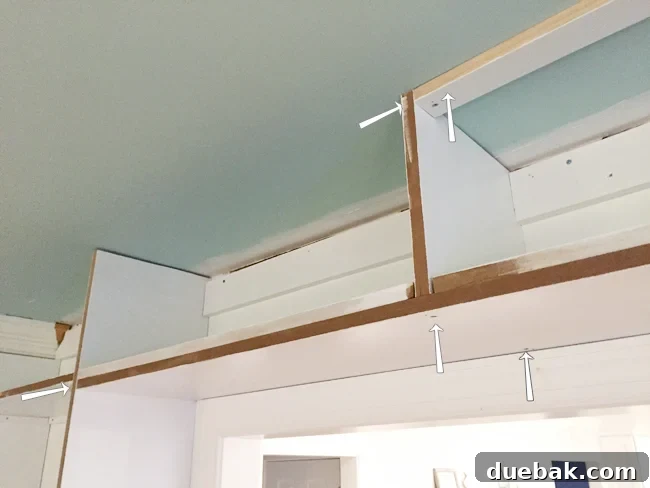
It’s also worth noting from the image above that the shelves installed directly over the doorway are effectively “doubled up.” This intentional design choice serves a specific aesthetic purpose: once the 1×2″ face piece is applied, these particular shelves will appear perfectly flush on both their top and bottom surfaces. In contrast, most other shelves throughout the built-ins feature a small lip on their bottom edge (created by the support strips). Eliminating this lip on the overhead section ensures a clean, uninterrupted line, which is particularly desirable in an area that will be frequently walked under, maintaining a smooth and integrated appearance.
Step 6: Nail In Your Face Pieces
The penultimate step in achieving that coveted custom, high-end aesthetic is the careful application of the 1×2″ pine face pieces. These pieces, ideally already primed and painted from Step 3, are designed to meticulously cover all the raw, unfinished front edges of your MDF shelves and vertical panels. This vital addition not only gives your built-ins a significantly tidier and more polished appearance but also ingeniously creates the illusion that your shelves are twice as thick and substantial as they actually are, elevating the overall visual impact of your project.
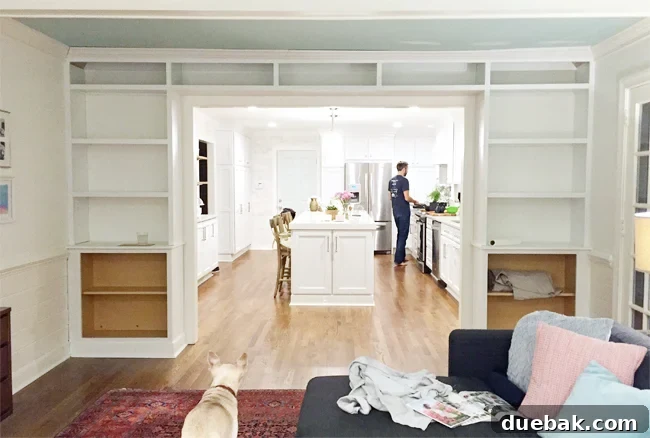
For a more comprehensive, step-by-step breakdown of this crucial finishing process, including tips for seamless joints and perfect alignment, we highly recommend referring back to this detailed tutorial. Mastering the installation of these face pieces is key to transforming your DIY project into a professional-looking masterpiece.
Step 7: Caulk & Touch-Up Paint
Finally, to achieve that truly seamless, professional, and built-in aesthetic, you’ll want to dedicate time to applying paintable caulk and wood filler. Essentially, anywhere two pieces of wood meet, or where nail holes are visible, a thin, consistent bead of caulk or a dab of wood filler should be meticulously applied. This process effectively fills all minor gaps, imperfections, and seams, giving your built-in bookshelves the flawless, integrated look they deserve, as if they were always part of your home’s original architecture.
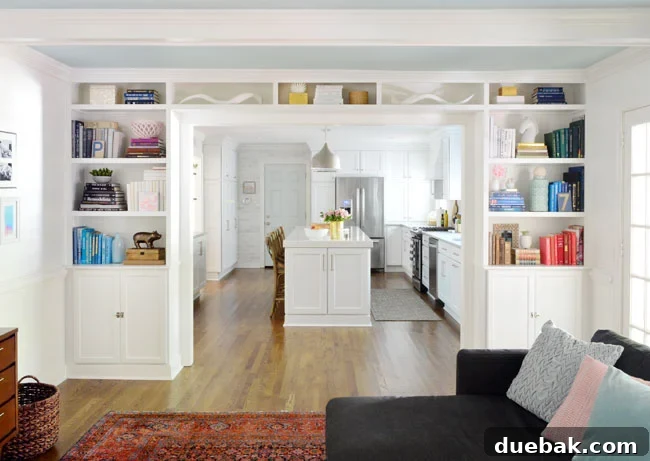
Once your caulk has fully dried – typically within a few hours, but always check product instructions – it’s time for the final touch-up paint application. This step should be relatively quick, using a good quality brush to carefully paint over all the caulked seams and filled nail holes. It’s also an opportune moment to address any scuffs, marks, or minor imperfections that may have occurred during the construction process. While this might feel like a repetitive step after your initial priming and painting in Step 3, trust us: a quick, targeted pass with paint now is far simpler and yields much better results than trying to apply multiple coats of primer and paint over assembled gaps later. This final stage is crucial for that polished, showroom-ready finish.
Step 8: Let Cure & Decorate!
Even after the paint feels dry to the touch, it undergoes a crucial “curing” period where it hardens completely and achieves its maximum durability. This process can extend for several days, or even weeks depending on humidity and paint type, so exercising patience is paramount before you begin loading up your brand-new built-in bookshelves. We understand the excitement – we felt it too! To err on the side of caution and protect our freshly painted surfaces, we patiently waited a full 10 days before placing any decor. This ensured the paint was thoroughly cured, significantly reducing the likelihood of scrapes, scuffs, or unwanted impressions being left in the still-soft coating. Allowing adequate cure time is a small investment that preserves the beauty and longevity of your hard work.
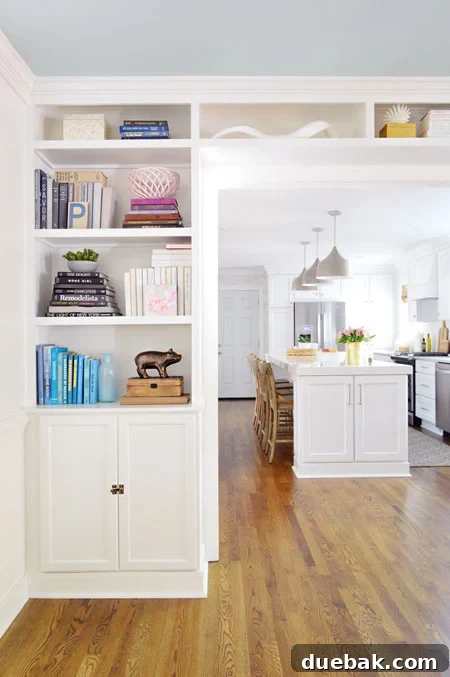
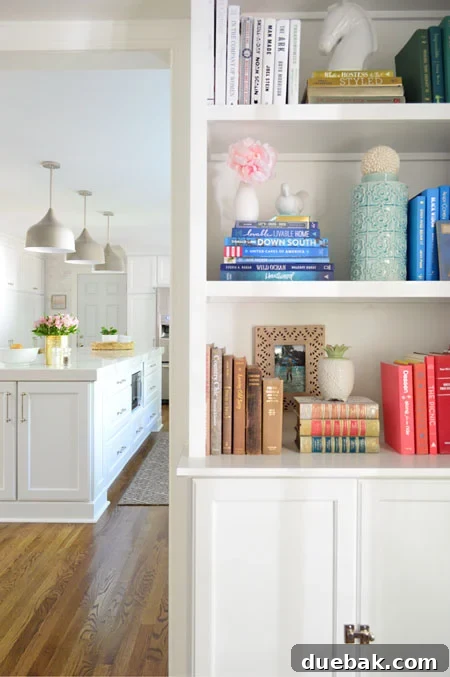
For a wealth of inspiration and practical advice, you can delve into our dedicated tips for decorating bookshelves. Generally, our approach involves curating a dynamic mix of books, stacked in various orientations to add visual interest, interspersed with thoughtfully chosen decorative objects. Our final shelf measurements of 15″ high and 13″ deep proved to be incredibly versatile, allowing us to display a significant amount of items without the space feeling cramped or cluttered. We also opted for a loosely color-coded arrangement for our books – not a strict rainbow, but grouping similar spine colors together. This subtle organization technique, we find, effectively minimizes visual chaos and contributes to a more serene and curated display.
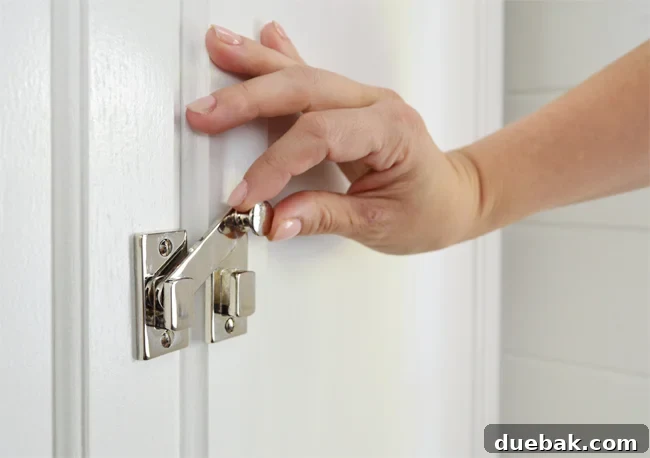
Oh, and don’t forget that crucial finishing detail: adding knobs or pulls to your cabinet doors! We discovered these charming latches online, and they provided a wonderful opportunity to introduce a unique design element, subtly differentiating them from the pulls used in our adjacent kitchen. This small choice adds character and a bespoke touch to the entire built-in unit.
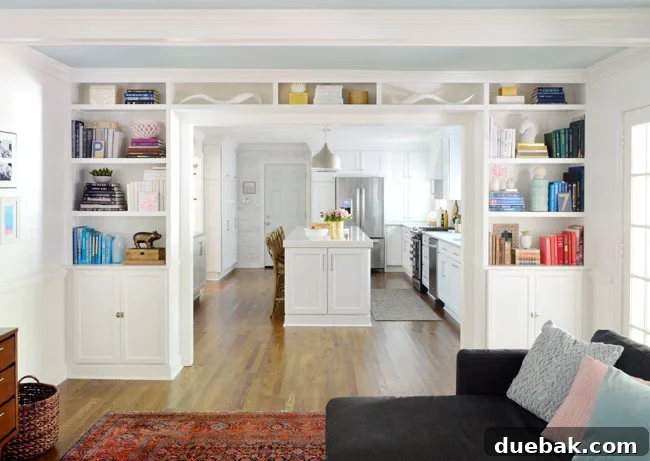
We are genuinely delighted with the spectacular outcome of these built-in bookshelves. They seamlessly integrate into the space, appearing as though they were an original feature of the house, which is always the ultimate objective for any built-in DIY project. This level of integration elevates the room’s architecture and imbues the living room with an inviting sense of warmth, coziness, and established character. Furthermore, the added storage capacity is a welcome bonus, making the space both beautiful and highly functional!
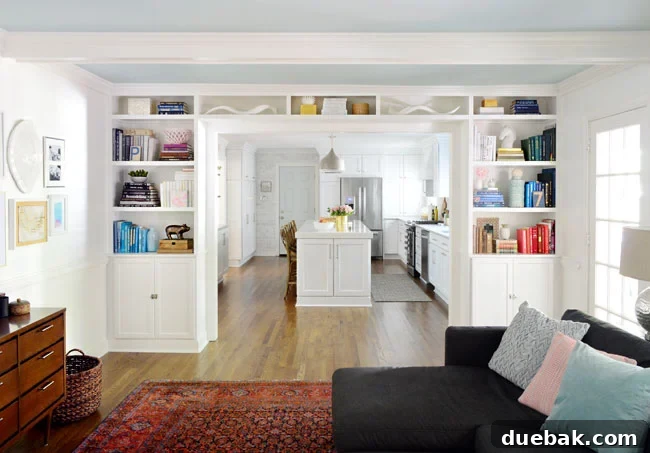
These custom shelves not only enhance the room’s architecture but also infuse the living room with a unique sense of coziness and a lived-in feel, making it truly feel like home. And, of course, the substantial increase in functional storage is an invaluable benefit!
Decorating Your Built-In Bookshelf
Now comes what many consider the most enjoyable part – or perhaps the most challenging for some: artfully filling your newly constructed built-ins! We’ve created an entire resource brimming with expert tips and clever tricks for styling a bookshelf like a pro. To provide a visual demonstration, you can also watch how we tackled decorating our friends’ built-in bookshelves in a captivating time-lapse video.
Note: You can watch the full bookshelf styling process in this video on YouTube.
More DIY Shelving Projects
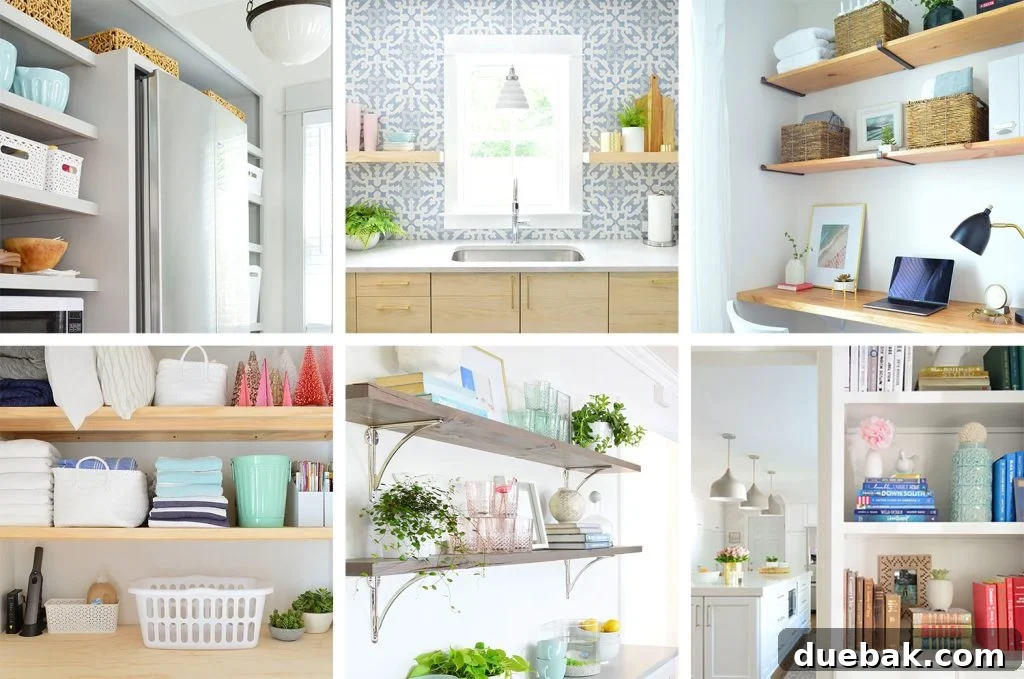
If you’re eager for even more DIY shelving inspiration and ideas, we’ve compiled a comprehensive roundup of over 15 incredible shelf projects that you can confidently build yourself. This collection offers a diverse range of styles and complexities to suit various needs and skill levels. You can even discover how we employed a very similar construction technique to the one detailed here to efficiently create highly functional kitchen pantry shelving, demonstrating the versatility of these DIY methods!
P.S. We frequently receive questions about the items in our home – specifically, “where did you get that?!” – so we’ve created a dedicated page detailing our home’s exact paint colors and a curated list of beloved items we’ve purchased and genuinely recommend. It’s a comprehensive resource for recreating the looks you love!
*This post contains affiliate links*