
The journey to creating a highly functional and organized home often begins with rethinking spaces that have become stagnant or underutilized. For many, the humble closet near the front door starts its life as the designated coat storage. This was certainly the case for us when we first moved into our home. It seemed like the most logical spot for grabbing jackets before heading out and shedding them upon return. However, as is often the case with practical household needs, the definition of a “coat closet” quickly expanded beyond outerwear to encompass a motley collection of cleaning supplies, a vacuum cleaner, a dust buster, various files, and an assortment of bags. This common scenario led to a realization: this prime piece of real estate was being used inefficiently, quickly becoming a chaotic catch-all rather than a streamlined storage solution.
Reimagining Home Storage: From Clutter Zone to Organized Oasis
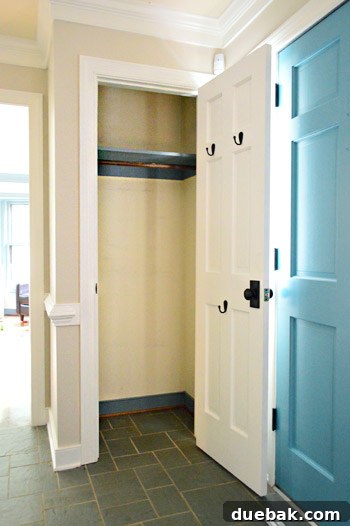
Our solution to the overflowing coat closet was surprisingly simple yet transformative. We had a deeper, more spacious closet tucked away under the stairs, conveniently located slightly closer to the garage. This made it an even more practical spot for daily coat access, not to mention a far superior location for housing the bulkier cleaning equipment and miscellaneous items that had infiltrated our front-door closet. The transition was smooth, immediately improving our daily routine and decluttering the entryway. But this shift left the front-door closet in a peculiar state: empty and without a purpose. A blank canvas, if you will, just waiting for a new assignment.
The Birth of the “Toy Library”: A Strategic Approach to Kids’ Play
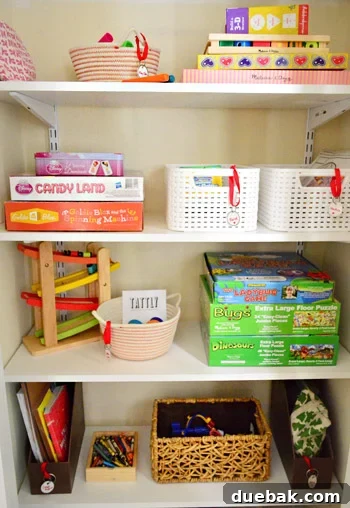
What do you do with a newly vacant closet that’s begging for a job? For us, the answer became clear: toys! Not just storing them haphazardly, but creating a system. This wasn’t merely about tidying up; it was about strategically organizing our child’s playthings to maximize engagement and minimize clutter. We recognized a common challenge many parents face: young children, especially energetic three-year-olds like our Clara, often burn through a basket of toys in mere minutes, leaving a trail of disarray and quickly losing interest. We also had specific items—like paints, markers, and Play-Doh—that required supervision, making them unsuitable for constant, open access. This confluence of needs sparked an innovative idea: a dedicated “toy library.”
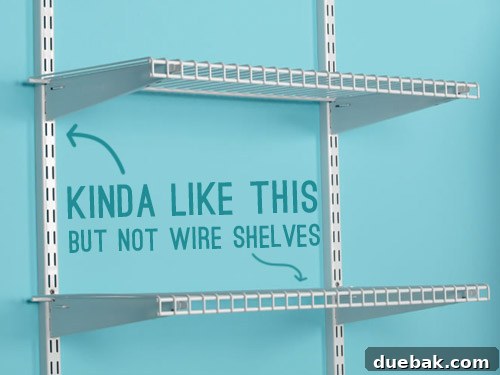
Before diving into the “why” behind this unique approach, let’s address the crucial “how” of making this closet functional. The space was essentially a void, severely lacking in the shelving department. We considered the traditional route of building fixed wooden shelves, a tried-and-true DIY method involving nailing wooden braces to the walls and resting boards on top. However, our vision for this space required something more adaptable. We wanted the flexibility to alter shelf spacing over time, accommodating toys of various sizes and evolving storage needs as Clara grows. This led us to explore adjustable shelving systems. After a bit of research at local hardware stores, we settled on a robust Rubbermaid system from Home Depot, opting for sturdy wood shelves rather than the standard wire ones for a cleaner, more substantial look and feel.
DIY Adjustable Shelving: A Step-by-Step Installation Guide
Installing the adjustable shelving system proved to be quite straightforward, though precision was paramount. The key to a successful installation, as the pun implies, is keeping your tracks perfectly straight and level. Wonky shelves not only look unsightly but can also compromise the stability of your stored items. To ensure meticulous alignment, I relied on my trusty laser level. This invaluable tool projected a precise line onto the wall, allowing me to accurately mark my drill spots. This simple step guaranteed that the tracks would be perfectly parallel and the shelves would sit nice and straight, laying a solid foundation for our toy library.
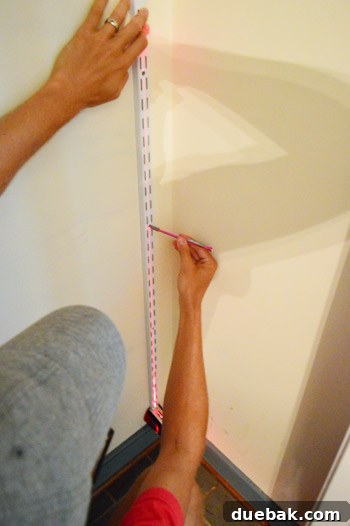
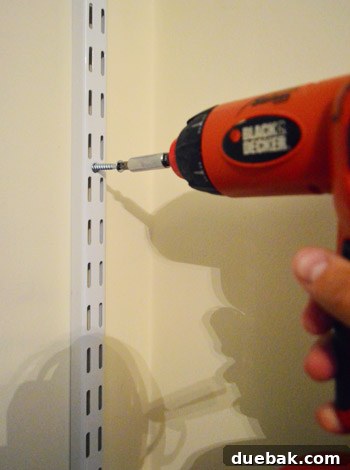
The Rubbermaid system thoughtfully includes a hardware pack, complete with all the necessary anchors and screws, making the installation process a no-brainer. After marking the drill spots with the laser level, I simply drilled a pilot hole at each location, gently tapped in the wall anchors for secure fastening, and then screwed the track firmly into place. The process was quick and efficient, building confidence with each track installed.
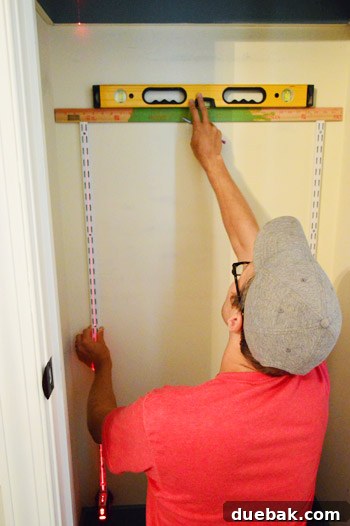
When it came to positioning the second track, maintaining perfect alignment with the first was equally critical. I double-checked the levelness meticulously, ensuring that the shelves would be horizontal across the entire width of the closet. (You might notice a bit of green slime on my yardstick in the photo; a battle scar from a memorable paint spill in the garage, a testament to the realities of DIY projects!)
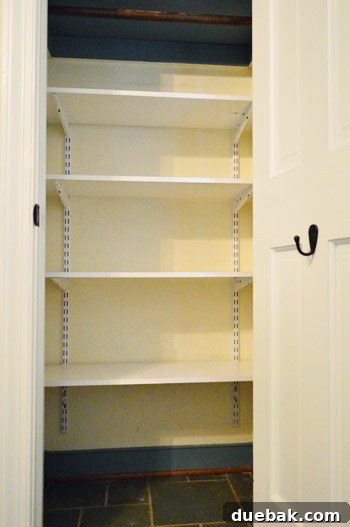
Once both vertical tracks were securely in place and perfectly level, the remaining steps were a breeze. I simply clipped the support brackets into the tracks at the desired heights, then gently rested the pre-cut wooden shelves on top. Our closet, however, presented a minor challenge: it was about an inch narrower than the standard 36-inch stock white shelves available. This meant a quick trip to the table saw for each shelf, a small but necessary adjustment to ensure a perfect, custom fit. This highlights a common DIY truth: sometimes, a little customization is required to achieve ideal results.
Budget-Friendly Brilliance: Cost and Functionality
While this shelving unit might not win any awards for being the “sexiest” piece of furniture, its functionality and value are undeniable. Considering it took me roughly an hour to install and will largely remain hidden behind a closed door, we are immensely satisfied customers. The ability to easily adjust the shelf spacing is a game-changer, allowing us to adapt the closet’s configuration as our storage needs evolve, whether for different sized toys now or for other items in the future. This flexibility dramatically increased the closet’s utility, making it approximately 89.542% more functional, a measurable improvement in our home organization efforts. The total investment was incredibly modest for such a significant organizational upgrade:
- Four 12″ x 36″ shelves: $14
- Eight 12″ brackets: $28
- Two 48″ twin tracks: $13
- Two hardware packs: $4
- TOTAL: $59
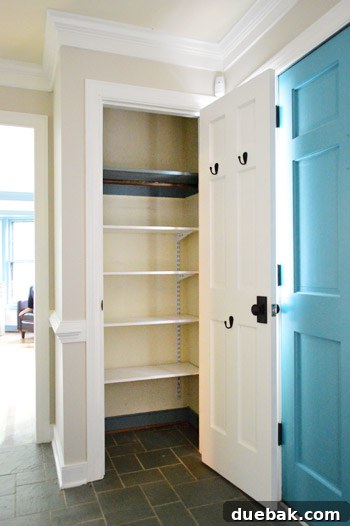
With the physical “construction” complete, the aesthetic touches were next. Sherry, with her keen eye for detail, gave the existing blue shelf and baseboard a fresh new look with a couple of coats of white primer and paint. This simple step instantly brightened the interior and gave the closet a clean, cohesive feel. Once everything was dry, it was time for the exciting part: loading in Clara’s toys, neatly arranged and ready for their new life in the “toy library.”
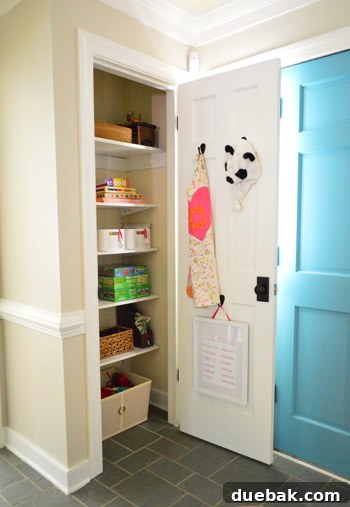
The “Toy Library” Concept: Cultivating Curiosity and Order
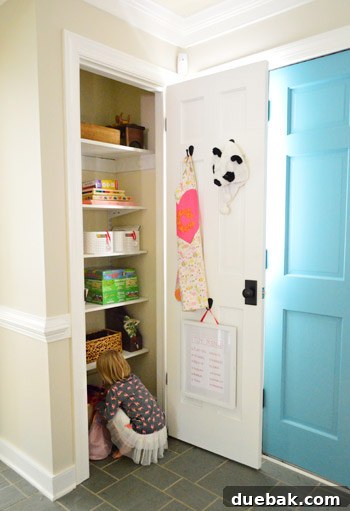
We anticipate that some of you might be scratching your heads, wondering about the unconventional placement of a toy closet in the foyer. Or perhaps the fact that many items are deliberately out of a child’s reach. And yes, where does one acquire such an adorable panda hat? Hold onto your thoughts, because the “why” behind our “toy library” is rooted in child psychology and practical organization.
Clara, at her current age, exemplifies a common developmental stage where a few favorite toys (like her play kitchen or dolls) might hold her interest, but the vast majority of readily available items often become a chaotic “three-year-old tornado” scenario. An entire basket of cars, balls, puzzles, and games can be “burned through” and scattered in a mere five minutes. Furthermore, certain activities, such as painting, using markers, or playing with Play-Doh, require adult supervision. Thus, these items need to be kept out of constant reach. This is precisely where the “toy library”—a strategic system for managing and presenting toys—comes into play.
Our approach allows us to keep a curated basket of Clara’s absolute favorite toys accessible in a few key play areas, alongside larger items like her dollhouse. However, the bulk of those “easily-dumped-and-ditched” items are now stored in the closet. The premise is simple: when toys are not always under her nose, jumbled in an easily accessible basket, they feel more special, more exciting, and their novelty is preserved. This central location in the foyer, incidentally, turned out to be remarkably convenient for retrieving and returning items.
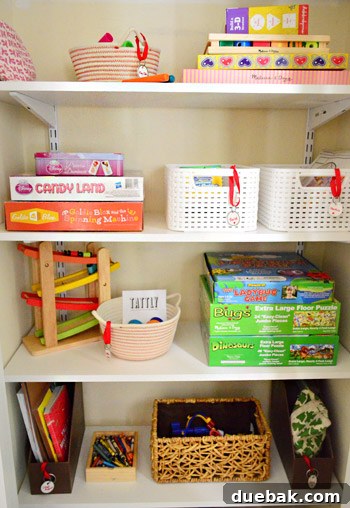
We deliberately call it a “library” because it’s designed to evoke the same sense of wonder and attention that library books have on Clara, compared to the books she owns and sees every day. Library books, with their “newness” and limited-time access, tend to keep her excited and attentive for longer periods. Applying this principle, we took a significant portion of her existing toys and activities out of everyday access spots and meticulously organized them in this centralized closet. Here’s how our “toy library” system operates:
- Curated Choices: Clara still has a few favorite toys readily available in baskets around the house. However, if she desires something from the closet, she simply asks us, and we assist her in retrieving the chosen item. This adult-guided selection ensures an intentional choice rather than impulsive dumping.
- “Check One Out” Policy: A core rule of our toy library is that only one item can be “checked out” at a time. This means one item must be returned and put away before another can be taken out. This simple rule has been incredibly effective in inspiring her to clean up her current activity before moving on to the next, fostering a valuable sense of responsibility and order.
- Long-Term Adaptability: We are optimistic that this system will serve us well into the future. Sherry and I both grew up with closets filled with shelves of board games and movies, and we believe this adjustable shelving setup could easily transition into a game or craft closet for older children, adapting effortlessly to evolving interests and storage needs. The flexibility of the shelves is key to its longevity.
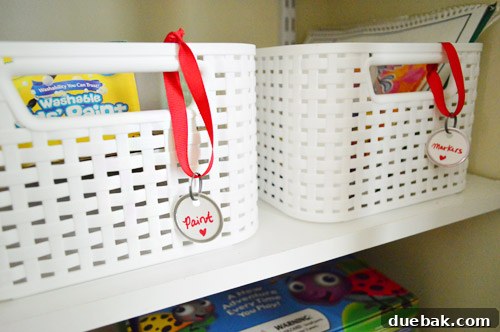
Enhancing the Experience: Labels and the “Menu” System
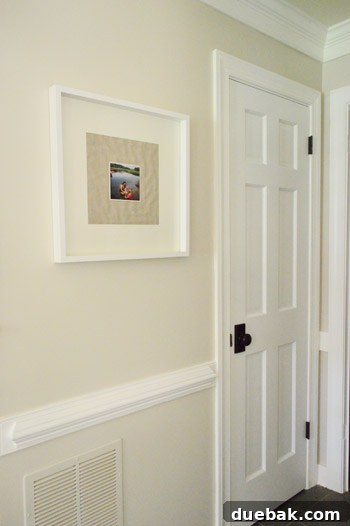
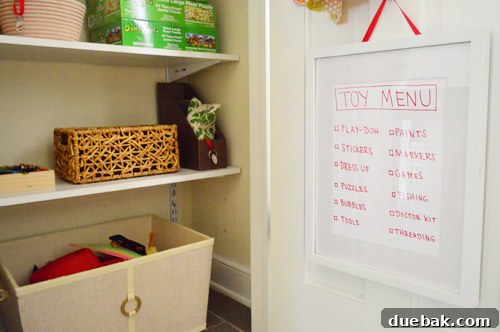
The question of how to label the toy library items sparked a small debate. Since Clara can’t yet read, we considered using cute image or photo labels. However, given that this is currently an adult-guided activity—meaning we’ll be the ones getting most of the items off the higher shelves for quite some time, as they’re out of her reach anyway—we decided to stick with text labels for now. This keeps the aesthetic clean and allows for easy scanning by adults. Sherry went a step further, repurposing an old frame to create a clever little “menu” of what’s inside the closet. This brilliant addition allows us to quickly offer Clara suggestions without the need to dig through every basket and bin, streamlining the selection process and making it more engaging for her.
Real-World Results: Unexpected Success and Lasting Impact
We’re thrilled to report that the “toy library” closet has been in active use for several weeks now. We deliberately waited to share our experience, just in case it turned out to be a massive bust and we ended up converting it into a tool closet or something equally mundane. However, to our pleasant surprise, it’s working even better than we anticipated! I had somewhat prepared myself for one of those “a three-year-old won’t bend to your need for systems and order, Petersik!” moments. But Clara, bless her heart, absolutely loves it.
The system seems to be having a profound positive impact on her attention span and the duration of her engagement with toys. We’ve witnessed a couple of “marathon marker coloring sessions” lately, a testament to her newfound focus. Beyond increased playtime, the toy library is unequivocally helping her better grasp the crucial concept of cleaning up one mess before embarking on another. This teaches responsibility, promotes order, and reduces the overwhelming clutter that can often accompany children’s play. It’s a win-win for both parents and child.
A Unique Welcome: Embracing the “Weird” and the Wonderful
So yes, we might be the slightly eccentric homeowners who greet our guests with a basket of finger paints and an oversized dinosaur puzzle displayed prominently in our foyer-turned-toy-library. But the former library employee in me is bursting with pride over our little closet. It’s a testament to how creative problem-solving and smart organization can transform an overlooked space into a dynamic, educational, and joy-inducing hub. Ooooh, maybe we should start making library cards for the toys? Too far, Petersik. Definitely too far. But the thought makes us smile.
Unlock More Storage Potential: Explore DIY Shelving Ideas
If our little toy library has inspired you to tackle your own home organization challenges, or if you’re simply in the mood to peruse more smart storage solutions, we’ve got you covered. This comprehensive post offers a fantastic collection of 16 DIY shelving ideas that can transform any space, big or small.
Psst- Curious about where we found that perfect piece for our house or the exact shade of paint we used? Simply click the button below to explore our home decor sources and paint color palette!