
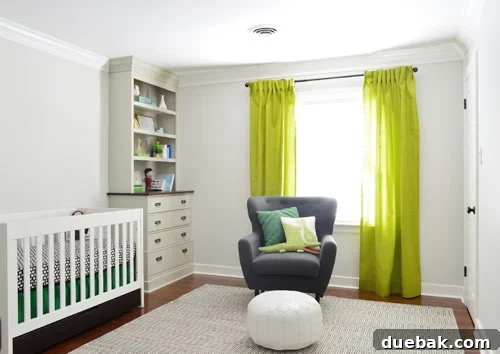
I’ve always believed that curtains are the true unsung heroes of interior design, often overlooked in conversations dominated by the transformative power of a fresh coat of paint. While paint undeniably makes a significant impact, I’d confidently argue that strategically chosen and expertly hung curtains can rival, if not surpass, the “wow” factor of a newly painted room. They possess a unique ability to revolutionize a space in ways few other elements can, making them an indispensable component of any successful room makeover, especially when aiming for a blend of style, comfort, and unparalleled functionality. Let me share why I’m such a fervent advocate for their power:
- Expand Visual Space: Curtains possess an incredible capacity to manipulate perception. By extending a curtain rod beyond the window frame and hanging panels high, you can effortlessly make small windows appear twice as wide and draw the eye upwards, creating the illusion of significantly taller ceilings, adding grandeur to even modest rooms.
- Infuse Style & Personality: Curtains offer a fantastic, high-impact opportunity to introduce a burst of color, a captivating pattern, or a sophisticated layer of textured interest into a room. Alternatively, for a minimalist or airy aesthetic, simple, breezy panels can provide understated elegance and a soft, natural feel.
- Enhance Coziness & Comfort: The soft, flowing drape of fabric instantly adds warmth, depth, and texture, transforming any room into a more inviting and cozy sanctuary. They effectively soften hard architectural lines and create a much-desired sense of enclosure and intimacy, making a space feel instantly more welcoming.
- Boost Functionality: Beyond their aesthetic appeal, curtains are practical powerhouses. They are essential for effectively blocking unwanted light, providing crucial insulation against drafts, offering privacy from the outside world, and even absorbing sound to contribute to a quieter, more peaceful environment. This multi-faceted utility makes them an invaluable addition to any living space.
- Elevate Design Aesthetics: From classic to contemporary, the right curtain style – be it tailored pleats, relaxed grommets, or a simple rod pocket – can significantly elevate the entire design scheme. They provide a polished, custom-made finish that cohesively ties together all the disparate elements within a room, resulting in a harmonized and sophisticated look.
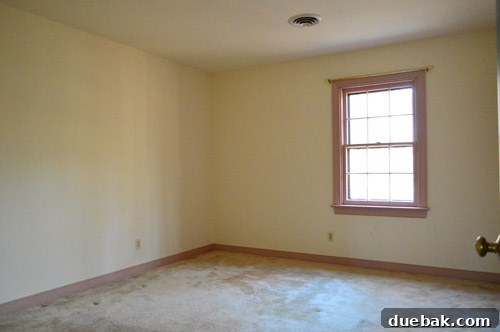
So, there it is. My name is Sherry, and I am an ardent advocate for the power of well-chosen and thoughtfully installed curtains. To truly appreciate the magic they can weave, let’s take a peek at our nursery wall before this essential transformation took place:
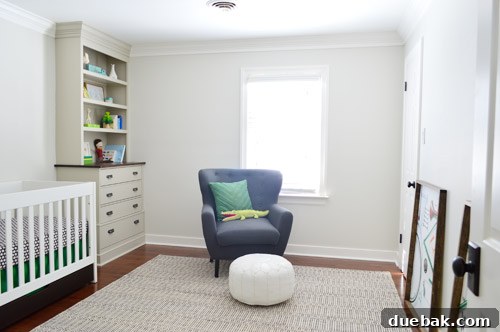
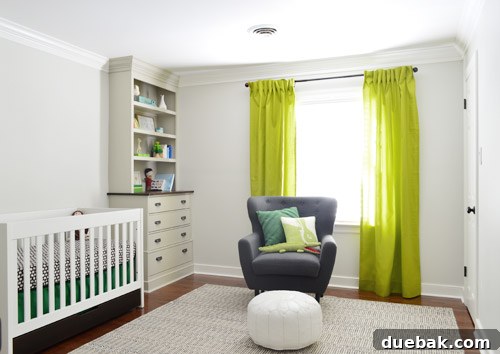
And now, behold the delightful infusion of happy, vibrant green-apple deliciousness! The transformation is truly night and day, instantly adding character, warmth, and a much-needed layer of softness to the space. It immediately feels more complete and inviting.
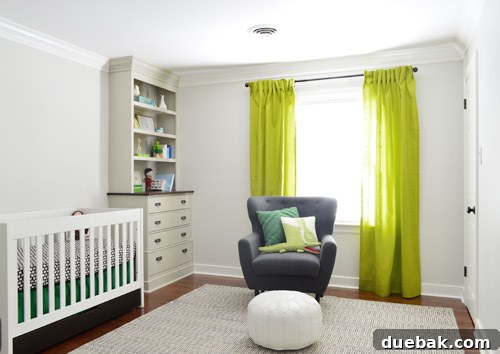
While this room is still a beautiful work in progress – we envision a captivating, colorful large-scale mobile gracefully suspended above the crib, perhaps something reminiscent of this inspiring design, and the expansive bare wall opposite the crib patiently awaits the perfect furniture and curated artwork – my focus today returns to the undisputed stars of this preliminary makeover: the curtains. Don’t they make an absolutely astonishing difference, breathing life into what was once a rather stark window? This time around, I experimented with a fresh, pleated approach, complemented by an extra-thick hem at both the top and bottom. This particular technique imparts a beautiful, added heft and luxurious drape to the panels, and I’m utterly captivated by the result. It was surprisingly straightforward to execute, yielding a custom look without requiring advanced sewing skills. So, without further ado, let’s delve into the detailed steps of this exciting DIY curtain project, proving that elegance doesn’t always come with a hefty price tag.
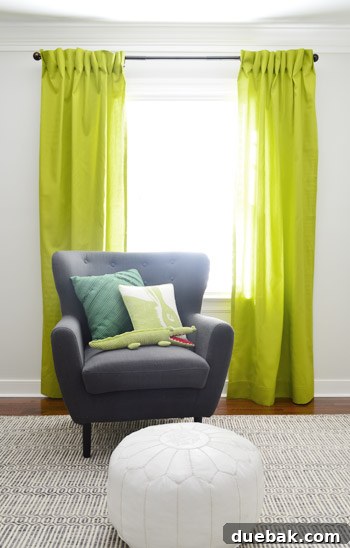
Choosing the Perfect Fabric: Balancing Aesthetics and Practicality
When it came to selecting the ideal fabric for our nursery curtains, our primary goal was to introduce a joyful and vibrant splash of color. This decision was largely driven by the room’s existing neutral palette, featuring serene white walls and custom built-ins. Our experience with Clara’s white-walled yet incredibly colorful room taught us a valuable lesson: opting for safer, more neutral choices on permanent or harder-to-change surfaces provides an excellent foundational canvas. This approach allows for immense flexibility to layer in abundant personality, intricate patterns, and rich colors through easily updateable accents like textiles, art, and various accessories. We meticulously considered a spectrum of options, from a bold, attention-grabbing pattern to a playful dip-dyed effect or a striking band of color along the bottom edge. Ultimately, we concluded that a single, solid hue would be the most harmonious choice. Our reasoning was simple: we wanted to avoid anything that might appear too visually busy or overwhelming, especially when paired with our already patterned rug and charming crib bedding. The goal was cohesion and a serene yet cheerfully vibrant atmosphere, allowing the different elements to complement each other without competing.
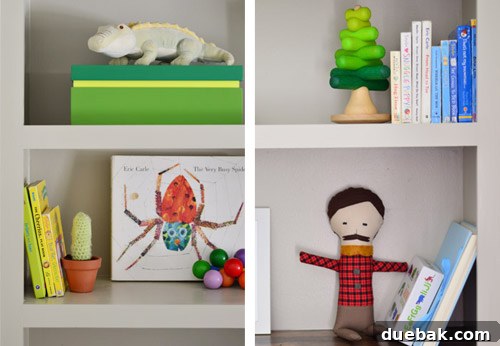
Our color inspiration truly crystallized when we encountered the delightful range of green tones present in a Target storage box we had recently acquired for the built-ins, alongside our cherished old stacking tree game. Both items vividly showcased how beautifully a vibrant, crisp apple green could complement a deeper, richer kelly green. This unexpected pairing solidified our color direction, convincing us that this specific shade of green would provide the perfect balance of freshness and depth for the nursery. It felt simultaneously lively and soothing, exactly what we envisioned for a baby’s room. With this vision firmly in mind, our fabric hunt began, focused on finding that perfect “solid apple” hue.
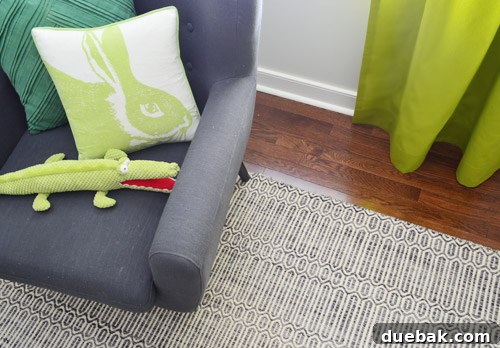
We embarked on our fabric quest, visiting a local specialty store, U-Fab, and then making our way to JoAnn Fabrics. It was at JoAnn’s that we truly fell in love with a wonderfully cheerful apple green fabric. We immediately envisioned how perfectly it would layer into the nursery’s existing elements, particularly complementing the kelly green bed skirt, the playful bike art, and the accent pillow on the chair. Our aim was to achieve a dynamic, layered look without anything feeling overly matched or flat; rather, we wanted a rich tapestry of coordinating greens. This particular fabric, 100% cotton and labeled “Solid Apple” – for those hoping to track it down at JoAnn’s – retailed at $6.99 per yard. I purchased five and a half yards, and thanks to a savvy 50% off coupon, my total expenditure for all the fabric amounted to a mere $19.22. This translates to each individual curtain panel costing less than ten dollars – an incredibly budget-friendly solution for custom, high-impact window treatments that look far more expensive than they actually were!
DIY Pinch Pleat Curtains: A Step-by-Step Guide to Custom Window Treatments
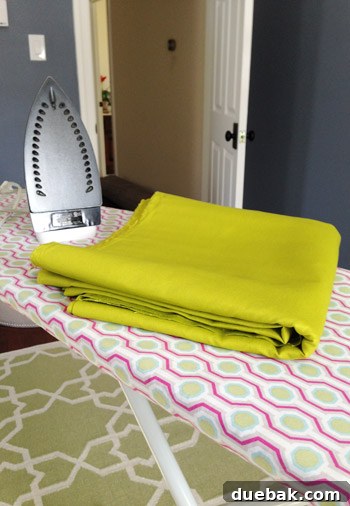
The journey to creating these bespoke pinch pleat curtains began the moment I brought the fabric home. The very first, and arguably most crucial, step was pre-washing the fabric. This essential preliminary measure is paramount for preventing any unwelcome shrinkage down the line. Skipping this step can lead to frustrating “highwater” panels if you decide to wash them post-assembly, ruining your carefully calculated lengths and requiring a complete re-do. After a gentle wash and dry, I laid my fabric out on a clean, spacious floor. I folded it meticulously in half, length-wise rather than width-wise, ensuring a precise alignment of the selvage edges. With a sharp pair of fabric scissors, I carefully cut along this fold, which yielded two perfectly sized 99-inch panels. My desired finished curtain length was 88 inches, a measurement that thoughtfully allowed for substantial, weighty 5.5-inch hems at both the top and the bottom of each panel. These generous hems are key to achieving that desirable luxurious drape and added visual weight, giving the curtains a professional, custom-made feel.
Crafting the Perfect Hems: Precision with Hem Tape
To begin the hemming process, I first folded the top and bottom raw edges of each panel over by approximately one inch. This creates a clean, initial fold that helps to hide the raw edge. For securing these initial folds, I turned to my trusted heavy-duty Heat N’ Bond hem tape. This product is a personal favorite for several compelling reasons. While I’ve certainly crafted curtain panels using my sewing machine in the past, I consistently find that hem tape allows me to achieve a beautifully straight, crisp seam with far greater ease and consistency, avoiding the slight meandering often characteristic of machine-stitched seams. Furthermore, I can confidently attest to its exceptional durability and washability, particularly in a high-traffic, frequently cleaned environment like a nursery or children’s room. Clara’s curtains, for instance, have been hemmed with this very same tape for over three and a half years and have held up splendidly through countless washes, making it an obvious and reliable choice for this project.
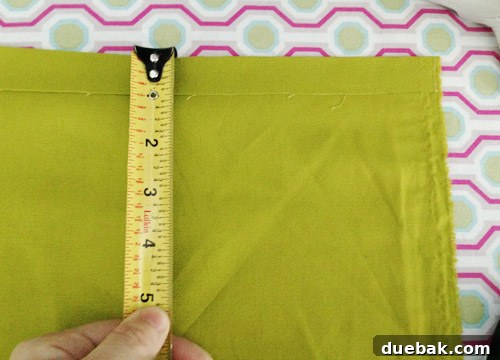
Following that initial one-inch hem at the top and bottom of each panel, I proceeded to create the robust, weighty cuffs that define the curtains’ luxurious drape. I folded each hem over again, this time by a generous 4.5 inches. This second fold creates a beautifully finished, clean-looking edge on both ends of the panel. The initial one-inch hem serves a crucial purpose here, ensuring that the raw edge of the fabric is neatly tucked away within this larger cuff, resulting in a polished and professional finish that looks seamless from both sides. Even though this part of the panel often faces the window and might not be immediately visible, taking the extra moment to make this fold and secure it properly significantly elevates the overall quality and appearance of the custom curtains, giving them a more bespoke and high-end feel.
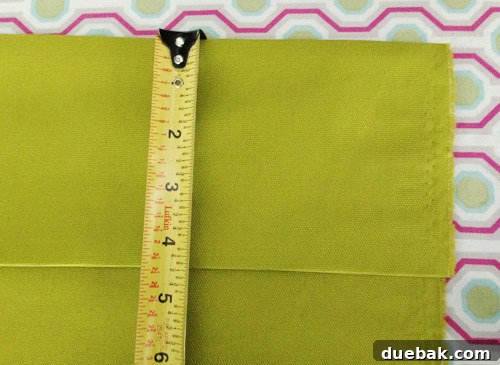
Once again, I employed the dependable hem tape to firmly secure this larger flap of fabric at the 4.5-inch mark. The heat-activated adhesive creates a strong, lasting bond that holds the fabric perfectly in place, giving the curtain panel its desired structure and weight without the need for a sewing machine. This method is incredibly forgiving and delivers results comparable to machine stitching, but with less hassle and specialized equipment, making it perfect for DIY enthusiasts of all skill levels.
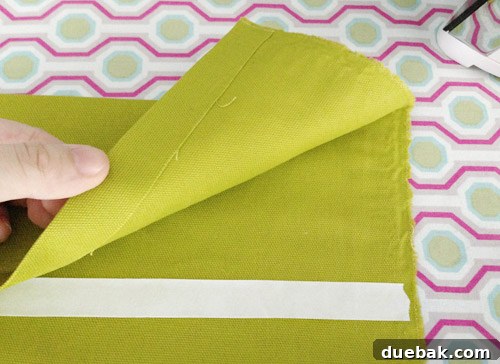
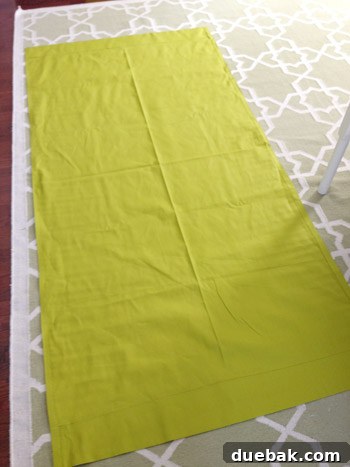
With the top and bottom hems securely in place, the final step in the hemming process was to finish the sides. I opted for simple one-inch side hems. This minimal hem width was chosen to keep the panel as wide as possible, maximizing its fullness and coverage when hung, while still providing a neat, finished edge that prevents fraying and offers a clean vertical line. After all the hemming was complete, this is what one panel looked like laid out on the floor, backside-up, complete with its natural fabric wrinkles awaiting the final touch of an iron.
Achieving the Elegant Pinch-Pleat Effect with Ease
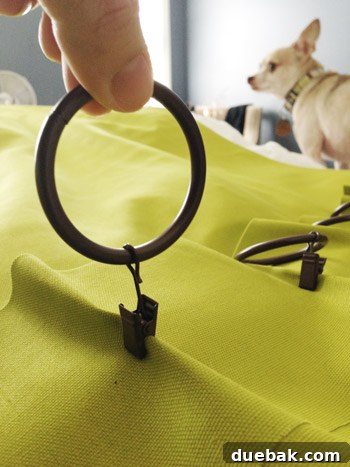
The next phase involved transforming the plain fabric into a beautifully structured window treatment with an elegant pinch-pleat effect. I began by thoroughly ironing each panel to release the majority of the wrinkles accumulated during the hemming process. (Truth be told, they could still benefit from a quick steaming session now that they’re gracefully hanging in place for that absolute crispness, but the initial ironing makes a significant difference in preparing the fabric for pleating!). Then, it was time to experiment with creating that sophisticated “pinch-pleat effect” using curtain ring clips. Rather than my usual approach of simply clipping rings to the very top edge of the fabric – resulting in curtains that hang with a more relaxed, gathered look like this or like this – I adopted a new, more tailored technique. I carefully pinched the fabric at ten equally spaced increments across the top hem. Crucially, instead of clipping to the front, I secured each clip to the *back* of the top hem, approximately 2.5 inches down from the very top edge of the panel. This subtle placement creates the distinctive, elegant pinch-pleat look, allowing the fabric to fall in crisp, defined folds. Our curious dog, Burger, was particularly intrigued by this step, observing the entire process with keen interest and an occasional sniff!
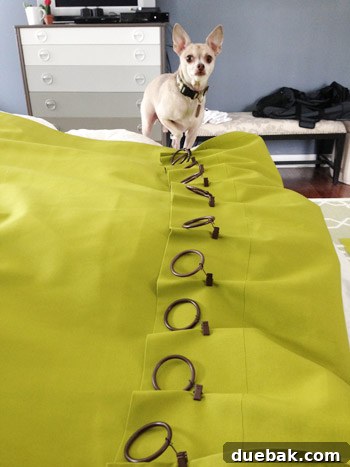
For a clearer understanding of how this pinch-pleat effect is achieved without complex sewing, here’s a close-up photograph detailing that crucial top hem along the back of the panel. As mentioned, I simply utilized ten standard ring hooks and spaced them out visually, aiming for increments that were as equal as possible by eye. This informal approach to spacing contributes to the relaxed, yet refined, aesthetic of these particular pinch pleats, making them feel less formal and more inviting than machine-sewn pleats, while still offering a custom, high-end appearance. The clips create distinct folds that give the curtains body and structure, allowing them to stack neatly when open and drape beautifully when closed.
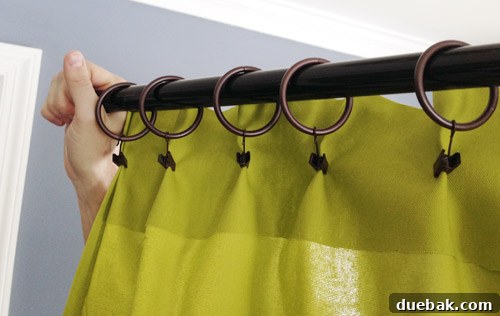
To give you a real-world perspective of the hanging mechanism, here’s John, ever the helpful assistant, holding up the curtain rod after I had strung just one panel onto it. This allowed me to capture a clear picture of the backside attachment for all of you to see the clip placement and how the fabric drapes from there, showcasing the beginning of the pleat formation even before full installation.
Installation and the Stunning Transformation
Finally, with the clips meticulously in place, it was time for the grand reveal. We installed the curtains using the anchors and screws thoughtfully provided with the curtain rod, which we had previously picked up from Home Depot. The installation process was straightforward, and the transformation was immediate and profound. Witnessing the rich apple green fabric gracefully cascade, structured by its new pleats, truly brought a new dimension of life, sophistication, and a much-needed splash of vibrant color to the nursery. The entire room instantly felt more finished and intentionally designed.
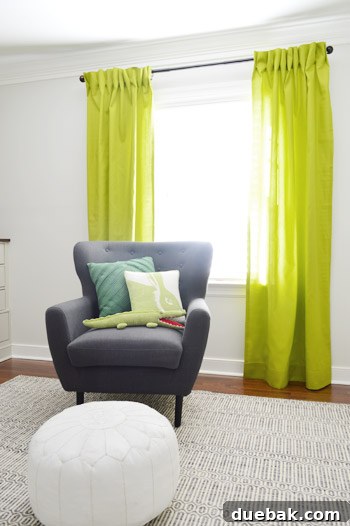
Do those casual pleats not add an undeniable touch of something extra? I particularly adore their slightly imperfect, organic charm; they possess more of a relaxed, casual pleat aesthetic rather than a super precise, uniform look. This makes them feel wonderfully approachable yet undeniably upgraded compared to the standard, straight-hanging ring-hook style I’ve traditionally used. The subtle imperfections lend a handcrafted, bespoke quality that truly enhances the room’s character. If you’re currently contemplating replicating this project at home and thinking, “I’d love to make these, but I wish each pleat was absolutely identical and perfectly uniform,” please do not fear! Achieving that level of precision is certainly possible. You could easily stand on a stepladder and meticulously tweak the clip placements on the back of the curtain to ensure everything is perfectly evened out to your preference, achieving a more formal look. However, John and I both felt that the slight irregularities gave them an effortlessly cool, bespoke character that suited our style perfectly. Or perhaps, we were simply too comfortable to retrieve the stepladder for such fine-tuning – a pleasant side effect of embracing the “perfectly imperfect”!
Addressing Your Common Questions: Blackouts, Furniture, and Future Plans
We’ve received a flurry of excellent questions about these curtains and the nursery, and I’d love to address a couple of the most frequent inquiries right here, providing more context and insight into our ongoing design decisions:
Update #1: Blackout Functionality & Privacy Considerations
A number of you have asked about our plans for blackouts and whether these curtains can effectively block light. Indeed, the panels are each 56 inches wide, allowing them to close completely across the window, providing both privacy and a good degree of light diffusion. However, for primary light-blocking and comprehensive privacy, we rely on the fantastic faux wood blinds installed on all the upstairs windows in our home (you can find more details about those here). Consequently, we typically close the blinds rather than the curtains for total darkness, especially during nap times. That said, nurseries often require near-total darkness for optimal infant sleep, and if our little one turns out to be a light-sensitive sleeper like Clara, I will absolutely consider adding some blackout panels to the back of these beautiful apple green drapes. This would be a simple modification, much like we did in Clara’s room, involving attaching blackout fabric to the reverse side of the existing panels. I’ll be sure to keep you all updated on that front as the baby arrives and we learn their sleep preferences!
Update #2: The Nursery Chair & Cozy Pouf Origins
Another popular question concerns the origin of the lovely nursery chair. We actually purchased that comfortable piece from Joss & Main a few years ago. It has quite the history and has traveled through different spaces in our home! Initially, it resided in a cozy corner of our kitchen, across from the fireplace in our old house, providing a charming spot for reading or casual conversation. Upon moving to our current home, it found a temporary home in our office, serving as extra seating. However, as we envisioned the nursery taking shape, it became clear that its comfortable proportions, inviting design, and neutral upholstery would make it a perfect, functional, and stylish addition to this new baby’s room for feedings and cuddles. The charming white pouf, which provides a comfortable spot for tired feet during late-night rockings, was also a fantastic sale find from Joss & Main. It just goes to show how versatile and adaptable quality furniture pieces can be, gracefully moving with you and finding new purposes in different spaces as your family and home evolve.
Seeing how much this space has transformed since we first purchased the house, especially with the strategic addition of these vibrant curtains, truly makes the impending arrival of our baby feel so much more real and tangible. It’s definitely starting to feel like a complete and welcoming home for our newest family member, filled with warmth and personalized touches.
I’m telling you, curtains possess an incredible, often underestimated, power to make a significant difference in any room’s aesthetic and feel. Of course, I must concede that a freshly installed floor, a new coat of perfectly chosen wall paint, the elegant pair of custom built-ins, crisp crown molding, and well-chosen furniture certainly contribute immensely to the overall appeal and functionality! But the curtains truly tie it all together, adding that essential layer of softness, a strategic pop of color, and that final touch of design finesse that elevates a room from merely functional to truly spectacular. They are the decorative icing on the cake, bringing warmth and personality.
So, that sums up the latest exciting updates in the nursery! And to keep you in the loop, Operation Homemade Mobile is officially underway, so I eagerly anticipate sharing that creative project with you all very soon, complete with DIY steps and plenty of photos. Additionally, stay tuned for some fantastic updates regarding that previously blank wall across from the crib – it won’t be bare for long, as we have exciting plans for art and storage! In the meantime, I’d love to hear from you, my fellow DIY enthusiasts: Have any of you ventured into making pinch-pleats before, either by traditional sewing methods or using the clever ring-clip approach like I did? Do they infuse your space with a sense of elevated elegance and a touch of custom luxury? And perhaps most importantly, was your furry companion equally fascinated by the entire DIY process, offering their unique brand of supervision and moral support?
Psst- Curious to know more about specific items in our home or the exact paint colors we’ve used? Simply click on the button below to explore our curated selection and get all the details! We love sharing our finds and sources with you.