
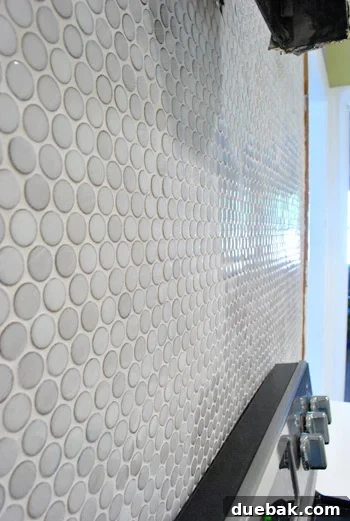
Bet you thought our grouting post was the last time we’d talk about installing tile. Not quite. After the grout dried we still had a few finishing steps: removing haze, sealing the grout, and caulking edges. Several readers asked for details on those final tasks, so here’s how we handled them.
Anyone who’s tiled knows grout often leaves a hazy film on the surface. We saw it on both the subway tile and marble floor in our old bathroom, and our penny tile backsplash was no exception. I checked my notes from a previous project and, as before, started with good old-fashioned elbow grease: a clean rag and firm rubbing. In many areas that was enough to restore the tile’s shine. Cheesecloth is often recommended, but a plain white rag worked well for us.
Sherry followed behind and scraped any stubborn grout haze around tile edges with her thumb to restore the round appearance of the penny tiles. That method worked, but it took a toll on her nails (so don’t use your fingernail if you can avoid it).
Despite our efforts, some tiles still showed a cloudy ring around the darker outer edge once the surface dried. The haze wasn’t obvious when the tiles were wet, but it dried in irregular rings that made the tiles look dusty. Scraping each spot with a fingernail would’ve worked, but it wasn’t a practical solution for a whole backsplash. We called The Tile Shop and they recommended a commercial haze remover appropriate for our tile type.
I’d been reluctant to use a chemical at first—why add another product if you don’t have to, and some removers can damage certain tile finishes. The Tile Shop reassured me the product was safe for our penny tile, so we bought a bottle for about $8. The haze remover made a dramatic difference: most of the cloudy rings disappeared and the tiles regained noticeable shine. The process was simple but a little tedious—apply with a sponge, let it sit for a few minutes, then rinse and dry—yet it saved us from laborious scraping.
After de-hazing, we sealed the grout. The sealer application is similar to haze removal (apply and then wipe/dry), though you don’t wait between steps. Sealing protects grout from staining, which is especially important for a kitchen backsplash exposed to splatters over the years. Because our penny tile isn’t porous, the sealer doesn’t change the tile’s appearance; the grout remains matte, which we like because the contrast between glossy tile and matte grout looks balanced. We’ve had good long-term results sealing grout in past homes—clean grout stayed clean through heavy use—so sealing is a step we strongly recommend. One tip: only seal when the surface is clean; sealing over grime just locks the dirt in place.
Finally, we caulked all the edges where tile met other surfaces at an angle: where the backsplash met the countertop, the corner walls, cabinet edges, door frames, and around the microwave cabinet. Caulk helps prevent those seams from cracking and keeps the transitions watertight. We used colored caulk that matched our grout, purchased from the same store where we bought the tile. Having a perfect color match made the joints nearly invisible and gave a clean, finished look.
The caulking was a bit of a rush-job because we needed to wrap up quickly—one of those moments when a baby was about to wake and our hands were covered in adhesive. We split the work: Sherry worked from one side across the counter and stood on the counter to reach higher seams, while I handled the doorway and pantry edges. In the end we smoothed the seams and cleaned the area thoroughly.
That covers the final steps: buffing away haze, using a haze remover where necessary, sealing the grout, and caulking edges. With those finishing touches complete, the tile installation looked polished and was protected for everyday kitchen life. We’re done talking about tile for now and will move on to other projects—thanks for following along.