
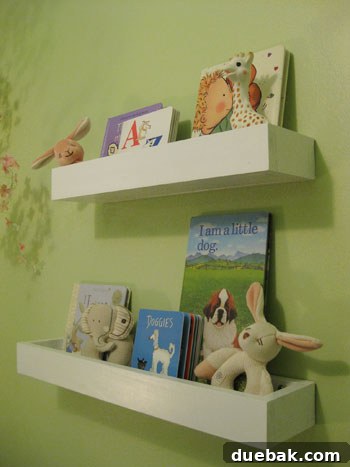
Last week we shared our DIY flower mobiles but intentionally left out the rest of the wall because it felt unbalanced. To set the scene, the wall above the dresser looked a little bare and needed something substantial to balance the mobile and the changing pad area.
We knew we wanted a mobile above the changing pad, but that left roughly half the wall empty. Since the dresser top would be largely taken up by the changing pad, we also wanted storage and display space nearby. On a trip to Charlotte in February we spotted deep-pocket floating bookshelves at a shop called Nesting. They were perfect for displaying children’s books while preventing items from rolling off the shelf and onto the baby — an important safety consideration.
Rather than buying the shelves, I decided to try building them myself. I liked the idea of making our daughter’s first little library, a nod to my grandfather’s woodworking and my mom’s lifelong work in a library. Building the shelves ourselves also meant we could customize their depth and width to suit the room.
To plan the placement and size, we used blue painter’s tape to map different arrangements on the wall: three equal shelves, two staggered shelves, varying heights and widths. Ultimately we chose one shorter shelf above a slightly longer one, both aligned on the right side and staggered on the left.
With the layout decided, we measured and determined the lumber needed for box-style pocket shelves inspired by the store find. We wanted shelves a bit wider to fit some toys and shallower so book covers would be visible. At Home Depot we picked up 3/4″ x 2.5″ poplar for the sides (lightweight and affordable) and 1/2″ x 3.5″ maple for the bottoms (stiffer and less likely to sag). The total material cost for both shelves was under $14.
Last Sunday I set up a makeshift workbench and got to work. I also had the chance to try a set of Kreg tools that a representative sent over — handy gadgets for pocket-screw joinery that simplify woodworking for beginners and experienced DIYers alike.
At first the tools were a little intimidating, but the instructions made them easy to use. With clamps, a drill guide and the Kreg Jig, I measured, marked and cut the pieces for the first shelf (using a miter saw). If you don’t own a saw, most home improvement stores will make cuts for you — they may charge a small fee after the first cut, but the project is definitely doable without your own saw.
After cutting the pieces, I assembled the sides using the Kreg Jig to drill pocket holes. The Jig guides the bit to create angled holes that accept pocket screws, giving a strong, hidden joint. I set the drill bit depth to match the 3/4″ side pieces, clamped the wood in the jig and drilled the holes. The Jig directs sawdust away from your face and keeps the holes consistent.
With two pocket holes drilled in the side pieces, I used a right-angle clamp to hold them flush against the front piece and drove in Kreg’s self-tapping screws. The joints came together quickly and securely without hours of gluing and clamping, and the screw heads were hidden inside the pocket holes.
I adjusted the drill guide for the thinner 1/2″ maple bottom and drilled pocket holes along the bottom edge before sliding the base into place and screwing it to the box. The second, slightly longer shelf took about 20 minutes to build using the same method.
For finishing, we had the option of using Kreg’s plastic or wood plugs to hide pocket holes, but we used wood filler we already had on hand. After applying DAP Plastic Wood, letting it dry and sanding smooth, we painted both shelves with two coats of FreshAire semi-gloss white (the same paint we use for trim throughout the house).
To mount the shelves we predrilled through the back, installed wall anchors and secured them with long screws driven through the shelf backs into the studs or anchors. The result is sturdy shelving that can easily handle the weight of books, toys and decor. We touched up the screw heads with paint inside the boxes and then filled the shelves with books and stuffed animals.
We’re thrilled with these budget-friendly DIY shelves. They added practical storage and crisp modern lines that balance the nearby flower mobiles. The shelves also make it easy to change the look of the wall by rotating books, toys or decorative items, or by leaning a monogram letter on the shelf once we pick a name.
Thanks to the Kreg tools for making this project approachable. If you’ve tackled a carpentry project, big or small, we’d love to hear about it — you might inspire our next build.
Psst— Want to follow our nursery progress from the beginning? See our painting post, the big shopping spree, our crib hunting rundown, the curtain-making tutorial, our chair search, the mirror-painting project, our faux sheepskin DIY, the dresser makeover and drawer lining, the closet update, our homemade crib skirt, and the DIY mobile.