
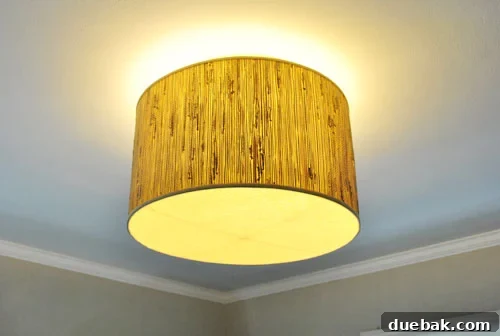
We did it — we made an oversized pendant light for the office, and the total cost was just $32. That’s especially satisfying when it’s reminiscent of a pricey $412 version, meaning we saved hundreds with a simple DIY. Here it is, glowing in the room:
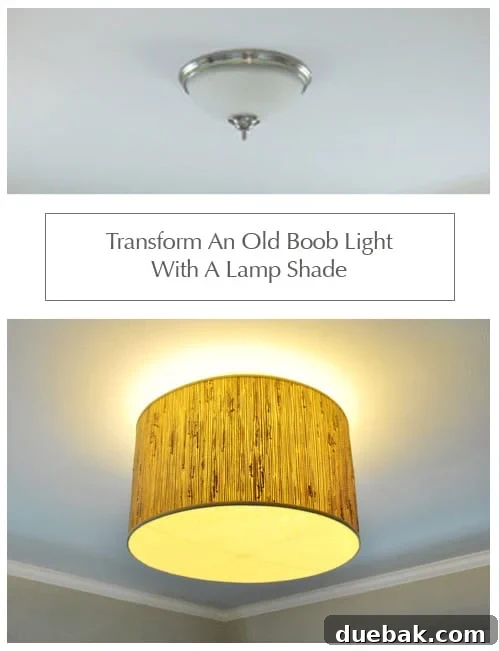
To start, here’s the original fixture we began with — a basic ceiling light that had served the room for years. The office has evolved into a multi-use space, and we wanted a pendant that felt more intentional and interesting overhead.
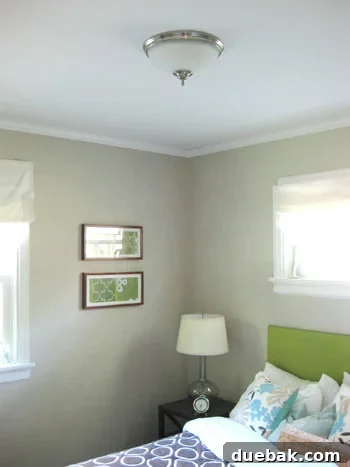
After spending many hours in this office-guest room-playroom combo, we decided it deserved a more inspiring focal point above.
We visited a local lighting outlet and found a huge 20″ drum shade on clearance for $29. It was marked “dented,” but when we inspected it the damage was nonexistent — likely a minor crush that popped back out. The plan was to hang it as a pendant and create a diffuser to hide the exposed bulbs. Initially we assumed we’d need a new lighting kit from a hardware store, but when we removed the old fixture’s glass dome we discovered an existing rod that could hold the new shade.
That discovery saved us the cost of a lighting kit. We slipped the shade over the ceiling rod and secured it with the finial from the previous fixture. With the shade mounted, the problem remained: the bottom view showed the bulbs and the interior hardware, and we wanted a clean, diffused look.
For a diffuser, we considered multiple options: a cut piece of plexiglass sprayed with frosted coating, a weighty acetate, or fabric. We noticed the pendant over our dining table used a simple cream-colored fabric diffuser and liked how soft it looked. Fabric would be easy, affordable, and would give the shade a warm, finished appearance.
Safety note: fabric or paper is suitable only if bulbs are not too close to the material and there is ventilation for heat to escape. In our installation the top of the shade was open and left about 4″ of clearance above the shade, allowing heat to dissipate. We also use compact fluorescent bulbs that burn cooler, and the bulbs are more than 18″ away from the bottom where the fabric diffuser sits, so heat buildup was not a concern.
Here’s the simple process we followed to create the diffuser:
- Remove the fabric trim that was glued around the rim of the drum shade.
- Cut a circular panel from a cream fabric large enough to cover the opening, leaving roughly 1/4″ of overhang around the edge.
- Apply craft glue to the rim where the fabric trim had been removed (work on the inner rim that will hold the diffuser).
- Flip the shade so the opening faces down, align the fabric circle, and press the shade onto the fabric so the glue bonds to the overhang.
- Trim any excess fabric so it won’t protrude past the re-glued fabric band, then use more glue to secure the small overhang and reattach the fabric band.
- Allow the glue to dry for about 10–15 minutes. The entire hands-on work took under 15 minutes, with drying time bringing the total to roughly 40–60 minutes.
The result is a polished, textured pendant with a soft, even glow and no visible bulbs from below. The oversized shade adds presence to this modestly sized 12′ x 12.5′ room — large-scale elements can actually make small rooms feel more elevated and cohesive rather than cluttered with many small items.
We’re thrilled with how it turned out: the fabric diffuser hides the hardware and bulbs, a hint of silver near the top reads like a high-end flush-mounted fixture, and the whole upgrade cost just $32. Initially we thought we might spend closer to $65 once we factored in a lighting kit and materials, so this was a pleasant surprise.
Changing bulbs is still easy because the shade isn’t mounted flush to the ceiling; that top gap allows us to remove the shade and access the bulbs if needed. Overall this DIY was quick, inexpensive, and effective — a great way to give a dated fixture a fresh, refined look without replacing the entire electrical assembly.
If you’re thinking about a similar update, look for an oversized shade you love, check for existing hardware that can be reused, and choose a diffuser material compatible with your bulb type and the shade’s ventilation. Small changes like this can make a big design impact in a room.
