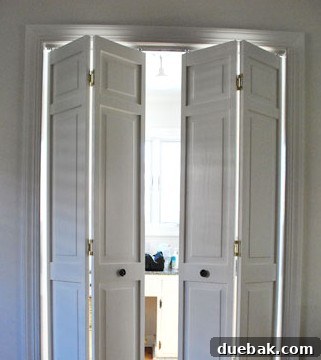
Our new home has quite a few bi-fold doors. For example, there’s a pair separating the future dining room from the main hallway (refer to the floor plan to get your bearings):
Nearby, another set closes off the hallway that leads to most of the bedrooms (we removed one of those doors to fit the daybed during the move):
In our bedroom there’s a large set that hides the bathroom sink area…
…and a single bi-fold next to it that closes the walk-in closet.
That doesn’t even count the bi-folds on the other three bedroom closets. So yes, there are a lot of them. Unfortunately, most of these doors clash with the open, airy vibe we want, so we removed several. The hallway already feels much more spacious without those doors.
Removing the remaining door to the back bedrooms made a noticeable difference too (we still need to patch and paint where the hinges and strike plate were).
Our master bedroom also feels airier now that its door is gone.
We left most bedroom closet bi-folds in place for now, but we did remove the one on our closet— it was constantly in the way. We’re considering replacing it with a heavy, floor-length curtain at some point.
One bi-fold we kept is between the kitchen and the laundry/mudroom.
We’re not crazy about how that door looks, but for now it serves a practical purpose. Without it there’s a direct line from the carport into the kitchen. Here I am peeking through the doorway to demonstrate.
We discovered that visitors tend to use the side door to the carport rather than the front door (the previous owners joked that anyone at the front door is probably a salesperson). Since my wife sometimes nurses at the kitchen table, we want that window obscured for privacy.
For now the bi-fold stays, but once we have time we’ll frost the glass so daylight still pours in while the view is blurred. After that it will likely come down like the others. In the meantime, we’re donating all the removed bi-fold doors to Habitat for Humanity’s ReStore so they can be reused instead of ending up in a landfill. ReStores are full of useful salvaged items—old windows, doors, sinks, fixtures, and more—and they’re great places to find affordable, unique pieces.
P.S. This week’s BabyCenter post covers how we helped Clara settle into the new house so she wasn’t upset or confused. Here are the strategies that worked for us.