
It’s Tuesday the 30th, which means it’s time to share this season’s unofficial Pinterest Challenge project (not sponsored by Pinterest—just an idea Katie dreamed up to get people to stop pinning and start doing). Huzzah!
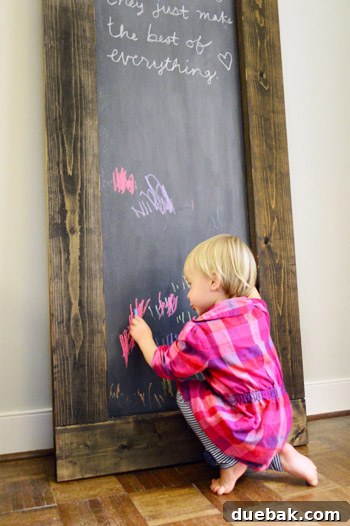
This time John and I built a large, chunky-framed leaning piece that looks like a mirror but functions as a giant chalkboard—chalkboard paint being one of the most Pinterest-tastic materials around. Designed like a leaning mirror, it can be moved from room to room and serves as a place for notes, lists, and Clara’s scribbles. We secured it to the wall with leaning mirror hardware so it’s kid-safe.
As per the challenge rules, I took inspiration from a few projects linked in last Tuesday’s post and put our spin on them. We were lucky enough to already have a large sheet of plywood leftover from another project, so we used that as the chalkboard base. The board we used measures 68″ tall and 21″ wide.
Before applying chalkboard paint, we rolled on magnetic paint—four coats—to make the surface magnet-friendly. After the magnetic paint cured, we applied two coats of chalkboard paint. We only painted the front, though John later painted the back a bright Citron color because the raw back was bothering him. It’s a hidden splash of color that’s only visible when the board is moved, which we love.
We wanted to build the frame without any fancy saws or complicated tools. Home improvement stores will cut plywood to size and can cut 1″ x 6″ boards for you, so you can often avoid making cuts at home. For our 68″ x 21″ plywood piece we used two 29.5″ 1 x 6 boards for the top and bottom of the frame and two 63″ pieces for the sides. That overlap makes the chalkboard look like it sits inside the frame while actually resting behind it. The finished project measures about 29.5″ wide by 74″ tall.
We stained the frame pieces before assembly using Minwax Dark Walnut, a stain we had leftover from past projects. Staining before assembly made it easier to avoid getting stain on the chalkboard surface. Once the stain dried, we assembled the frame and attached it using a Kreg Jig. If you don’t have a Kreg Jig, you can use metal brackets or screws from behind; the goal is to secure the corners cleanly so the front stays smooth.
We attached the chalkboard panel to the back of the frame by screwing through the plywood edge into the stained frame. The panel overlaps the frame slightly, so using screws long enough to reach through the plywood and into the frame—without poking through the chalkboard surface—is important. We used screws about 1 1/4″ long.
After assembly we allowed the chalkboard paint and stain to fully cure and aired the piece out, since both products can be smelly until they fully dry. Then we moved the board into the living room and secured it to the wall with the same child-safe hardware mentioned earlier, so it won’t tip over and bonk any little ones.
To prepare the surface for use, we “conditioned” the chalkboard by rubbing the side of a piece of chalk over it and wiping the surface clean. This helps prevent ghosting and gives you a better writing surface right away.
The finished chalkboard functions as a bridge piece in our living room: the dark color of the paint connects with the sofa and ceiling beams, while the walnut frame ties into the wood console behind the sofa. As we bring in other rustic-finish pieces, the board will fit even more naturally into the room palette.
For now the top of the board displays a favorite quote: “The happiest people don’t have the best of everything, they just make the best of everything.” When Clara woke up from her nap and saw it, she wasn’t sure what to think at first. We handed her a box of chalk, and she got very excited—her scribbles are, of course, the best kind of art to us.
Here’s a quick budget breakdown for the project:
- $0 – leftover plywood, leftover stain, leftover magnetic paint (estimate to buy these new might be around $45)
- $10 – chalkboard paint from the home center
- $16 – four 1 x 6 boards for the frame
- Total: $26 (If you need to buy all materials, plan for up to about $70.)
We’re excited to see what other people have made for this Pinterest Challenge. If you’ve tackled a project recently, feel free to share it: link to your project post (not your homepage), give it a descriptive name, and consider linking back to the inspiration posts. If you don’t have a blog, you can post photos to a public gallery on a photo-sharing site so others can see your work. Can’t wait to see your projects!