

Kitchen Renovation Unleashed: Tackling Old Appliances & Crafting a New Layout
Our kitchen renovation saga continues with another exhilarating chapter in our home transformation journey. Previously, our “heroes” – the refrigerator and pantry – were caught in a strategic shuffle, laying the groundwork for what was to come. Now, as our shiny new kitchen appliances begin to arrive, the real work of preparing their new, modern home is in full swing. This involves not just installing new equipment, but meticulously removing outdated fixtures, solving unexpected challenges, and thoughtfully redesigning our entire culinary workspace.

Phase One: Decommissioning the Outdated Wall Oven and Cabinet
Before the much-anticipated arrival of our brand-new kitchen appliances last week, a critical preparatory step was to clear out the old. First on our demolition agenda was the cumbersome cabinet that housed the old wall oven. This particular piece wasn’t just an appliance; it dictated a significant portion of our previous kitchen’s layout, and its removal was key to unlocking our new design possibilities.

Strategic Decision: Why the Wall Oven Had to Go
For those who’ve been following our journey, you’ll recall our firm decision to bid farewell to the old wall oven. Its departure was driven by a confluence of practical and aesthetic considerations. The oven itself was an outdated bisque color, visually jarring against our desired modern palette, featured a burnt front panel, and, most importantly, delivered frustratingly uneven cooking results. Our choice to replace it with a freestanding range rather than another wall oven was carefully weighed, offering several compelling advantages for our kitchen renovation:
- Cost-Effectiveness: Wall ovens typically carry a premium price tag, often costing over $1,000 more than comparable freestanding ranges. Opting for a range allowed us to reallocate significant budget resources to other crucial areas of our kitchen remodel.
- Addressing Space Constraints: The existing wall oven cabinet was uncommonly narrow. Most contemporary wall ovens simply wouldn’t fit, severely limiting our replacement options and complicating future appliance upgrades.
- Optimizing Kitchen Layout and Aesthetics: Our vision for the new kitchen emphasized a more open, streamlined feel. We wanted the refrigerator and pantry to be the only tall, prominent fixtures, allowing for clearer sightlines and a less bulky appearance. Removing the massive wall oven cabinet liberated valuable space, contributing to a modern and more efficient kitchen layout.
Therefore, the entire tall cabinet was marked for removal. However, in true DIY spirit, we planned to repurpose its components, embracing sustainability and smart resource management.

The Removal Process: Safety, Skill, and Shimmying
As with any electrical work in a home improvement project, safety was our top priority. The first crucial step was to completely shut off the power to the kitchen area. Once the electricity was confirmed off, we emptied the cabinet and carefully unscrewed it from the back wall. We then removed any surrounding trim, preparing for the laborious task of “shimmying” the large cabinet out of its snug position. This often-repeated maneuver, which feels like a hallmark of our DIY adventures, requires patience, precision, and a bit of creative force.

The old wall oven was hardwired, which meant a simple unplugging wasn’t an option. I had to carefully disconnect the electrical wires, a process involving unscrewing connections and securely re-fastening them. Handling exposed wires demands utmost caution. I immediately capped the live wires and ensured all connections were safely contained within a metal junction box with its lid firmly in place. The power to that specific circuit remained off, safeguarding the area until our professional electrician could arrive. He was also tasked with unraveling the mystery of that puzzling wire above the pantry – a detail we’re eager to share once he sheds some light on it!

With the electrical work safely managed, a few more screws were loosened, and after more strategic “shimmying,” the oven was finally detached from its wall cavity. We promptly prepared it for removal from the kitchen, intending to donate it to our local Habitat For Humanity ReStore. Donating old appliances is a fantastic way to support community initiatives and minimize waste during a kitchen remodel.

Resourceful Renovation: Repurposing and Donating
Once the heavy oven was out, the cabinet itself felt remarkably light. We carefully disassembled it, adding its components to our ever-growing collection of kitchen scraps in the sunroom. Our philosophy emphasizes maximum reuse and repurposing in our home improvement projects. Elements like the cabinet doors, drawers, and even some of the oak trim will likely find new life, either within the updated kitchen or in other creative projects around the house. We diligently keep everything on hand until the kitchen renovation is fully complete, just in case a piece proves unexpectedly useful. Our sunroom might currently resemble a cabinet graveyard, but it’s a testament to our commitment to sustainable DIY! Once the project concludes, anything we can’t repurpose will be responsibly donated or listed for sale on Craigslist.

A Glimpse of the Future: New Appliances Arrive
The sight of exposed, unpainted paneling where the oven once stood was a momentary visual setback, quickly overshadowed by excitement. The very next morning, our gleaming new appliances made their grand entrance! The new refrigerator was promptly installed in its designated spot, replacing its predecessor which was whisked away for donation to a local church. Our new stove, a cornerstone of our evolving kitchen design, was temporarily positioned beside it. It awaits its permanent hook-up on the wall to the left of the fridge. We’ll soon share more intricate details about the full future floor plan. Meanwhile, the new dishwasher and microwave are patiently biding their time in boxes by the fireplace. Yes, our kitchen currently resembles a construction zone, but the instant gratification of our new, functional fridge has been an absolute joy!

Phase Two: The Cooktop Conundrum and Countertop Demolition
With the wall oven gone and the new stove not yet operational, we found ourselves in a temporary culinary void – specifically, without a functional baking or cooking surface. This necessitated a rapid progression to our next mission: getting the new stove fully installed. However, one significant obstacle remained firmly in our path: the old cooktop.

It was time for the existing cooktop to join its predecessor, the wall oven, in our “Craigslist/donate purgatory.” Initially, we hoped to sell this rather nice JennAir model on Craigslist. We began by emptying the cabinet directly below it. Following stringent safety protocols, I meticulously disconnected its electrical supply by first turning off the power, then carefully capping the wires, and securing them within a metal junction box. The circuit remained de-energized, awaiting our electrician’s professional assessment and conversion.

The Unexpected Battle: A Glued-Down Cooktop
Consulting the online installation manual for the JennAir cooktop, we expected a straightforward removal; it wasn’t designed to be screwed down, implying it should simply lift out. Yet, this stubborn appliance refused to budge. Our investigation soon uncovered a surprising and unwelcome discovery: the cooktop had been firmly glued down with a thick, black silicone sealant.

Sherry’s quick online research into “removing cooktop glue” confirmed our fears: this was indeed bad news. Gluing down a cooktop is widely considered an improper installation technique because it makes removal incredibly difficult, often resulting in the glass shattering. Numerous frustrated homeowners shared their stories of anger towards granite installers who had incorrectly glued their cooktops, only realizing the mistake when servicing or replacement became necessary – often leading to catastrophic damage. Despite the grim outlook for our “Craigslist the cooktop” plan, we were determined to at least try. We meticulously began scraping and slicing away at the tenacious caulk, hoping to free the cooktop without further damage.

A Hard-Learned Lesson: Battling the Silicone Seal
Unfortunately, the odds were stacked against us. After a painstaking 15 minutes of slow, careful prying, we heard the first disheartening crack in the glass. Then a second, and a third. At this point, we had to confront the inevitable truth: our cooktop was beyond salvaging for resale or donation. It was a frustrating setback, but a valuable DIY lesson. From what we’ve learned, many improperly caulked drop-in cooktops suffer a similar fate. Therefore, a crucial piece of advice for anyone planning a new cooktop installation: explicitly instruct your granite or countertop installers NOT to glue it down! This simple precaution can save you significant frustration, time, and money in the long run.

With our cooktop “rescue mission” unfortunately downgraded to a recovery operation, we shifted focus to detaching the now-damaged cooktop from the granite. This entire section of granite was slated for removal anyway to accommodate the new stove, and it was already going to be incredibly heavy without a broken cooktop still attached. Sherry continued her efforts with the cooktop while I began working on the granite backsplash. Ironically, the backsplash came out with surprising ease! Its removal created sufficient clearance for Sherry, whose smaller hands could then reach behind the cooktop to cut along its back edge. Perhaps this new angle would finally yield results?

NOPE. Still no luck. Ultimately, we conceded defeat on separating the cooktop from the granite and decided to remove them as one unit. Sherry, understandably, was eager to divert her attention to a task that promised more immediate satisfaction – and based on my backsplash experience, the main granite countertop seemed a promising candidate.
Countertop Demolition: A True Team Effort
And satisfying it was! After a few precise slices along the silicone caulk that secured the main granite countertop, Sherry was able to strategically wedge a crowbar and screwdriver into various points. Within minutes, the heavy granite slab began to lift from its base. This was a significant step forward in preparing the kitchen for our new range installation.

Once the granite was fully detached, we knew this was a job requiring more than just two sets of hands. We called in reinforcements – my dad, whom we had cleverly invited over to “help with a little project.” Given his prior experience with our DIY endeavors, he likely knew our definition of a “little project” often involves work gloves and significant heavy lifting, so he arrived perfectly prepared!

To our pleasant surprise, moving the granite wasn’t as arduous as anticipated, thanks to the extra help. We successfully maneuvered it out to the carport without major incident, where it now awaits its final disposition in our ongoing Craigslist/donation bonanza. Back inside, the kitchen space was dramatically transformed: no more cooktop or granite, just an empty cabinet base where our new stove was destined to go. This newly cleared space was precisely what we needed for the next, exciting phase of our kitchen remodel.

Installing the New Range: Redefining the Kitchen Layout
With the space now cleared, we proceeded with removing the last remnants of the old setup. We pried out a few more pieces of trim and unscrewed the final fasteners of the old cabinet base, which had been designed specifically for the cooktop and wouldn’t accommodate our new freestanding range. This meticulous preparation was essential for a flawless range installation.

Once fully detached, the old cabinet was pulled cleanly out of its spot, creating the perfect open space for our new appliance.

And then, with another satisfying “shimmy” (a recurring dance in this renovation!), we carefully guided the new stove into its designated, soon-to-be-permanent home. This was a pivotal moment in solidifying our new kitchen layout, bringing us significantly closer to a fully functional and aesthetically pleasing culinary space.

We deliberately left all the protective wrapping on the stove as a clear visual cue that it is not yet ready for use. It will remain in this temporary state until the electrician completes his final work this morning, converting the raw electrical wires to a standard plug connection. Prioritizing safety and professional installation is a non-negotiable aspect of our DIY kitchen renovation strategy.
Key Design Considerations for the New Kitchen Setup
As we integrate the new appliances, a few important design aspects and future plans come into sharper focus:
- Addressing Microwave Height: You might notice the uncomfortably close proximity of the stove’s top to the bottom of the microwave. This highlights an existing, awkward problem: our microwave is hung unusually low. This isn’t ergonomically ideal, and we are eagerly anticipating upgrading to a properly hung range hood, which will rectify this height discrepancy and vastly improve kitchen ventilation.
- Achieving a Seamless “Built-in” Look: The new stove measures a standard 30 inches wide, but the original cabinet base it replaced was 36 inches. To create a seamless, custom “built-in” appearance, we plan to install 3-inch filler pieces on either side of the stove. This strategic design choice is crucial because our existing range hood is vented and ducted to be centered over the original 36-inch opening. Shifting the stove to one side would necessitate major, complex, and costly ceiling surgery – a project we are keen to avoid! Once these filler pieces are installed and everything is painted a cohesive white, we are confident the result will be remarkably seamless and visually integrated. More importantly, this configuration contributes significantly to establishing a highly functional “work triangle” in the kitchen, a stark improvement over the less efficient “odd work parallelogram” that our previous layout offered.
- Understanding the Counter-Depth Stove: While the stove might appear slightly deeper than the surrounding counter space in the photo, it is indeed a counter-depth model. We simply haven’t pushed it all the way back into its final position yet, as it will need to be pulled out again briefly when the electrician performs the final wiring connections.
Envisioning the New Kitchen: Beyond Appliances and Cabinets
Speaking of that 36-inch cabinet base we removed – it certainly did not end up in the sell/donate pile! Instead, in a testament to clever cabinet repurposing, it’s being given a second, strategic life. It will now form a fundamental part of a brand-new workspace, situated precisely where the giant wall oven cabinet once resided.
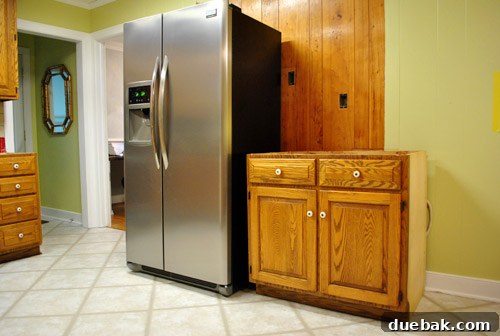
This repurposed cabinet will serve as the anchor for a continuous new workspace, extending from the integrated, built-in refrigerator all the way around to the peninsula we plan to add. By intelligently reusing this existing cabinet, we are not only achieving significant cost savings but also actively minimizing waste in our renovation efforts. This smart planning means we only need to purchase two new cabinets – specifically, one corner base cabinet and one 21-inch drawer base cabinet – to complete our desired peninsula configuration. We’ll dive into the exciting specifics of these intricate kitchen design plans in much greater detail in an upcoming post; suffice to say, we’ve got some serious “planz, yo!”

Upcoming Kitchen Transformations: What Lies Ahead?
It often feels like for every item we confidently check off our extensive kitchen to-do list, ten more magically appear! So, while I won’t attempt to detail every single impending task here, the immediate and crucial priorities for our comprehensive kitchen renovation include:
- Material Procurement: The urgent task of securing all remaining materials, including our chosen backsplash tiles, additional custom cabinets, and beautiful new countertops, is ongoing.
- Surface Preparation: Diligently painting all newly exposed paneling to create a clean, uniform, and cohesive backdrop for the finished kitchen’s aesthetic.
- Structural Modifications: The eagerly anticipated scheduling of our “wall knock-down-fest.” We’ve finally selected a trusted contractor to assist us with this significant structural change, which means we are optimistically anticipating this major step to be accomplished within the next month! Woo hoo!
Our journey to a fully transformed, functional, and beautiful kitchen is progressing steadily, filled with a blend of unexpected turns, satisfying victories, and continuous learning experiences. Stay tuned for more exciting updates as we continue to bring our dream kitchen design to vibrant life!