
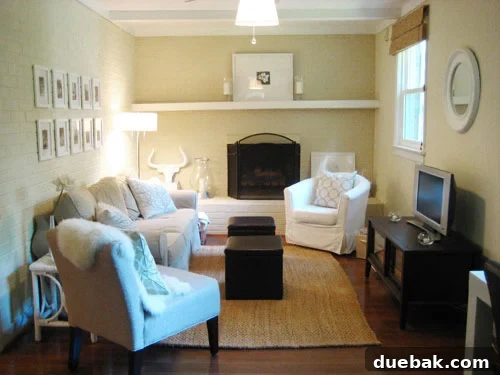
Every home, no matter how grand or modest, often presents its owners with a unique set of design challenges – those peculiar quirks that initially seem like insurmountable obstacles. Our house is certainly no exception, having its own collection of architectural eccentricities that demanded creative solutions. In the spirit of transparency and celebrating our blog’s journey, we’re thrilled to pull back the curtain and share the inside scoop on our home’s most puzzling shortcomings, detailing exactly how we transformed these seemingly “wackadoo” design flaws into visually pleasing and functional spaces. Prepare to be inspired as we unveil our journey from design dilemma to delightful domesticity!
Conquering Home Design Flaws: Creative Solutions for Common House Quirks
House Quirk #1: The Uncentered Bedroom Window – A Symmetry Illusion
One of the most vexing design challenges in our bedroom was undoubtedly the window situated directly above our bed. It wasn’t just slightly off-center; it was glaringly misaligned, shifted over a foot too far to the right. This asymmetry was an immediate eyesore, disrupting the balance of what should have been a serene and symmetrical focal point. We grappled with various ideas, from complex architectural interventions to elaborate custom furniture, but ultimately sought a more elegant and budget-friendly solution.
Our breakthrough came with a simple yet ingenious approach: the strategic placement of curtains. Instead of merely framing the window itself, we opted to hang long, flowing tan curtains significantly wider on either side of the window frame. By extending the curtain rod well beyond the actual window’s dimensions, we were able to “cheat” the visual center of the window dramatically to the left. The expansive fabric on both sides created the optical illusion of a perfectly centered window, instantly balancing the entire wall. This clever trick transformed an obvious design flaw into a harmonious feature. For just $25, a set of curtains negated a major architectural headache, lending a much-needed sense of peace and balance to our built-in wall and overall bedroom aesthetic. This simple act reinforced our belief that effective design doesn’t always require a hefty investment, but rather a keen eye for illusion and creative problem-solving.

House Quirk #2: The Obtrusive Steel Fuse Box – A Hidden Gem
The den, a central and frequently used space in our home, harbored another significant eyesore: a large, industrial steel fuse box prominently displayed in the middle of a wall. It was not only aesthetically unappealing but also a constant reminder of the house’s utilitarian components, completely at odds with the cozy and inviting atmosphere we aimed to create. When we first moved in, its presence was painfully obvious, drawing the eye and detracting from the room’s potential charm. Even our cheerful realtor couldn’t quite distract from this metallic monstrosity.

Our solution involved a multi-faceted approach, combining clever concealment with strategic aesthetic enhancements. We conceptualized a “make-shift mudroom” – a functional and stylish corner designed not only to corral coats and scarves but primarily to obscure that colossal fuse box. The wall was given a fresh coat of paint, transforming its drab appearance, and a row of sturdy hooks was installed. These hooks, laden with everyday items like bags and outerwear, effectively drew attention away from the metal box, rendering it virtually invisible to the casual observer. The transformation was so complete that now, no one even suspects its hidden presence. Beyond this specific fix, we simultaneously opened up the space by widening the doorway to the sunroom and the passageway into the kitchen. This, coupled with the installation of gleaming hardwood floors throughout the adjoining rooms, unified the entire area, creating an expansive and much more welcoming open-concept living space. The once-obvious fuse box became an integral, yet unseen, part of a beautifully redesigned and highly functional home.

House Quirk #3: The Peculiar Living Room Divider and Faux Stone Floor – Uncovering Hidden Beauty
Our living room presented perhaps the most perplexing and, frankly, classless design elements upon move-in. Near the front door, a bizarre wooden divider, complete with a center panel of stained glass (a true relic of questionable taste), awkwardly bisected the space. Adding insult to injury, the corner beneath it sported a faux stone linoleum floor – an egregious design faux pas that seemed to mock the potential elegance of the room. The path to redemption for this space was strikingly clear: these elements had to go. They were immediately earmarked for demolition, a task I eagerly undertook.

The day after we moved in, with my trusty hammer in hand, I set about dismantling that hideous divider. It was a cathartic experience, easily reduced to manageable pieces for curbside disposal. The linoleum, however, posed a trickier problem. Our initial thought for addressing the egregious faux stone was to procure an oversized natural fiber rug for the entryway, hoping it would simply cover the visual offense. However, finding a rug of the exact, unconventional size and shape needed for that corner proved to be an unexpected challenge, leading to a temporary stalemate.

Then, one serendipitous day, a thought sparked: what if the linoleum wasn’t installed over a subfloor, but directly over our existing wood floor? The possibility, though seemingly optimistic given the absurdity of covering hardwood with linoleum, offered a glimmer of hope. Every fiber of my being knew this was a long shot; surely, it would be riddled with glue and nail holes if true. Yet, fueled by a mixture of curiosity and desperation, I carefully pried up a corner of the linoleum. To my utter astonishment, beneath that repulsive fake stone, lay a pristine, flawless wood floor! It was a moment of pure joy, like unearthing a hidden treasure. The discovery meant we no longer needed an awkwardly large rug to hide anything. Now, a small, practical welcome mat serves its purpose at the entryway, celebrating the beautiful, authentic wood flooring that had been secretly preserved for years. This revelation not only elevated the aesthetic of our living room but also proved that sometimes, the best design solutions are simply about uncovering what was always meant to be there.

House Quirk #4: The Awkward Den Addition – Blending Old and New
Our den, once part of what we affectionately call our “former hunting lodge,” revealed another significant design flaw that spoke volumes about the home’s evolutionary history. This room, along with our second bathroom, laundry area, and sunroom (a much-appreciated addition, thankfully!), was appended to the main structure back in the 1970s. While most of this addition seamlessly integrated with the original house – with no disruptive steps up or down, which we truly appreciate – one particular aspect stood out like a sore thumb. A section of the den wall, which was originally an exterior window, had been rather inelegantly bricked over during the construction of the addition. This “patch job” was anything but subtle.

The bricks themselves were dusty, mismatched in color, and visually disconnected from the rest of the room, starkly highlighting the fact that this wall had undergone a significant change. It was a constant reminder of the room’s past life as an exterior space, and it created an oppressive, unfinished feel. However, we had a clear vision for this den: to transform it into a bright, cohesive, and inviting space. Since we never intended to leave any of the oppressively dark brick, or indeed the existing dark beams and wood paneling, unpainted, this particular flaw was one of the quickest and most satisfying to remedy. With a fresh coat of unifying paint, the mismatched bricks, the heavy beams, and the dated paneling all melted away into a harmonious backdrop. The chosen paint color instantly brightened the room, erased the visual disjointedness of the added wall section, and created a fluid, modern aesthetic that effortlessly blended the old and new sections of our home. It was a powerful demonstration of how a simple application of paint can unify disparate elements and utterly transform a space, eliminating any hint of its awkward past.

House Quirk #5: The Bathroom Outlet Conundrum – Modernizing Essentials
Perhaps the most baffling and inconvenient design flaw we encountered when moving into our home in 2006 was the complete absence of electrical outlets in *either* of the bathrooms. It was a head-scratching revelation, prompting us to wonder about the previous occupants – perhaps a community of dreadlocked hippies or bald individuals who had no use for hair dryers, electric razors, or curling irons? Regardless of the reason, this oversight presented a significant daily inconvenience. I was forced to resort to drying my hair in the sunroom, a space that became quite chilly during the winter months, simply because it was the only room with an available outlet near a mirror. This particular quirk wasn’t just an internal frustration; it quickly became the most apparent flaw to our early guests (sorry, Cat!), who couldn’t believe a modern home would lack such a basic amenity.
Unlike some of the more elaborate cosmetic fixes, this challenge demanded a proper, professional solution. We understood the importance of electrical safety and the need for a licensed expert. Hiring a qualified electrician to install a double outlet right next to the bathroom mirror proved to be an incredibly straightforward and surprisingly affordable fix, costing just $65. This small investment was, without a doubt, the best $65 we ever spent on the house. It instantly resolved a daily struggle, brought our bathrooms into the 21st century, and significantly improved the functionality and convenience of our home. It served as a powerful reminder that sometimes, the most impactful home improvements aren’t grand renovations, but rather precise, professional updates that address fundamental modern living needs.
So, what about your home? Does it harbor any nagging design flaws that you’ve been struggling to conquer? Or perhaps you’ve already found ingenious ways to remedy even the stickiest and most peculiar of design challenges? We’ve proudly shared our journey and our solutions – now it’s your turn to inspire us with your creative home transformations!
Update – Craving details on where we sourced specific items in our home or curious about the paint colors we used? Simply click the button below to explore our curated selections: