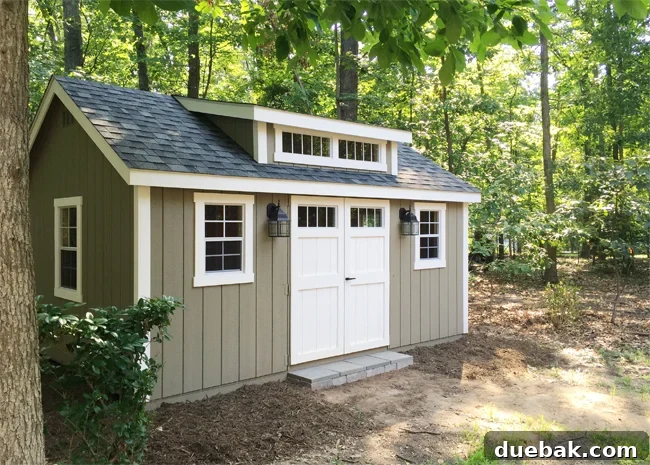
There’s a common thread that weaves through conversations among homeowners and outdoor enthusiasts alike: the humble backyard shed. Often dismissed as mere storage, a well-planned shed can be a transformative element for any property, addressing a multitude of organizational, aesthetic, and even privacy challenges. For years, the idea of a shed was a recurring fantasy among my running buddies and me – a secret aspiration for more space, better organization, and perhaps a personal retreat. We’d admire stately sheds on our routes, lament our own storage woes, and jokingly strategize on how to convince our spouses of this essential addition. Our lives, as you can imagine, are brimming with such thrilling dilemmas!
However, thanks to a recent and much-anticipated arrival, I’ve officially become the envy of my running crew – a fleeting moment of glory, no doubt, but one I’ll savor. And the best part? I didn’t even have to deploy my elaborate “wife-convincing” schemes. This new “puppy,” as I affectionately call it, has landed right in our backyard, promising to revolutionize our home life.
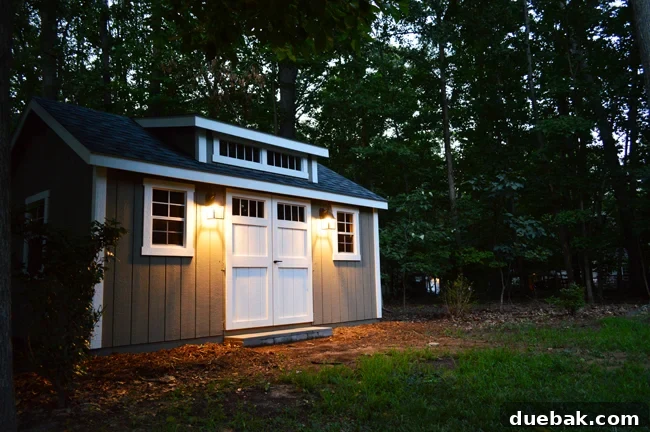
Transforming Your Home: The Dual Purpose of Our New Backyard Shed
So, why embark on this shed journey? For us, the motivation was clear and two-fold: to profoundly improve the functionality and organization of our garage, and to significantly enhance the privacy and aesthetic appeal of our backyard. This strategic addition wasn’t just about adding extra square footage; it was about solving persistent problems that impacted our daily living and enjoyment of our outdoor space.
Reclaiming the Garage: A Haven for Family Life, Not Sawdust
Our garage had become a constant battleground of clutter and chaos. As the primary hub for most of our DIY projects, cutting, and building, it was perpetually coated in a fine, inescapable layer of sawdust. Anyone familiar with our podcast knows this space has been an organizational sore spot, struggling under the weight of its conflicting roles: a main entryway, a bustling workshop, and a catch-all for an eclectic mix of household items. This constant disarray made it inefficient for any single purpose and certainly not conducive to a tidy entrance.
For a long time, I’d been yearning to liberate our garage from the Grip of tools, scrap wood, and other messy project supplies. My vision was simple: a garage focused purely on family essentials like sports equipment, bikes, sleds, beach chairs, and strollers, along with its primary function of car parking. Moving the workshop paraphernalia into a dedicated shed would not only drastically reduce the sawdust accumulation but also create a clean, accessible, and organized space for everything else, making our daily routines smoother and more enjoyable. It’s about safety, efficiency, and finding what you need when you need it.
Enhancing Backyard Privacy and Aesthetics: A Strategic Landscaping Solution
The promise of a major improvement to our landscaping was what truly resonated with Sherry and swiftly brought her on board with the shed idea. Our backyard presented a unique privacy challenge in one particular area. Our oddly-shaped lot put us uncomfortably close to one neighbor, a stark contrast to the wonderful tree privacy we enjoyed with our other backyard neighbors. This specific spot felt exposed, and our previous attempts to create a natural privacy screen with plantings had, frankly, failed spectacularly. We invested a considerable sum in two large holly trees that, to our dismay, eventually perished – certainly not our proudest home improvement moment.
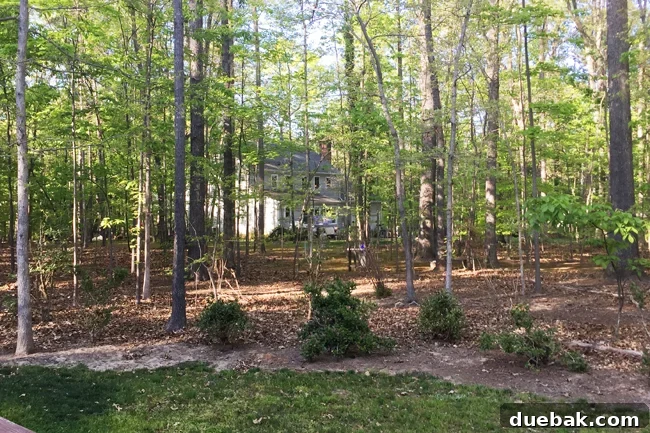
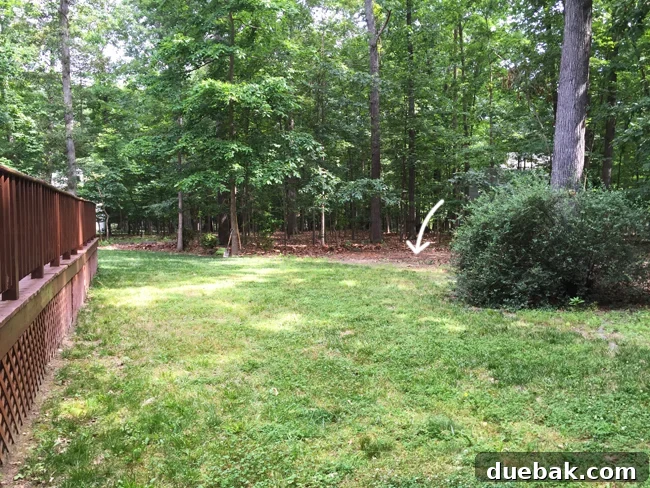
Beyond privacy, we’ve also been actively working to extend the usable grassy area of our backyard. Each season, fallen leaves seem to creep closer, making the yard feel smaller. Placing a shed in this strategic location, at the visual “end” of the yard, would help us push back this perceived boundary and keep it there, creating a more defined and expansive green space. We also plan to relocate a large bush currently in the foreground on the right side of the yard (a fall project, as it requires the right season for transplanting). Imagine it 10 feet further back into the woods, no longer encroaching on our precious backyard space. The shed thus serves as both a practical structure and a key architectural element in our ongoing landscaping efforts, providing a much-needed visual anchor and a permanent solution to our privacy woes.
Choosing the Right Shed: Customization Meets Convenience
The journey to our perfect shed involved considerable deliberation over how it would be completed. We carefully weighed a variety of options: building it completely from scratch, assembling a pre-fabricated kit, hiring a local handyman, or purchasing a ready-made unit from a big-box store. Each option presented its own set of advantages and disadvantages in terms of cost, time commitment, and quality.
Ultimately, after much discussion and research, we decided to purchase our shed from a local company. This particular company specialized in custom-built sheds crafted by an Amish company located in Pennsylvania, then transported to customers. This option struck the ideal balance between high-quality craftsmanship and the convenience of a professionally built and installed structure.
Like any significant home project, we meticulously evaluated the cost versus time equation for a DIY approach versus hiring out. Considering my demanding work schedule and the lengthy timeline typically associated with my larger building projects (anyone remember the deck project?), it became clear that our time would be better spent focusing on other professional commitments. Furthermore, we were genuinely captivated by the superior quality and robust design options offered by the Amish-built versions. Their attention to detail and durable construction made them incredibly difficult to pass up, assuring us of a long-lasting and aesthetically pleasing addition to our property.
The Power of Customization: Designing Our Dream Shed
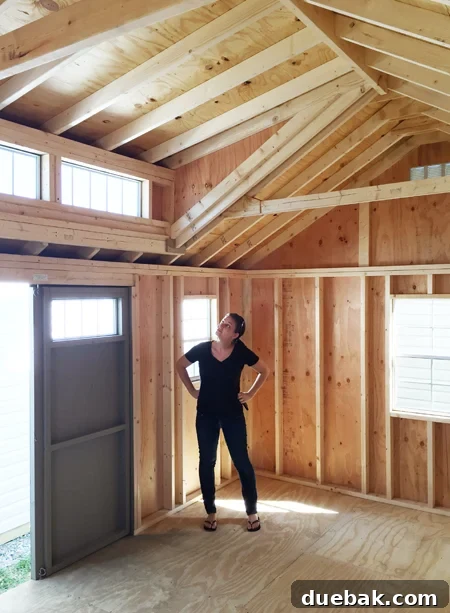
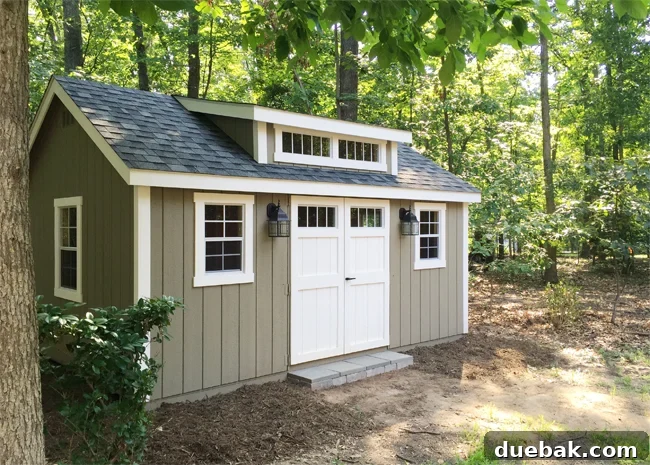
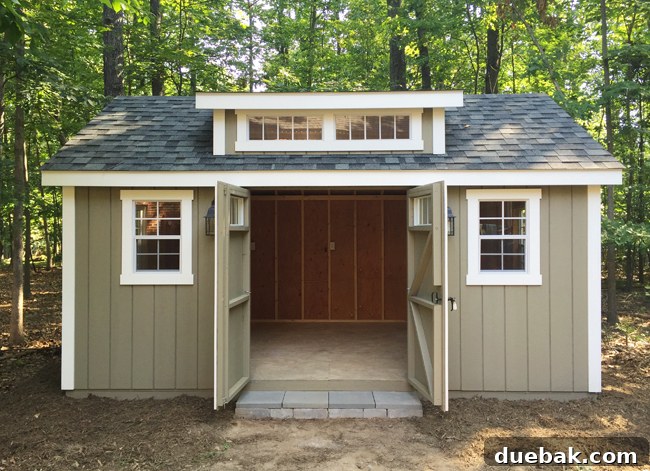
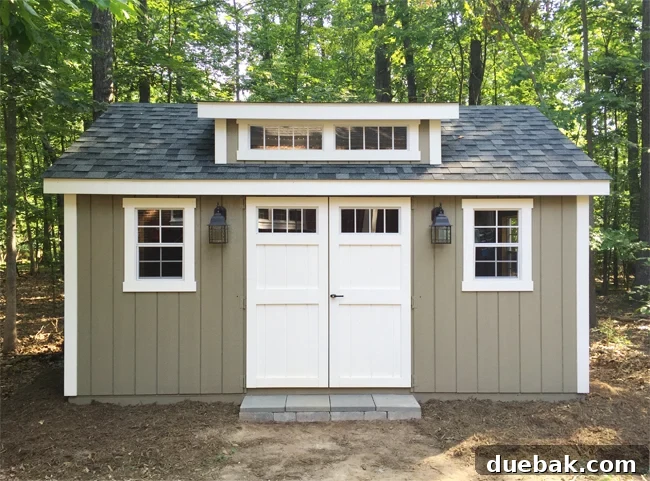
One of the most appealing aspects of working with this local company was the extensive level of customization available. We truly had the flexibility to tailor almost every detail of our shed to our specific needs and aesthetic preferences. We opted for a spacious 12′ x 16′ footprint, ensuring ample room for storage and a dedicated workspace. We carefully selected the color of the siding and roofing, the specific type of siding, and even the number and dimensions of the windows to maximize natural light and complement our existing home’s exterior.
Further customization included the choice of doors, trim style, and a particularly impactful addition: an extra dormer on the roof. Browsing samples at their sales lot, this dormer truly “wowed” us. The difference it makes in allowing natural light to flood the interior is simply amazing, transforming what could have been a dim storage space into a bright, inviting area perfect for projects. This level of personalized design ensured that our shed wasn’t just a utilitarian structure, but a harmonious and functional extension of our home.
The Grand Arrival: Shed Delivery and Expert Installation
Once our custom order was placed, we patiently awaited its construction. Approximately four weeks later, the day arrived when our shed, meticulously built in Pennsylvania, was trucked down for installation. Prior to delivery, we undertook some necessary site preparation, which involved transplanting a few bushes and carefully cutting down two small trees. Fortunately, the chosen area was already quite clear, minimizing the effort required. Before we knew it, our new “puppy” was rolling down the street, an exciting spectacle, heading directly into my eager, shed-loving arms.
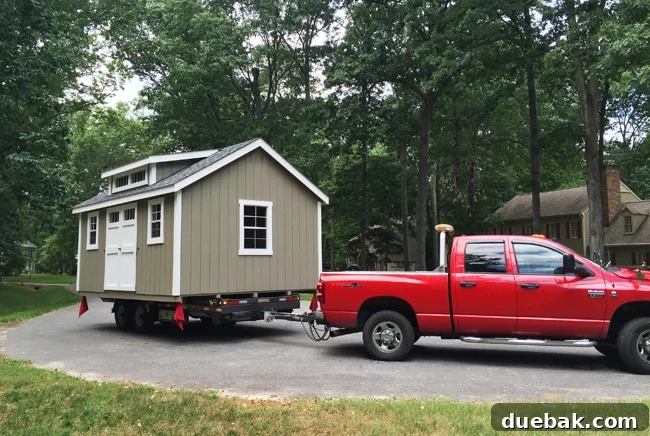
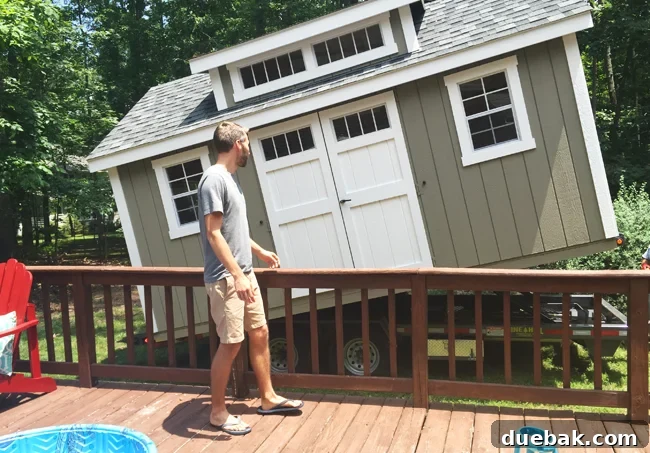
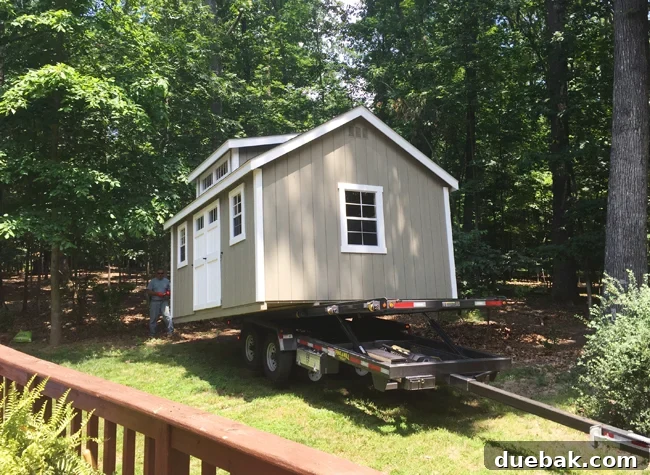
The installation process was genuinely fascinating to observe. It was orchestrated by a single, highly skilled individual, equipped with a specialized truck and a unique rig designed to maneuver the large structure precisely into place. Weeks prior, he had conducted a thorough site assessment, carefully mapping out the installation spot and ensuring all access points were clear for his equipment. This meticulous planning paid off, as there were thankfully no hiccups on the much-anticipated delivery day. His expertise highlighted the importance of professional installation for such substantial structures, guaranteeing a smooth and efficient process.
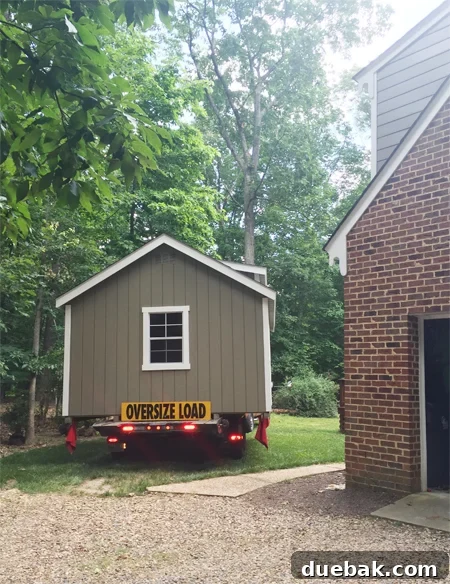
With his truck strategically positioned, the trailer slowly and steeply tipped the entire shed, initiating its precise movement backwards. It was certainly not an everyday sight, watching this colossal structure gracefully slide into its designated spot. I still find it incredible that a single person could manage such a feat. Once the shed was lowered close to the ground, he ingeniously slid several PVC pipes underneath its base. These acted as rollers, allowing him to precisely guide the shed into its final position. Utilizing the hydraulics on the trailer, he nudged it exactly where we wanted it, ensuring it was perfectly level and securely settled. This meticulous process underscored the importance of a stable and level foundation for the long-term integrity of the shed.
Beyond Installation: Essential Upgrades for a Functional Shed
Even after the shed was perfectly placed, our work wasn’t entirely complete. To truly make it a functional extension of our home, two critical tasks remained: bringing electricity to the structure and building a safe, accessible step at the entrance. These upgrades would transform it from a mere storage box into a versatile workspace.
Electrifying the Shed: Powering Projects and Lighting the Way
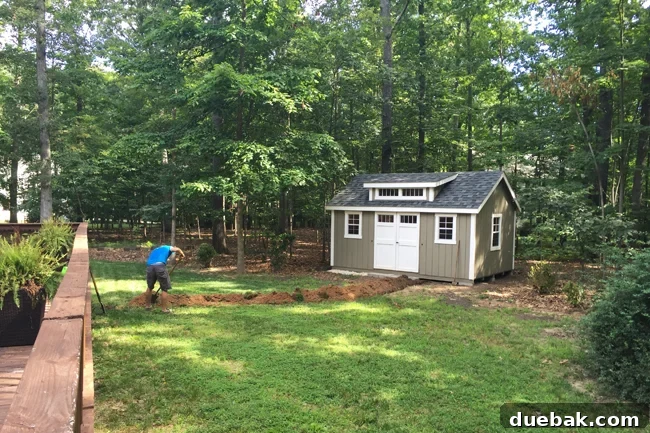
First and foremost, we needed to get electricity to the shed, essential for lighting, powering tools, and charging batteries. With our electrician scheduled for the wiring, I took on the task of digging the trench for the underground power line. Our electrician provided clear guidance on the optimal path and the required depth – a consistent 12 inches. I tackled this on a thankfully not-too-scorching Sunday morning, making steady progress. This particular step even had a little side story, which we humorously recounted in this week’s podcast, episode #10, highlighting the minor mishaps that often accompany DIY projects.
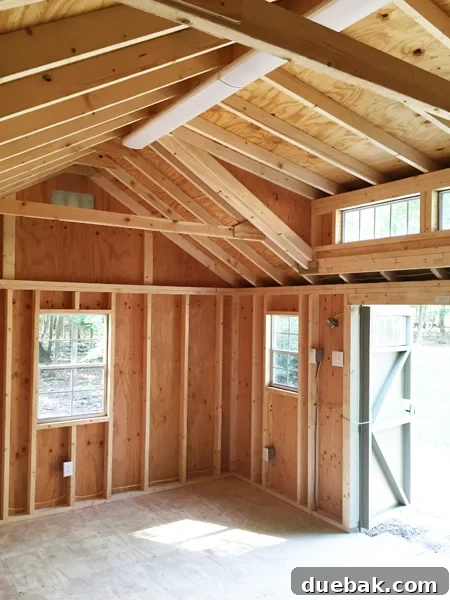
Inside the shed, we strategically placed outlets on each wall, with those along the back wall set at counter-height. This foresight was crucial, as I plan to build a permanent work table there, making it incredibly convenient to plug and unplug tools without bending or searching. For overhead lighting, we installed two 4-foot fluorescent-style LED lights across the ceiling. While we initially considered “prettier” decorative fixtures, our ultimate priority was bright, unobstructed illumination that would make the space genuinely functional for any task.
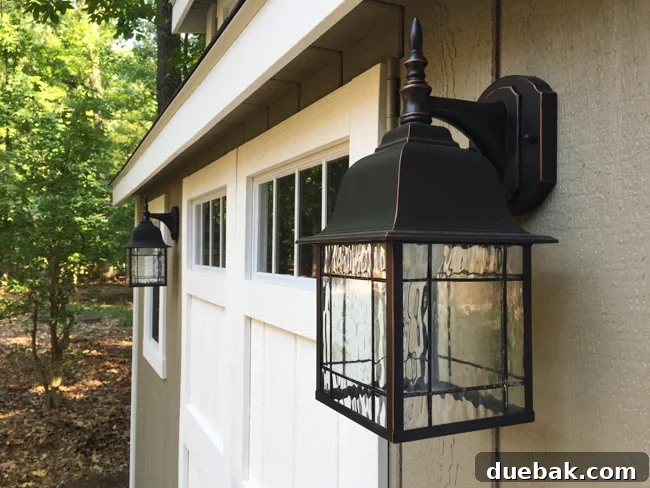
To enhance both safety and charm, we also added two sconces to the exterior of the shed, providing additional outdoor lighting for the backyard. We selected these LED fixtures because their design closely matched the existing sconces on our main house. This consistent aesthetic, along with matching the shed’s siding color to our house and ensuring the roof color was identical, helps to create a cohesive and integrated look between the two structures. This attention to detail ensures the shed doesn’t feel like an afterthought but a natural extension of our home’s design.
Building a Safe and Inviting Entrance: The Paver Step
Besides the electrical work, our other essential task was constructing a step at the shed’s entrance. The base of the shed was just slightly too high to feel natural or safe when stepping up into it. We opted for a simple step rather than a ramp, as we don’t anticipate storing our lawnmower or any other wheeled equipment inside. We built a sturdy step using stock pavers from Lowe’s. Interestingly, the hunt for the perfect pavers also generated its own share of “behind-the-scenes mishaps,” which we shared on the podcast – it seems this shed project was a catalyst for numerous mini-adventures!
I laid the step much like we constructed the paver patio at our previous house, albeit on a significantly smaller scale. The only slight complication arose from a cinder block that jutted out from beneath the shed. This isn’t typical installation, but the installer encountered a stubborn root that prevented him from pushing the shed back any further. This required a creative approach to integrate the step seamlessly.
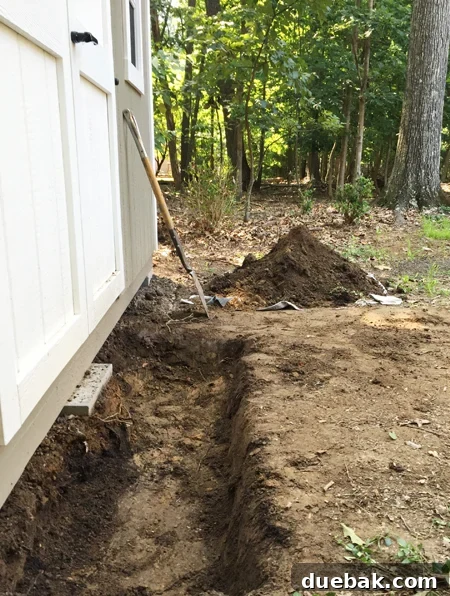
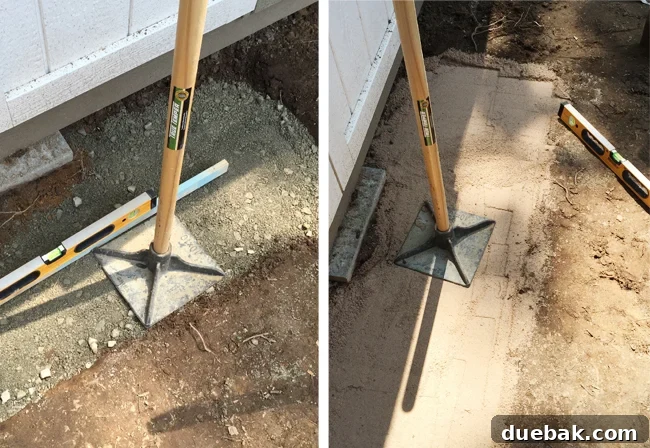
After digging my 12-inch deep hole (as seen in the photo above), I began filling it layer by layer. First came approximately 6 inches of paver gravel, which I carefully tamped down and leveled. This provides a crucial, stable base. Following the gravel, I added about 4 inches of paver sand, repeating the tamping and leveling process to create a perfectly flat surface for the pavers.
Initially, we weren’t entirely sure about the ideal height for the step, so we experimented with a few variations. We tried it with and without thin pavers on the bottom, and with the brick pavers laid flat or standing on their edge. Ultimately, we chose the middle variation: a thin paver base, topped with brick pavers laid flat, and then another thin paver layer on top. This configuration provided the best height, both aesthetically pleasing and ergonomically comfortable when stepping in and out of the shed.
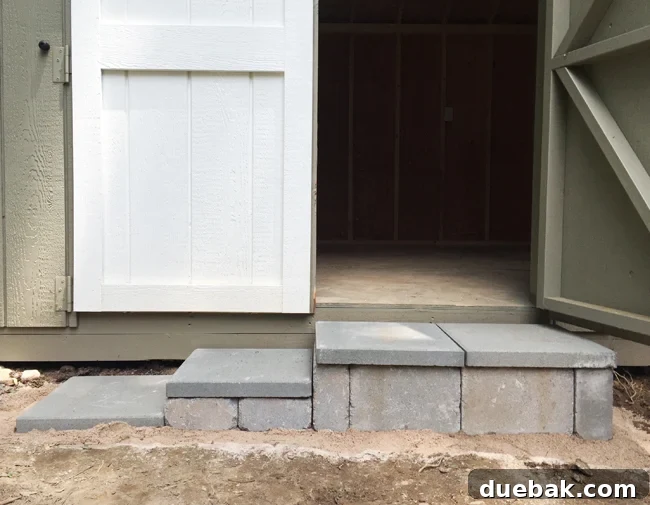
I had to carefully break up some of the pavers to accommodate that rogue cinder block, but I managed to ensure the visible portion around the border looked clean and normal. Once the pavers were in place, I filled any small gaps with additional sand, which I then packed down firmly. This creates a solid, cohesive surface that is both durable and visually appealing.
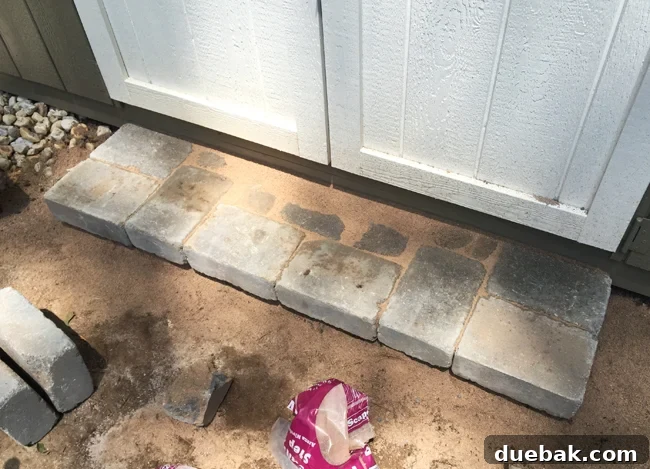
I purchased some landscape adhesive to secure everything permanently, though I haven’t applied it yet. We’re considering searching for a single, continuous piece for the top of the step, rather than the four individual pavers in a row. A single piece with a slight overhang could offer a more polished and finished appearance. But for now, this sturdy paver step is serving its purpose perfectly, making access to the shed safe and convenient.
Looking Ahead: Landscaping, Organization, and the Joys of a New Shed
With the shed fully installed and its essential utilities in place, our thoughts naturally turn to the final touches and long-term functionality. It doesn’t seem wise to undertake any intensive landscaping around our new shed in the intense summer heat – though I desperately hope this is the peak; it surely can’t get any steamier, can it? So, for now, here’s a quick Photoshop mock-up, offering a glimpse into our potential landscaping vision for this fall. We envision lush plantings that will further enhance the privacy, soften the shed’s lines, and seamlessly integrate it into the natural beauty of our backyard, fulfilling our initial goals of improved aesthetics and extended green space.
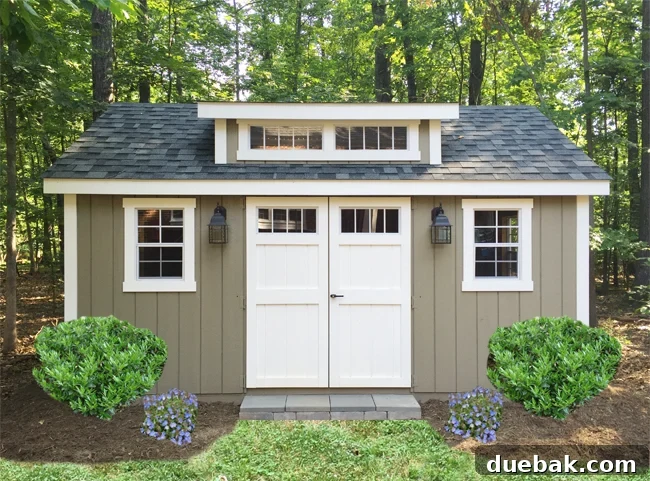
While we haven’t yet begun the exciting task of moving items into the shed, we’re taking our time to meticulously plan the interior layout. This includes designing the ideal size and configuration for a robust workbench, considering shelving units, and envisioning optimal storage solutions for all our tools and supplies. But despite the remaining tasks, I am an incredibly happy individual. All my shed dreams have come true, and the transformation has been truly remarkable. My wife has marveled no fewer than ten times at how much more cozy, private, and functional our backyard feels these days. The ultimate lesson gleaned from this entire project is clear: if you find yourself struggling to keep privacy plants alive, and every surface in your garage is perpetually covered in a half-inch of sawdust, it might just be the perfect time to invest in a big, beautiful, and utterly practical backyard shed. It’s more than just storage; it’s a home improvement that delivers on multiple fronts, bringing order, beauty, and peace to your living spaces.
*This post contains affiliate links