
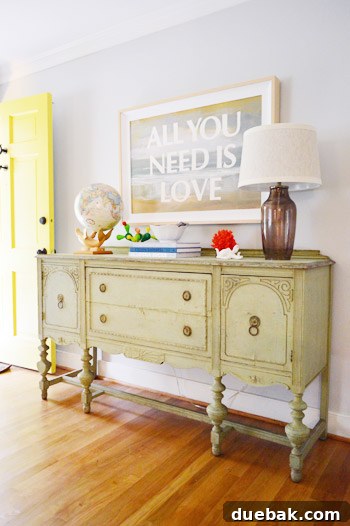
Welcome back to the world of vintage finds and satisfying DIY projects! Today, we’re revisiting a beloved piece that has taken center stage in our home: the gorgeous buffet cabinet we scored for an absolute steal on Craigslist. Remember the one that found its perfect spot in our entryway? Let’s take a fresh look at this beautiful piece and delve into its remarkable transformation journey. This isn’t just about furniture; it’s about seeing potential, embracing character, and giving a deserving antique a new lease on life without breaking the bank or dedicating an entire weekend.
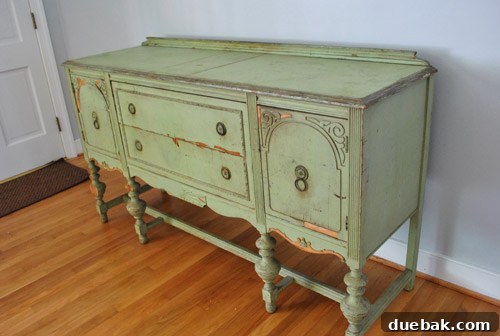
Upon acquiring this magnificent buffet, its inherent beauty was undeniable. It possessed a stately presence and a charming vintage appeal that immediately captivated us. However, like many treasures from the past, it also bore the marks of time and use – a few minor bumps, scuffs, and areas of wear that, while part of its story, needed a little tender loving care. Our goal wasn’t to strip away its history but to gently restore its dignity, addressing the more prominent imperfections while preserving its authentic, timeworn character. We envisioned a simple yet effective repair that would highlight its natural charm without sacrificing its hard-earned patina.
If you’re looking for a quick, impactful, and incredibly budget-friendly furniture refresh, this project is for you. We’re talking about a transformation that took roughly half an hour of active work and cost less than $3! This isn’t a complex, multi-day endeavor requiring specialized tools or extensive experience. Instead, it’s a testament to how minor touch-ups can make a monumental difference. The secret lies in a strategic approach that focuses on critical areas, blending repairs seamlessly with the existing finish. Here’s a look at the incredibly simple materials list we used to achieve such a dramatic revival:
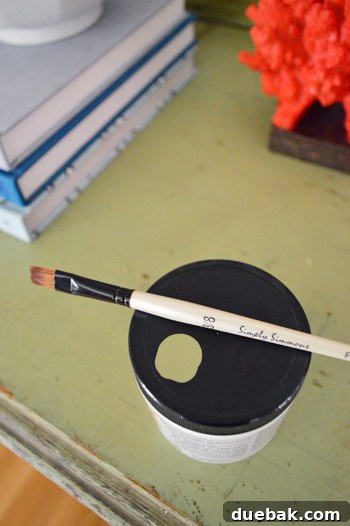
Essential Tools for a Swift Furniture Refresh
Indeed, the simplicity of our material list might surprise you. All it took was a small craft brush, which we already had on hand, and a $2.99 test pot of paint from Home Depot. The key to success here was meticulous color matching. We brought home a diverse selection of paint swatches and carefully held them against the buffet’s original finish under various lighting conditions. Our aim was to find a shade that didn’t just complement but practically melted into the existing color, creating an almost invisible repair. The winning color, for those seeking a soft, evocative green, was “Cricket” by Behr – a truly spot-on match that perfectly captured the buffet’s muted, moody elegance.
The Art of Restoration: A Step-by-Step Guide
Before diving into the painting, proper preparation is paramount, even for a quick refresh. This crucial phase ensures the repairs are durable and the final finish looks impeccable. Our preparation involved two vital steps:
- Securing Loose Elements: We began by thoroughly inspecting the entire buffet for any loose trim pieces or small, decorative wood carvings. Daily use can cause these elements to become unstable, leading to further chipping or detachment. To prevent future damage and ensure structural integrity, we applied Gorilla Glue to re-secure any wiggly parts, ensuring they were firmly adhered for the long haul. We allowed a full day for the glue to cure completely, guaranteeing a strong bond before moving on.
- Thorough Cleaning for a Fresh Canvas: Next, we gave the buffet an incredibly satisfying and cathartic scrub-down using a Magic Eraser. Over time, furniture can accumulate grime, smudges, and dullness, much like lead pencil rubbings, that obscure its true beauty. The Magic Eraser worked wonders, lifting away dingy areas and leaving the surface visibly cleaner and brighter. This step was essential for achieving a more uniform appearance and ensuring the paint would adhere properly, reducing any muddled look.
With the buffet thoroughly prepped and ready, it was time for the moment of truth: the paint application.
Strategic Spot Painting for Seamless Blending
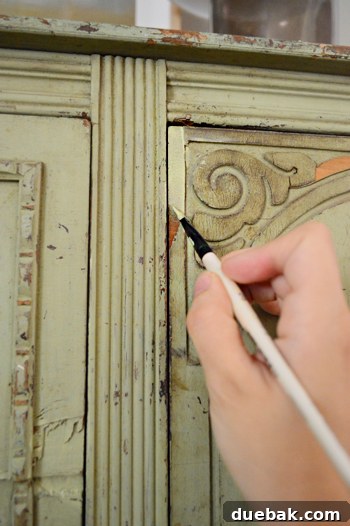
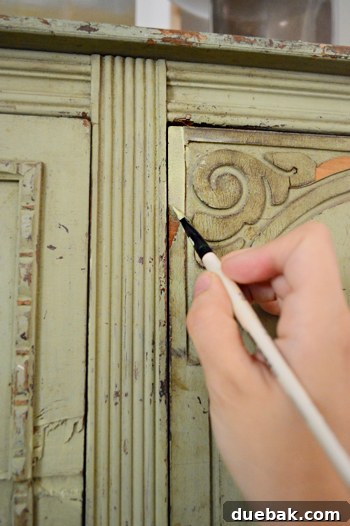
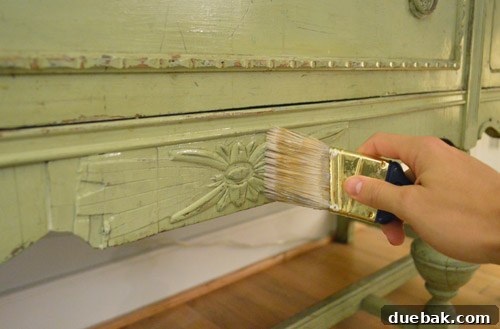
Our painting technique was far from conventional. We weren’t aiming for a full, even coat, but rather a strategic spot treatment designed to blend imperfections. Using the small craft brush, we carefully applied the “Cricket” paint only to the areas where we observed significant chunks of bare wood or deep scratches that detracted from the buffet’s overall aesthetic. The method involved a two-step process: first, we brushed on a thin layer of paint, and then, almost immediately, we gently blended the wet paint with the surrounding finish using the swipe of a paper towel. This technique was crucial. We deliberately avoided a thick, perfectly opaque application. The paper towel swipe served to subtly “distress” the newly painted area, ensuring it seamlessly integrated with the buffet’s existing, wonderfully imperfect, and timeworn surface. This process wasn’t about achieving a pristine, factory-new look; it was about respectfully filling in those more noticeable gaps and damages, allowing the buffet to retain its beloved, aged charm.
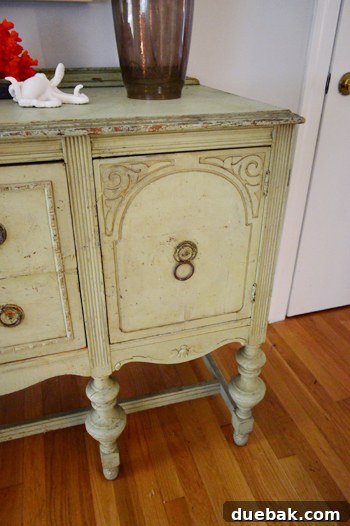
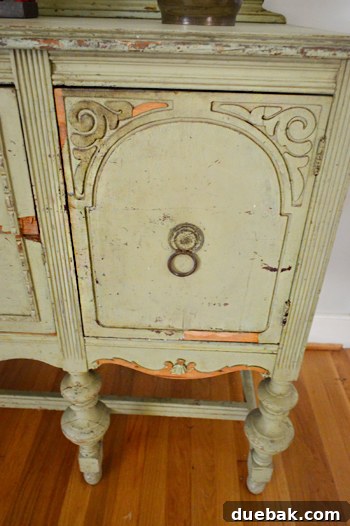
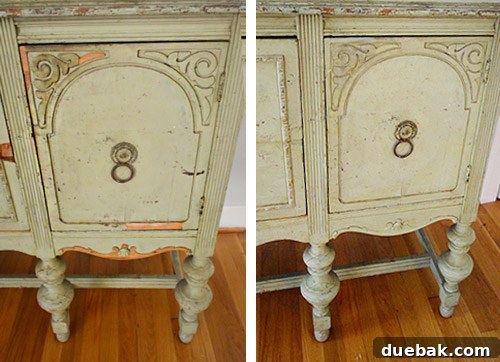
To truly illustrate the effectiveness of this technique, here’s a side-by-side comparison. You can clearly see that our objective was not to erase every dark spot or minor scratch. Instead, we focused our efforts on the more significant, gaping areas where the wood was extensively exposed or visibly broken. It’s important to note that freshly applied paint often appears lighter than its dried counterpart. However, once our carefully blended paint dried, the results were incredibly satisfying – a remarkably seamless integration that brought a renewed sense of cohesion to the buffet’s surface without sacrificing its antique allure.
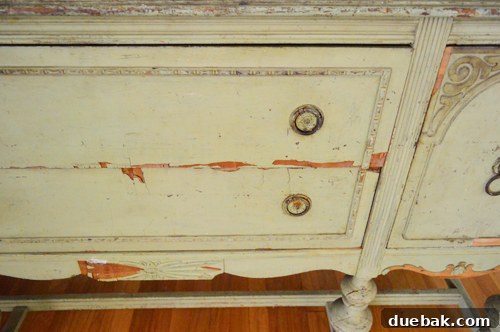
Let’s take a closer look at another detail to fully appreciate the transformation. Before the touch-ups, certain areas of the buffet broadcasted a more significant level of damage, appearing a bit too “dinged-with-a-baseball-bat” rather than simply aged gracefully. These were the spots that truly needed our attention, impacting the overall perception of the piece.
And here is the after shot of that same area:
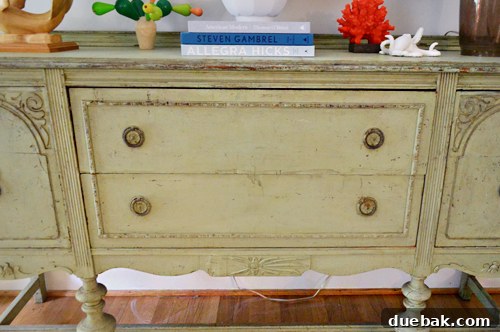
Now, our beautiful buffet still proudly bears its history, looking old and deeply loved, but without those distracting, almost jarring imperfections that subtly broadcasted neglect. The transformation was quick, incredibly easy, and undeniably cheap – a true win-win in the world of DIY. You might also notice that our playful, snake-adorned pumpkins aren’t gracing the console in this particular image (they’ve since moved to the front porch, ready for autumn). However, exciting plans are already brewing to “fall-a-fy” this surface with new seasonal decor very soon. It seems the spirit of crafting and decorating is calling once again!
The Final Layer of Protection: Sealing Your Masterpiece
After the meticulous gluing, the refreshing scrub-down, and the artful spot-painting, the final, crucial step in our “Operation Buffet-mou-flage” was to apply a protective sealer. This layer is essential for durability, ensuring that our carefully restored buffet can withstand daily use without its newfound beauty fading. For this, we turned to SafeCoat Acrylacq, which has become our absolute favorite non-toxic sealer. Its satin finish is a key feature; it provides excellent protection without creating an overly shiny or artificial look, allowing the natural luster and character of the wood and paint to shine through subtly.
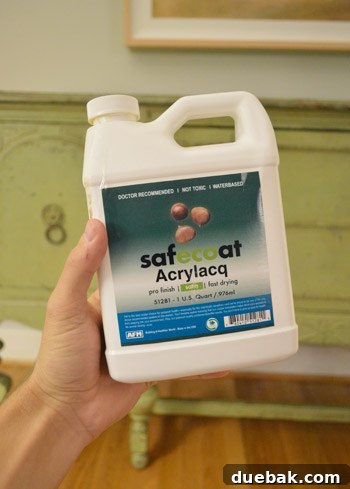
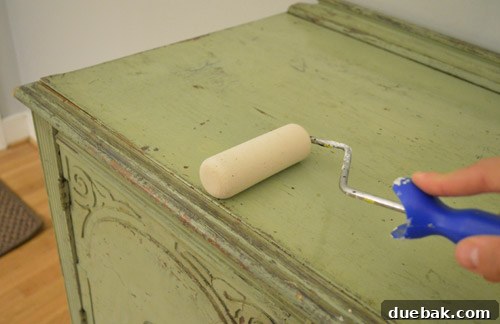
To achieve the best possible finish with SafeCoat Acrylacq, we swear by applying it in three thin, even coats. Our preferred method for broad, flat surfaces involves using a small foam roller. This tool ensures the sealer is spread thinly and uniformly across the surface. A common mistake is to apply the sealer too thickly, which can result in a gloppy, uneven, and less appealing finish. Thin coats are key to a professional-looking, durable result.
For the more intricate details and bumpy parts of the buffet – the ornate carvings, grooves, and edges that a roller can’t reach effectively – a small brush becomes an indispensable tool. It allows for precise application, ensuring that every nook and cranny receives adequate protection. Again, the principle of thin and even application remains paramount. Overloading the brush or applying too much product in these detailed areas will lead to the dreaded “gloppy territory,” compromising the smooth, satin finish we worked so hard to achieve. Patience and a light hand are your best friends here.
A Testament to Timeless Beauty
With its minor blemishes carefully addressed, its character preserved, and a protective layer applied, this buffet now truly deserves a metaphorical “lovingly restored” sticker. It stands as a proud example of how mindful intervention can elevate an old piece without erasing its soul. But please, resist the urge to apply any actual stickers to the buffet itself – our furry friend, Sherdog, has a particular disdain for such adornments and might get a bit feisty! Thankfully, our little Clara tends to confine her sticker artistry to various body parts, which is a much more amusing and less permanent canvas.

Atta girl!
Embrace the Quick Fix: Your Next Furniture Adventure Awaits
Are you out there, like us, showing some much-needed love to old pieces of furniture without resorting to the laborious and often messy process of stripping them down entirely and starting from scratch? There’s an undeniable charm and efficiency in these “quick fix” projects. Instead of dedicating an entire demanding weekend to a full-scale overhaul, these kinds of restorations typically take just a few hours, offering immense satisfaction with minimal time investment. It’s truly a rewarding experience, wouldn’t you agree? These shorter projects also free up more of your precious time for other important pursuits, like, say, indulging in an excessive amount of Halloween candy corn and then, inevitably, experiencing profound regret about an hour later. Or perhaps that delightful scenario is just a unique personal tradition of mine?
We hope this detailed guide encourages you to look at your own worn furniture pieces with fresh eyes and consider the transformative power of a little paint, glue, and a whole lot of love. Sometimes, the most beautiful restorations are those that honor the past while preparing a piece for many more years of cherished use.