
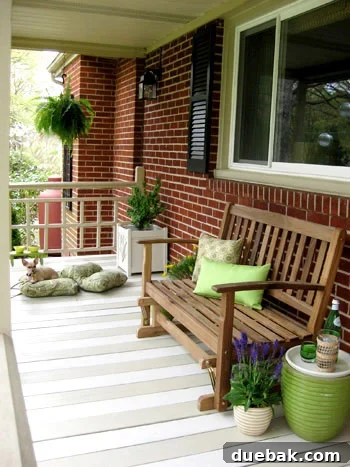
Transform Your Outdoor Space: A Comprehensive Guide to Painting Your Wood Deck or Front Porch (Including Stylish Stripes!)
Are you dreaming of revitalizing your outdoor living area? A fresh coat of paint can dramatically transform a tired, weather-beaten wood deck or breathe vibrant new life into a dull front porch. Far more than just a splash of color, painting your outdoor surfaces offers protection against the elements, enhances curb appeal, and provides a customized aesthetic that truly reflects your style. Whether you’re looking to protect your investment, add a pop of color, or create a unique design like a chic striped pattern, this detailed guide will walk you through every step of the process. We recently took on this challenge ourselves for a 48-Hour Challenge with Better Homes & Gardens and Home Depot, opting for subtle tan and cream stripes, and the results were stunning. Now, we’re sharing our simple yet effective tutorial to help you achieve a professional-looking finish with confidence.
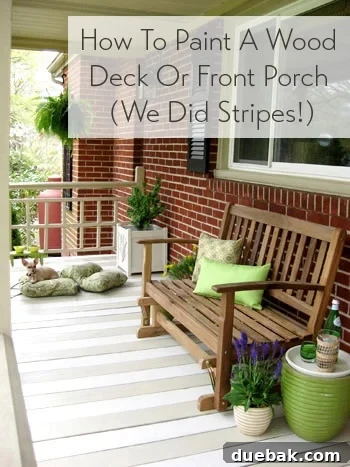
Step 1: Selecting the Perfect Colors and Paint for Your Deck or Porch
The foundation of any successful painting project lies in choosing the right colors and paint type. This crucial first step sets the tone for your entire outdoor space. Don’t rush it! For our project, we envisioned a subtle yet sophisticated striped effect, leading us to consider various shades of tan and cream. To make an informed decision, we gathered an assortment of paint swatches from our local home improvement store and laid them directly on the porch floor. Observing the swatches in the natural light that our front porch receives daily was indispensable. Artificial indoor lighting can drastically alter how colors appear, so viewing them in their intended environment ensures you select hues that perfectly complement your home’s exterior and landscaping.
After careful consideration, Behr’s Harvest Brown (a warm, inviting tan) and Ralph Lauren’s Greenwich (a classic, crisp cream) emerged as the perfect combination for our striped design. Once our colors were chosen, we had them custom-matched to a gallon each of Behr Porch & Floor Paint. This specific type of paint is engineered for high-traffic outdoor surfaces, offering superior durability against constant foot traffic, varying weather conditions, and UV exposure. When selecting your paint, you’ll also encounter a choice between different finishes, typically glossy or flat. We opted for a flat finish, primarily for practical reasons. A flat finish provides more grip, making it less slick and safer in wet conditions, which is an important consideration for any outdoor surface. We’ve since tested our freshly painted deck in the rain and can happily report that the flat finish maintains a texture comparable to unpainted wood, offering excellent traction.
Beyond color and finish, consider the overall aesthetic you want to achieve. Do you want a bold statement or a subtle enhancement? Are you aiming for a modern look, a rustic charm, or a timeless elegance? Research different outdoor paint trends and finishes to inspire your choice. Investing in high-quality porch and floor paint is essential for longevity and a professional result, as these areas endure significant wear and tear.
Step 2: Thorough Preparation – Cleaning Your Deck or Porch for Optimal Adhesion
Before any paint touches your wood deck or porch, meticulous cleaning and preparation are absolutely non-negotiable. This step is critical for ensuring proper paint adhesion and a smooth, long-lasting finish. Skipping this can lead to premature peeling, blistering, and a significantly diminished lifespan for your paint job. Start by removing all furniture, potted plants, and any other items from the area. Sweep away loose debris, leaves, and dirt.
For most decks, a thorough scrubbing with a specialized wood cleaner (readily available at Home Depot or Lowe’s) is highly recommended. These cleaners are formulated to remove grime, mildew, algae, and even tough grease or oil stains that accumulate over time. Follow the product instructions carefully, which often involve applying the cleaner, allowing it to penetrate, and then scrubbing with a stiff brush. For severely stained or mildewed areas, you might need to use a pressure washer, but be cautious with the pressure setting to avoid damaging the wood fibers. If you don’t have severe stains, a simple yet effective method is to spray each plank down at close range with a garden hose set to a “full spray” nozzle. This powerful stream can effectively blast away pollen, old acorn pieces, spiderwebs, and other superficial debris, providing a nice, clean slate for painting.
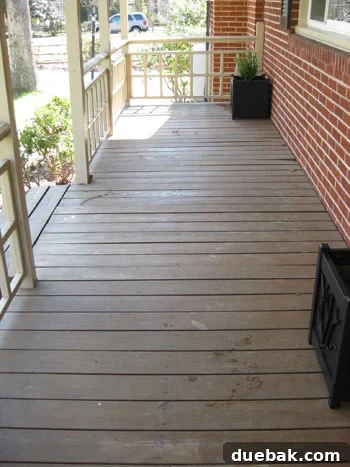
After cleaning, allow your deck or porch to dry completely. This can take anywhere from 24 to 48 hours, depending on humidity levels and weather conditions. Painting moist wood is a recipe for disaster, as it prevents proper paint adhesion and can trap moisture, leading to peeling. While the deck dries, take the opportunity to inspect between the wood planks for any lodged rocks, leaves, or other small debris. A flat-head screwdriver works perfectly for dislodging these stubborn bits. Here’s our porch just before its essential hosing-down session:
Step 3: Protecting Your Home’s Exterior and Edges
With your deck sparkling clean and completely dry, it’s time to protect the surrounding areas of your home. This step is crucial for achieving crisp, clean paint lines and preventing accidental drips or splatters on your siding, stucco, brick facade, or any adjacent trim. High-quality blue painter’s tape is your best friend here. Apply the tape meticulously along the edges where your deck or porch meets the house. Press it down firmly to ensure a tight seal that prevents paint from seeping underneath.
Don’t skimp on the tape – it’s a small investment that saves a lot of time and frustration later. Consider taping off any posts, railings, or permanent fixtures that you don’t intend to paint. If you have delicate landscaping or plants directly bordering the deck, use drop cloths or plastic sheeting to cover them. Once everything is properly masked off, you’re ready to start painting! At this stage, grab a good quality angled paint brush. While rollers are great for large, flat surfaces, an angled brush is far superior for getting into the cracks and crevices between individual wood planks, ensuring complete coverage and a truly professional finish. Now, with your deck thoroughly dry and your protective measures in place, it’s truly go-time!
Step 4: Strategic Painting – Starting Your Project with Precision
Now for the exciting part – applying the paint! When painting any floor, especially a large outdoor surface, strategic planning of your starting point is key. You need to ensure you can comfortably paint yourself out of the area without stepping on wet paint. For our striped project with two distinct colors, we opened both paint cans and dedicated a separate, clean brush to each color, exercising extreme caution to prevent any accidental mixing of brushes or paint. This meticulous approach is vital for maintaining the integrity of your striped pattern.
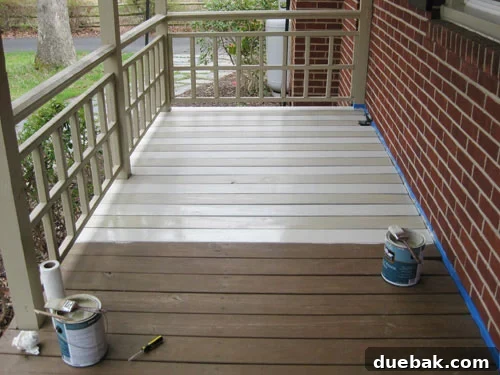
Our strategy involved starting at one end of the deck and meticulously working our way towards the center, where the main stairs provided a natural exit point. Begin by painting one plank or a section of planks in your first chosen color, ensuring full coverage and smooth, even strokes. If you’re creating stripes, precisely apply the first color to your designated planks, then move to the adjacent planks for your second color, following your predetermined pattern. Always apply thin, even coats, rather than thick, heavy ones, which can lead to bubbling or uneven drying. Patience is key here, especially for the initial application. Observe how the paint is absorbed by the wood and aim for consistent coverage. Taking your time in this initial phase will lay the groundwork for a beautiful and enduring finish. Here’s a glimpse of our porch as the painting process began:
Step 5: Maintaining Momentum – The Art of Continuous Painting
Painting a large deck or porch, especially with a striped pattern, can be a time-consuming endeavor. It requires endurance and a steady hand. The key to success is to find a rhythm and maintain your focus. Don’t be discouraged by the sheer volume of work; instead, break it down into manageable sections. Put on your favorite music or a podcast, get into a comfortable position, and let the process flow. Try not to get caught up in constantly calculating “two planks down, fifty-nine to go,” as this can quickly diminish your enthusiasm. Focus on the plank you’re currently painting, ensuring clean lines and consistent coverage. For striped patterns, this means paying close attention to the demarcation between colors and ensuring each stripe is crisp and even.
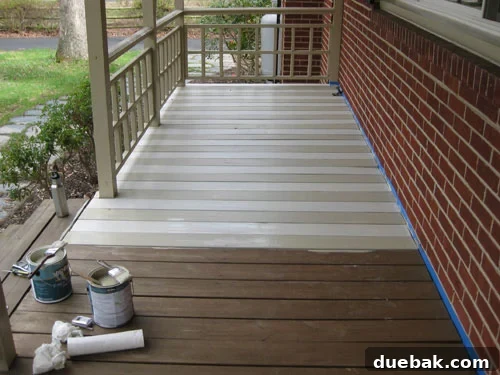
As you continue, you’ll naturally develop a technique that works best for you. Remember to frequently stir your paint to keep the pigments evenly distributed, especially if you’re using multiple colors. If you need to take a break, ensure your brushes are properly stored to prevent drying out; wrapping them tightly in plastic wrap or placing them in a brush keeper with water (for latex paints) can keep them pliable. Consistency in application is crucial for a professional-looking result. Ensure that each stripe is painted with the same attention to detail as the last. Embrace the journey, enjoy the transformation unfolding before your eyes, and keep painting until your vision starts to truly materialize.
Step 6: The Exit Strategy – Planning Your Retreat and Pattern Accuracy
One of the most critical aspects of painting a floor is the “escape plan.” For our front porch, I determined the most logical approach was to paint myself towards the front steps, allowing that section to dry. Then, I would strategically restart painting from the opposite corner of the deck, working my way back towards the front steps. This allowed me to finish the remaining sections and exit the house through the back door, leaving the entire front porch undisturbed to dry thoroughly. This strategy minimizes the risk of stepping on wet paint and ruining your hard work.
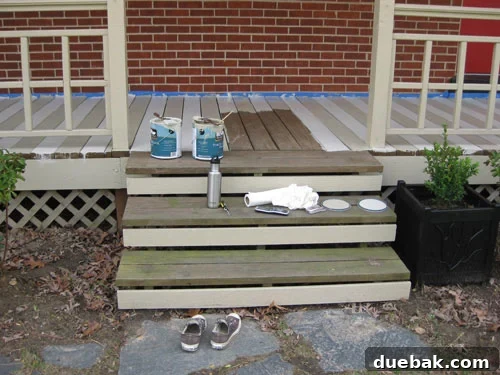
For a striped pattern, this exit strategy becomes even more imperative and requires meticulous planning. It was absolutely crucial that I accurately calculated which planks would be tan and which would be cream. Before picking up my brushes for the second half of the deck, I carefully counted “tan, cream, tan, cream” down each plank three times. This redundancy ensured I could restart painting from the opposite end of the deck without disrupting the established pattern. A simple miscalculation here could mean hours of corrective work, or worse, a compromised aesthetic. Always double-check your pattern and plan your painting path to avoid any missteps, literally and figuratively.
Step 7: The Edges Define the Finish – Adding That Crisp, Professional Look
After you’ve successfully painted yourself off the main surface of the porch or deck, you’ll notice that the sides of the wood planks, which form the perimeter, still need attention for a truly finished look. As seen in the image above, ignoring these edges can leave your project looking incomplete. This step is about adding that final touch of professionalism and crispness.
For our striped porch, I opted for a consistent approach on the sides of each plank: sticking entirely to the tan color. Instead of attempting to alternate the tan and cream stripes down the vertical edges – which would have been significantly more challenging and time-consuming – I chose to have only the top surface of the planks boast the alternating colors. The side/front edges of the decking remained a uniform tan. This decision provided a wonderfully crisp, clean boundary for the striped pattern and was considerably easier to apply. This singular color choice for the edges creates a sophisticated frame for the striped deck, tying the entire look together without introducing unnecessary complexity. Take your time with this step, using your angled brush to carefully apply paint to all visible edges, ensuring an even coat and a smooth transition.
Step 8: Celebrate Your Achievement – Final Touches and Curing Time!
Congratulations, you’ve painted the entire perimeter of your porch or deck! Once the edges of your wood planks are painted all around, you are officially finished with the application. Well, almost. This assumes that one coat of paint achieved the desired effect, as it did with our project. We personally loved the subtly weathered, slightly translucent look that a single coat provided, giving it a charming, lived-in feel.
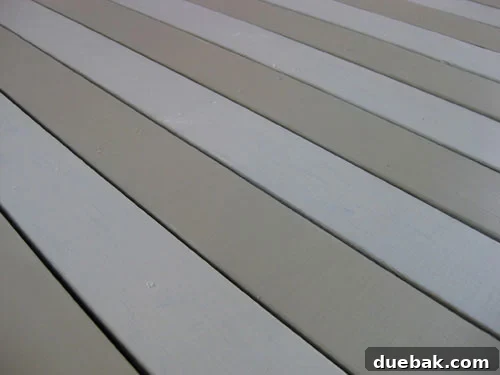
However, if you’re aiming for a super solid, opaque, and vibrant color effect, a second coat of paint is highly recommended. For optimal results, wait at least 24 hours – or even longer, depending on the paint manufacturer’s instructions and local humidity – before applying the second coat. This ensures the first coat has fully dried and cured sufficiently to withstand additional paint application without lifting or smudging. It’s also crucial to allow the deck or porch to cure completely before resuming regular foot traffic and replacing furniture. This “cure time” is typically longer than the “dry to touch” time, often several days to a week. Refer to your paint can’s instructions for specific drying and curing times to ensure maximum durability and longevity of your new deck or porch paint. Once fully cured, you can confidently dance it out – your beautiful, transformed outdoor space is ready to enjoy!
Enhancing Your Entryway: The Power of Painted Accents
Beyond full deck painting, consider the impact of painted accents. You might have noticed in earlier photos that we had previously painted the front of our steps and the wide plank of wood encircling the deck in the same inviting tan tone used for our stripes. This is an excellent, often overlooked, way to accent a front porch and visually break up large expanses of natural wood, especially if you’re hesitant about painting the entire surface.
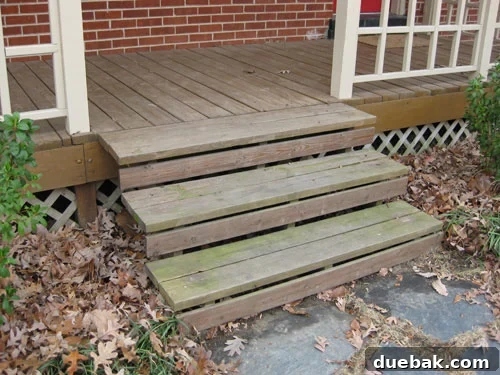
Painting just the risers of your steps or the trim around your porch can be a super simple yet incredibly effective way to add a touch of crispness and definition to your entryway. It requires less paint, less labor, and significantly less drying time, making it an ideal weekend project. To protect the actual treads of the stairs from paint drips, you can meticulously tape them off, or, as we did, use a piece of sturdy cardboard as a quick and effective shield against accidental swipes.
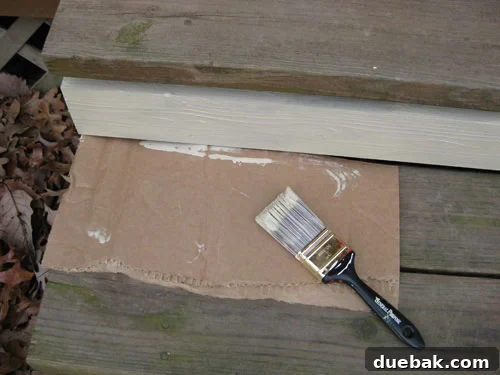
Here’s a picture of the front of the steps after we painted them tan, along with the wood “front” that encircles the porch. This entire accent project took less than an hour! An added bonus: you don’t even necessarily need specialized porch and floor paint for these areas, as they don’t typically withstand heavy foot traffic. We simply used some leftover exterior trim paint from another project, effectively transforming the look without spending an extra dime. The lesson here is clear: whether you’re interested in adding a little bit of subtle zing with some painted porch “trim” or a roller barrier for security…
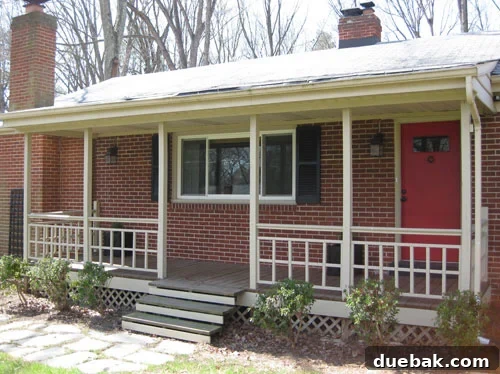
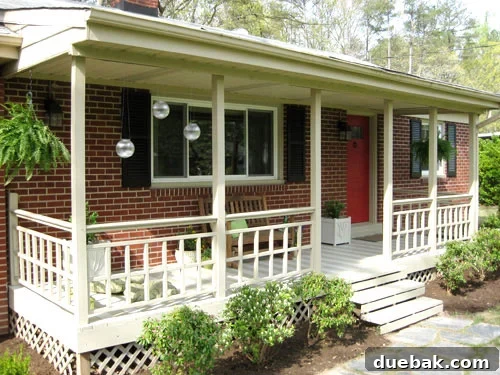
…or aiming for a whole lot of polish and personality with a fully painted (and perhaps even striped) porch floor, there’s truly nothing inherently difficult about either process. If you possess the basic skills to paint a wall, you can absolutely conquer painting a wood deck or a porch floor. With a bit of planning, the right materials, and a touch of patience, you’ll be doing the happy dance on your beautifully transformed outdoor space in no time, enjoying the enhanced curb appeal and extended life of your wooden surfaces.
Eager to explore more floor painting techniques? Discover our other helpful tutorials on how to stain a concrete floor for a durable, modern look, or learn how to paint an indoor floor for a more polished and finished effect that mirrors the elegance of a newly renovated room.