

Unplug and Play: Discover the Timeless Fun of Pen and Paper Games
In an increasingly digital world, there’s a unique charm and undeniable benefit to unplugging and engaging in classic, screen-free entertainment. If you’re searching for an engaging and accessible way to spend quality time with friends, family, or even enjoy some reflective solo moments, look no further than the delightful realm of pen and paper games. These timeless activities are not only incredibly fun and easy to learn but also require absolutely no fancy gadgets, expensive technology, or cumbersome setups.
Everyone should have a repertoire of a few favorite paper and pencil games at their fingertips, ready to spontaneously bust boredom wherever life takes them. Whether you’re stuck in a waiting room, embarking on a long road trip, enduring a plane journey, or simply need to keep energetic kids happily occupied, these games are the perfect solution. Beyond mere entertainment, they can also serve as a fantastic tool for those who find doodling or drawing helps them listen more effectively or concentrate better – making them a versatile option for various situations.

While modern family board games offer wonderful opportunities for creating shared memories, they often come with small pieces that are easily lost, making them less ideal for on-the-go fun. Pen and paper games, however, shine in their simplicity and portability. The absolute best part? All you truly need is a single piece of paper and a writing utensil – a pen or pencil – to unlock hours of engaging entertainment and cognitive stimulation. They offer a refreshing break from screens, fostering creativity, strategic thinking, and social interaction in a wonderfully uncomplicated way.
Why Pen and Paper Games Are Essential for Everyone
Beyond being mere time-fillers, pen and paper games offer a wealth of benefits for players of all ages. Their accessibility and simplicity belie their power to develop crucial skills and foster meaningful connections.
Cognitive Benefits: Sharpening the Mind
Many pen and paper games are stealthily educational. They encourage critical thinking, problem-solving, and strategic planning. Word games, in particular, can significantly boost vocabulary, spelling, and language skills. Even simple drawing games enhance creativity and visual-spatial reasoning. For children, these games are fantastic for developing fine motor skills and hand-eye coordination.
Social Benefits: Connecting Through Play
In an era dominated by individual screen time, pen and paper games provide a valuable opportunity for genuine face-to-face interaction. They encourage communication, turn-taking, and healthy competition. Playing these games together can strengthen family bonds, foster teamwork (in collaborative games), and create lasting memories without the distractions of digital devices. They’re excellent conversation starters and relationship builders.
Practical Benefits: Accessible Fun Anywhere
Perhaps the most compelling advantage of pen and paper games is their unparalleled practicality. They are incredibly cost-effective – often free if you have basic supplies on hand. Their portability makes them perfect travel companions, fitting easily into any bag without adding significant weight or bulk. From waiting rooms to camping trips, long car rides to rainy afternoons at home, these games are the ultimate boredom busters, ready to provide instant entertainment whenever and wherever you need it.
Easy Pen and Paper Games for Young Explorers & Quick Fun
These simple yet captivating games are perfect for introducing younger children to the world of analog play. They require minimal instructions, making them ideal for quick engagement and instant gratification.
Tic Tac Toe
The enduring classic. The rules of Tic Tac Toe are universally simple, making it one of the most recognizable and beloved pen and paper games. It’s played on a straightforward three-by-three grid. One player chooses to be ‘X’, and the other ‘O’. Players take turns marking an empty square with their symbol. The objective is to be the first player to get three of your marks in a row – be it horizontally, vertically, or diagonally. This game is excellent for teaching basic strategy, pattern recognition, and the concept of winning and losing in a friendly manner. Perfect for very young children or whenever you have just a minute or two to spare.

Dots and Boxes
Simple to learn, surprisingly strategic. This engaging game, often played by two players but adaptable for more, starts with a grid of dots. You can either use graph paper or quickly draw your own grid of dots on any piece of paper. Each player takes turns drawing a single straight line to connect two adjacent dots, either horizontally or vertically – no diagonal lines allowed. The strategic twist comes when a player draws the fourth line that completes a box. When you complete a box, you immediately claim it by writing your initial inside, and then you get an extra turn to draw another line. Play continues until all possible lines have been drawn and all boxes are closed. The player with the most initialed boxes at the end of the game is declared the winner. Dots and Boxes is fantastic for developing spatial reasoning and foresight, as players try to create boxes for themselves while preventing opponents from doing the same.

Hangman (or Spaceman)
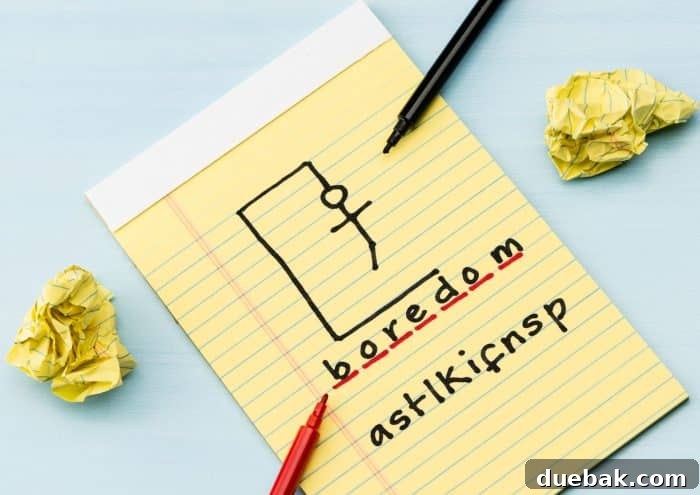
A classic word-guessing challenge. For those who prefer a less violent, more contemporary twist on the classic, “Spaceman” is an excellent alternative name with the same engaging rules. One player secretly thinks of a word and draws a series of dashed lines on a sheet of paper, each dash representing a letter in their chosen word. The other player (or players) then takes turns guessing a letter of the alphabet they believe might be in the word.
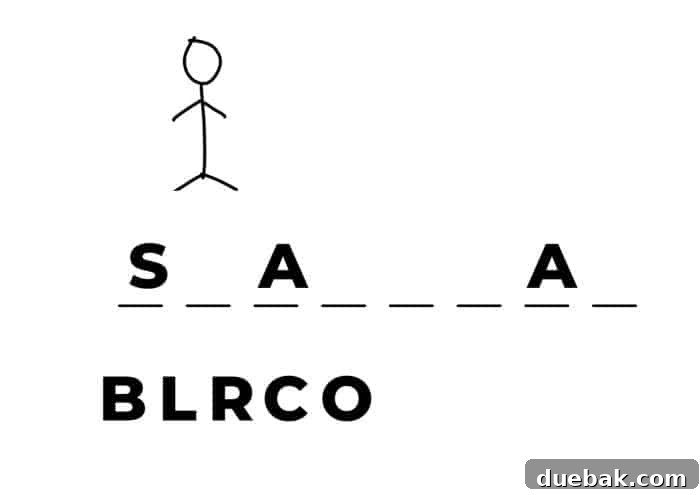
If a guessed letter is correct, the word-master writes it above all corresponding dashes in its correct position(s). If the guess is incorrect, the letter is typically written below the dashed lines (to keep track of used letters), and a part of the ‘hangman’ or ‘spaceman’ figure is drawn. Before the game begins, players decide how many incorrect guesses are allowed – a common setup involves drawing a head, body, two arms, and two legs, totaling six incorrect guesses. For a harder challenge, you can add details like eyes, a mouth, or even hair. Players continue guessing letters until they either successfully deduce the entire word or the hangman/spaceman drawing is completed, signaling too many incorrect guesses. This game is fantastic for building vocabulary, improving spelling, and developing deductive reasoning skills.
Intermediate Pen and Paper Challenges for Growing Minds
For those seeking a bit more depth, strategy, or a longer gameplay experience, these intermediate pen and paper games are ideal. They often require more elaborate rules and offer greater opportunities for strategic thinking, making them a hit with older children, teenagers, and adults alike. It might take a few rounds to fully grasp the nuances, but the rewarding gameplay is well worth it.
Pictionary
Unleash your inner artist (and guesser!). Pictionary is a fantastic team-based drawing and guessing game that can accommodate any number of players and groups of all sizes. To start, divide your group into at least two teams. Each team will need its own separate sheet of paper to brainstorm and create a list of words or phrases that can be drawn. Think everyday objects, animals, movie titles, famous landmarks, actions, or abstract concepts – anything interesting that offers a visual representation. Write down these chosen words on small pieces of paper and fold them up, placing them into a designated container for each team.
Teams take turns. One player from the active team acts as the “drawer,” while their teammates try to guess what is being sketched. A crucial element is setting a time limit, typically one minute per drawing, to add excitement and urgency. The drawing player cannot speak or use gestures other than drawing. If their team guesses correctly within the time limit, they earn a point. The team with the highest score at the end of the game wins. Pictionary is a brilliant game for fostering creativity, non-verbal communication, and quick thinking under pressure. It’s also incredibly adaptable; you can tailor the word lists to specific age groups or themes.
Battleship
A naval strategy showdown. The classic game of Battleship, renowned for its plastic board game version, actually originated as a pen and paper game known as “Broadsides,” played by sailors during their downtime at sea. It was later commercialized into the popular board game we know today, becoming a timeless classic for children and adults alike.
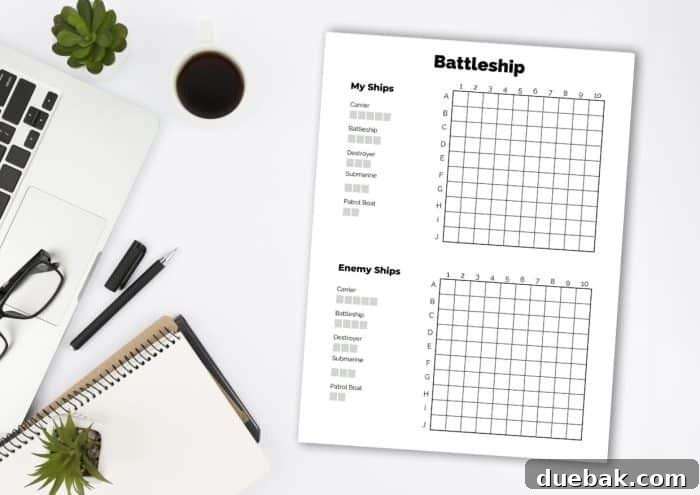
The basic gameplay is simple yet incredibly engaging: each player secretly places their “ships” (represented by drawing rectangles of varying lengths) on a grid, typically 10×10, marked with letters and numbers (A-J, 1-10). The goal is to locate and sink your opponent’s entire fleet before they sink yours. Players take turns calling out coordinates (e.g., “B7”). Their opponent then replies “Hit!” if a ship occupies that square, or “Miss!” if it’s empty. Hits are marked, and once all squares of a ship are hit, that ship is sunk. The first player to successfully sink all of their opponent’s ships wins. For the paper version, you’ll need two grids per player: one “My Ships” grid to place your own fleet and mark enemy hits, and one “Enemy Ships” grid to record your guesses and mark hits/misses against your opponent. The simple setup combined with deep strategic elements makes Battleship a perpetually appealing game for the whole family, honing logical deduction and spatial reasoning.
Connect 4 (Paper Version)
The vertical strategy game on paper. This is a clever paper adaptation of the popular board game where players aim to be the first to get four of their markers in a row, either horizontally, vertically, or diagonally. Just like Tic Tac Toe, this two-player game assigns one player ‘X’s and the other ‘O’s. The gameboard is typically a grid, often six rows high and seven columns wide, mimicking the physical game’s dimensions. Players alternate drawing their chosen letter into one of the squares.
The critical rule that translates the physical game’s gravity to paper is this: you must always place your letter in the lowest available space within a chosen column. If a column is empty, you can place your letter in the bottom-most square. If there are already letters in that column, your letter must be placed directly above the highest existing letter. The first player to successfully align four of their letters in a consecutive row – horizontally, vertically, or diagonally – wins the game. This paper version of Connect 4 provides excellent practice in strategic planning, pattern recognition, and anticipating your opponent’s moves.
Jumbled Up
A brain-teasing word unscramble. Jumbled Up is a straightforward yet highly effective game for boosting vocabulary and exercising your brain. Player one thinks of a word, typically a moderately challenging one, and then deliberately jumbles up its letters into a confusing sequence. Player two’s challenge is to rearrange these scrambled letters to decipher the original word. To make it more visually stimulating and perhaps trickier, a great game tip is to write the jumbled letters in a circular pattern, making their linear order less obvious and encouraging a more free-form rearrangement.
For an added layer of excitement and difficulty, introduce a time limit for player two to solve the anagram. This game is not only fun but also a superb way to improve spelling, recognize common letter patterns, and expand one’s word bank. It can be played collaboratively, with multiple players working together to solve the scramble, or competitively, with teams racing against each other.
Categories (or Paper Scattergories)
A rapid-fire word association challenge. The beloved board game Scattergories actually finds its roots in this classic pen and paper game known simply as “Categories.” This is a dynamic game where players must quickly name objects within specific categories, all of which must start with a randomly chosen letter of the alphabet. This game truly shines when played with groups, ideally six to eight people, as the diversity of answers makes it more competitive and exciting.

To play, everyone draws a grid with several columns labeled for categories (e.g., “Animals,” “Countries,” “Things in a Kitchen,” “Famous People,” “Adjectives”). A random letter is chosen (e.g., by rolling a die with letters on its sides, or simply picking one from a hat). A timer, usually set for one to three minutes, is started. During this time, all players simultaneously try to write down a word for each category that begins with the chosen letter. The object of the game is to score the most points by choosing unique and legitimate answers that no other player has used. If multiple players have the same answer for a category, no points are awarded for that answer. Unique, correct answers earn a point. Categories is excellent for quick thinking, expanding general knowledge, and vocabulary, and it always generates lively discussions and laughter as answers are compared!
Scramble (The Word-Building Race)
A race to find the most words. This game is a fantastic blend of luck and lexical skill. Players take turns calling out a single letter until a predetermined number of letters, typically nine, have been written down and are visible to everyone. Once the nine letters are established, set a timer for two or three minutes. During this frantic period, each player works independently to list as many words as they can possibly find using only the chosen set of nine letters. Letters can be used multiple times if they appear more than once in the initial pool, or once if only one of that letter is present.

When the time is up, players take turns calling out the words they found. For each unique and valid word (as agreed upon by the group, often checked against a dictionary if disputes arise), the player earns a point. Words found by multiple players typically do not score points, encouraging more creative and obscure word discovery. The player with the most points at the end of the round wins. Scramble is brilliant for enhancing vocabulary, improving spelling, and boosting quick recall under pressure. It’s a highly engaging game that can be easily modified by changing the number of letters or the time limit.
The Enduring Appeal of Analog Play: In Summary
From the foundational simplicity of Tic Tac Toe to mind-bending word puzzles and strategic naval battles, the world of pen and paper games offers an incredible array of activities that kids and adults alike can enjoy with just the most basic supplies. Whether your goal is to keep kids enthusiastically engaged over the summer months, entertain them quietly while running errands, or simply provide a much-needed break from screens, you now have a comprehensive toolkit of simple, effective games to bring out at a moment’s notice.

Planning ahead for a trip? Consider printing out some dedicated road trip games for even more structured summer fun. For an alternative form of analog entertainment, always pack a deck of cards and familiarize yourself with these 15 classic card games for kids. Both options provide endless hours of captivating play, fostering connection and creativity.
What are your absolute favorite pen and paper games? Do you recall any cherished pen and paper games from your childhood that we should absolutely include here? Share your thoughts and help us expand this list of timeless fun!
