
Transforming a home often means tackling ambitious projects, and installing hardwood flooring is undoubtedly one of them. While it might seem daunting, especially for a traditional nail-down installation, the satisfaction of walking on beautifully installed, solid wood floors is unparalleled. We recently undertook this very task in our bonus room above the garage, and we’re excited to share a detailed, step-by-step guide to help you conquer your own hardwood flooring project. Forget the DeLorean; let’s dive straight into the timeless craft of laying oak hardwoods.
Having previously tackled a floating hardwood installation, we approached this nail-in method with a mix of excitement and cautious optimism. It proved to be a thoroughly rewarding experience, albeit with its own unique set of challenges. This comprehensive guide will walk you through our process, offering insights and tips gathered from our firsthand experience, ensuring you’re well-equipped for a successful DIY flooring adventure.
Choosing the Perfect Hardwood Floors
The first significant decision for any flooring project is, of course, the type of floor itself. Initially, our plans for the bonus room leaned towards wall-to-wall carpet. The thought was that carpet would lend a cozy, inviting atmosphere, perfect for a recreational space. Furthermore, we hadn’t purchased enough extra hardwood three years prior when we installed it throughout the rest of our second floor, making carpet seem like the path of least resistance. However, as the project loomed, a persistent vision took hold: the continuous flow of rich wood floors extending seamlessly from the hallway into the bonus room. We’re incredibly relieved we followed that instinct; the aesthetic continuity and timeless appeal of the hardwood floors were undoubtedly the right choice for our space.
Choosing hardwood isn’t just about aesthetics; it’s a long-term investment. Hardwood floors are known for their durability, longevity, and ease of cleaning, making them ideal for high-traffic areas or homes with pets and children. Unlike carpet, hardwood can be refinished multiple times, significantly extending its lifespan and allowing for future style updates. This makes it a sustainable and cost-effective option over decades, often increasing a home’s resale value.
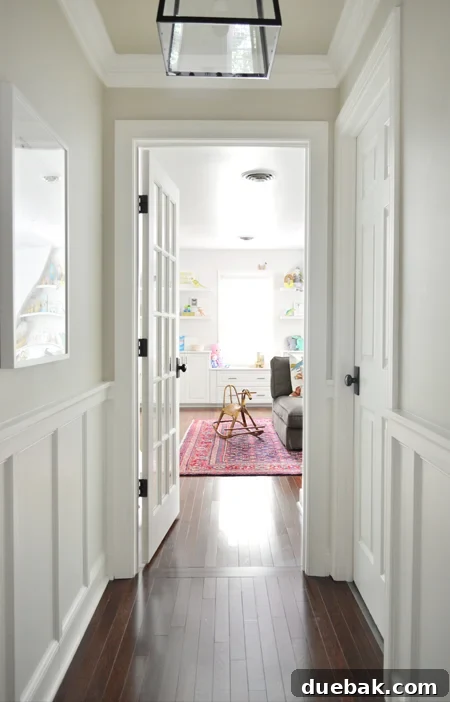
Our initial hurdle was finding floors that matched the “Lono Oak” color we had used upstairs. This particular shade, purchased from Lumber Liquidators, had been discontinued shortly after our initial purchase years ago. The prospect of finding an exact match seemed slim, forcing us to consider alternatives that might blend reasonably well. We braced ourselves for potential compromises, perhaps integrating a subtle transition if a perfect match was impossible.
However, fate, or perhaps sheer luck, intervened. Through persistent searching and a touch of serendipity, we discovered that while Lono Oak had indeed been out of production for years, a few stores still had small, scattered quantities lingering in their warehouses. The catch? These precious boxes were spread across four different states: Nevada, Tennessee, Pennsylvania, and Texas. Shipping materials from such distant locations was neither quick nor cheap. Yet, the extraordinary discount on the “final closeout markdown” materials—priced at an unbelievable $1.50 per square foot compared to the $3.29 we originally paid—more than offset the additional shipping expenses. This unexpected stroke of luck meant we could achieve a seamless, matching floor without breaking the bank. And, thankfully, I didn’t have to personally transport these boards home, avoiding a repeat of past logistical adventures!
Essential Preparation for Hardwood Installation
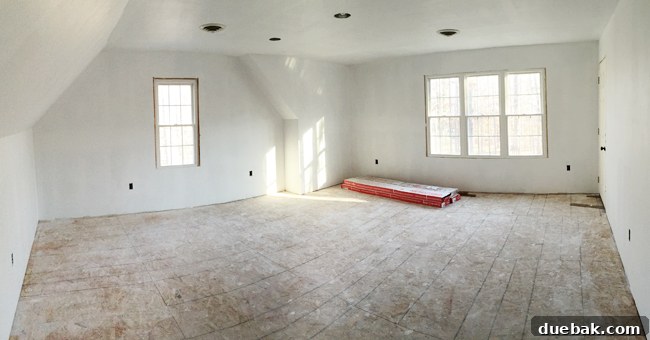
Once all the hardwood boxes arrived, our first critical step was acclimation. This process involves moving the sealed boxes of flooring into the room where they will be installed and allowing them to adjust to the ambient temperature and humidity levels of your home. We painstakingly hauled all 15 boxes up into the bonus room, a significant workout in itself! We then allowed the wood to acclimate for five full days, exceeding the generally recommended minimum of three days. This step is non-negotiable; it allows the wood to naturally expand or contract before installation, preventing issues like gapping, cupping, or buckling after the floor is laid. Proper acclimation ensures a stable and long-lasting floor.
Before laying any flooring, thorough subfloor preparation is crucial. We meticulously inspected the plywood subfloor, ensuring it was clean, dry, and free of debris. Any loose spots were securely fastened with screws to prevent future squeaks. We also checked for levelness, addressing any significant inconsistencies, as an uneven subfloor can lead to an unstable finished floor. A clean and stable foundation is key to a professional-looking and durable installation.
Following acclimation, the next task was rolling out the underlayment. This material serves multiple vital functions: it acts as a vapor barrier, protecting the wood from moisture rising from the subfloor, and it provides a cushion that helps prevent the wood planks from squeaking against the plywood. While many installers opt for traditional black roofing felt, we chose a white silicone version based on recommendations for its cleaner application. We carefully rolled out each strip, ensuring a slight overlap between adjacent pieces, and used a utility knife to trim the ends precisely as we reached the opposite walls. This meticulous placement of the underlayment creates a crucial protective layer for your new hardwood floors.
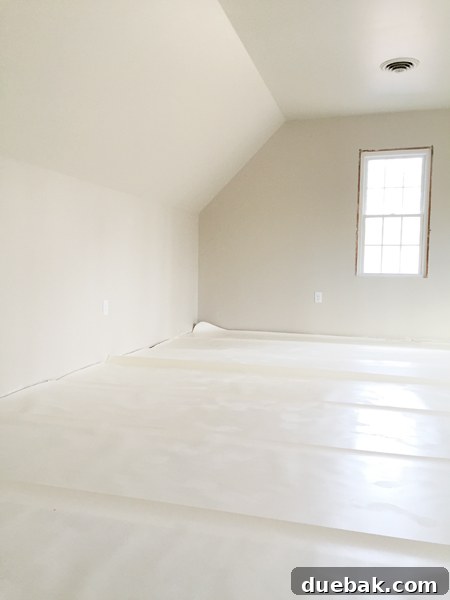
Mastering the Initial Rows: Precision and Patience
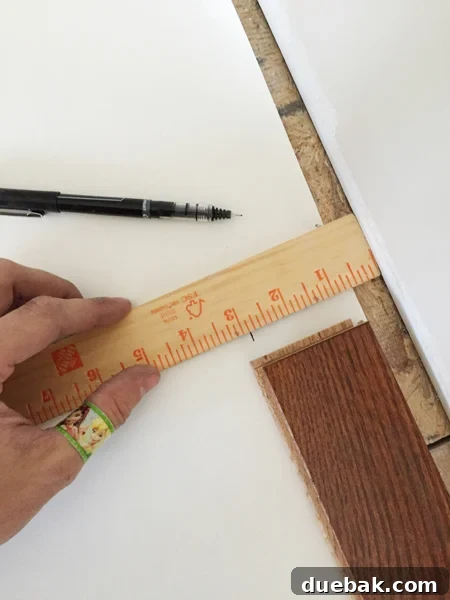
Laying the first few rows of hardwood is arguably the most critical and mentally demanding part of the entire installation. These initial planks set the tone and direction for the entire floor, so precision here is paramount. A fundamental principle of hardwood installation is the necessity of an expansion gap around the perimeter of the room. Wood is a natural material that expands and contracts with changes in temperature and humidity, and this gap provides the essential space for that movement. Without it, your beautiful new floor could buckle or cup. For our 3/4-inch thick oak flooring, we aimed for a 3/4-inch expansion gap, a standard recommendation for this thickness.
To ensure a consistent gap and perfectly straight first rows, we used a ruler to mark the exact position for the outside edge of our first plank at both ends of the starting wall. With these marks established, we snapped a chalk line between them. This chalk line served as our unwavering guide, ensuring the first row remained perfectly parallel to the wall, even if the wall itself had minor imperfections or waves. Many guides recommend using spacers, but a chalk line offers superior reliability, especially when dealing with older homes or less-than-perfect walls.
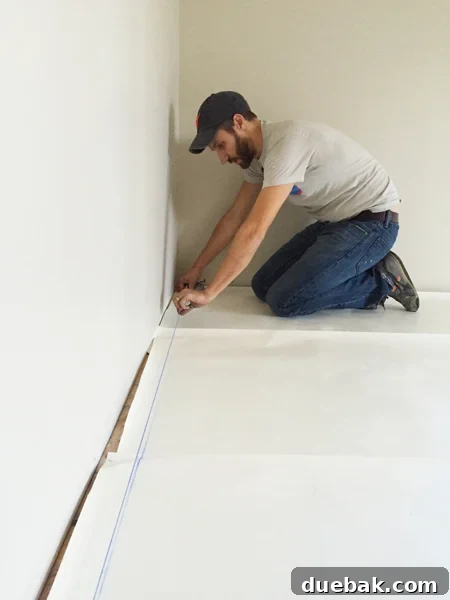
As we carefully laid out the first row of planks, we temporarily secured them with small finish nails along the top, inside edge. These “face nails” are driven directly through the face of the board and are essential for holding the planks firmly in place until they can be permanently nailed. Don’t worry about their appearance; they will later be concealed by baseboards and quarter-round molding. This temporary securing prevents any shifting as you prepare for the more permanent installation method.
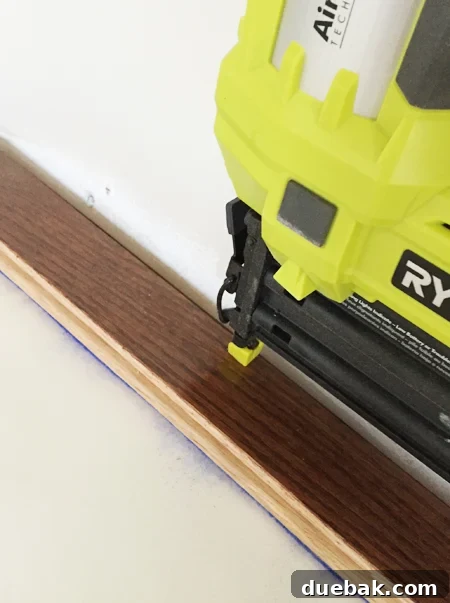
The initial rows, typically the first two to three, must be installed using a hand-nailing technique. The power floor nailer is simply too bulky to operate so close to a wall. This part of the process requires patience and precision. We drilled pilot holes approximately every 10-12 inches along the tongue of each board. These pilot holes prevent the wood from splitting when the nails are driven in. After drilling, we carefully hammered in flooring nails, ensuring they were almost flush with the wood. Finally, a nail punch was used to “set” the head of each nail slightly below the surface of the wood, making it invisible and ready for subsequent planks. This tedious step is crucial for a secure start, but the reward of seeing those first straight rows come together is immense.
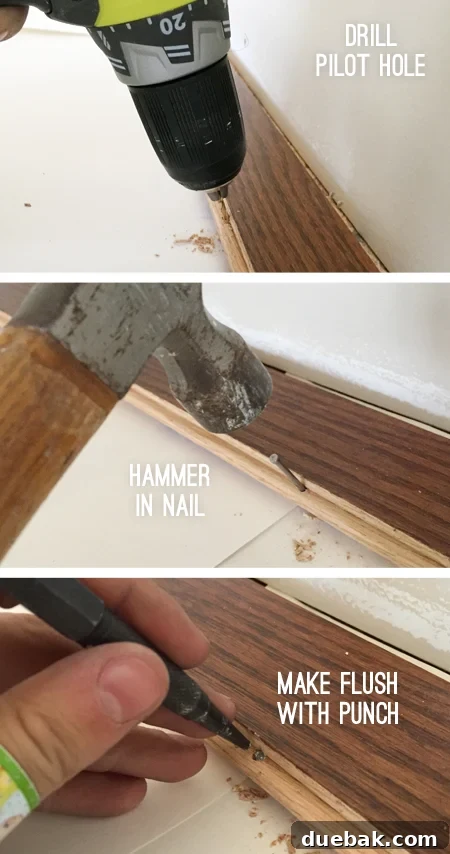
It took us three full rows of careful hand-nailing before we had enough clearance to comfortably introduce the power floor nailer. We eagerly anticipated this transition, expecting the project to pick up significant speed. While it didn’t exactly “fly” – this room still took us two full days – the difference in efficiency compared to hand-nailing was substantial and a welcome relief.
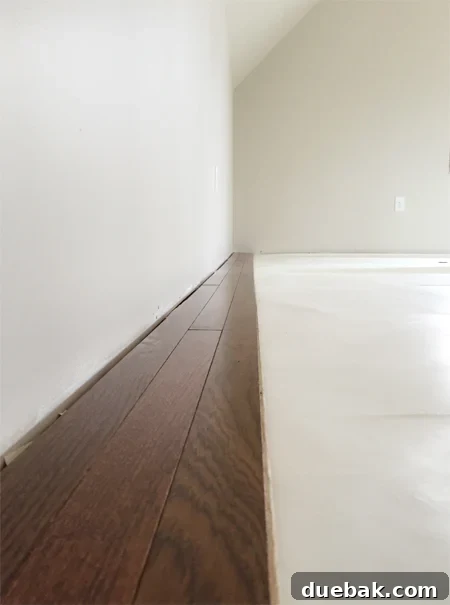
Unleashing the Power Floor Nailer
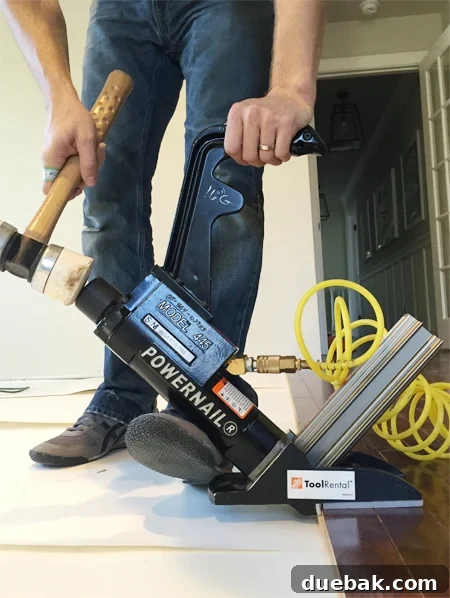
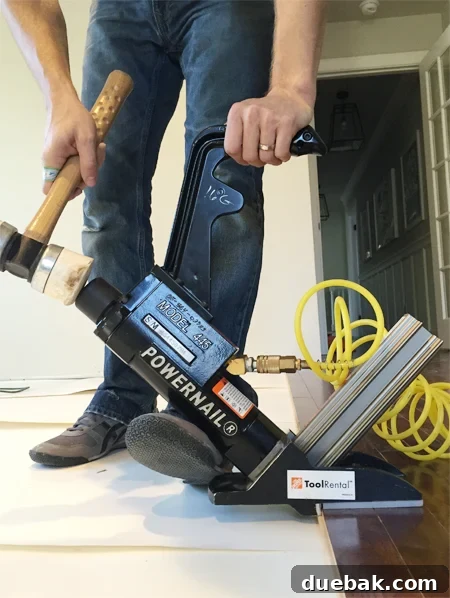
Once we had established a few rows by hand, it was time for the true workhorse of hardwood installation: the air-powered floor nailer. For DIY enthusiasts, renting this specialized tool is often the most cost-effective solution. We rented ours from Home Depot for $39 a day, using it for two days, totaling approximately $80. A floor nailer requires an air compressor to operate. We owned one already, but if you don’t, these are also readily available for rent at a similar daily rate. A pancake air compressor, like this similar model for about $130, is a popular and versatile option for many home projects.
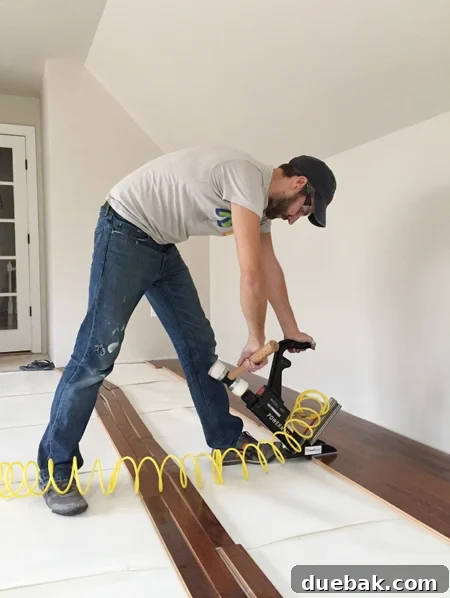
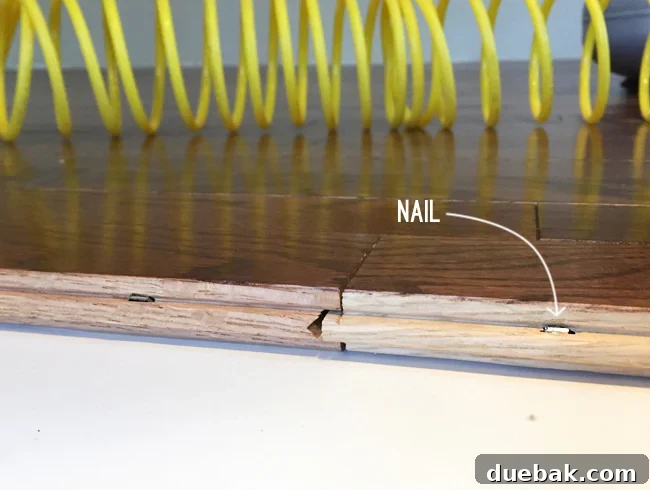
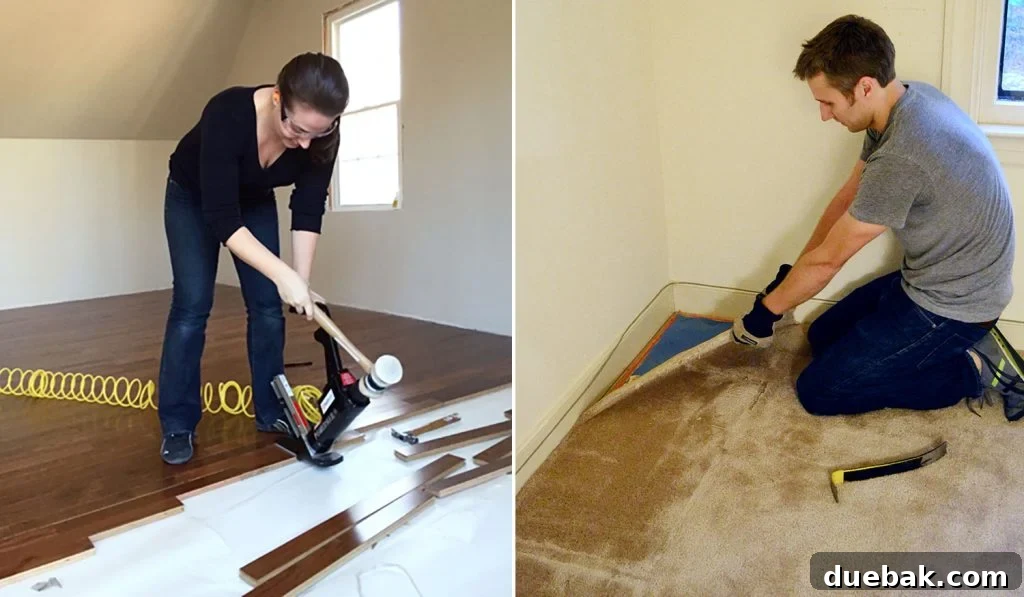
The floor nailer, while initially a bit intimidating, is a remarkably efficient tool. Its primary function is to drive specialized flooring nails, known as “cleats,” directly into the tongue of each hardwood board. Simultaneously, the tool forces the planks tightly together, securing them firmly to the plywood subfloor below. The cleats come in long strips, which are loaded into the back magazine of the nailer. The nailer uses the force of compressed air to embed these cleats deeply and at an angle, ensuring a strong, invisible hold that allows the next board to fit snugly.
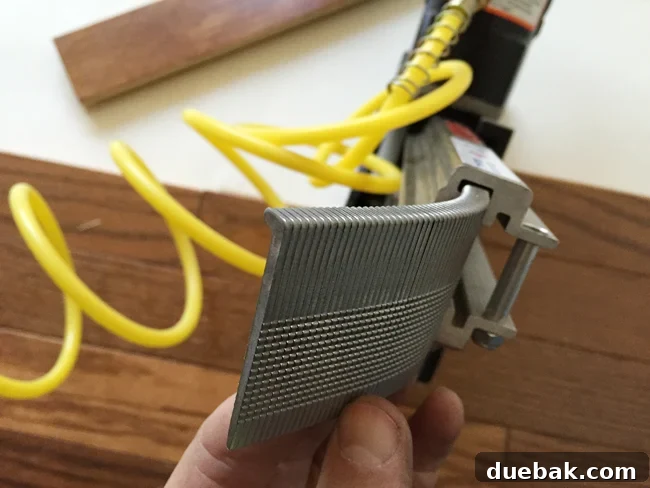
Observing the cleats in action reveals the clever engineering behind this tool. They are driven precisely into the tongue of the board, angled to pull the board tight against its predecessor while sinking deep enough to be completely out of the way for the groove of the next plank. This ingenious design creates a robust, seamless, and visually appealing floor without visible fasteners.
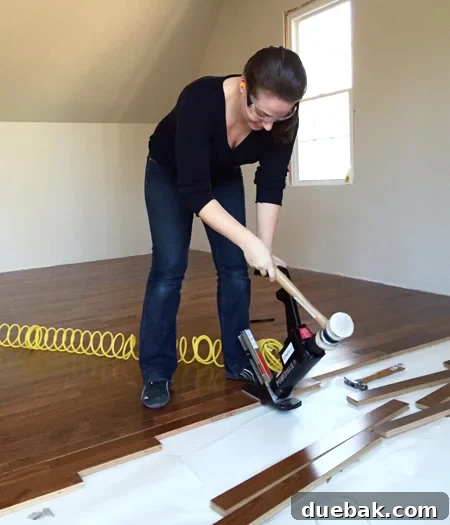
Operating the floor nailer becomes second nature surprisingly quickly. The process involves sliding the nailer into position over the edge of the board you’re about to nail. With one hand, you pull the trigger, and with the other, you firmly strike the plunger on the back of the tool with a specialized mallet. The strike doesn’t need to be excessively forceful, but it requires a solid, deliberate hit to activate the air piston and drive the cleat properly. Wearing ear protection is highly recommended, as the nailer can be quite loud, and safety glasses are a must to protect against any flying debris.
While the nailer significantly speeds up the process, it’s still physically demanding. We went through over 1,000 cleats in two days. The repetitive motion of bending over and swinging the mallet can lead to soreness, even when alternating tasks. To keep spirits high and combat the fatigue, we found that shouting obnoxious song lyrics with each mallet strike, like “HIT ME BABY ONE MORE TIME!” or “SHE BANGS! SHE BANGS!” provided much-needed amusement (and potentially exasperated our spouse, which was an added bonus). Remember those earplugs!
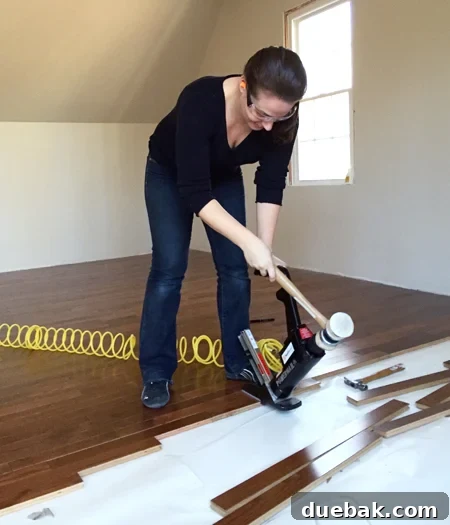
Effective teamwork is vital during this phase. While one person handled the nailing, the other was responsible for laying out the boards. This significantly improved efficiency, keeping the nailer person working at a steady pace. When laying out boards, we consciously staggered the lengths of the planks to create a random, natural pattern, avoiding noticeable “H-joints” or repetitive seams, which can weaken the floor and detract from its aesthetic. Additionally, we pulled planks from several different boxes simultaneously. This helps to blend any slight color variations that might exist between batches, ensuring a cohesive and harmonious floor appearance rather than patches of concentrated color.
Strategic Cutting of Hardwood Boards
Nearly every row of hardwood flooring requires at least one cut at the end. To optimize material usage and minimize waste, we maintained a running pile of boards that had minor flaws, such as small cracks or knots, typically on one end. These imperfect boards were perfect candidates for end cuts, as we could simply saw off the flawed section and still use the remaining, pristine portion of the board. This strategy ensures that even less-than-perfect planks contribute to the finished floor.
Accurate measurement is critical for these end cuts to maintain the necessary expansion gap. As we approached the end of each row, we would take the board to be cut, spin it 180 degrees, and push its tongue end firmly against the opposing wall. Then, we made a precise cut mark approximately 1/2 inch in from where the board met the end of the previously installed plank. This 1/2-inch measurement, combined with the 1/4-inch thickness of the board’s tongue that would press against the wall, perfectly achieved our target 3/4-inch expansion gap. This method ensures consistency and prevents miscalculations that could lead to an improperly gapped floor.
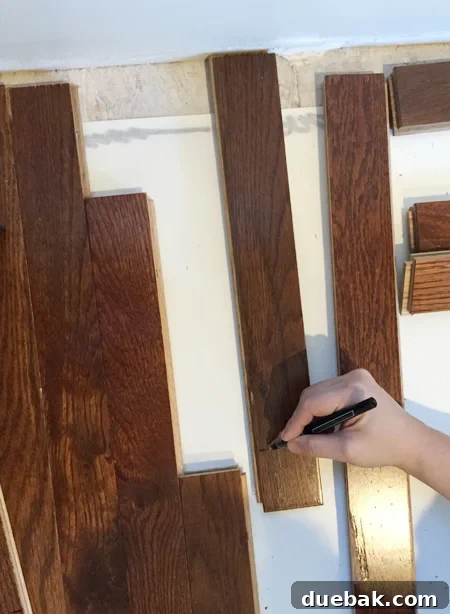
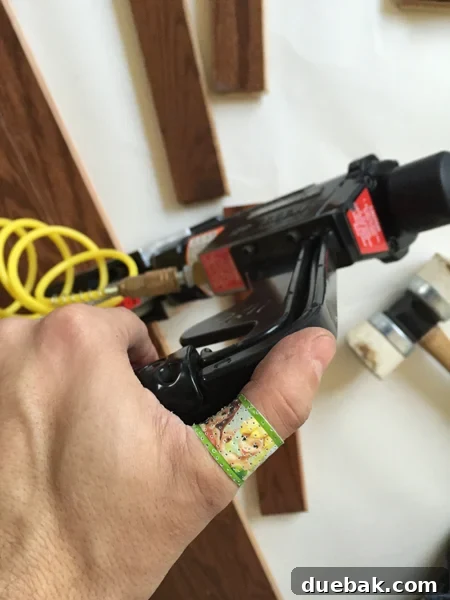
With marks made, it was a constant trek downstairs to our miter saw for the cuts. This back-and-forth certainly added to our daily exercise! To make this process more efficient, we tried to batch our cuts whenever possible, taking several marked boards down at once. Safety is paramount when operating a miter saw: always ensure the blade is sharp, wear eye protection, and keep hands clear of the cutting path. While not glamorous, the satisfaction of a perfectly fitted plank made every trip worthwhile. My Tinkerbell band-aid served as a constant reminder of my commitment to the project, a true badge of honor for this #girldad!
The Final Push: Completing the Last Rows
Just as the first few rows demanded a meticulous hand-nailing technique, the final rows of hardwood flooring also require a return to this slower method. As you approach the opposing wall, the space becomes too confined for the bulky power floor nailer to operate effectively. Attempting to force the nailer into tight spots risks damaging freshly installed drywall or creating uneven fastening. So, with a sigh of both resignation and determination, we once again brought out the drill for pilot holes, the hammer, and our trusty nail punch.
This final hand-nailing phase often feels like the most tedious part of the entire installation. After experiencing the speed and efficiency of the power nailer for the majority of the room, reverting to the slower, more labor-intensive hand method can be mentally challenging. It’s a cruel trick to have to meticulously drill and set each nail by hand after the rapid-fire progress enjoyed earlier. However, these last few rows are just as important for the integrity and appearance of your finished floor. Maintaining the expansion gap, ensuring tight joints, and securely fastening each plank are crucial right up to the very end. Sometimes, a pry bar and a wood scrap can be useful to gently nudge the last boards into place, ensuring a snug fit before nailing. This final stretch requires sustained focus and patience, knowing that the beautiful, continuous hardwood floor is almost complete.
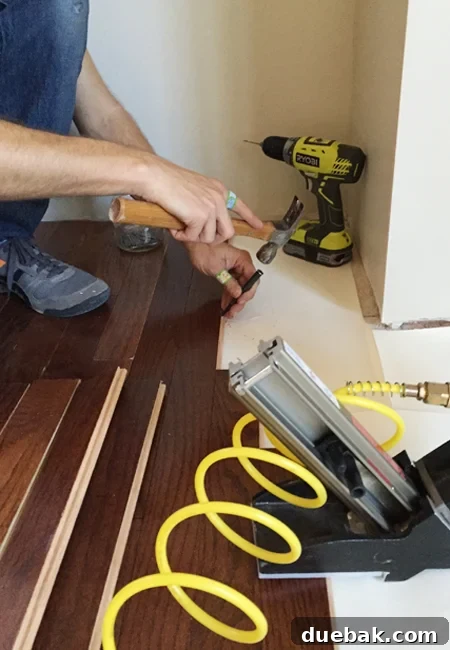
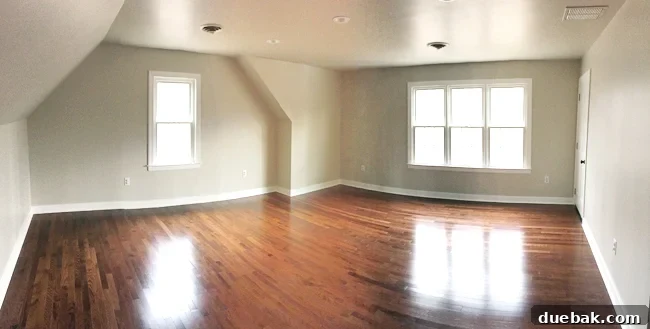
Once every last board was securely in place, the primary installation was complete. The immediate next steps involved a thorough cleanup of any sawdust or debris. Then, it was on to the exciting finishing touches: installing the baseboards to cover the expansion gap, adding quarter-round molding for a polished look, and fitting the window molding. These elements transform a raw flooring installation into a beautifully finished space.
…and then came the addition of custom built-ins, adding both character and functionality around the window niche.
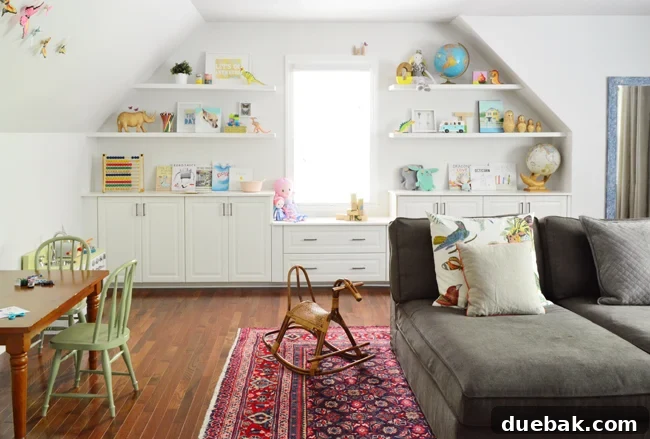
…and finally, filling the room with furniture and decor to create the inviting bonus room we now cherish and utilize every single day. The “Mega Sofa-Thing” is a particular favorite, having hosted a truly impressive Father’s Day nap recently!

Embarking on a hardwood floor installation is a rewarding endeavor that will undoubtedly enhance your home. Be prepared for some heavy lifting, meticulous hand-nailing at the beginning and end, and the exhilarating mallet-smacking rhythm of the power nailer. For an optional boost of morale, we highly recommend some obnoxious ’90s pop song shout-singing (HEYYYYY MACARENA!) to keep the energy high. The end result—a beautiful, durable, and timeless hardwood floor—is truly worth every ounce of effort.
Explore More Flooring Projects
If you’re eager to delve deeper into other aspects of flooring, from maintenance to different installation types, check out our comprehensive guides below:
- Refinishing Hardwood Floors 101: Revitalize Your Old Floors
- How To Select Hardwood Flooring: A Comprehensive Buying Guide
- How To Install Floating Hardwood Floors Without Nails
- How To Install Click-And-Lock Cork Flooring for a Sustainable Home
- How To Paint A Floor: Durable Solutions for High-Traffic Areas
- How To Stain A Concrete Floor: Achieve a Modern Industrial Look
- How To Remove Carpet: A Step-by-Step Guide for Demolition
*This post contains affiliate links, meaning we may earn a small commission if you make a purchase through them, at no extra cost to you. We only recommend products we trust and use ourselves.