
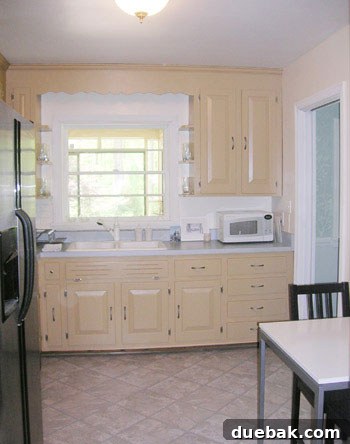
It’s a stick up—er, down! This straightforward tutorial walks you through the practical process of installing peel-and-stick vinyl tiles. Widely available at big box stores for around a dollar per tile, these self-adhesive squares are an inexpensive way to refresh a worn floor. We used them to cover the blue-and-white linoleum that came with our kitchen before we could afford a full remodel. The original sheet had printed “tiles” that looked unconvincing and dated:
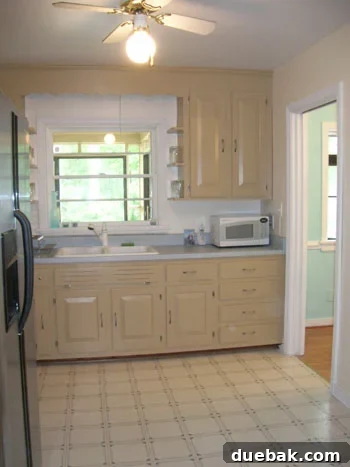
Peel-and-stick vinyl tiles give a more authentic tiled look than a continuous sheet because each tile includes a faux grout edge and subtle variation in color and texture. Those variations mimic natural stone and create depth and realism. Best of all, you can transform an outdated floor in a single weekend for roughly $100. Below is our kitchen after about four hours of installing tiles on a diagonal to make the space feel larger:
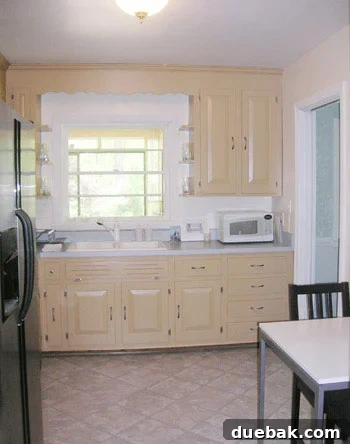
Here’s a concise, step-by-step breakdown to help you get the best result.
Step 1: Be Picky. Choose your tiles carefully. Avoid an exact match to your cabinets or walls, which can make the room feel too uniform, but also avoid colors that clash. The most reliable approach is to buy a few sample tiles and bring them home to evaluate under your household lighting—store lighting can be very different from the light in your home.
Step 2: On the Level. Install self-adhesive tiles only over a flat, even surface. Patch any holes, fill gaps, and remove bumps so each tile can bond securely. If there’s a missing old tile and the depths match, you can test-fit a new tile to fill that gap before starting the main installation.
Step 3: Get Centered. Find and mark the room’s center, then lay a tile there without removing its backing. From that center, place unstuck tiles outward to create a cross that reaches wall to wall—this lets you visualize the layout and determine whether centering is the best approach. If centering creates awkward narrow slivers at visible areas like doorways, shift the layout slightly so any partial tiles fall under cabinets or appliances instead.
Step 4: Press On. Once you commit and adhere the center tile, continue working outward in all directions. Firmly press each new tile against the last so edges sit tightly together; even tiny gaps will detract from a seamless look. Accurate alignment by eye is important for a convincing result. Continue until you reach the room’s perimeter where custom cuts will be required.
Step 5: Get Edgy. Cutting and fitting perimeter tiles is the most challenging part. Many people remove shoe molding to give themselves extra room and to hide small gaps when the molding is reinstalled. If you keep molding in place, cut tiles carefully so they fit snugly along walls and cabinet bases. Either approach can produce a clean, finished edge when done patiently.
Step 6: Template Time. Use a box cutter to trim the vinyl tiles, making multiple shallow passes until the tile cuts cleanly. Always cut on a scrap tile, plywood, or another sacrificial surface to avoid damaging the new floor. For complicated edges or odd corners, make paper templates first and trace those outlines onto the tiles. Templates simplify tricky cuts and save time by ensuring accuracy.
Step 7: Dance It Out. After installing perimeter tiles, celebrate your progress—tapping each tile down with your body weight helps set the adhesive and ensures a solid bond. A quick happy dance is optional but encouraged.
With careful selection, preparation, and patience on the perimeter cuts, peel-and-stick vinyl tiles are an affordable and effective way to update bathrooms, laundry rooms, hallways, playrooms, or kitchens. Follow these steps and you’ll have a refreshed floor that looks much more expensive than it was. Happy sticking!