

In the realm of home decor, the allure of a stunning transformation is undeniable. You might have already caught a glimpse of the remarkable before & after images of our latest bench project featured in R. Home magazine. Now, we’re thrilled to pull back the curtain and meticulously detail the entire process of revitalizing a humble, even rickety, old bench into a captivating centerpiece. This journey involved nothing more than a fresh coat of paint, a carefully chosen fabric, and a generous dose of elbow grease – proving that exceptional home furnishings don’t have to come with a hefty price tag. Our adventure began with this unassuming specimen, a mere $7 find from our favorite local spot, Love of Jesus Thrift. Its initial state was, to put it mildly, a shoddy excuse for a bench, yet brimming with untapped potential.

What some might see as discarded junk, we saw as a diamond in the rough. Peering beyond its dingy, scuffed wood finish and the unequivocally dated fabric, we envisioned a piece with immense promise for a complete DIY furniture makeover. The bench’s inherent clean lines and its easily accessible seat cushion immediately flagged it as an ideal candidate for a significant upgrade. Our initial step in this furniture restoration journey was to address its structural integrity. We carefully removed the seat cushion, revealing the interior bolts. A quick tightening of these fasteners immediately resolved the bench’s wobbly nature, transforming it from rickety to robust. Following this, we gently but thoroughly sanded the entire wooden frame using 100-grit sandpaper. Older pieces often respond beautifully to sanding, quickly revealing the bare, natural wood beneath years of grime and old finishes, making the preparation surprisingly straightforward. This crucial preparation step creates the perfect canvas for the subsequent painting process, ensuring optimal adhesion and a smooth, professional-grade finish.

While sanding is a fundamental step for preparing any surface for paint, especially when undertaking a wood furniture refinishing project, we went a step further to ensure a flawless result. Our plan was to paint the bench a delicate, light celery green. To prevent any unsightly old stains, tannins, or sap marks from bleeding through our brand-new, light-colored finish – a common challenge when painting over older wood – we applied a thin, even coat of high-quality white oil-based primer. Primer acts as a crucial barrier, sealing the wood and creating a uniform base for the topcoats. This preventative measure is absolutely vital for achieving that crisp, clean aesthetic, particularly with lighter paint colors, guaranteeing that your painstaking efforts result in a durable and beautiful finish that stands the test of time.
Once the primer had fully cured, we proceeded with the most visually impactful part of our bench makeover: painting. We opted for two thin coats of semi-gloss latex paint in a serene, soft celery green, specifically “Lunar Tide” by Valspar. The semi-gloss finish offers both a subtle sheen and enhanced durability, making it ideal for furniture that will see regular use. Contrary to popular belief, often driven by wall painting practices, rollers are not always the best choice for achieving a smooth finish on furniture, especially pieces with intricate details like spindles or thin legs. Even seasoned Benjamin Moore paint specialists advocate for the superior results achieved with high-quality paint brushes when it comes to furniture items. Brushes offer unparalleled control and can deliver an incredibly smooth, bubble-free application. Of course, paint sprayers also provide an immaculate finish, but brushes are far less messy, more accessible for the average DIY enthusiast, significantly more affordable, and provide a greater degree of control for precision work. The golden rule for any furniture painting project is always two thin coats over one thick, gloppy one, which is prone to unsightly brush strokes and dreaded drip marks. Patience truly pays off in this stage.

With the painting complete, we allowed the bench frame to dry for a minimum of 24 hours, ensuring the paint had fully cured and hardened. This critical waiting period allowed us to shift our focus to the equally transformative task of reupholstering the cushion. For this, we selected a stunning green and cream lattice fabric from William’s & Sherrill, requiring just half a yard at an incredibly budget-friendly price of $12. This choice was deliberate, aimed at imparting a fresh, luxe aesthetic to our once-sad little bench. When working with patterned fabrics, meticulous placement is paramount. Before even thinking about reaching for the staple gun, it is essential to take the time to carefully position the fabric, ensuring the pattern is perfectly centered and straight. We cut our fabric with a generous allowance of several extra inches on each side. This margin allowed us the flexibility to shift and adjust the fabric, constantly checking from the front perspective to confirm that the lattice lines were impeccably straight and visually balanced before securing it with our trusty $12 Home Depot staple gun. This attention to detail in fabric placement is what elevates a DIY project to a professionally finished piece.
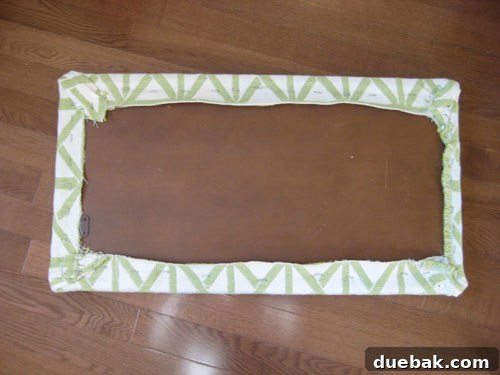
Securing the fabric to the bench cushion is a strategic process that ensures a taut, even, and perfectly centered finish. Instead of simply stapling in a continuous clockwise motion, which can inadvertently cause the fabric to rotate and result in a twisted or unbalanced final product, we employed a tried-and-true method. We began by pulling the fabric tight and placing a single staple at the 12 o’clock position, then repeating this at the 3 o’clock, 6 o’clock, and 9 o’clock positions. This “quarter-point” stapling technique effectively anchors the fabric, keeping it perfectly centered and under uniform tension across all sides. After these initial anchors were in place, we proceeded to layer the new fabric directly over the old. This decision was made because the underlying cushion was still in excellent condition, firm and well-shaped. Removing the old fabric carried the risk of disturbing or even damaging the plush batting underneath, which could compromise the comfort and form of the finished cushion. Layering provided a straightforward and effective solution, preserving the cushion’s original integrity while giving it a completely fresh and modern look.

Once the initial four anchor staples are in place, the remainder of the perimeter stapling becomes remarkably quick and satisfying. With the fabric securely held at its main points, you can then go around the entire edge of the cushion, adding additional staples about an inch apart. This entire process, from the first anchor to the last staple along the straight edges, typically takes no more than five seconds per side, allowing you to achieve a remarkably neat and professional-looking finish on the underside of your cushion. The result is a beautifully taut and evenly secured fabric, ensuring no slack or wrinkles from the front. Even at this stage, just looking at the back, you’ll be impressed by how good your DIY upholstery project is shaping up.
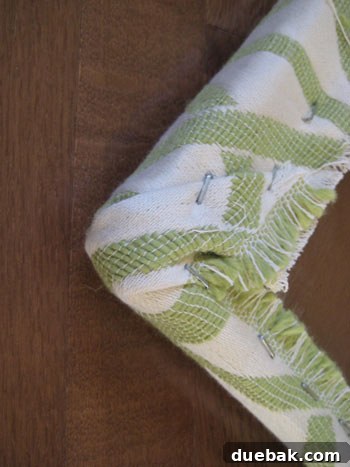
The corners are often the most challenging aspect of any upholstery project, but with the right technique and a bit of patience, they can be flawlessly executed. The secret lies in treating them as if you’re wrapping a meticulously presented gift. The goal is to create crisp, clean folds that look seamless and tailored from the front of the cushion. This usually involves creating at least two distinct “darts” or pleats in the fabric at each corner, securing each with a staple. It’s crucial to resist the urge to tackle the entire corner in one go; attempting to do so often leads to bulkiness or an uneven finish. Instead, work slowly, making one fold, stapling it, then making the next, continuously pulling and smoothing the fabric. After each staple or fold, step back and check the appearance from the front of the cushion to ensure it meets your aesthetic standards. Remember, slow and steady truly wins the corner-upholstery race. One of the greatest advantages of using a staple gun for DIY upholstery projects is its forgiving nature. If a fold isn’t quite right, or a staple is misplaced, you can easily pop it out with a flat-head screwdriver and try again. This flexibility practically guarantees a flawless finished product, allowing you to achieve a professional look even as a beginner.
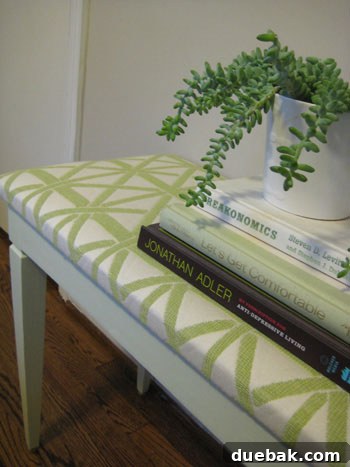
And there you have it – our newly refurbished bench, meticulously put back together, piece by transformed piece. Isn’t she an absolute beauty? It’s hard to imagine that this elegant and inviting piece of furniture started its journey as a pitiful, rickety $7 thrift store find. One can only wonder how many people overlooked, or perhaps even chuckled at, that sad little bench before we saw its potential and embarked on its rescue mission. This thrift store furniture flip is a testament to the power of vision and a little creative effort, proving that incredible home decor statements don’t always demand a designer price tag. The satisfaction of transforming something so humble into something so chic is truly unparalleled.

To further illustrate the attention to detail that elevates a DIY project to a professional standard, here’s a top-down view of our newly upholstered bench cushion. This angle clearly demonstrates the meticulous effort we put into centering the patterned fabric, both horizontally and vertically, before securing it permanently with staples. Notice the distinct center line of the lattice pattern running perfectly down the middle of the bench. Additionally, observe how the stripes on each side align consistently, hitting approximately a half-inch away from each edge. These are the subtle but significant details that make all the difference, transforming what was an afternoon project executed on a serious budget into a piece that looks clean, intentional, and professionally finished. It’s this commitment to precision and symmetry that ensures your budget-friendly home decor truly shines and earns admiration.

The beauty of this project lies in its accessibility. If you possess the basic skills to paint a wall and wrap a present, you inherently have all the necessary abilities to undertake a complete bench refinishing. And even if those skills feel daunting, our step-by-step guide has now equipped you with the knowledge and confidence to tackle it. This type of upcycling furniture project is not only surprisingly easy but also incredibly rewarding. Imagine the pure satisfaction as every visitor stops to compliment your exquisite “new” addition, only for you to casually mention, “Oh, this old thing? I picked it up for a mere $7 at a thrift store!” That priceless moment of revelation truly makes all the effort worthwhile. And speaking of price, the entire cost of this stunning bench transformation – including the bench itself, the fabric, and all the paint supplies – totaled a remarkable $30. Not too shabby for a piece that now exudes elegance and charm!
So, what are you waiting for? Go find your own neglected piece of furniture and get benched! We eagerly await hearing all about your incredible transformations and the joy they bring to your home. Share your triumphs and inspire others to discover the magic of DIY.
Seeking inspiration or another detailed tutorial for your next home project? Be sure to explore our extensive How-To page. It’s packed with a diverse range of guides, from comprehensive cabinet-painting instructions to expert advice on crafting your own custom headboard, providing everything you need to embark on your next DIY adventure.