
Transforming Your Kitchen: A Deep Dive into the Delta Pilar Faucet with Touch2O Technology
Sometimes, even beloved fixtures reach a point where an upgrade becomes truly beneficial. Our journey began with a reliable Price Pfister faucet, a loyal companion in our kitchen since our 2007 remodel. We had absolutely no complaints about its performance, especially considering we snatched it up for a fantastic $71 on eBay. It served its purpose admirably, a testament to practical choices and savvy shopping. However, the world of kitchen technology evolves, and with it, opportunities for enhanced convenience and efficiency.
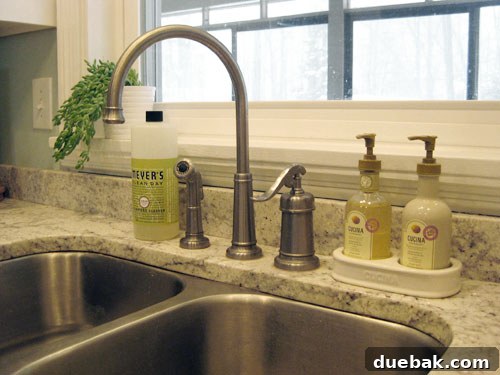
The prospect of change arrived in the form of an incredibly generous offer from the kind folks at Delta Faucets. They presented us with an exciting opportunity to put their innovative new Pilar Pull-Down Faucet with Touch2O Technology to the test. This wasn’t just about replacing an old fixture; it was about embracing a new level of functionality and modern design that promised to revolutionize our daily kitchen routine. For any homeowner considering a kitchen refresh or simply seeking to elevate their everyday experience, a smart faucet like the Delta Pilar offers compelling advantages.
P.S. Looking to experience this incredible technology yourself? Keep an eye out for our upcoming giveaway this week, as we’ve managed to secure one of these fantastic Delta Pilar faucets for a lucky reader!
The Delta Pilar with Touch2O: A Smart Solution for Modern Kitchens
The moment we laid eyes on the Delta Pilar, its sleek brushed nickel finish immediately caught our attention. It’s a design that perfectly complements the contemporary aesthetic of our kitchen, adding a touch of understated elegance. Beyond its visual appeal, the Touch2O Technology truly piqued our interest. As avid DIY enthusiasts, our hands are often covered in paint, caulk, sawdust, or garden dirt. The idea of being able to turn the water on and off with a simple tap of a wrist or elbow, without smudging the handle, sounded like an absolute dream.
This innovative feature allows you to activate or deactivate the water flow by merely touching any part of the faucet’s body or handle. Imagine your hands are covered in raw dough, gardening soil, or sticky paint. Instead of trying to grasp and turn a handle, potentially spreading mess, a gentle tap with your forearm or wrist is all it takes. This not only promotes better hygiene by minimizing cross-contamination but also saves precious time and effort during messy tasks. It truly is a DIYer’s ultimate convenience, promising a cleaner, more efficient workspace.

DIY Faucet Replacement: Out with the Old, In with the New
With the excitement of the new Delta Pilar building, it was time to bid farewell to our old faucet. We gently conveyed the news, and it graciously prepared for its departure. But fear not, this isn’t a tragic tale of abandonment! We’re giving our dependable Price Pfister faucet a wonderful second life by donating it to The Habitat For Humanity ReStore, ensuring it continues to serve a purpose in another home. This commitment to recycling and reusing is an important aspect of sustainable home improvement, something we deeply value.
While we’ve tackled numerous bathroom faucet replacements over the years, a kitchen faucet was a new frontier for us. Our last kitchen faucet installation was handled by the granite and sink installers, so this would be our first solo attempt. Nevertheless, I was confident it would be a straightforward task. My preparation involved clearing out the under-sink cabinets, gathering all the necessary tools, and, most crucially, turning off the water supply to prevent any unexpected indoor floods. With my plumber’s crack (luckily, not pictured for your viewing pleasure!) at the ready, I dove in.
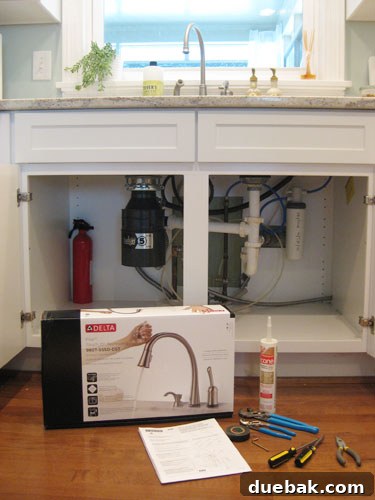
Overcoming Installation Hurdles: A DIYer’s Secret Weapon
Initially, I resisted the urge to document the removal process, assuming it would be so simple it wouldn’t warrant any photos. However, I hit a minor snag almost immediately. A particular piece refused to budge, leaving me scratching my head. This is where the power of modern resources comes into play! Rather than succumbing to frustration, I leveraged the internet, a DIYer’s best friend. I quickly tracked down the instruction manual online, a common practice these days as many manufacturers provide PDF versions of their guides on their websites. It turned out I had simply misunderstood how certain components connected, specifically thinking parts 8B and 8C were fused together when they merely needed to be unscrewed. Problem solved, and a valuable lesson learned: always check the instructions, even for seemingly simple tasks.
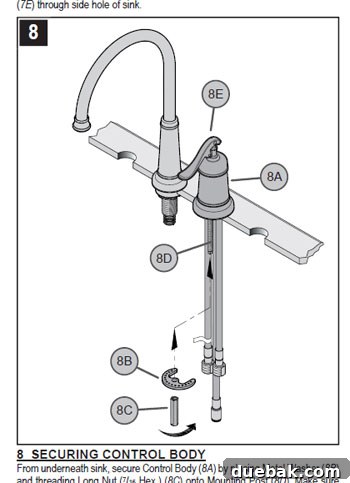
From that point, the removal process was swift. Within minutes, the old fixtures were detached, boxed up, and ready for their new life at the Habitat ReStore. The basic principle involved unscrewing the mounting nuts and bolts located beneath the sink that secured the faucet and accessories to the countertop. After a quick scrub to remove any lingering grime, our countertop was left with four clean, expectant holes, eagerly awaiting their new occupants. You might be wondering why we had four holes when the “before” picture only shows three fixtures. This is a common scenario in kitchen remodels! We initially had a soap pump that came with the Price Pfister faucet, but it proved leaky and prone to jamming. It was eventually replaced by our beloved Cucina soap/lotion caddy, which not only performs flawlessly but also elegantly covers the unused hole, providing both functionality and aesthetic appeal.
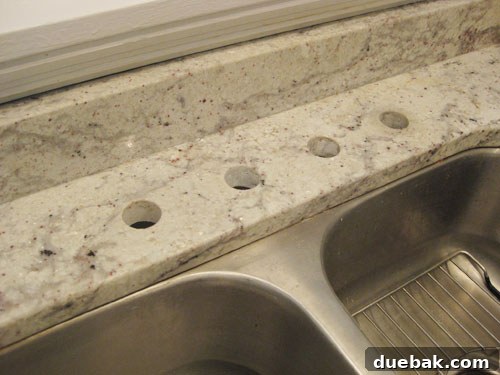
Installing the High-Tech Delta Pilar: A Seamless Process
With our sink practically begging for an upgrade, the installation of the sparkling, high-tech Delta Pilar model proved surprisingly easy. I had anticipated it might be more complex than the removal, given its advanced features, but it was remarkably seamless. Having the included instructions right there was, of course, a huge help. The first step involved securing the gooseneck spout. This was a straightforward process of tightening a series of washers and nuts from the underside of the granite, while Sherry held the spout firmly in place from above. Teamwork makes the dream work!
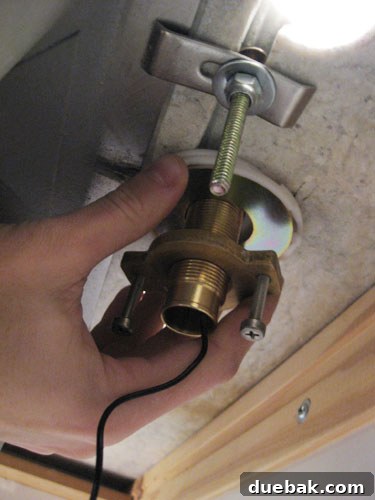
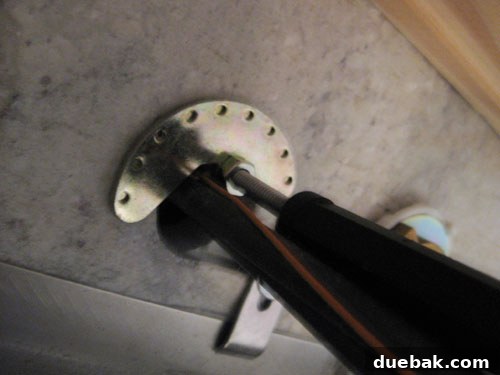
Next came the installation of the handle, or valve assembly. This step utilized a special long tool, conveniently included in the box, to tighten a nut over a super long bolt. This setup was quite similar to the challenging 8B and 8C parts of our old faucet, but with the right tool and clear instructions, it was far less confusing this time. You can clearly see how the nut fits neatly into the top of a long plastic tube, which then slides over the extended bolt, allowing for secure tightening even in tight spaces.

Here, the specialized tool is captured in action, having successfully secured the nut into its proper position. The process felt quite straightforward, especially given that many of the essential tubes and even the wiring for this advanced faucet were already pre-connected. Yes, you read that right – our fancy new faucet actually came with wiring, a clear indication of its high-tech capabilities!
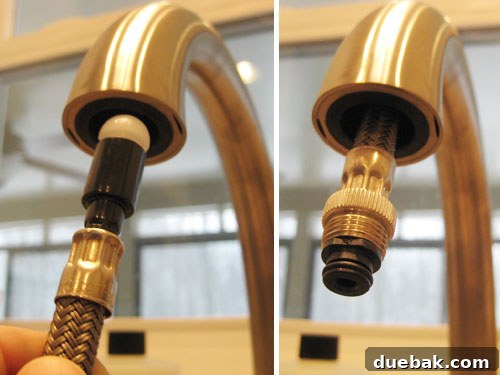
The subsequent step involved feeding the extension hose through the faucet body. This was facilitated by a simple white nub, designed to help the hose slide smoothly and easily. It was important to leave enough of the hose extending out so it wouldn’t get lost inside the gooseneck, ensuring easy access for the next connection. This is the crucial point where the nozzle end would later be screwed on, transforming the unit into both a standard faucet and a versatile pull-down sprayer. Who doesn’t appreciate a hardworking multitasker in the kitchen?
Wiring the Future: The Solenoid and Power Source
This is where the installation truly steps into the high-tech realm. The “Jetsons-esque” touch feature doesn’t materialize by magic; it’s all thanks to the Solenoid. While I might not grasp the intricate scientific principles behind its operation, I do know it arrived in one of those anti-static bags typically reserved for sensitive computer components. That alone underscored its advanced nature!
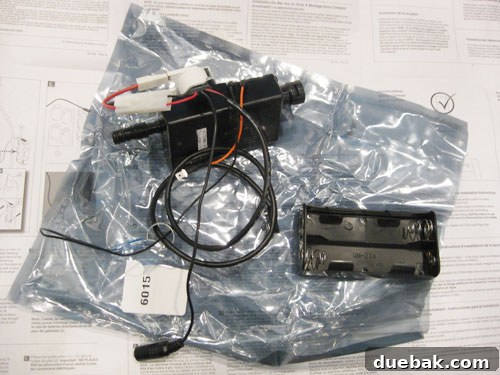
Connecting the Solenoid was straightforward. It snapped onto a plastic tube extending from the valve assembly on the top side and was secured firmly with a metal clamp (the golden-hued component pictured). Next, after removing a white plastic guide, I snapped the spray hose into the bottom of the Solenoid, securing it with a black plastic clamp. With each connection, our faucet was taking on more of its sophisticated, almost robotic, capabilities.
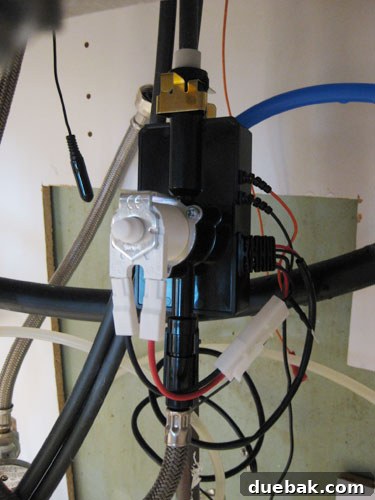
Following these core connections, my task was to link a series of wires from the Solenoid to other specific parts of the faucet fixture. For instance, I attached a small metal clip to the underside of the spout (apologies for the slightly blurry photo – it’s quite dark and cramped under the sink!).
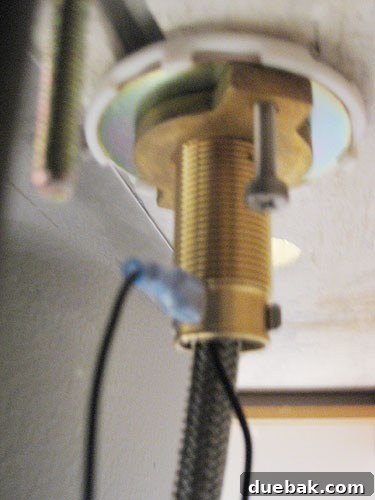
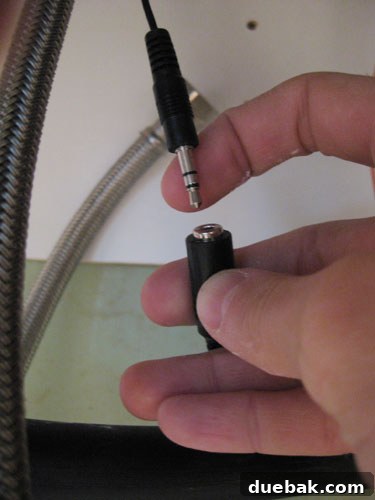
…and then connected these two corresponding wires, one from the spout and one from the Solenoid. While the precise scientific mechanics remained a mystery, my role at this point was simply to follow the clear, step-by-step directions provided by Delta, trusting in their engineering expertise.
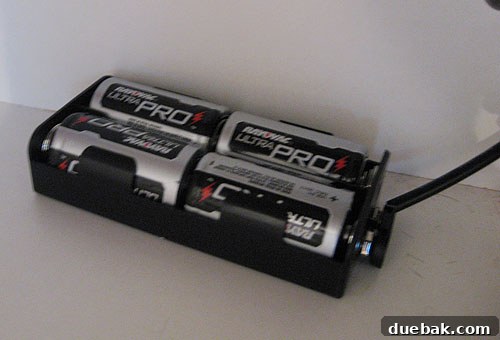
Of course, no electrical component works without a power source. In this case, the Delta Pilar relies on a battery case designed to hold four C-sized batteries. To our genuine surprise and delight, these batteries were actually included in the box! It’s a rare and welcome occurrence to find batteries included with a new product. The battery pack also features an adhesive backing, allowing you to secure it to the cabinet wall. However, we chose not to commit to a permanent spot just yet, simply resting it on the cabinet base. This flexible placement will make it incredibly easy to access and change the batteries when needed, ensuring continuous functionality without hassle.
Water Connections and Final Checks
With the electrical components securely connected, it was time to don my plumber’s hat once more and reconnect the water lines. The hot water connection was straightforward: simply attaching the black plastic tube from the faucet’s valve to our existing hot water supply. The cold water line, however, presented a slight variation due to the water filter we had installed last summer. Fortunately, the new tubing provided with the Delta faucet was the same size as the blue plastic tubes used by our Filtrete filter. This meant I could easily cut the new tube to the appropriate length using a small hacksaw, insert it into the filter connection, and complete the cold water hookup seamlessly.
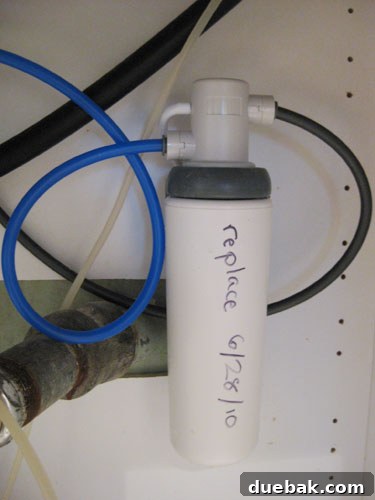
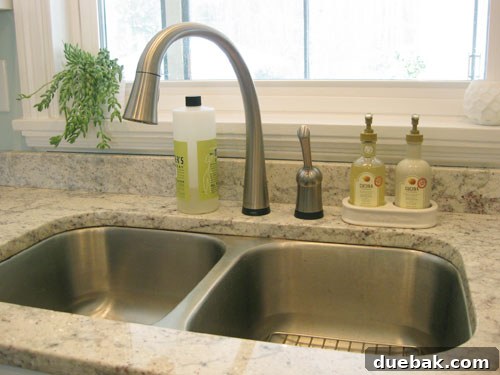
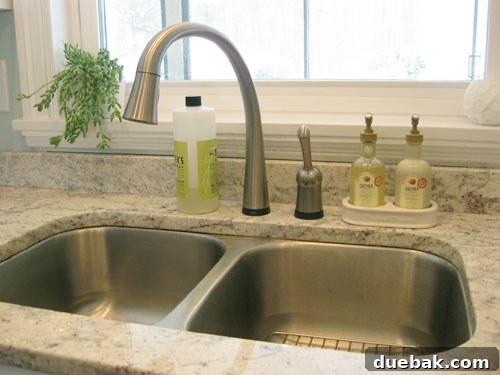
Finally, I turned the main water supply back on and used the faucet handle to initiate water flow. The crucial final step was to meticulously test for any leaks. Our tried-and-true, patent-pending technique involves simply placing a dry paper towel under all the newly connected pipes, turning on the water, and praying that the towel remains perfectly dry. Once we confirmed the absence of any leaks or installation snafus, I prepared myself for the moment of truth: activating our new kitchen faucet in a completely novel way – with a simple tap. We particularly appreciate that the Touch2O feature can be effortlessly turned on or off, allowing the faucet to function just like a normal one when desired, offering unparalleled flexibility. But first, take a moment to admire our new faucet in its rightful place:
Living with the Delta Pilar: Practicality Meets Innovation
Once again, we decided against installing the included soap pump, choosing instead to utilize a decorative Mrs. Meyers bottle to elegantly cover the second pre-drilled hole in our counter. While some might question the aesthetics of two covered countertop holes, we firmly believe in building in flexibility for the future. Our philosophy is that having the room to grow – should we ever decide to install another four-hole faucet down the line, especially since we plan to call this home for many years – is far preferable to the arduous task of cutting new holes if the need arises. Essentially, we view our sink setup as highly adaptable. We’ve never encountered issues with water bypassing our soap or lotion caddy and dripping into the cabinet below, making it a remarkably foolproof system. Moreover, numerous resources, like various online retailers, offer specialized “hole covers” for enhanced security and water protection, providing excellent options if we ever desire that extra layer of long-term safeguarding.
One of our absolute favorite features is the integrated pull-down sprayer. Having it built directly into the spout, rather than requiring a separate, often cumbersome side sprayer, is a huge convenience. The sprayer itself is incredibly versatile, allowing for seamless toggling between a solid stream for filling pots and a multi-stream spray for rinsing, all with a simple switch located on the back of the nozzle. It’s thoughtful design in action.
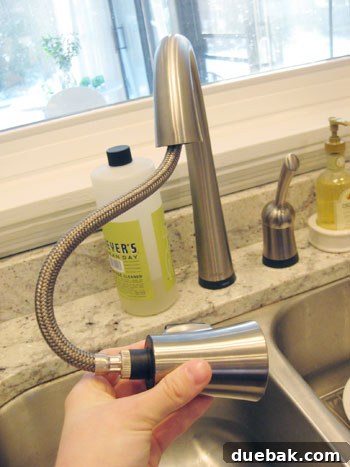
Beyond its smart technology, we are genuinely impressed by the sheer heft and robust construction of our new Delta faucet. We hadn’t truly realized how comparatively light and somewhat flimsy our previous faucet felt until we experienced the solid, substantial feel of the Pilar. Given that we frequently swing our faucet from side to side to accommodate both basins of our double sink, this added weight and stability is an undeniable plus, signaling superior build quality and durability that promises years of reliable use.
And the Touch2O functionality? It works like a charm. Initially, I encountered a brief moment of alarm during my first few attempts, as I didn’t realize the handle needed to be in the “on” position for the touch activation to engage. However, once we flipped the handle back towards the window – into its active position – it was instantaneous. A simple tap on any metallic part of the faucet (the spout, neck, or even the underside) instantly toggled the water on or off. Adding to the modern experience, a subtle blue light at the base of the spout illuminates whenever the touch feature is activated, providing clear visual feedback.
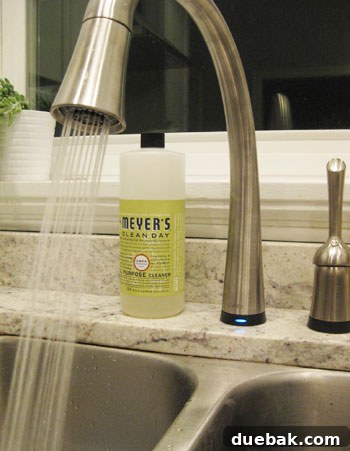
Another remarkably intelligent aspect of this faucet is its ability to differentiate between a deliberate tap and a grab. Since we constantly pivot the spout between the two basins of our double sink, the faucet is smart enough to know when you’re simply moving it (by wrapping your fingers around the neck) versus when you intend to activate or deactivate the water flow (with a distinct tap). This intuitive design means it won’t accidentally turn on or off while you’re repositioning it, only when you specifically tap it. It truly feels like an Einstein-caliber faucet, showcasing exceptional engineering and user-focused design.
Naturally, concerns about fingerprints often arise with touch-activated devices. The instruction manual even suggests touching the underside of the faucet to minimize visible prints. However, in our experience, despite tapping it all over, we haven’t noticed a single discernible fingerprint. The brushed nickel finish proves incredibly effective at obscuring them, or perhaps even preventing them from showing up in the first place. This peace of mind is a significant advantage, allowing us to fully embrace the convenience of touch technology without worrying about constant cleaning.
My only whimsical wish? I’m a tad disappointed it doesn’t greet me in a Knight Rider-esque voice, perhaps something like: “Welcome, John, what can I wash for you today?” But alas, Delta is probably still working on that particular feature! On a more practical note, we appreciate that the batteries are only activated when the faucet is actively being touched on or off. This smart energy management means they aren’t constantly draining power, providing efficient operation and extended battery life, even if we only use the touch feature for a few minutes a day. It’s a truly smart design choice that reflects a commitment to both innovation and sustainability.
Conclusion: Embrace the Future of Kitchen Faucets
And so, that’s the story of how we painlessly upgraded our kitchen faucet, living to tell the tale and, more importantly, to wash our hands thoroughly after a job well done. We sincerely hope our detailed, step-by-step photo session proves useful for anyone contemplating a similar project, particularly if you find yourself armed with a wrench under your sink in the near future. And for those whose new faucet doesn’t come equipped with wires and batteries, rest assured, your installation process is likely to be even simpler and quicker. You absolutely have the skills to tackle this; it can probably be done in under twenty minutes!
Before you go, don’t forget to swing by later today for an exciting chance to win your very own Delta Pilar with Touch2O Technology (a fantastic prize that typically retails for around $300!). Until we return with our big weekly freebie this afternoon, we’re eager to hear from you. Has anyone else embraced this cutting-edge wave of hand-washing future devices? Or perhaps you have other special technologies in your home that effortlessly simplify your daily life? Motion-sensored lights that greet you in the dark? Luxuriously heated towel bars? A smart coffee maker that anticipates your morning caffeine craving? If not, do you dream of a specific high-tech device or invention that would make your house hum like a well-oiled robot, streamlining tasks and adding a touch of sci-fi convenience to your everyday? Share your futuristic home aspirations with us; spill the sci-fi beans!