
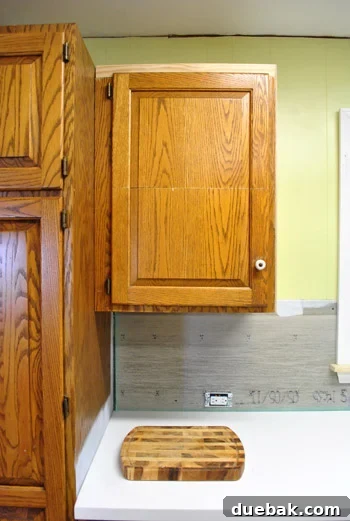
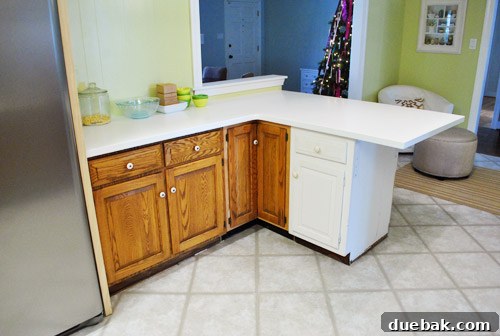
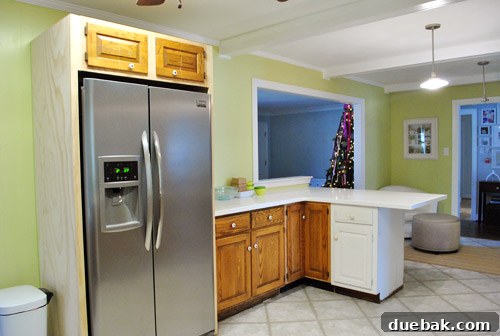
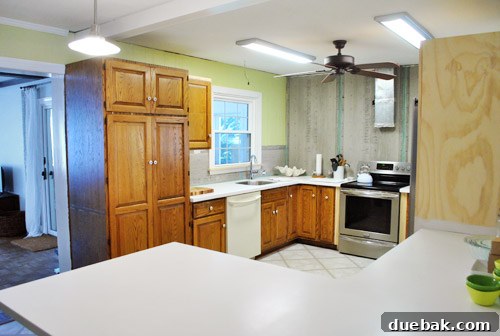
Embarking on a kitchen renovation can be an exciting journey, especially when you find amazing secondhand elements like the custom oak cabinets we integrated into our new kitchen space. However, such treasures often come with their own unique set of challenges. For us, the biggest hurdle emerged the moment we decided to incorporate these beautiful, pre-loved cabinets: five crucial doors were missing. Achieving a cohesive, built-in look was paramount; we didn’t want our kitchen to scream “mismatched thrift store finds.” Our goal was a seamless, professional finish that made our budget-friendly approach look anything but. Below, you can see the initial state of these five cabinets, patiently awaiting their custom solution.
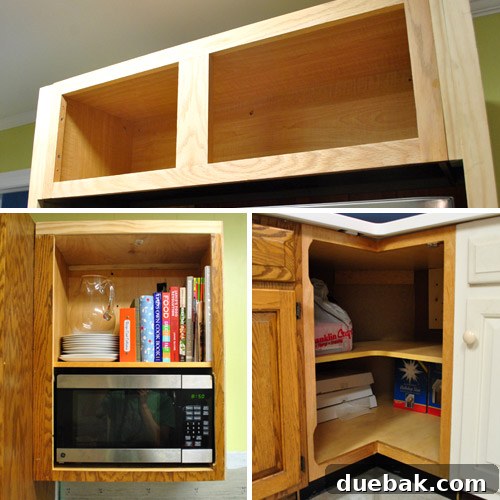
We understood that addressing these missing cabinet doors was non-negotiable for a truly integrated kitchen design. With a clear vision for a uniform aesthetic, we explored several avenues to achieve a kitchen full of perfectly matched doors. These options varied significantly in terms of complexity, cost, and feasibility, ultimately guiding us towards the most practical and inventive solution. Here’s how we weighed our choices, moving from the most expensive and least appealing to the most economical and DIY-friendly route:
- Complete Door and Drawer Face Replacement: This involved purchasing brand new doors and drawer fronts for every single cabinet in the entire kitchen. While guaranteeing a uniform look, this was by far the most significant investment.
- Custom-Made Replacements: This option focused on ordering custom doors specifically for the five missing spots, designed to precisely match the existing unique style of our secondhand cabinets.
- Repurposing Existing Materials: Our most adventurous and budget-conscious choice: attempting to modify and reuse leftover doors from the original configuration of our old cabinets, many of which we had previously removed during the initial tear-down phase.
Our initial inclination led us to investigate Option #1, primarily because we have a strong affinity for the clean lines and timeless appeal of shaker style doors. This style adorned our previous kitchen, as shown below, and it certainly held a strong allure for this project too.
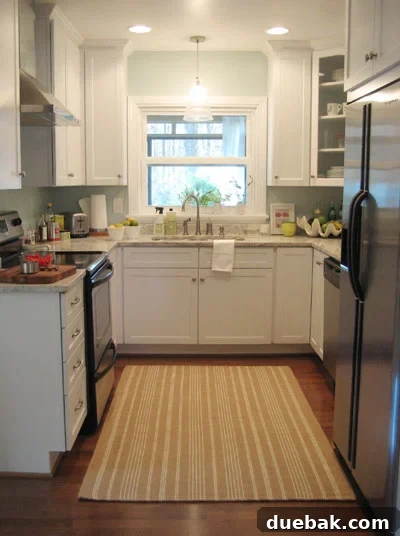
However, the dream of a full shaker conversion quickly dissolved when we started tallying the potential expenses. After obtaining quotes from various suppliers, including major home improvement retailers like Home Depot and specialized online door manufacturers, the estimated cost soared to an alarming $2,000 to $3,000. This steep price tag immediately prompted us to reconsider; a full door replacement simply wasn’t aligned with our budget-conscious renovation goals. With a sigh, we swiftly moved on to explore our next alternative.
Fortunately, Option #2, focusing on custom-made doors for just the five missing cabinets, presented a substantially less expensive proposition. Yet, this path brought its own distinct set of complexities, primarily stemming from the very specific nature of our existing cabinetry. These weren’t standard off-the-shelf units; they were exceptionally solid, custom-built oak cabinets and doors, a quality we truly appreciated. However, their custom design meant they possessed somewhat unusual characteristics, making it particularly challenging to find exact matches. Our cabinets feature a framed construction, meaning there’s a slight lip on the front of the cabinet box. Crucially, they utilize partial inset doors – a design where part of the door sits within the frame, and part rests on top of it. This intricate design creates an impressively tight and seamless fit, akin to a perfectly crafted puzzle. But this bespoke style also rendered the idea of simply “finding” ready-made matching doors in the correct custom size, style, and depth virtually impossible.
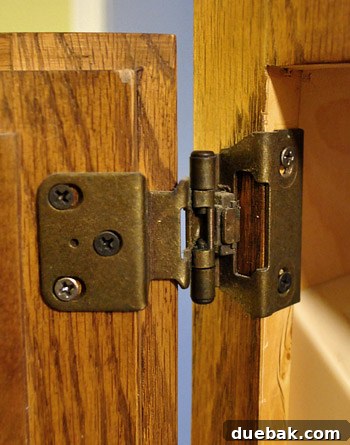
Our search for custom-order doors proved equally fruitless. Most manufacturers we consulted didn’t offer partial inset doors with the exact detailing and profile of our existing ones. Using non-partial inset doors was simply not an option, as they would protrude about half an inch further from the cabinet frame when closed, creating an obvious visual inconsistency that would detract from the overall desired aesthetic. The subtle nuances of cabinet construction truly make all the difference in achieving a high-end, finished look.
Determined to find a suitable solution, we decided to contact the original manufacturer of our cabinets, a Pennsylvania-based custom cabinetry specialist called “Quaker Made.” They graciously connected me with an independent repair technician who specialized in crafting new doors. After providing him with approximate measurements, he quoted around $800 to produce the five custom doors. While significantly less than replacing all the doors, it was still a considerable sum, especially given that we had an abundance of extra doors readily available. Among these were five doors that appeared to be perfect candidates for repurposing, as illustrated below. These presented an exciting opportunity to leverage existing resources and dramatically reduce our expenditure.
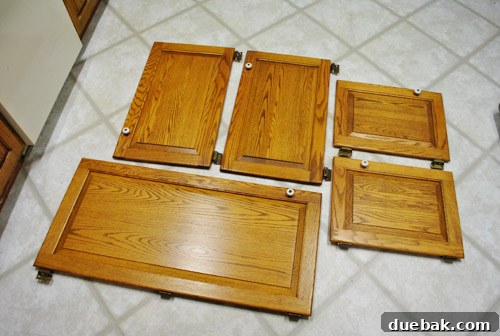
It felt almost negligent not to at least attempt to make these spare doors work. If our DIY endeavor didn’t pan out, we always had Option #2 – ordering custom doors – as a reliable fallback. We’ve always prided ourselves on working creatively with what we have, embracing the challenge of transforming existing materials. Thus, the decision was made: it was time to bring out the power tools and put our ingenuity to the test.
The primary challenge with these surplus doors was their size; all of them were simply too large for their new cabinet homes. This meant they needed to be cut down. However, this wasn’t a straightforward task of merely slicing off excess inches. The intricate design of our cabinet doors, featuring a raised border, a distinct raised inner panel, and a precise inset edge around the perimeter, demanded a more delicate approach. To preserve these critical aesthetic elements, the excess material had to be removed from the *middle* of the doors, rather than just the edges. This “Frankensteining” approach, while daunting, was essential for maintaining the doors’ original style and ensuring they would seamlessly integrate with the existing cabinetry.
To achieve the consistently super straight cuts required for this precise work, I relied on my trusty table saw. For fellow DIY enthusiasts curious about our equipment, we’ve found our $150 Skil table saw to be an invaluable and reliable tool for projects like this, offering accuracy and ease of use that we greatly appreciate.
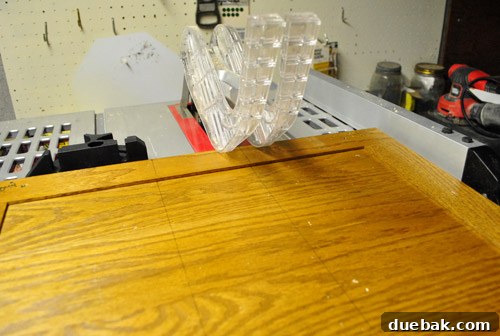
With careful measurements and precise execution, I made two strategic cuts, effectively removing a section from the middle of the door. This left me with two perfectly sized halves, each maintaining the original door profile, ready to be rejoined to create a door of the ideal length for its new cabinet opening.
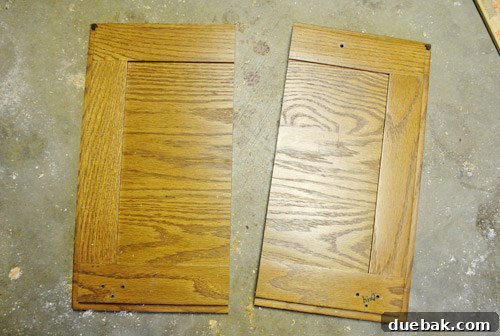
To securely join these two halves, I turned to another indispensable tool in my workshop arsenal: my Kreg jig. This clever device allowed me to create strong, concealed pocket holes, which are crucial for a durable and professional-looking bond.
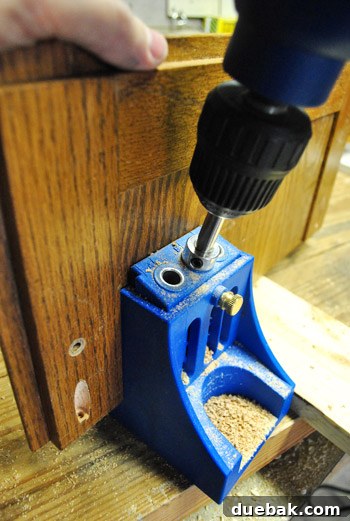
Once the pocket holes were drilled, I applied a generous amount of wood glue along the cut edges for the strongest possible adhesion. Then, I carefully clamped the two halves together, ensuring perfect alignment, before driving the heavy-duty metal screws into the pocket holes to secure them tightly. I always wipe away any excess wood glue immediately with a damp rag to maintain a clean finish, which is why you won’t see it oozing from the seam in this photograph.
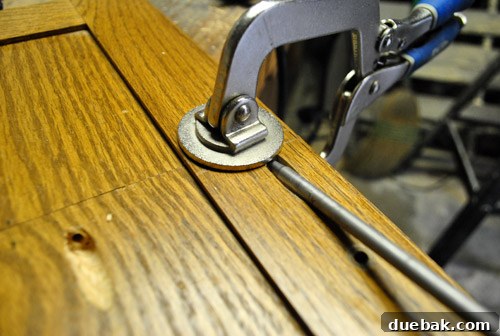
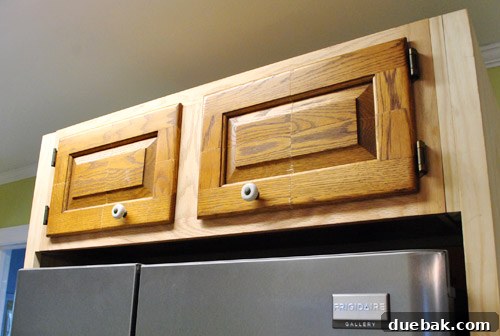
The doors destined for the cabinet above the fridge presented an even greater challenge. The spare door I had was both too tall *and* too wide, requiring me to repeat this meticulous cut-jig-screw process in both directions. This truly was a “Frankenstein” operation, piecing together sections to achieve the perfect dimensions.
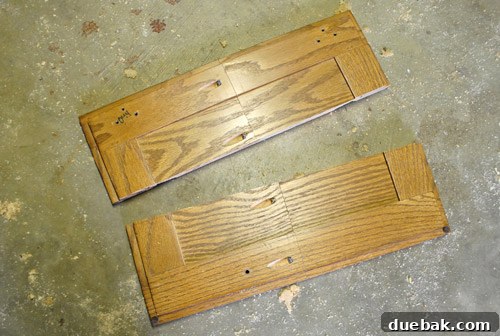
Despite my initial skepticism – I’ll admit, I fully anticipated this method might not succeed – the results were surprisingly good. Once all the sections were securely joined and the hinges reattached, the doors fit remarkably well. The potential savings of $800 certainly made the effort worthwhile, even if it was a bit of a gamble.
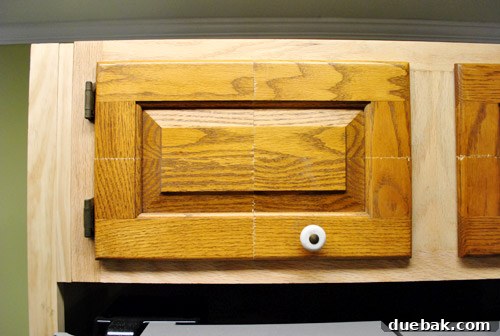
I can already hear some of you thinking, “That doesn’t look very appealing!” And you’re right, in its raw, unfinished state, the doors reveal the evidence of their transformation. However, I continuously reminded myself of the subsequent steps: once we meticulously apply wood putty to fill any seams, sand them smooth until they are utterly seamless, and then prime them with a high-quality, self-leveling primer before painting, these initial imperfections will vanish. Our experience with painting oak office cabinets using self-leveling paint taught us that even prominent wood grain can be completely obscured, and we’re confident the hairline cracks will similarly disappear. Oh, and yes, the knob’s current awkward placement is temporary; new hardware will be installed in a more ergonomic position.
We’ll also use wood putty to fill all the screw holes on the back of the doors, ensuring a clean and finished look even on the interior surface, which currently appears a bit “treacherous.”
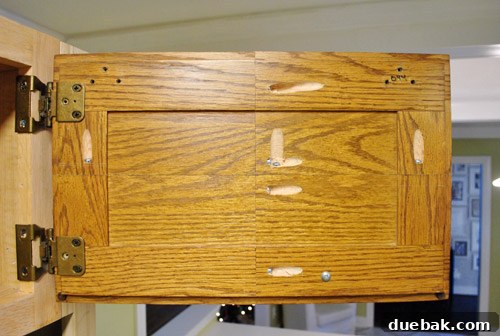
While I might make this process sound swift and straightforward, it was anything but. Crafting just these two doors consumed an entire morning, not counting the time spent on a preliminary test door to refine the technique. Furthermore, it wasn’t simply a matter of two initial cuts per door; numerous minor trims and recuts were necessary along the way to ensure a perfectly snug fit, accounting for that crucial inset-back edge without making it too tight to operate smoothly. Patience and precision were key.
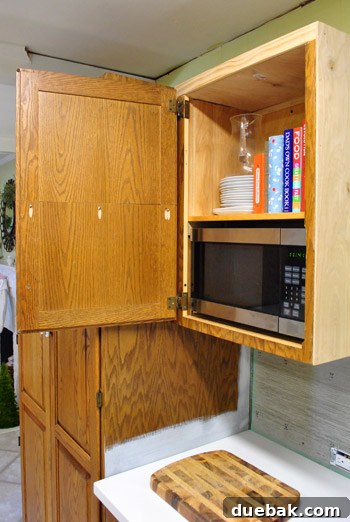
The microwave cabinet door presented a comparatively easier task, as I was fortunate enough to reuse a door that originally belonged to that very cabinet, albeit when it was taller. This simply involved cutting a few inches from its middle to achieve the correct height, making it a less complex modification.
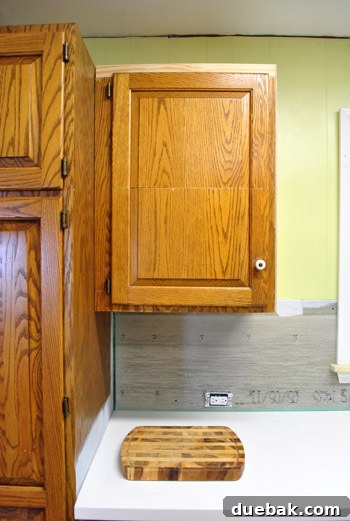
This particular door only took me about an hour to complete – a satisfying moment of progress! The reason even seemingly simple cuts require significant time is my meticulous approach: I measure, then remeasure, and then make my cuts very cautiously on the conservative side. It’s always possible to shave off a little more material, but attempting to add material back is a far more arduous and often impossible task.
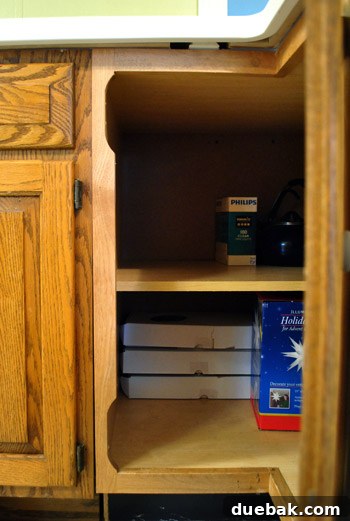
Our smooth progress hit a temporary snag when I confronted the corner cabinet. This secondhand unit originally came equipped with bi-fold doors and specific hidden hinges. The problem was, these hinges were incompatible with our partial inset doors. Attempting to use them would result in the doors protruding at least half an inch further than all the other doors in our kitchen, creating an unacceptable visual disruption. We briefly considered installing a pie-cut lazy susan and directly attaching the doors to it, similar to the setup in our other corner cabinet. However, after careful deliberation, we decided against it. One lazy susan in the kitchen was sufficient, and we truly valued the wide, open storage space this cabinet offered for larger items – space that would be significantly diminished by a lazy susan. The image below shows the corner cabinet’s initial state.
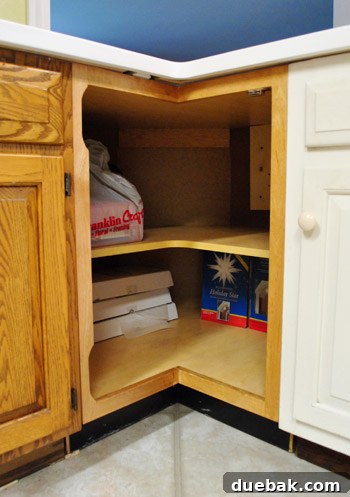
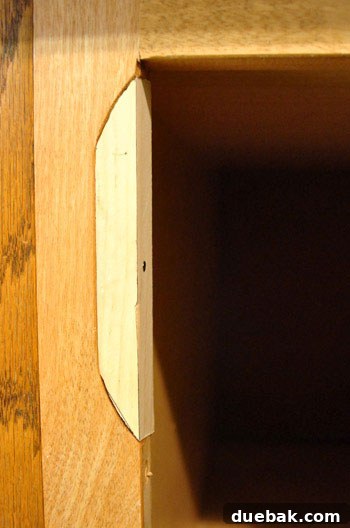
Before I could even begin modifying the doors for this particular cabinet, I first had to address the existing frame. The previous hinges required significant notches to be cut out of the cabinet frame, leaving unsightly and problematic gaps that needed filling.
After a few attempts, I finally managed to jigsaw a couple of wood pieces that fit reasonably well into these notches. While not a perfect, flush fit – wood putty, thankfully, is incredibly forgiving when you’re painting cabinets – these additions created solid anchor points for our new hinges. I screwed them securely into place, delighted to finally have a stable foundation for the hardware. (Note: These hinges, along with all others, will be temporarily removed again for the extensive wood-puttying and sanding phase, and most likely sprayed a fresh color to perfectly complement our new hardware.)
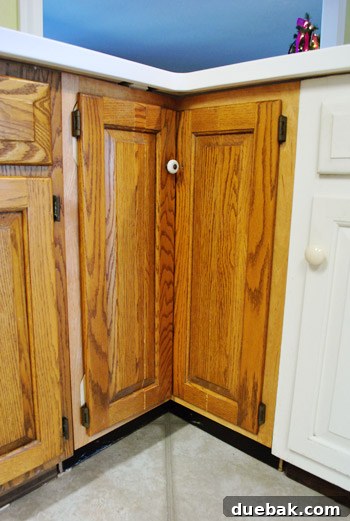
Our ultimate solution for the corner cabinet was the simplest and most effective approach we could devise using our existing materials: two separate doors, each hinged on opposite sides. This design maximized accessibility while maintaining the desired aesthetic consistency.
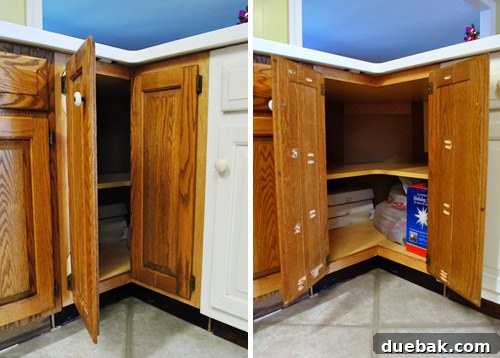
Getting these doors to fit just right consumed the rest of that afternoon, extending into part of the following morning. It was a testament to the intricate nature of custom-fitting. However, the effort was well worth it, as you can observe their functionality below. The left door, which currently features a somewhat awkwardly placed knob (soon to be relocated), opens first. Once it’s open, the right door can then be easily pulled open. This configuration provides complete, unobstructed access to the spacious shelves within, reinforcing our decision against the lazy susan option, especially since we already have one in another corner cabinet.
In the end, this entire DIY door modification project certainly demanded more time and meticulous effort than initially anticipated, largely due to extensive “noodling” – the process of figuring things out as I went – and countless trimming adjustments. Despite the challenges, I am genuinely pleased with the outcome. Every door now fits perfectly, closing smoothly and securely. Once they undergo the final stages of wood putty application, thorough sanding, priming, and a fresh coat of paint, I am confident they will look virtually brand new, seamlessly blending with the rest of our beautifully updated kitchen.
Of course, a contingency plan always exists. Should we find, after all the painting is done, that the aesthetic isn’t quite what we envisioned, we always have the option to contact the custom door maker for that $800 quote. It wouldn’t be worth enduring a less-than-perfect door situation in our newly renovated kitchen just to save that amount, so we’re prepared to make that investment if it comes to it. But we’re optimistic it won’t be necessary!
Regarding durability, simply joining solid oak doors with nails or glue alone would undoubtedly lead to structural failure over time. However, by utilizing a combination of precisely drilled pocket holes, robust heavy-duty metal screws specifically designed for this purpose, and a strong wood glue, we’ve created a permanent, exceptionally strong, and professional-grade bond. I prioritize thorough research to ensure our projects stand the test of time, preventing future repairs and additional work. Consequently, there is zero flex in the newly joined doors; they don’t close oddly, nor do they feel at all “wiggly.” They are as solid and reliable as our original solid oak doors, designed to function flawlessly for the long haul.
As you can imagine, with these structural challenges behind us, our excitement to get these doors painted has surged dramatically. Especially now that all these “ugly cuts” are ready to be hidden beneath a pristine finish. If only I didn’t have other essential tasks, such as adding toe-kick molding and various other trims, to complete first. Though, I must mention, I did manage to install a new window sill and window trim recently – more on that update later!
Being realistic, a fully painted cabinet update before Christmas, which is just ten days away, is highly unlikely. The sequential steps of puttying, sanding, and allowing adequate drying times for both primer and paint make such a swift turnaround practically impossible. Perhaps Santa might lend a hand with the sanding and priming when he descends the chimney in a week and a half! A sigh escapes me imagining how wonderful it would be if these extensive projects could simply materialize overnight while we sleep.