
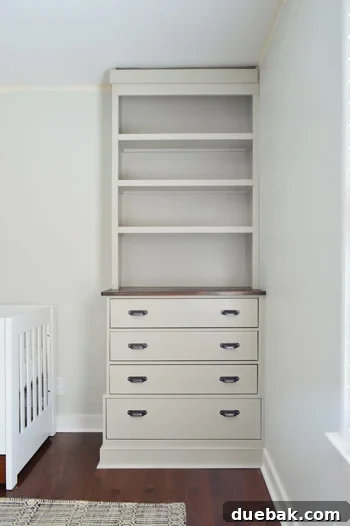
Transforming a room with custom built-in bookshelves is a rewarding DIY project that adds both beauty and valuable storage. Today, we’re excited to walk you through the process of how we crafted the elegant built-in bookshelves for our son’s bedroom. This design proved to be so versatile and effective that we’ve since adapted it for various spaces, from enhancing the aesthetic and functionality of our living room to creating practical pantry shelves in our beach house. Yet, this particular bedroom shelving unit holds a special place, marking our very first foray into this type of custom build, and we were absolutely thrilled with the results.
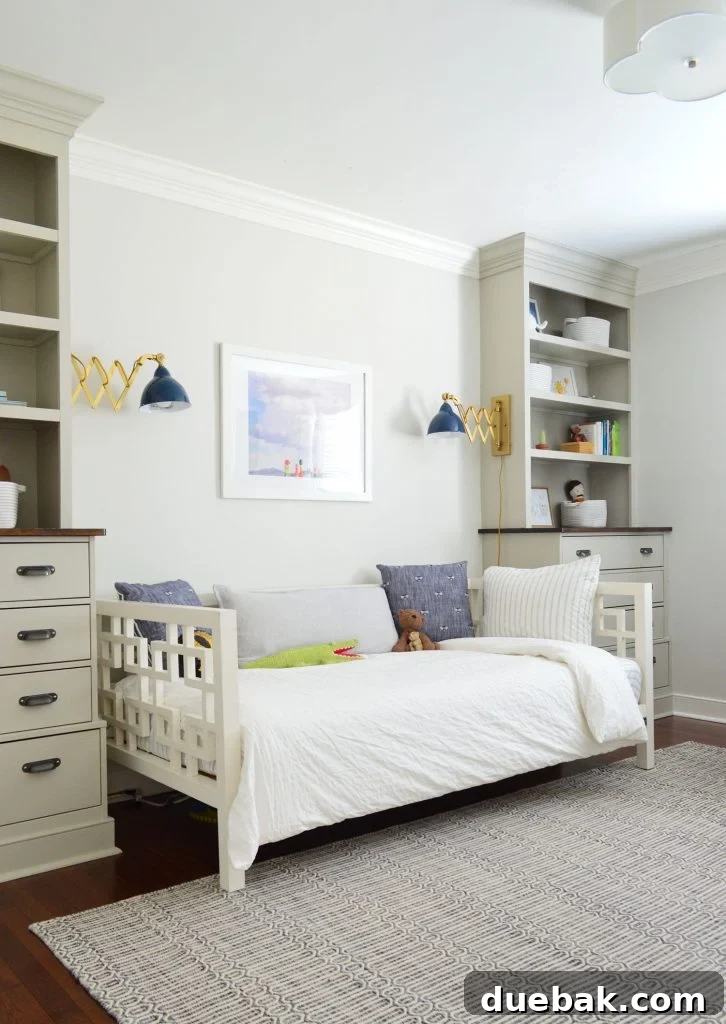
This comprehensive guide focuses specifically on the construction of the shelving units themselves – the upper portion of these integrated built-ins. For those looking to complete the entire ensemble, you can find separate detailed tutorials on how we first created the sturdy cabinet bases (an ingenious IKEA hack!) and subsequently finished them with elegant crown molding. However, since not every bookshelf project requires these additional features, our discussion today will be dedicated solely to building the functional and stylish shelving.
To fully appreciate the transformation, you can also explore the finished room through its various stages of evolution. Take a tour of its initial charm as our son’s nursery, and then witness its seamless transition as we updated it to a “big boy” bedroom, showcasing how these versatile shelves grow with a child’s needs.
Tools & Materials To Build A Bookshelf
Embarking on a built-in bookshelf project requires a specific set of tools and materials to ensure a professional, sturdy, and long-lasting finish. Below is a comprehensive list of what you’ll need. If you don’t own a table saw or circular saw, consider renting one from your local home improvement store; these tools are indispensable for achieving precise, straight cuts essential for this project. Alternatively, many stores offer wood cutting services, which can be a huge time-saver for the initial large cuts, though having a saw at home allows for on-the-fly adjustments.
- 1/2″ MDF or Plywood: This will form the main body of your shelves and side panels. MDF (Medium-Density Fiberboard) is excellent for a super smooth, painted finish due to its uniform density, minimal grain, and cost-effectiveness. Plywood offers greater strength and resistance to warping, making it ideal for heavier loads, and its subtle wood grain can be a desirable feature if you plan a stained or semi-transparent finish.
- 1×3″ Pine (ripped in half): These pieces will serve as your shelf support cleats. Ripping a 1×3 into thinner strips (approximately 0.75″ wide) ensures they are strong enough to support the shelves but remain hidden behind the face frames for a seamless look.
- 1×2″ Pine: Used for the face pieces that trim the front of each shelf. These boards create a finished edge, hide raw plywood/MDF edges, and give the shelves a thicker, more substantial appearance.
- 1×4″ or 1×6″ Pine: Essential for constructing the top brace and any internal bracing needed to secure the bookshelf frame to the wall, providing crucial structural integrity.
- Measuring Tape: For all your precise measurements.
- Stud Finder: Absolutely critical for locating wall studs to securely anchor your bookshelf, ensuring it’s stable and safe.
- 24″ Level: To guarantee all your shelves and vertical pieces are perfectly straight and plumb. A longer level can be very helpful for larger installations.
- Clamps: Indispensable for holding pieces together while cutting, gluing, or nailing, ensuring accuracy and safety.
- Nail Gun with Finish Nails: Speeds up assembly significantly and creates cleaner, less visible fasteners than traditional hammering.
- Miter Saw: For accurate crosscuts, especially useful for face frames and crown molding.
- Table Saw: Ideal for ripping long pieces of wood (like your 1x3s for supports) consistently and precisely.
- Circular Saw: A versatile tool for cutting sheet goods like MDF or plywood, especially when paired with a straight edge guide.
- Power Drill/Driver: For pre-drilling holes and driving screws, essential for sturdy construction.
- Wood Glue: Enhances the strength of nailed or screwed joints.
- Paintable Caulk: For filling gaps and seams, creating a seamless, built-in appearance.
- Primer & Paint: For a durable and aesthetically pleasing finish.
- Painting Supplies: Rollers, brushes, painter’s tape, drop cloths.
- Safety Gear: Safety glasses, hearing protection, gloves are always recommended when working with power tools.
The exact quantity of wood you’ll need will vary significantly based on the dimensions and design of your specific bookshelf. This is precisely why the initial planning stage is not just important, but absolutely crucial for a successful and efficient build.
Step 1: Plan Your Build
The foundation of any successful DIY project, especially one involving custom built-ins, lies in meticulous planning. Begin by thoroughly measuring the space where your bookshelf will reside. Pay close attention to height, width, and depth. Next, translate these measurements into a detailed sketch on paper. This isn’t just a formality; it’s a critical step that helps you visualize the finished product, determine the number of shelves, their spacing, and ultimately, calculate the precise amount of material you’ll need. While flexibility to make minor adjustments during the build is always good (like fine-tuning shelf spacing), a solid upfront plan prevents costly material overages or inconvenient mid-project trips to the hardware store.
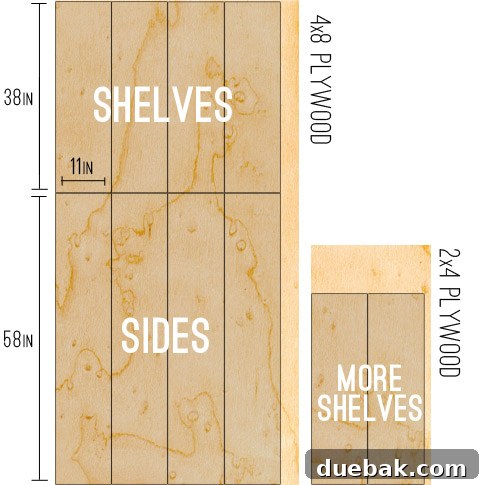
For our project, this planning phase was vital to ensure we purchased just enough — but not too much! — plywood for our shelving. As you can see in the diagram above, figuring out how to maximize a standard 4×8-foot sheet of plywood often feels like solving a puzzle, where every cut needs to be strategically mapped out to minimize waste. Consider not only the width and depth of your shelves but also the thickness of the material itself when planning spacing and cuts.
NOTE: For this particular build, we opted for plywood to achieve a subtle wood grain that beautifully complemented the existing base cabinets. However, if your goal is a flawlessly smooth, painted finish without any visible grain, we highly recommend using MDF (Medium-Density Fiberboard) instead. MDF takes paint exceptionally well and offers a perfectly uniform surface.
Step 2: Cut Your Shelf Pieces
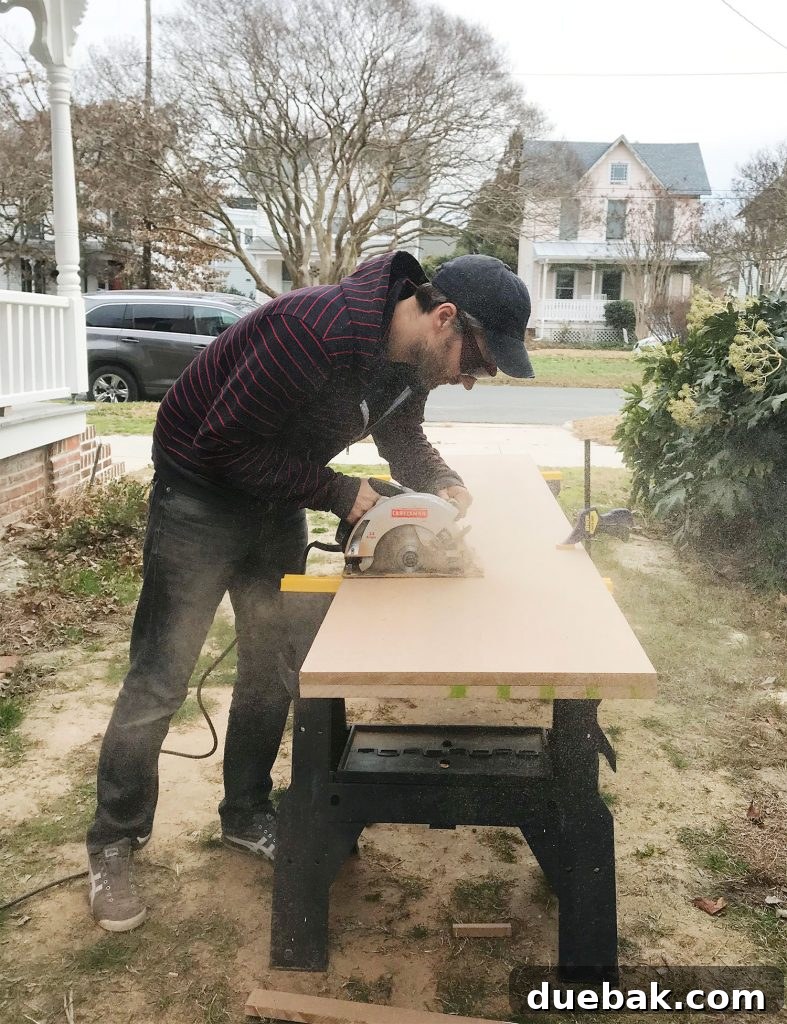
With your detailed plan in hand, the next critical step is to accurately cut your main shelf pieces and side panels from your chosen plywood or MDF. This can be accomplished efficiently using either a table saw for long, consistent rips or a circular saw, especially when paired with a reliable straight-edge guide for precision. The image below, actually from our pantry shelf project, demonstrates the use of a circular saw for such cuts.
For these specific bedroom bookshelves, we took advantage of the in-store cutting services at Home Depot. After reviewing my sketch, a helpful associate expertly ripped my plywood sheets into consistent 11-inch wide strips using their industrial-grade panel saw. This service was an immense help, ensuring perfectly straight and equal cuts for all my shelves and saving significant time and effort. While many stores offer this, ensure you have exact dimensions ready and understand their cutting policies.
If you’re making your cuts at home, precision is paramount. Measure carefully and take your time. A straight edge clamp or a DIY guide for your circular saw can make a world of difference in achieving perfectly straight lines. As an advanced tip, you can see in the photo above that I clamped two pieces of MDF together. This allows you to make two identical cuts simultaneously, guaranteeing that your shelves will match perfectly in size and depth. Always prioritize safety when operating power tools: wear appropriate eye and ear protection, and keep your work area clear.
Step 3: Prime & Paint Your Shelves
One of our top tips for achieving a professional, seamless finish on built-in shelving is to prime and paint all your large pieces BEFORE installation. This pre-painting strategy offers several distinct advantages. It is typically far easier to apply an even coat of primer and paint to flat surfaces with a roller when you don’t have to contend with tight corners, wall edges, or awkward angles. This method drastically reduces the need for meticulous cutting-in and painstaking masking once the unit is assembled.
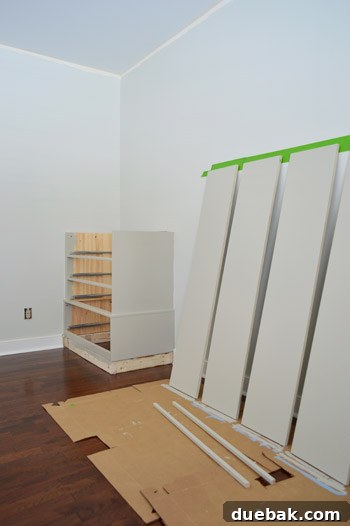
While some touch-ups will inevitably be required after assembly, especially around seams and nail holes, the bulk of your painting will already be done, saving you a considerable amount of time and effort in the long run. Just be sure to apply a high-quality primer to all surfaces first, which is particularly important if you’re working with raw plywood or MDF. Primer creates a uniform base, seals the porous surface (preventing excessive paint absorption, especially with MDF), and ensures better adhesion and a more vibrant final color. For this project, we chose Benjamin Moore Senora Gray, a versatile and appealing shade that complements various interior styles. Allow ample drying time between coats and before proceeding to the next construction step to prevent smudges and ensure proper curing.
Step 4: Build Your Bookshelf Frame
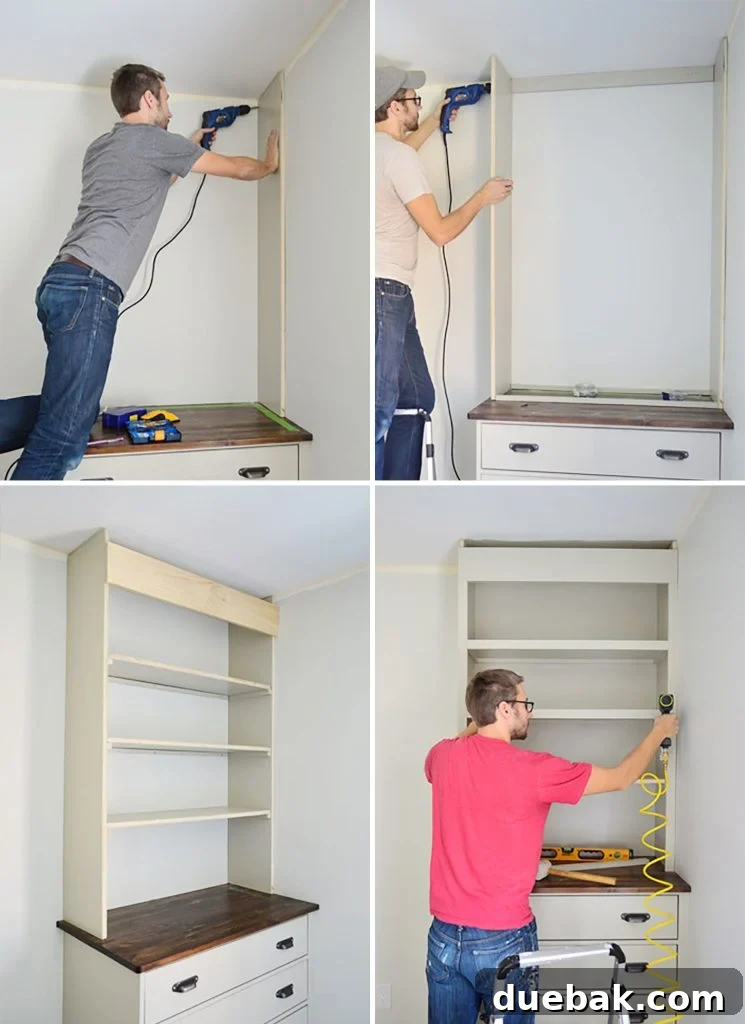
Once all your pre-painted pieces are thoroughly dry, the structural phase of your built-in bookshelf begins. Start by meticulously securing one of the tall side pieces directly to the wall. This is a critical step for stability. Use a reliable stud finder to locate the wall studs and mark their positions. Attach the side piece using countersinking screws, ensuring they are driven deeply enough so that the heads can be filled with wood putty later for a perfectly smooth finish. Always use a level to ensure this first vertical piece is perfectly plumb, as it will dictate the straightness of your entire bookshelf.
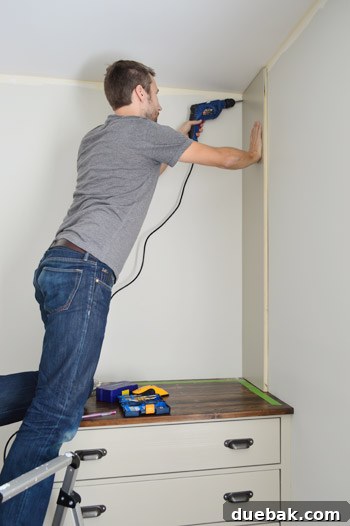
Attaching the second side piece, which doesn’t directly meet a wall, presents a unique challenge. While it gains significant stability once the shelves are added, keeping it firmly in place during the initial framing is key. To achieve this, we employed a strategic brace system. First, a 1×3-inch brace piece was securely attached along the top of the back wall, screwing it into a couple of studs. This unseen brace provides a solid anchoring point for the top of your freestanding vertical side piece. An alternative, albeit more material-intensive, approach would be to purchase a large piece of MDF or plywood to serve as a solid back panel for the entire bookshelf. We opted for the wall-as-back method primarily to reduce material costs and simplify the build.
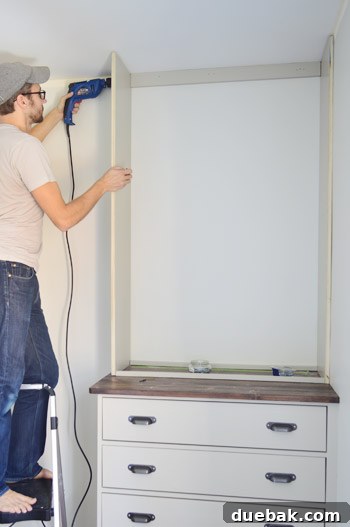
To further ensure the frame remained perfectly square and stable during construction, we added a temporary 1×6-inch brace piece across the front top section of the bookshelves. This brace acts as a temporary cross-member, holding the two vertical sides at the correct distance and preventing any racking or twisting. While not part of the final visible structure, it’s invaluable for maintaining accuracy. You might notice this piece wasn’t pre-painted in our photos – a testament to its impromptu yet essential role in keeping things “square.”
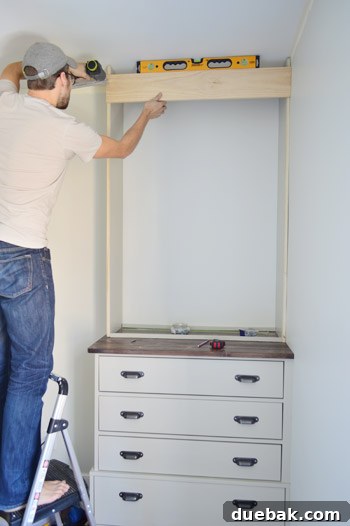
You can also observe some temporary pieces at the very bottom of the bookcase. These were cut to the same length as the eventual shelves and simply laid in place to help keep the bottom section perfectly square and stable during the initial framing. These elements, though temporary, are crucial for building a robust and accurately aligned bookshelf frame before adding the permanent shelves.
Step 5: Add Your Shelves
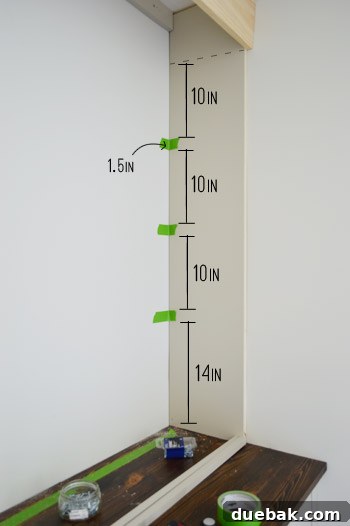
With the primary vertical sides of your bookshelf frame securely in place, it’s time to focus on the heart of the unit: the shelves themselves. The first crucial step here is to finalize your shelf spacing. While you likely sketched this out during the planning phase, it’s always good to visualize it in the actual space. Grab a ruler or measuring tape and some painter’s tape. Mark potential shelf heights on the side panels and the back wall. This allows you to visually adjust the spacing, ensuring it’s aesthetically pleasing and practical for the items you intend to store. For our project, we ultimately settled on evenly spaced 10-inch shelves, leaving a slightly larger gap at the very bottom for bulkier items. Remember to account for the actual thickness of your shelf material (typically 1/2-inch to 3/4-inch) when calculating your clear opening, as represented by the width of your painter’s tape.
Next up is attaching the shelf supports, also known as cleats. These are thin strips of wood that will run along the back and both sides under each shelf, providing crucial structural support. We created these pieces by ripping a 1×3-inch pine board lengthwise on our table saw, resulting in strips approximately 0.75 inches wide. The reason for this specific thinner dimension will become clear in the next step, but it’s vital to ensure these supports aren’t too thick, otherwise they would be visible below the face pieces that get added to the front of each shelf.
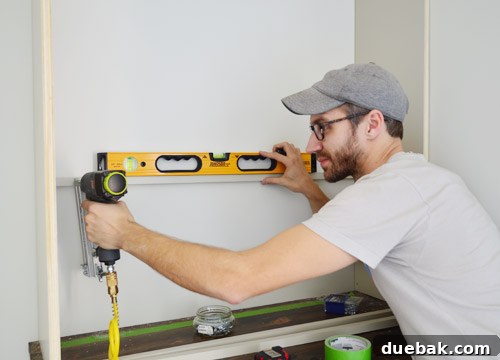
Begin by nailing these support pieces into the wall studs (along the back) and into the vertical side panels (along the sides). Use your level constantly to ensure each support is perfectly horizontal. Nailing them first is a quick way to get them accurately positioned. Once nailed, go back and reinforce each support by screwing it more securely into the studs along the back wall and into the wood of the side panels. This dual fastening method (nails for speed, screws for strength) ensures that your shelves can bear significant weight over time without sagging or failing. It’s an essential step for the longevity and durability of your built-in unit.
With all the support pieces securely in place, adding the pre-cut, primed, and painted plywood or MDF shelf pieces is remarkably straightforward. They simply slide into position, resting firmly on their dedicated supports. The satisfaction of seeing your prepared pieces fit perfectly into the frame is immense!
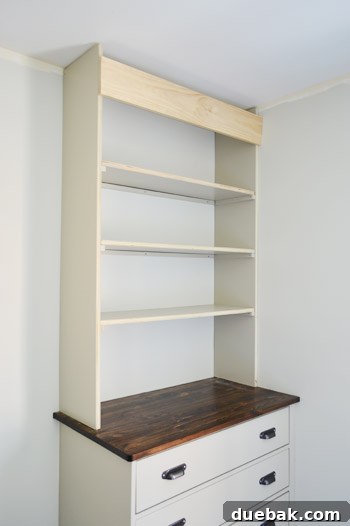
To further secure each shelf and prevent any future movement, we also recommend nailing each shelf down into the support pieces from above. This simple step ensures the shelves remain firmly in place, eliminating any potential for them to pop out, jiggle, or shift over time, especially when loaded with books or other items.
Step 6: Finish With Face Pieces
This stage is often considered the most transformative step in building custom bookshelves, as it’s where the raw, functional structure truly begins to look like a finished, integrated piece of furniture. Now, you’ll cut and nail in the 1×2-inch pine pieces, which should already be primed and painted. These pieces are meticulously applied to cover all the exposed, raw edges along the front of your shelves. This serves a dual purpose: not only does it elegantly hide the less appealing raw edges of your plywood or MDF, but it also cleverly makes your shelves appear significantly thicker and more substantial than they actually are, lending a high-end, custom appeal. This visual trick is precisely why it was so important to cut your shelf support pieces thinner in the previous step – ensuring they remain invisible behind these beautiful face pieces.
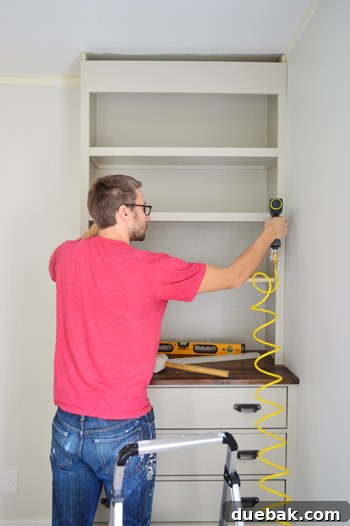
As you apply these face pieces, ensure they are flush with the top surface of each shelf and perfectly plumb. Use a nail gun for quick and secure attachment, driving nails into both the shelf edge and the underlying support cleats. This creates a robust and seamless connection. You may also notice from the image that prior to this step, some painting was already completed – specifically on the back wall and the structural brace at the very top. Additionally, some initial caulking may have been done to address larger gaps. However, for a truly polished look, the final caulking and touch-up painting will be addressed in the subsequent step, providing a comprehensive finish.
Step 7: Caulk & Touch-Up Paint
Once the construction of your bookshelf is complete and all the main components are assembled, it’s time for the meticulous finishing touches that transform a DIY project into a professional-looking built-in. This stage involves comprehensive caulking of all seams, filling any visible nail holes, and applying necessary touch-up paint. Caulking is a time-consuming but incredibly rewarding step, as it creates a seamless, integrated appearance that truly makes the bookshelf look like it was always part of the room. You’ll want to caulk any place where two surfaces meet: where a shelf meets the wall, where the wall meets a support piece, where a support piece meets a shelf, and crucially, where the face pieces meet the shelves and the side panels.
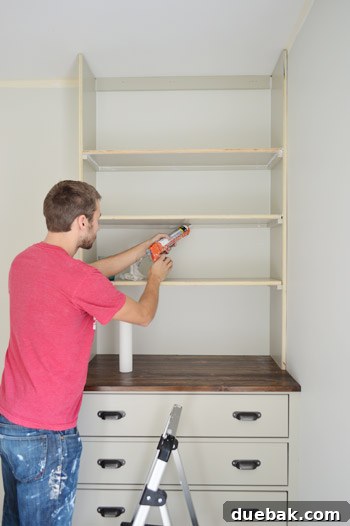
For best results, apply a consistent, thin bead of paintable caulk along each joint, then smooth it with a wet finger or a caulking tool for a clean line. This process not only fills gaps but also conceals minor imperfections in your cuts or the unevenness of your walls. We found it helpful to do some preliminary caulking as we went, particularly to address any larger gaps where our wall wasn’t perfectly flat. After the caulk has fully dried (check manufacturer instructions for drying times), you’ll need to fill all nail holes with wood putty, let it dry, and then lightly sand it smooth. Finally, apply touch-up paint over all caulked seams and filled nail holes. While it might feel tedious to paint again after pre-painting, this step is essential. It’s significantly faster to do quick touch-ups on specific areas than to paint the entire unit from scratch at this point, and it ensures a flawless, factory-like finish that truly elevates your built-in bookshelf.
Step 8: Add Crown Molding (Optional)
For those seeking to elevate their built-in bookshelves to a truly custom and integrated architectural feature, adding crown molding to the top is the ultimate finishing touch. In our project, we opted to seamlessly integrate the bookshelf’s crown molding with the crown molding installed around the entire room, creating a cohesive and sophisticated aesthetic. We employed a technique we affectionately refer to as “beefy crown,” a method we first perfected in our daughter’s room. This technique involves installing a piece of baseboard horizontally along the top of the room and the bookshelf first, creating a deeper, more substantial surface onto which the traditional crown molding is then attached. This layering effect makes the crown molding appear thicker and more impactful, adding a touch of grandeur and classic elegance.
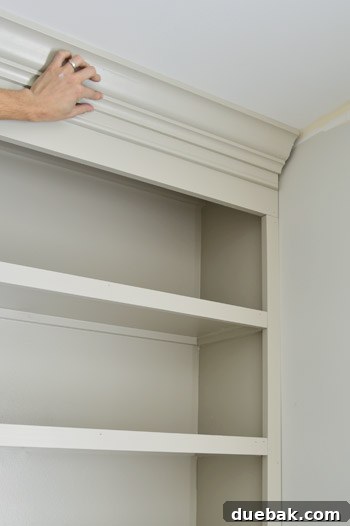
The process of cutting and installing crown molding, particularly mitered corners, can be a bit more challenging than other trim work, requiring precision and patience. For a more in-depth guide on the intricacies of working with this type of trim, you can explore our dedicated tutorial on installing crown molding in this very room. It covers everything from measuring and cutting angles to securing the molding for a flawless finish. The addition of crown molding effectively caps off your built-in, concealing any gaps between the bookshelf and the ceiling, and providing a polished, high-end appearance that makes your DIY creation look professionally installed.
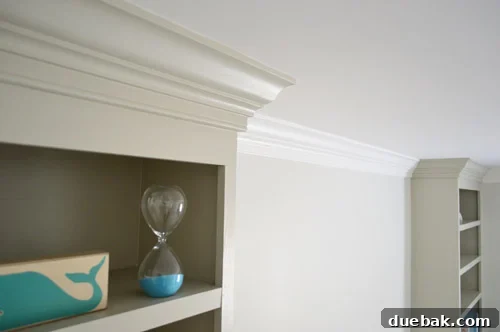
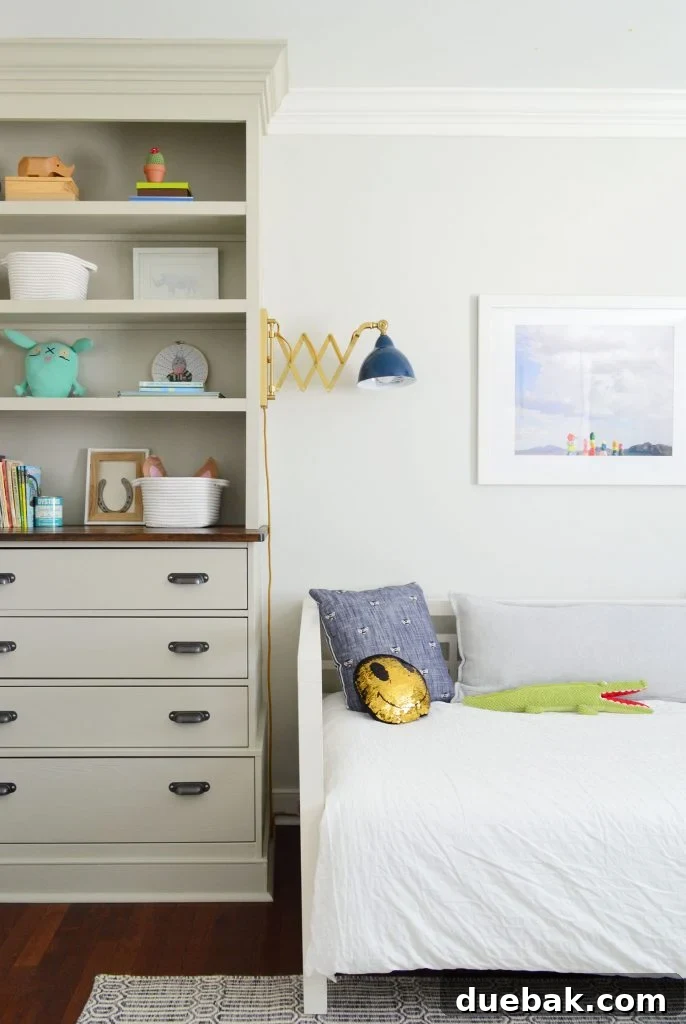
We are incredibly proud of how these built-in bookshelves transformed our son’s bedroom. Not only were they surprisingly easy to create, but they were also incredibly affordable, costing approximately $60 per unit, which even includes the materials for the base cabinets. They have proven invaluable for both functional storage, keeping toys and books organized, and as a charming display area for decorative items, adding personality and warmth to the space.
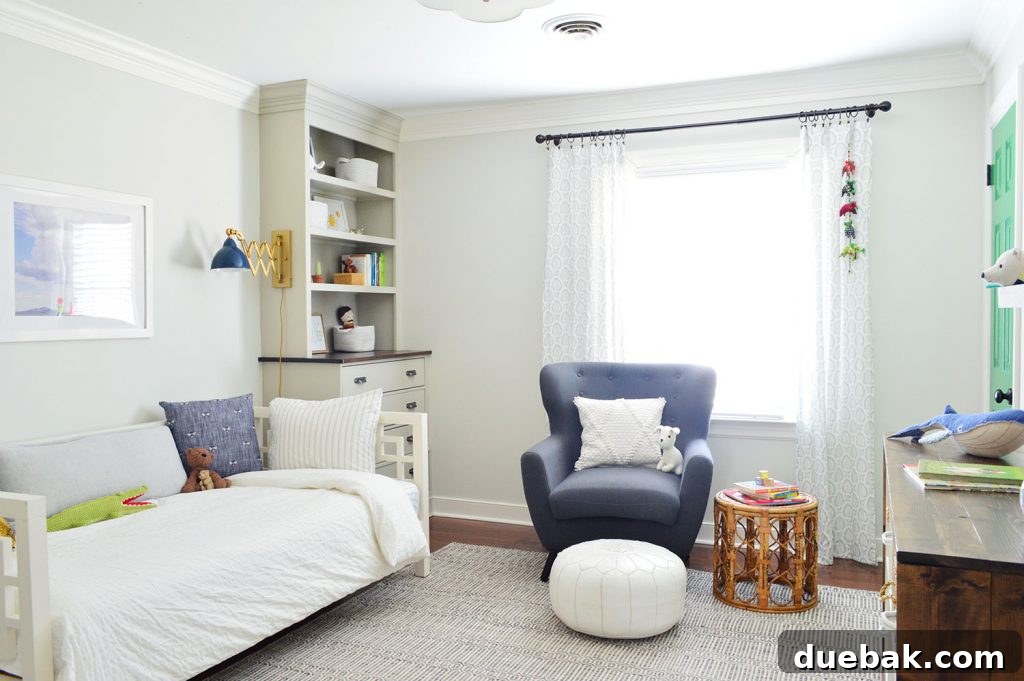
Again, to see the complete journey of this room’s transformation, explore its charm in its first iteration as a nursery, and then discover its evolution a few years later into a vibrant and functional big boy room. These built-ins truly adapted beautifully through both stages.
More DIY Shelving Projects
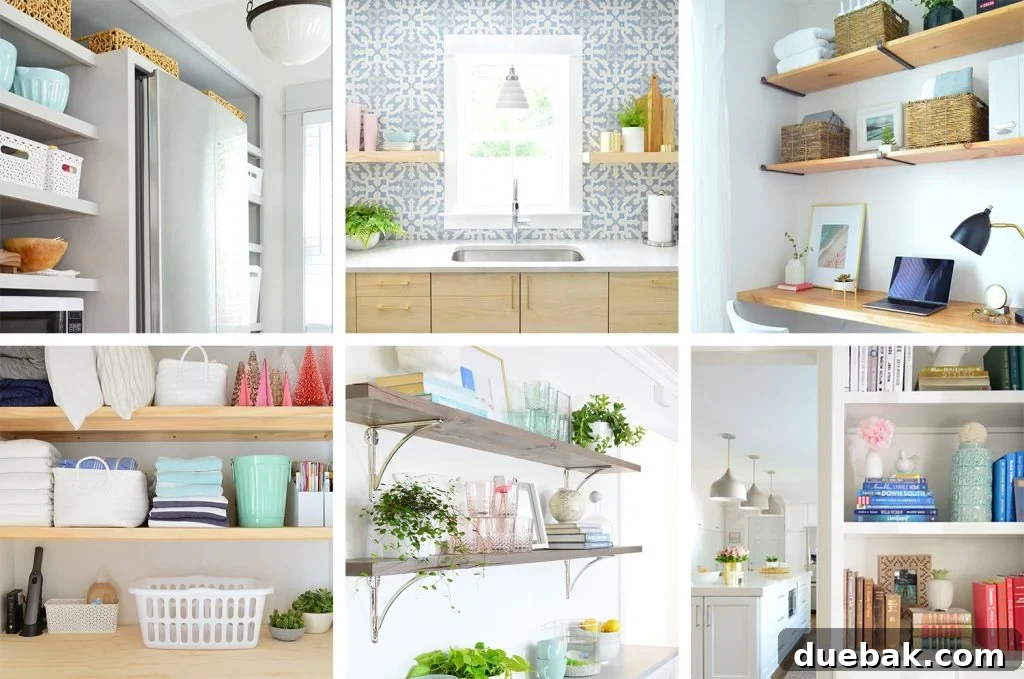
If this project has sparked your enthusiasm for custom storage solutions, you’re in luck! We’ve compiled a comprehensive roundup of over 15 DIY shelving projects that you can confidently tackle yourself. From floating shelves to freestanding units, there’s an idea for every skill level and every room in your home. You can even see how we applied a very similar technique to the one detailed here to ingeniously create highly efficient kitchen pantry shelving, maximizing storage in a functional space.
P.S. We often get asked about the specific items and finishes in our home. For those curious about “where’d you get that?!”, we’ve created a dedicated resource page featuring our home’s paint colors and a curated list of beloved purchases.
*This post contains affiliate links*