
Revitalizing Our Home Office: A Journey Towards Enhanced Productivity and Family Harmony
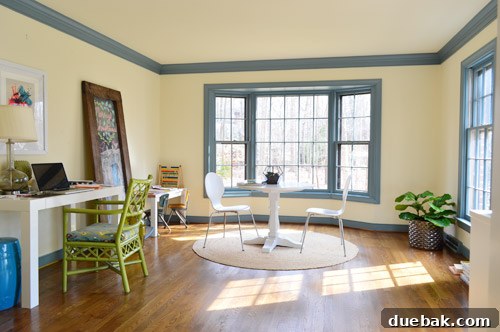
Our enthusiasm for the upcoming showhouse office project has undeniably sparked a much-needed drive to address the state of our own home office. To be frank, it’s been a little neglected lately. The recent “borrowing” of its key furnishings – both the comfortable armchair and the versatile Expedit shelving unit – to outfit the nursery has left it feeling rather sparse. Adding to its current lack of charm, the chalkboard still proudly declares “Merry Christmas.” It’s safe to say, this room currently sends a clear message of “I’ve definitely got my act together,” in the most ironic sense possible.
The Catalyst for Change: Why Our Office Needs an Overhaul
We’re genuinely thrilled to dive into redesigning this office, primarily because it’s one of those spaces in our home brimming with untapped potential. Its generous size and abundant natural light are incredible assets just waiting to be maximized. With the baby’s arrival mere weeks away (six weeks, to be exact!), there’s a growing urgency to consolidate and streamline our business operations. Our goal is to create a dedicated workspace that supports our professional lives without allowing them to spill over and infringe upon precious family time. This means implementing crucial boundaries, such as the new “no more laptops on the dinner table” rule, which we’re eager to enforce.
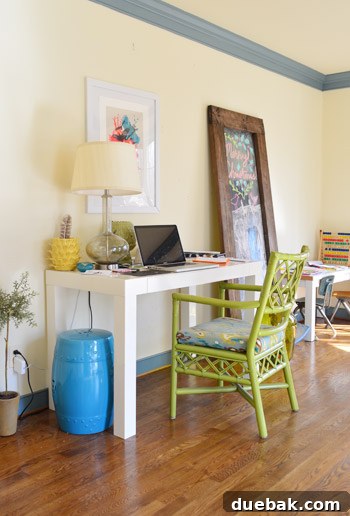
Currently, our work setup is far from contained. For instance, all my essential accounting documents reside haphazardly in a kitchen cabinet, a clear indicator that my current desk wall utterly lacks proper storage (though it doesn’t seem to lack lingering holiday cheer). This scattered approach to our work not only creates visual clutter but also makes it challenging to maintain focus and efficiency. We recognize that a well-organized and clearly defined workspace is paramount for both our professional productivity and our personal well-being, especially as our family expands.
Unlocking Potential: Initial Thoughts on Our Office Space
Unlike more extensive renovations like kitchens or bathrooms, which often demand significant planning, saving, and splurging on pricey appliances, new counters, and intricate tile work, our office project is different. We plan to bypass the typical “Phase 1” cosmetic updates and jump straight into “Phase 2” – a comprehensive transformation. This approach is similar to how we handled our sunroom renovation, where we quickly moved to create a functional and aesthetically pleasing space. We’re confident that we can achieve a long-term solution for this office without the extensive percolation time that often accompanies major home overhauls (we’re still refining our ideas for the kitchen and bathrooms daily!). This room, with its inherent charm and potential, feels ripe for a more immediate and impactful transformation. For those interested in our philosophy on Phase 1 updates, you can find more insights here.
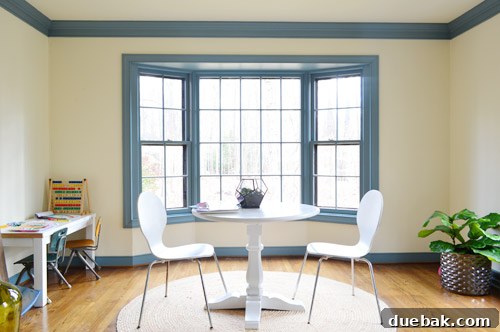
Beyond mere functionality, we truly believe this space has immense potential to be not just practical, but genuinely beautiful. It stands out as one of the most light-filled rooms in our entire house, courtesy of its large windows, and features a particularly charming bay window at the rear. These elements provide an excellent foundation for a design that balances aesthetic appeal with professional demands, creating an inspiring environment for our daily work.
Embracing the Bay Window: A Design Dilemma
The bay window, centrally located and visually striking, is a feature we absolutely want to preserve as a focal point in the room. We gave serious consideration to incorporating a built-in bench seat beneath it, imagining a cozy nook. However, after much deliberation and sketching, we’ve officially decided against it for several practical reasons:
- Firstly, we don’t envision a bench seat being particularly functional for an office environment. Prolonged sitting for work demands ergonomic support, which a bench typically doesn’t provide.
- Secondly, the window itself is surprisingly shallow. A built-in bench would end up being very narrow, diminishing its comfort and utility significantly.
- Finally, and perhaps less critically, it might interfere with our traditional Christmas tree placement. (Yes, that’s my third mention of Christmas – clearly, I’m still holding onto that holiday spirit!). While we could certainly find an alternative spot for the tree if absolutely necessary, it wasn’t a strong enough motivator to push for a less-than-ideal seating solution.
Ultimately, while the bay window offers undeniable charm, our priority for this office is practical functionality over decorative seating that wouldn’t serve our working needs effectively.

Navigating Design Challenges: Beyond the Bay Window
While the room blesses us with the beauty of the bay window, it presents its own set of challenges elsewhere. For instance, the doorway on the opposite side of the room is noticeably off-center. This asymmetry is something we’ll need to strategically work around in our design, as it impacts potential furniture placement and visual balance. It’s a reminder that even in the most promising spaces, perfect symmetry isn’t always achievable, and creative solutions are often required.
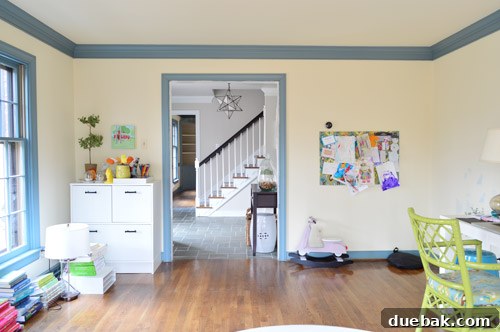
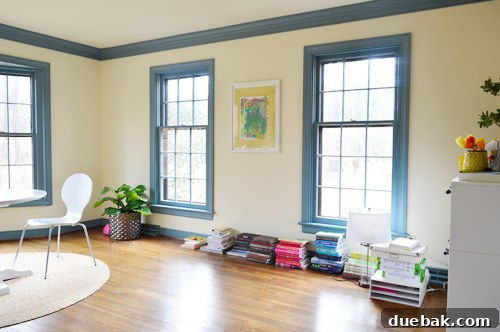
Furthermore, the front window wall, while excellent for natural light, poses difficulties for furniture arrangement. The windows are situated quite low to the floor, making it challenging to place any significant furniture along that wall without obstructing a considerable amount of natural light. This also creates an undesirable view from the street, as the sides of desks or other furniture would be prominently visible. These structural quirks necessitate a thoughtful and innovative approach to our office layout, ensuring we maximize both light and functional space while maintaining aesthetic appeal from both inside and out.
Crafting Our Ideal Workspace: Key Priorities for the New Office
With these opportunities and challenges firmly in mind, Sherry and I collaborated to brainstorm a comprehensive list of priorities for our redesigned office. Some of these are direct carryovers from our previous workspace experiences, while others are newly inspired by the larger, more light-filled potential of this particular room. Our aim is to create a dynamic and efficient environment that caters to both our individual work styles and our evolving family needs.
- Two Desks: This might seem obvious, but it’s crucial. Sherry often finds herself working at the kitchen table (you can read more about that here), which, while sometimes convenient, isn’t ideal for focused work or spreading out projects. We envision creating a dedicated, spacious workstation for her within the office. My current small parson’s table, while functional, could greatly benefit from more surface area and, crucially, more drawers for organized storage. Therefore, optimizing our individual desk setups is a top priority, offering both of us ample space and ergonomic comfort.
- Ample Storage: While we don’t accumulate excessive amounts of physical paperwork, the need for expanded, centralized file storage is significant. Our primary goal is to bring in documents currently scattered across other rooms – think tax records, important contracts, and various “side gig” paperwork – into one cohesive, organized system within the office. This will eliminate clutter in other parts of the house and ensure that critical documents are easily accessible.
- A Big Meeting / Craft Table: Although we don’t host daily meetings, recent collaborations (especially showhouse-related discussions) have often taken over our kitchen or dining room tables. A dedicated, large multi-functional table in the office would eliminate this inconvenience. Moreover, this table would serve a dual purpose as an ideal area for completing and photographing smaller projects. The abundant natural light in this room makes it a perfect spot for photography, showcasing our creative endeavors. This central table would foster collaboration and creativity, away from the domestic hub.
- Dynamic Wall Organization: We’re keen on designating a prominent wall for a large organizational system, be it a whiteboard, pinboard, or magnet board. This communal space would be dedicated to displaying our shared to-do lists, project calendars, future ideas, and ongoing tasks, ensuring both of us are always in sync. Currently, we manage our individual schedules using phones and notebooks, so a central visual hub is essential to keep us on the same page and boost collective efficiency. We’re actively brainstorming various aesthetic and functional options for this feature.
- Sound-Dampening Doors: The addition of doors, ideally stylish French doors, is high on our list. Partially, it’s because the room’s architecture seems to call for them, enhancing its overall aesthetic. More importantly, they would provide crucial soundproofing. This is particularly vital during conference calls, focused work sessions, or any time one of us needs an undisturbed environment for deep concentration, minimizing distractions and maximizing productivity.
- Evolving Kid-Friendly Zone: We’ve truly appreciated having Clara’s drawing desk in the office, allowing us to “work” alongside each other during less intense moments of the day. Our vision is to create a flexible, dedicated area for children that not only works for smaller kids now but can also seamlessly transition to accommodate bigger kids as they grow. This ensures the space remains relevant and useful for many years, integrating our family life naturally into our professional environment without permanent fixtures that we’d quickly outgrow.
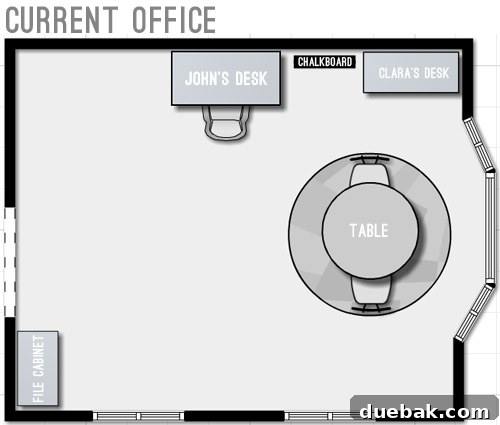
With these priorities firmly established, we embarked on the exciting (and sometimes challenging) process of floor planning. I experimented with a few new apps to visualize the room layout, and I’ll be sharing more details about those tools in an upcoming post. For now, let’s look at a rough representation of our current, rather uninspiring, furniture plan.
From Concept to Reality: Exploring Floor Plan Ideas
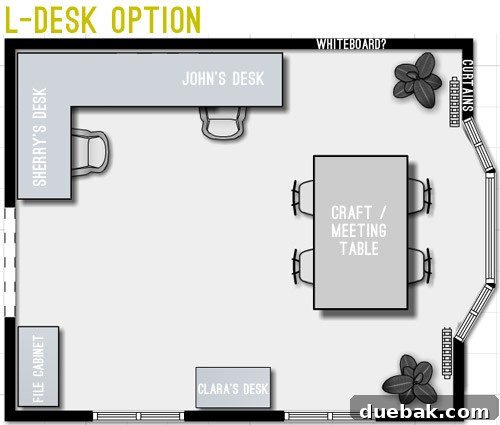
Our design journey began by simply attempting to expand upon our existing layout, aiming to incorporate our new priorities and scale everything appropriately for the room’s dimensions. We’ve always appreciated having a table centered within the bay window, so one initial thought was to merely upgrade to a larger table and add some elegant curtains. This idea also included wrapping an L-shaped desk around the corner, which would provide built-in storage (similar to our previous office setup) and create sufficient seating for both of us.
Initial Forays: Expanding the Familiar
While this first option seemed logical, we weren’t entirely satisfied with the corner-desk arrangement. It felt somewhat cramped and restrictive. Given that this is where we’d likely spend the majority of our working hours, it felt counter-intuitive not to give our primary workstations more prominence within the room. Moreover, it didn’t fully capitalize on the beautiful natural light and views offered by the windows, as we wouldn’t be directly facing or easily able to look out of them from that position. This layout, while attempting to solve some problems, introduced new discomforts that we knew would hinder long-term productivity and enjoyment of the space.
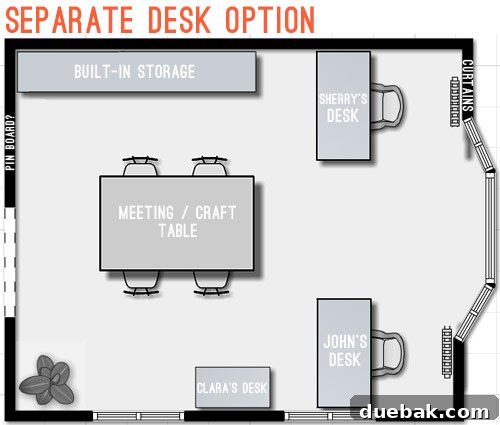
The “Desks as Stars” Experiment
Next, we ventured into a more daring concept: making the desks the absolute “stars” of the room, positioned symmetrically with the bay window. The most rational interpretation of this idea involved two distinct desks flanking the window. However, even this attempt quickly revealed its impracticalities. One desk would sit directly in front of a window that was too low, meaning the side of the desk would be awkwardly visible from the street – a minor aesthetic concern, but a concern nonetheless. More significantly, this layout would necessitate us constantly navigating around a large central meeting table every time we needed to access our desks. This constant maneuvering would quickly become cumbersome and detract from the efficiency we seek. It was clear that while symmetry was appealing, it couldn’t come at the expense of practical access and comfort.
The Winning Solution: Integrated Storage and Flexible Space
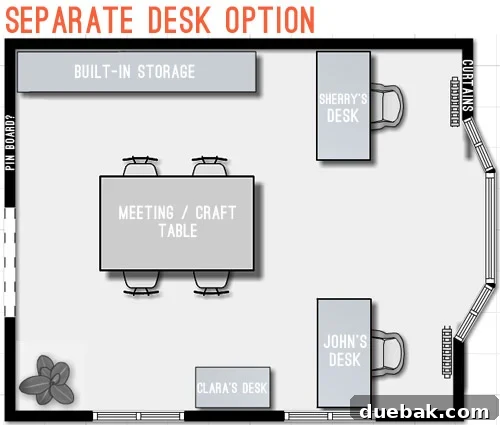
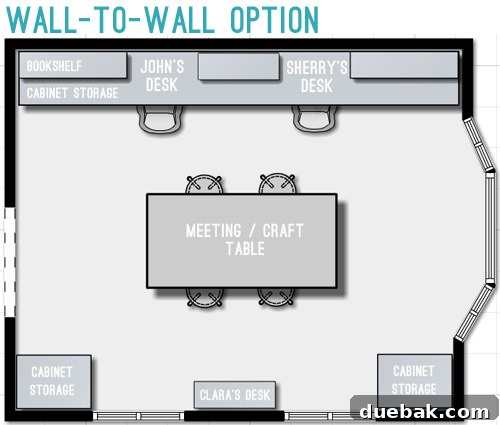
Following these experiments, we revisited an idea that was, surprisingly, our original concept for this space. This plan features extensive office storage built along the entire back wall, with our individual desk areas seamlessly integrated into these custom units. You can see our inspiration picture here, complete with a friendly feline adding to the charm.
We initially set this idea aside, fearing it would disrupt the beloved symmetry of the bay window – a feature we particularly cherished. However, as we meticulously adjusted the floor plan, we discovered a brilliant workaround: by strategically placing a complementary element in the bottom right corner of the room, we could effectively maintain the visual balance, ensuring the bay window still felt perfectly centered and celebrated. This solution cleverly addresses both our storage needs and our desire for a balanced aesthetic.
Crucially, this plan leaves the middle of the room wonderfully open, providing ample space for our large meeting and craft table. This flexibility is a huge advantage; the table can be easily moved around as needed, or even completely removed if we require an expansive, unobstructed area for a specific project. Furthermore, this layout offers a fantastic degree of adaptability for our laptops. If we ever feel “wall-locked” at our integrated desks, we can simply relocate our laptops to the central meeting/craft table, enjoying a beautiful view out the window. This isn’t a significant adjustment for Sherry, who already routinely unplugs and works from the kitchen table every day, embracing mobility in her workspace.
Regarding Our Youngest Family Member: We’ve received a few questions about where “the Barnacle” (our new baby) will fit into this setup. We’re happy to confirm that Clara’s existing desk is designed with two chairs and is long enough to comfortably accommodate two children. We’ve even had four kids happily working at it when we pull it away from the wall for extra space. So, it will certainly provide a wonderful, flexible spot for both our existing bean and the new bun.
Addressing Window Glare Concerns: Another common query has been about potential window glare when working along the back wall. John has been working in this very spot for the past nine months without any issues. While the sun does stream into the room, the office is sufficiently wide enough for the sunlight to hit the floor approximately five feet from his chair. This means the direct glare is well below screen level, ensuring comfortable and uninterrupted work even on the brightest days.
The Road Ahead: From Vision to Execution
While the chosen concept is still “simmering” in our minds, allowing us to mentally refine every detail, we are quite confident that we will proceed with this final layout. It feels like the most sensible and intuitive design, perfectly aligning with our workflow, aesthetic preferences, and family needs. However, initiating this exciting transformation first involves a considerable amount of painting – specifically, tackling sixty-six window mullions, all of which require four coats of paint. That’s a significant painting endeavor, but one we’re ready to embrace to bring our vision to life.
We’re eager to begin this revitalization, transforming a neglected space into a hub of productivity and a harmonious extension of our home. A well-designed home office is more than just a place to work; it’s an investment in efficiency, well-being, and work-life balance, especially when balancing professional demands with a growing family.
What’s on your priority list when it comes to designing or improving your home office? Do you have a desk cleverly tucked into a corner of your den, much like we did in our very first house? Or perhaps a small, dedicated work area integrated into your kitchen with laptop hookups? Maybe you’re fortunate enough to have a fully dedicated home office space. We’re curious to hear about your unique setups. Does anyone still have work materials in their bedroom? Growing up, Sherry’s dad kept his computer and all his paperwork in their bedroom, though that seems to be a less common practice these days. Share your experiences and insights – we’d love to learn from your home office journeys!