
Holey moley. After some electrical work last week, our ceiling had a few holes that needed fixing (warning: $herdog cameo in this post)…
We suited up with sunglasses, hats and breathing masks — safety glasses were nowhere to be found thanks to a busy book shoot — because ceiling dust is unpleasant and gets everywhere.
Then we got to work. I’m the designated spackler in the house, but John’s longer reach meant he took care of the first step: lightly sanding the edges of the holes to create a clean surface for the patch.
We used self-adhesive wire-mesh patches from Home Depot. They’re basically mesh attached to sticky backing. Press the patch firmly over the hole, apply spackle, sand smooth, then paint. They make ceiling repairs much easier — the only real challenge is working against gravity. (There’s video evidence of the struggle.)
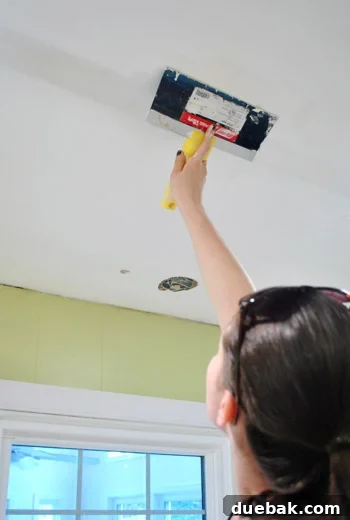
With the mesh in place, use your largest putty knife to press spackle over the patch. Try to smooth it as much as possible, but remember that sanding afterward is what creates the final seamless look. It’s better to apply a bit more spackle than you think you need so you can sand it down to a flat surface.
Allow the spackle to dry according to the product instructions, then sand. For ceilings and large wall areas I prefer a sanding block because it helps keep surfaces straight. Loose sandpaper can be floppy and hard to control on broad flat planes, though it’s great for curved furniture where flexibility helps follow contours.
After sanding, and after sweeping, vacuuming and a quick shower to remove all that white dust, the patched spots will look like slightly darker areas against the ceiling. Those just need paint; we also took the chance to cover other dirty patches left behind by old fluorescent fixtures.
We also patched a hole next to the new pendant lights. The opening above the sink is still waiting for a fixture, so we left that one alone for now. Once we pick a fixture, we’ll close that up and finish it too.
Two coats of ceiling paint later (thank you to the previous owners for leaving extra paint behind), and the repairs disappeared:
After the final coat, the former holes blend in perfectly with the rest of the ceiling. You can’t even tell they were there — victory!
We also recorded a video of the whole process. It includes a few outtakes — falling spackle, some shrieking, and an offhand mention of a slug — but it captures the practical reality: this work gets messy, it can take a few tries, and it’s not always graceful. Still, this is an easy DIY — about a 2 on the difficulty scale — so don your favorite underoos and get it done.
Hope this helps if you’re tackling similar repairs. Next up in the kitchen: shelf planning and hood painting, then flooring. I’m excited to bring in colorful plates and bowls — accessorizing is the best phase. What are you working on this week? Any hole patching, shelf building, painting or secret projects? Tell $herdog all about it.